

What is a hellbender?
Hellbenders are the largest salamander in North America. They are fully aquatic, residing in rivers throughout the lower Midwest and Appalachia. Hellbenders are long-lived for amphibians, typically living for more than 30 years.
What does a hellbender look like?
Adults are capable of reaching 29 inches in length; however, most individuals are typically 16-20 inches long. This North American giant salamander has short limbs and a widely flattened head and body. Fleshy folds of skin extend along the sides of the body between the front and hind limbs giving them an overall wrinkly appearance. Body color is often variable, including varying shades of brown, green or yellow. Dark spotting is typically present along the back and tail.
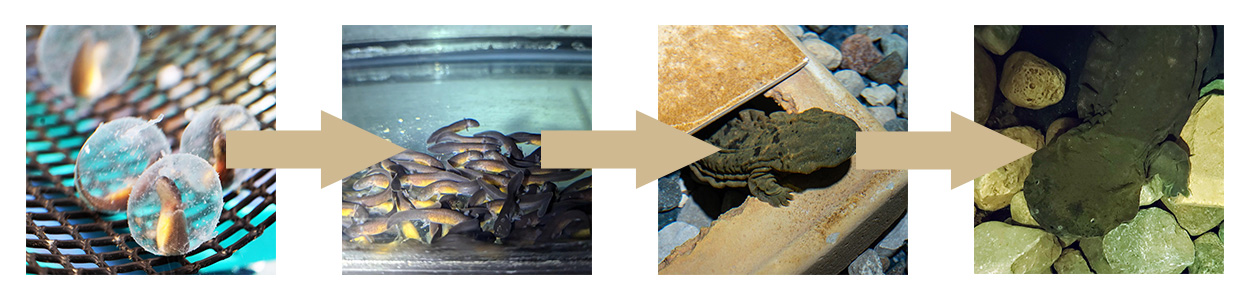
Larval hellbenders differ from adults in several ways: they possess external gills, visible yolk sacs, and lack functioning limbs at hatching. Newly hatched larvae are extremely small, generally less than an inch in length. They are typically uniform in color with a dark back and light belly. Dorsal spotting begins to form at 6 months (~2 – 2.5 inches) and becomes more prominent at one to two years of age (~4 – 5 inches) when external gills are lost.
Hellbenders are often confused with mudpuppies, another larger brown aquatic salamander that lives in the same range as hellbenders. However, there are a few key differences. First, mudpuppies have gills their whole lives while adult hellbenders do not. Second, compared to adult hellbenders, adult mudpuppies are smaller (~ 8-13 inches). Third, the body of mudpuppies is slender and lacks skin folds. Fourth, mudpuppy heads are more square shaped compared to the rounder head of hellbenders. Lastly, mudpuppies are found in more states and in habitats such as lakes and ponds.

Discover More
These interesting creatures are quite secretive and spend most of their time underneath large, flat rocks. They also utilize woody snags, debris, and bedrock for shelter. They are primarily nocturnal and forage for crayfish at night, returning to their shelter rock/object before dawn.
Hellbenders are most active during their breeding season, which occurs in late or early fall. During this time period, males will choose suitable nest rocks for reproductive purposes and will defend it from other males. They prefer gravel and cobble substrates due to their importance in providing habitat for larvae. These substrates also offer hiding places for food items (macro-invertebrates) consumed by younger individuals.
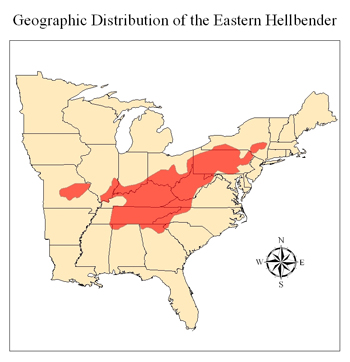
Eastern Hellbenders are currently found across Appalachia, parts of the Midwest, and across the northern tips of several southern states. Their range occupies an area from southern New York to sections of northern Georgia through Tennessee, and west to central Missouri (see distribution map). The Eastern Hellbender has experienced significant declines throughout its geographic range resulting in various levels of protection among state agencies.
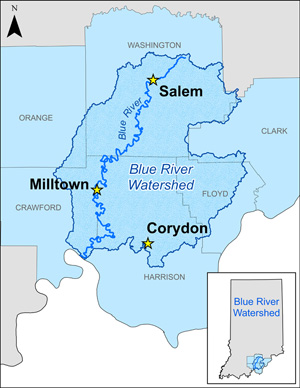
The main stem of the Blue River runs nearly 60 miles before it falls into the Ohio River near Leavenworth. Because much of the flow comes from springs and underground sources, water temperatures remain lower than many other Indiana streams, even during hot summer months. Many of the banks are shaded by large trees, providing additional cooling and structure for fish habitat. The river drops approximately 4 feet per river mile, a gradient that is perfect for canoeists and swift enough to keep many sections relatively free of sediment. The limestone bedrock in the area also provides many crevices for hellbenders and their prey to hide and to thrive. All of these characteristics help provide a suitable living environment for the hellbender.
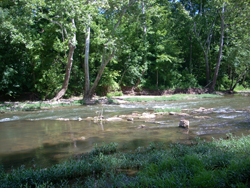
Hellbenders are aquatic amphibians that spend their entire lifecycle in water. They prefer cool, well oxygenated rivers where rocks are not embedded in sediment. These conditions exist in many parts of the Blue River in Indiana.
Clean water is important for hellbenders because they have semi-permeable skin. They absorb most of their oxygen from the water by “breathing” through their skin. However, they can also absorb toxins from the water.
Adults are typically active at night or on overcast days and otherwise remain hidden under rocks and other cover. As adults. their diet consists almost entirely of crayfish, though they will also eat some small fish and aquatic insects.
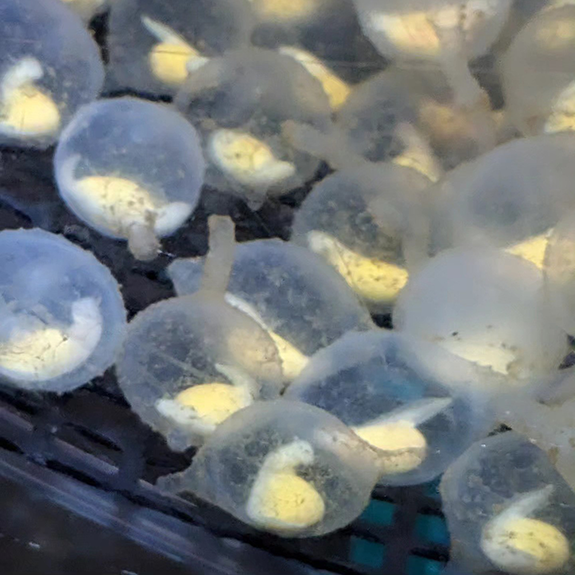
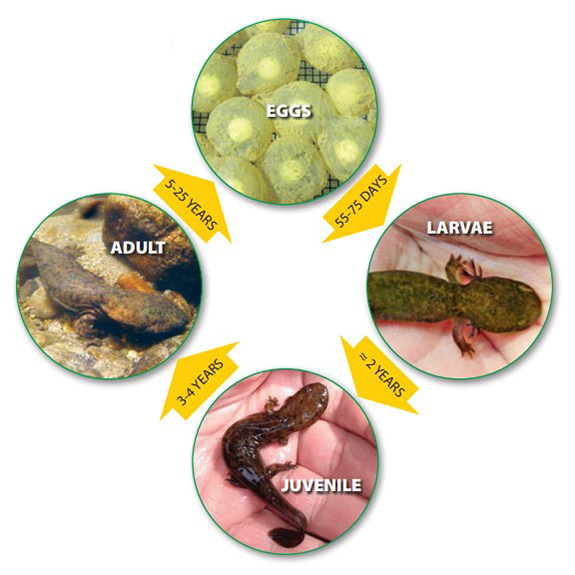
Hellbenders are one of the few salamander species to externally fertilize eggs. In late summer/ early fall, females will enter a male’s den or nest chamber. As the female begins to deposit eggs, the male will simultaneously release sperm to fertilize her clutch. Females lay approximately 300 eggs. Individual eggs are attached to each other and resemble a string of pearls. The female will leave after egg laying is complete, while the male defends the eggs from predators, which can include other hellbenders. Eggs hatch into about 1-inch larvae after 55-75 days.
Larvae will rely on their yolk sacs for nutrition for the first several months of life, before slowly switching to small aquatic invertebrates. After they leave the males nest rock in the spring, the larvae reside under gravel and cobble to avoid predators. It is during this stage that individuals are the most vulnerable to predation by fish, crayfish, and other aquatic organisms. The larval stage lasts for approximately two years while the young undergo a partial transformation. They begin to develop their lateral skin folds and eventually reabsorb their gills, relying on cutaneous respiration. After transformation, juveniles will become sexually mature in three to five more years.
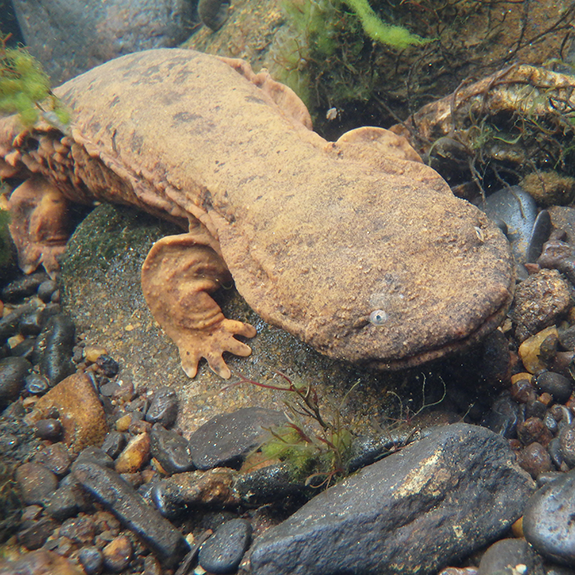
These interesting creatures are quite secretive and spend most of their time underneath large, flat rocks. They also utilize woody snags, debris, and bedrock for shelter. They are primarily nocturnal and forage for crayfish at night, returning to their shelter rock/object before dawn.
Hellbenders are most active during their breeding season, which occurs in late or early fall. During this time period, males will choose suitable nest rocks for reproductive purposes and will defend it from other males. They prefer gravel and cobble substrates due to their importance in providing habitat for larvae. These substrates also offer hiding places for food items (macro-invertebrates) consumed by younger individuals.
Eastern Hellbenders are currently found across Appalachia, parts of the Midwest, and across the northern tips of several southern states. Their range occupies an area from southern New York to sections of northern Georgia through Tennessee, and west to central Missouri (see distribution map). The Eastern Hellbender has experienced significant declines throughout its geographic range resulting in various levels of protection among state agencies.
The main stem of the Blue River runs nearly 60 miles before it falls into the Ohio River near Leavenworth. Because much of the flow comes from springs and underground sources, water temperatures remain lower than many other Indiana streams, even during hot summer months. Many of the banks are shaded by large trees, providing additional cooling and structure for fish habitat. The river drops approximately 4 feet per river mile, a gradient that is perfect for canoeists and swift enough to keep many sections relatively free of sediment. The limestone bedrock in the area also provides many crevices for hellbenders and their prey to hide and to thrive. All of these characteristics help provide a suitable living environment for the hellbender.
Hellbenders are aquatic amphibians that spend their entire lifecycle in water. They prefer cool, well oxygenated rivers where rocks are not embedded in sediment. These conditions exist in many parts of the Blue River in Indiana.
Clean water is important for hellbenders because they have semi-permeable skin. They absorb most of their oxygen from the water by “breathing” through their skin. However, they can also absorb toxins from the water.
Adults are typically active at night or on overcast days and otherwise remain hidden under rocks and other cover. As adults. their diet consists almost entirely of crayfish, though they will also eat some small fish and aquatic insects.
Hellbenders are one of the few salamander species to externally fertilize eggs. In late summer/ early fall, females will enter a male’s den or nest chamber. As the female begins to deposit eggs, the male will simultaneously release sperm to fertilize her clutch. Females lay approximately 300 eggs. Individual eggs are attached to each other and resemble a string of pearls. The female will leave after egg laying is complete, while the male defends the eggs from predators, which can include other hellbenders. Eggs hatch into about 1-inch larvae after 55-75 days.
Larvae will rely on their yolk sacs for nutrition for the first several months of life, before slowly switching to small aquatic invertebrates. After they leave the males nest rock in the spring, the larvae reside under gravel and cobble to avoid predators. It is during this stage that individuals are the most vulnerable to predation by fish, crayfish, and other aquatic organisms. The larval stage lasts for approximately two years while the young undergo a partial transformation. They begin to develop their lateral skin folds and eventually reabsorb their gills, relying on cutaneous respiration. After transformation, juveniles will become sexually mature in three to five more years.
Come with us on this Hellbender Journey one of our wildlife biologist takes us through the process of the eggs arriving, hatching and how they become part of the breeding program with our partner zoos.
Eastern Hellbender Identification Video
This video explains how to identify a hellbender, North America’s largest salamander, and highlights key differences between hellbenders and mudpuppies. It covers physical traits like the hellbender’s flat head and loose skin folds versus the mudpuppy’s external gills, helping viewers distinguish these two aquatic species.
Nature of Teaching: Wildlife Resources
Explore the Nature of Teaching program, offering engaging curriculum and publications on hellbender conservation and watershed education. These resources help educators and learners understand wildlife and water quality issues while promoting stewardship of natural resources. Visit the website to access lesson plans, activities, and research-based materials.

The Help the Hellbender Teachers page offers classroom-ready lesson plans aligned with state standards, engaging videos, and interactive activities like coloring pages and games. Find out more about the Hellbender Minecraft Quest and the Hellbender Havoc game. This web page is packed with resources to teach students about hellbenders, watersheds, and freshwater conservation in fun and educational ways.

News & Awards from Help the Hellbender
Connecting people, research and conservation for hellbenders.
Explore Hellbender News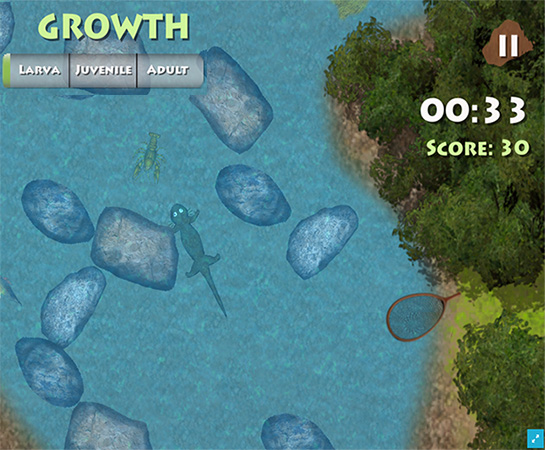
Hellbender HAVOC
Help Herbie thrive by navigating the river, eating crawfish, and avoiding natural and man-made hazards.
Install the App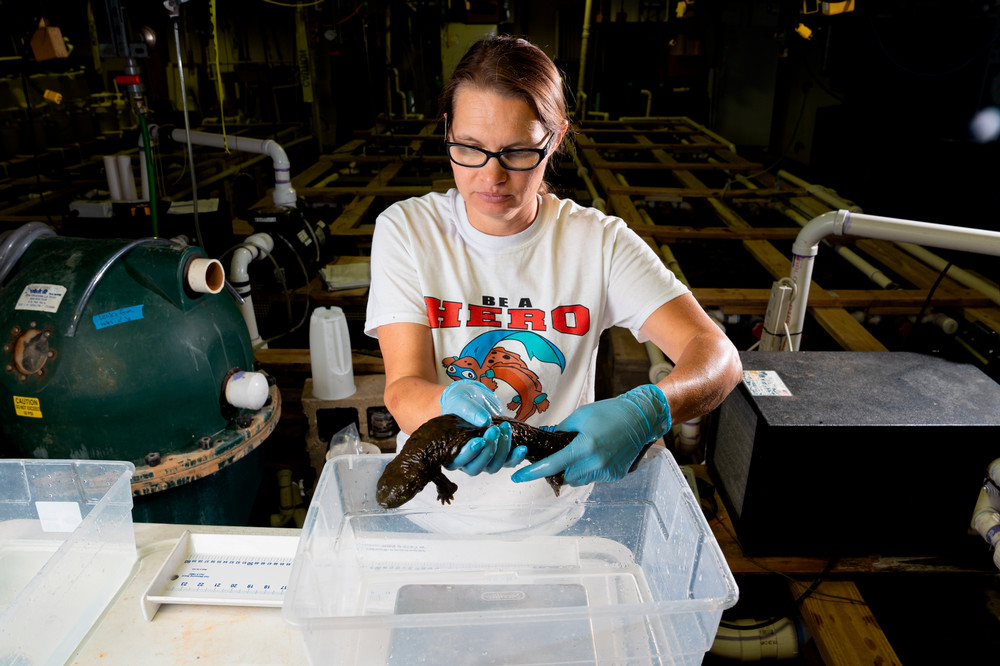
The eastern hellbender salamander will never win a wildlife beauty pageant. It’s believed...

The Help the Hellbender research program, based in Purdue Forestry and Natural Resources, was...
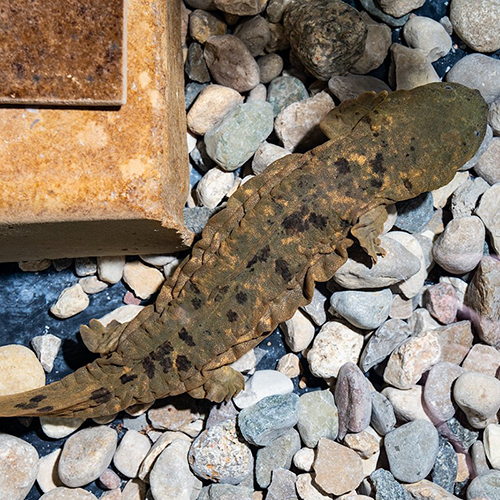
The eastern hellbender (Cryptobranchus alleganiensis alleganiensis) is a large, fully aquatic...

Dr. Rod Williams, extension wildlife specialist Nick Burgmeier and the Help the Hellbender team...
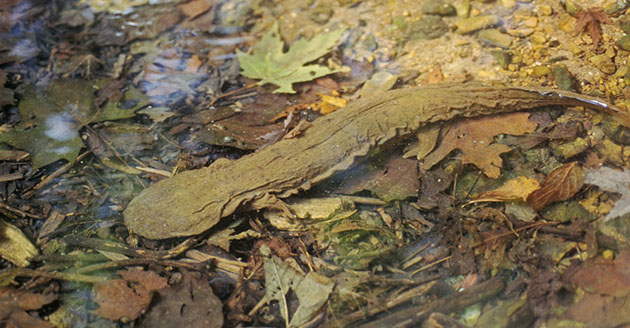
Biologists with the Indiana Department of Natural Resources (DNR) and Purdue University recently...

Dr. Rod Williams and the Help the Hellbender research team have earned three honors in 2023 for...