

Trucks and Trailers for Drone Operations: Increasing the Efficiency of Drone Spraying
Authors
Fred Whitford, Director, Purdue Pesticide Programs
Alex Helms, Assistant Director, Purdue Agricultural Centers
Dustin Polasek, Owner, Roots to Ridges
Dustin Osborne, President, Osborne Ag Services
Brad Peas, Sales Representative, AgroChem
Contents
- Spray Drones Take Agriculture and Industry by Storm
- Opportunities to Learn About Drones
- Trucks and Trailers: The Hub of an Efficient Drone OperationSupporting the Drone with Proper Equipment
- Common Needs of Drone Setups
- A Trailer and Truck for Today and Tomorrow
- Supporting the Drone with Proper Equipment
- Generators: Providing the Power to Operate
- Transfer Pumps: Pushing Liquid Through the Plumbing System
- Tanks: Holding the Mixture
- Hoses: Serving as the Arteries
- Hose Reels: Reducing Clutter on the Deck
- Flowmeters: Measuring How Much
- Nozzles: Dispensing the Product
- Different Styles of Trucks and Trailers for Spray Drones
- Limited-Use Trailers
- Enclosed Trailers
- Truck Bed Inserts
- Deckover Trailers
- Safety Concerns with Drones
- Fatigue: Reduce Heat Exposure and Bending Motions
- Losing Control of the Drone: Be Careful When Setting the Controller Down
- Spinning Blades and Jagged Edges: Are You Protected?
- Refills: The Drone Must Remain Off
- Pesticides: Follow the Label and Wear PPE
- Fumes and Spills: Be Careful Where You Mix
- Falls: Put Handrails Along Steps
- Roadside Parking: Be Selective When Parking
- Power Lines: Locate Them Before Flying
- Blowouts: Size Your Tires for the Trailer Weight
- Driving: Know the Law and Follow the Rules
- Conclusion
- Acknowledgments and Disclaimer
Spray Drones Take Agriculture and Industry by Storm
Viewed as a futuristic possibility just a few years ago, spray drones have undergone a remarkable journey to become a legitimate and widespread application tool in agriculture and allied industries. The application of pesticides, fertilizers, and biologicals by drones has demonstrated that their uses include protecting the public by reducing mosquito populations, lessening the impact of invasive weeds on terrestrial and aquatic environments, and improving crop yields by using fungicides. When driving rural roads, it is common to see drones spraying corn, soybeans, and wheat. Historically, a large sprayer would have been used even if it meant mudding a field in less-than-ideal conditions for the sake of a timely application.
The current uses are just the tip of the iceberg compared to how spray drones will be utilized in the future. Whether spraying, collecting data, or merely taking photographs, drones have found wide use in multiple industries, including farming. The market for drones continues to set new sales records and show unprecedented growth. The following factors have encouraged agricultural use of drones:
• A drone spraying setup costs significantly less than a new, fully equipped self-propelled agricultural sprayer. A person can start a new business venture by investing somewhere between $100,000 to $200,000 to purchase two drones and a fully loaded truck and/or trailer with tanks, pumps, and generators. In comparison, a modernday new ground sprayer can range between $500,000 and $1 million depending on the options purchased.
• Drones can operate when the ground is too wet to support ground equipment. A couple of inches of rain might keep a ground rig out of a field, but a drone sprays over a crop without worries about compacting soil or damaging a crop. As agricultural enterprises become more intense in management, more frequent and timely applications become ever more important. For example, a wheat farmer 20 years ago may have crossed the field just one or two times during the entire growing season, but now progressive wheat farmers commonly make four or more passes during a growing season.
• Farmers can utilize drones to make their own timely applications at the best growth stage for maximizing insect, weed, or disease control. By doing some or all their own applications, farmers can lower their production costs and avoid waiting for their local retailer to schedule the treatment, which could take some time if there is a long list of farmers. As already mentioned, high-intensity crop management has increased the demand for custom applicators to cover many acres in a narrow optimum time frame; some farmers who are last on the list will end up with less-than-ideal application timing. Spray drones offer the ability for more people to enter the spraying market to fill the gaps that other operators cannot.
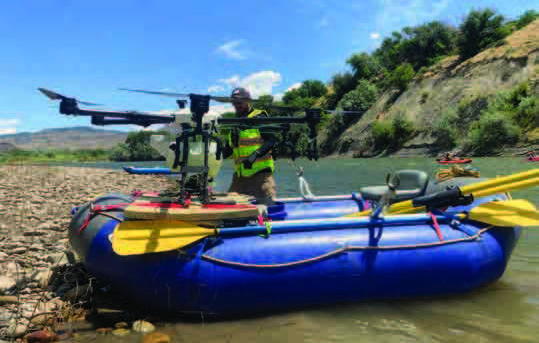 Not every drone operation is designed to be efficient. Some are unique, specialized operations that require a special set of skills by the operator and a special setup to get to the location.
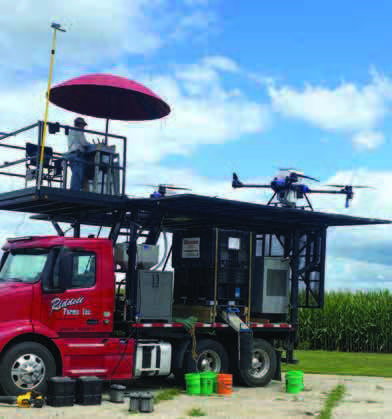 This efficient setup all fits on a truck with no trailer needed. This can be important for regions with winding roads or field entrances that are not designed for larger equipment. However, the driver might require a commercial driver’s license (CDL), making it more difficult to find an employee.
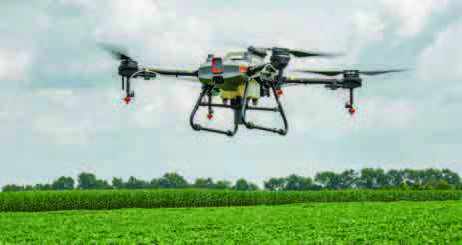 While drones can operate when the soil is too wet for ground rigs, you still need to be able to access the site. Is there a gravel lane or pull-off to access the field, or will your truck/trailer cut ruts and get stuck getting to the spot? Plan your days so that you can stay on the side of a road or have nice pull-offs for the wetter times.
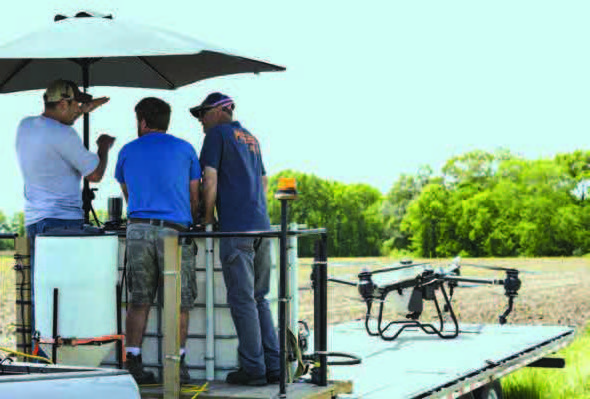 Finding experienced operators is important when building out your truck/trailer setup. Pilots should discuss issues with the team and address problems before they arise. Experienced operators can tell you what is reasonable to expect and can be an invaluable source of information that may make the difference between success and failure.
• The increase in the carrying capacity of drones has opened the doors for more acres to be treated on each application pass. Advances in battery technology have helped drone manufacturers increase carrying capacity and charge batteries quickly enough to limit downtime. A few years ago, a drone with a 5-gallon tank capacity doubled the volume that its predecessors carried. That trend continues: Today drones are marketed with tanks holding 20 or more gallons. These larger tanks can now apply the higher volumes required by some product labels while still getting enough acres done to remain profitable. However, larger drone sizes and tank capacities mean a larger crew is needed to move the drones around.
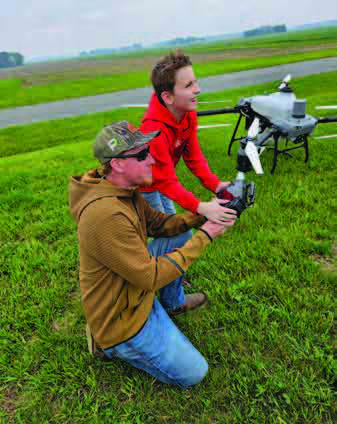
Drones are an obvious attraction to many young people who want to get involved with agriculture. The physical controls and troubleshooting of technology are like those for other technologies that are commonplace in the environment of today’s youth.
• Drones offer a potential enterprise for younger generations to be added to the farm. When operations are landlocked, it can be difficult to find production methods that add enough monetary value to a farm to support another person. By adding a spray drone enterprise, a farm can potentially save money by applying products themselves and earning income through custom hire work. The younger generation has a competitive advantage as the technology, controls, and troubleshooting for spray drones are like those for many other technologies they grew up learning how to use. This gives them experience that other generations may not have. Using a drone to commercially apply agricultural can generate the revenue to support those who want to remain on the family farm. • The younger generation has less interest in applying products with conventional spray equipment. But young people grew up using joysticks and controllers (for example, using PlayStation), making drones very attractive to them. In a recent article, the military found that younger users with a background in dirt biking and all-terrain vehicles made the best pilots. As this younger generation enters the workforce, they would rather fly a drone than sit in a ground sprayer. • Insurance agencies and lending firms are becoming more familiar with spray drone operations, allowing users to be more confident of insurance protection and financing to support spray drone enterprises. Along this same trend, overall general information about spray drones is becoming more readily available, and researchers are helping operators fine-tune application methods to limit potential issues.
• The Federal Aviation Administration (FAA) is adapting the pilot and drone licensing processes to be less cumbersome and confusing for users who are not familiar with FAA rules, regulations, and operating procedures. The FAA is making reasonable efforts to make operating spray drones easier. • The cost of drones has dropped. At the beginning, a 2-to-6-gallon drone capable of spraying 5 acres per hour cost between $40,000 and $60,000. As the technology and production lines have improved, the cost has gone down. Today a 16-to-20-gallon unit spraying 40 to 50 acres an hour costs $30,000 to $40,000. In addition, the number of used drones on the market allows people to purchase them at a Drones are an obvious attraction to many young people who want reduced cost and reduce their initial investment.
“It is my dream to farm and to work into my family farm, as it’s what I love, and I want to do it long term. But there isn’t really room for me at this time, thus why I got into drone spraying. 2025 was my first year, and there was for sure a lot that I learned.” — Written by a 20-year-old farmer
Opportunities to Learn About Drones
When drones became part of a national discussion, they piqued people’s curiosity, generating questions, conversations, and discussions. Each new adaptation increased the interest in how best to deploy drones. But behind that excitement was a significant misconception. Earlier pilots erroneously thought a spray drone was an easy way of making lots of money. These operators were drone wise, but unfortunately, many were not well versed in what it took to grow a crop and conduct an application to meet a farmer’s standard.
They would tell their customers that their drone sprayed a 30-foot swath, applied 5 gallons per acre, and flew 25 miles per hour (mph). In fact, the early drones had pumps that could only deliver up to 2.15 gallons per minute, producing an application rate closer to 1.4 gallons per acre at the maximum speed. Drone operators received lots of complaints about the drone’s poor performance, primarily because the pilots did not understand the application side. These operators had to field calls from less-than-happy customers who paid full price but got a less-than-complete job. To compound the problem, there was little relevant data to help applicators do a better job.
Many who had entered the drone market thinking it would be a lucrative business venture became disillusioned when their operations failed to produce the financial returns they had expected. Those who survived those initial challenging times and those starting their business within the past five years have a higher chance of succeeding in the industry. Why? A massive education campaign across the United States has occurred over the past five years in which research has focused on enhanced safety, efficacy, and efficiency; it has provided a deeper understanding of the equipment needed and of ways to use drones’ capabilities to control pests.
Once universities and public entities geared up their research efforts on drones, they began to redefine what a drone could and could not do. These new research findings provided the drone industry with scientific facts to help operators better understand drone operations and enhance their ability to establish businesses. For spray drones, environmental conditions can dictate the success of an operation, and it can be difficult to develop rigid recommendations that apply across platforms and environments.
Spray drone research and education are important due to drones’ widespread adoption across the industry. With manned airplanes and helicopters, researchers could more easily target their audience because relatively few individuals and companies performed such operations. Because spray drones are more widely utilized, and drone pilots may have limited aerial applicator experience, research and outreach have become much more critical. To further complicate matters, there is a greater variety of new platforms that could influence the recommendations provided.
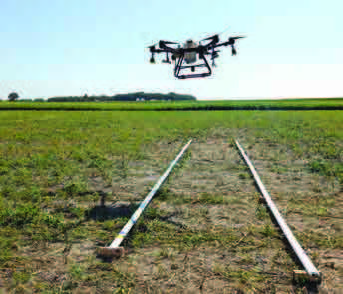
Proper swath testing is essential to a successful spray drone business. No one wants to pay for a spray job that leaves streaks of unapplied and missed areas where pests continue to damage the crop. See next page for photos.
Keeping Up with Drone Technology
“Currently we are spraying from a 10-gallon tank, but new drones can carry 20 gallons. We are going 30 feet per second, while the new models travel 45 feet per second. Staying up with the latest drone technology provides the impetus for continued education.” — A drone operator
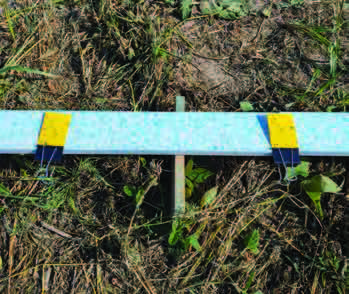
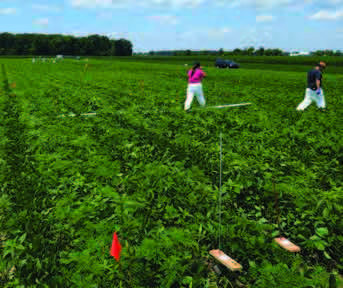
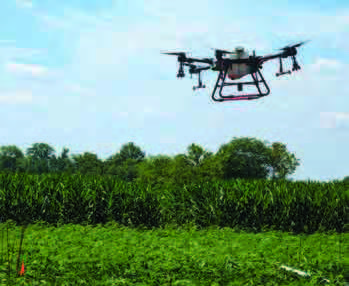
University extension staff, researchers, professionals, trade association personnel, and commercial companies have been at the forefront of introducing the latest science behind the practical use of drones, as well as explaining the regulations and teaching applicators how to sell their services to potential clients. It is common to hear discussions of topics such as FAA licensing requirements, differences among drone models, differences between effective and advertised spray widths, and the influence of travel speed and height above a crop canopy on spray delivery.
Complying with federal and state regulations has become a significant topic of conversation. Federal aviation regulations can be complex and complicated to understand, especially for those outside of the aviation community. Also, at times, documents and labeling are specific to traditional aviation. Because of this, early adopters were not well versed in licensing or reporting requirements. Obtaining the proper license and keeping records is important to the industry.
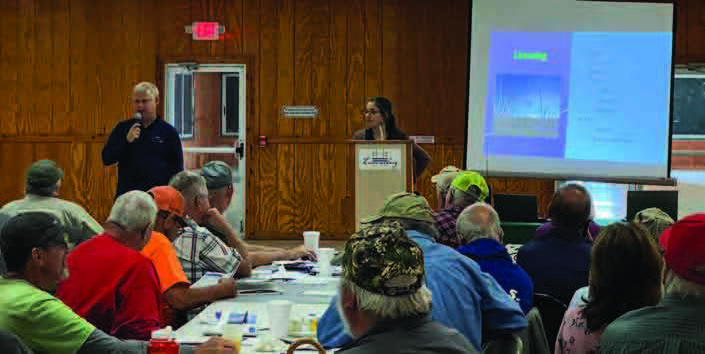
Significant effort in drone outreach programs has helped interested parties understand the requirements for adopting this technology and has helped new applicators refine their operations to make efficient and effective applications.
To further complicate matters, obtaining the needed licensing was an extended process that could take over two years, during which one would hear little from the FAA. These issues were exacerbated by confusion about which process to do first and what groundwork had to be completed before applying for certain exemptions and certifications. Earlier adopters were forced to invest a generous sum of money into a unit that they might not get approval to fly, or at least the timeline on when they would get to fly was unclear, and they would potentially miss out on an entire application season. Today it’s still true that you will need to purchase a drone and have it registered prior to getting your part 137 certificate (required for larger drones that apply product); however, the two-year wait period has been reduced to as short as 45 days.
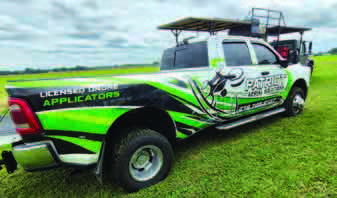
It takes a lot of work, time, and money to get licensed by the Federal Aviation Administration and become certified to apply pesticides by your state’s department of agriculture.
Even now that changes to the original regulations have simplified pilot licensing and drone registration, the nuances of remaining in compliance still take time for a pilot to comprehend, and it can be difficult to keep up with the frequent changes. State agencies (e.g., state departments of agriculture) have further added to this complexity, now requiring operators to obtain the same level of licensing as required for a conventional aerial applicator. However, due to the drastic cost difference between conventional aerial equipment and drones, farmers are now taking to the sky, presenting a new unique challenge most state agencies are still trying to tackle. With these struggles to become certified and compliant, businesses have developed models to help current and potential applicators to understand drone capabilities and regulations. Several private and public companies now exist to help drone operators comply with federal regulations, submit required monthly reports, apply for waivers, and monitor distinct aspects of the operation. With continued education and the continued interest of university researchers, pilots flying spray drones today are better equipped to succeed. While there are many who could be credited for their efforts to educate drone pilots, Dr. Steve Li from Auburn University should be mentioned as one of the earlier pioneers who championed both research and education in using drones for pesticide applications. University weed scientists, entomologists, and plant pathologists quickly ramped up efforts to develop recommendations and outreach efforts.
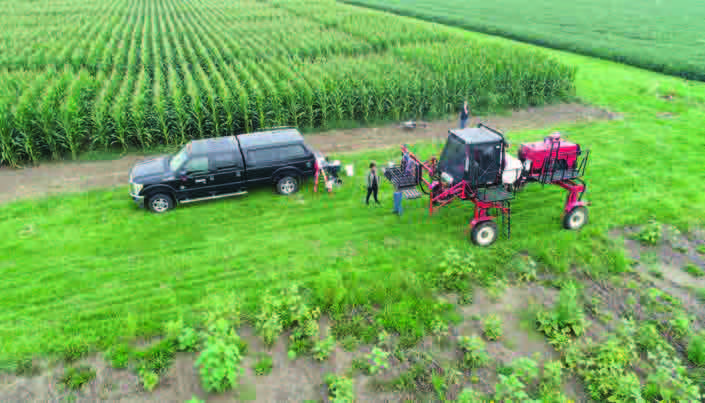
Researchers have been vigorously comparing application technology using high-clearance ground rigs, airplanes, helicopters, and drones
While there has been great effort to provide resources on effective application parameters and information on rules and regulations, there has been a general lack of guidance on how to develop efficient infrastructure to effectively utilize spray drones in the field. The intent of this publication is to provide examples of current trucks and trailers utilized to support drone operations. It includes an overview of generators, pumps, motors, hoses, and tanks.
Some of the ideas and practices being used by the drone industry are simple, but pilot experiences have shown they work well for making effective and profitable treatments with spray drones. (Note: Drone setups take a variety of configurations: just a truck, a truck and trailer, or a trailer that may be pulled by an ATV or other equipment. To simplify, we will often use truck/trailer when we mean the entire range of configurations.)
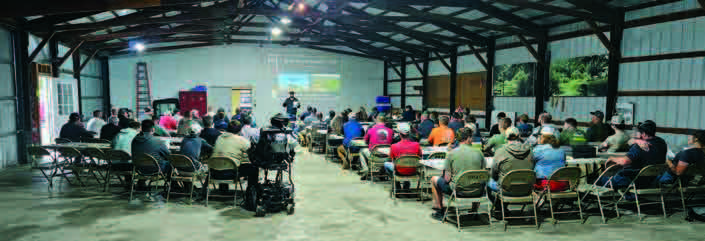
Educational programs in the classroom are great opportunities to share information on the latest drone research and inform farmers and commercial pilots about a technology that may be used on their farm now or in the future.
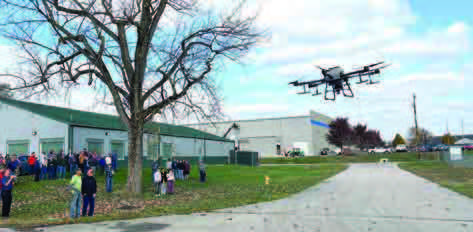 Local flight demonstrations are always a sought-after program. Seeing and hearing the drone take off in person gives people a true perspective on the technology
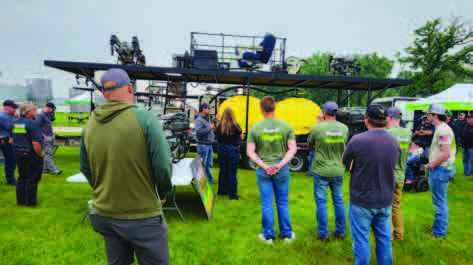 Each commercial operator has a slightly different setup, including various features to make long days easier. Seeing several different setups at field days can give you ideas of what may work for your own operation.
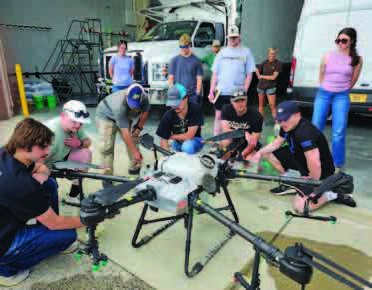 Drone training occurs at all levels. Field talks and demonstrations introduce the hardware in ways classroom instruction cannot. Industry professionals are the best to teach about truck and trailer setups for spray drones.
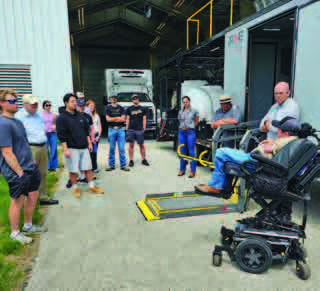 While universities can give an analytical analysis of effective applications, commercial operators with experience know how to be efficient and make money
Trucks and Trailers: The Hub of an Efficient Drone Operation
Initially, equipping trailers and retrofitting trucks for drone use took a secondary role compared to drone technologies, updated regulations, and insurance questions. Perfecting the truck/trailer situation would also take a back seat because trucks and trailers can be the most expensive assets of the enterprise. Applicators wanted to make sure they could be successful before investing in such infrastructure. As the rules, regulations, and application parameters became better known, drone trucks/trailers took on a more pivotal role in the industry. The success of day-to-day operations can depend more on the truck/trailer setup than on the actual drones applying the products.
The question “How many acres does your drone get done in a day?” is one of the most common questions left unanswered. As early adopters shifted their focus to that question, the importance of the truck and trailer rose. It became obvious to everyone that a drone sitting on the platform was losing money because it was not spraying acres. The answer came down to how quickly the drone sitting on the ground or platform could be filled and the battery replaced, and how quickly the operator could get the drone set up or packed up in order to make it to the next site. Pilots now had to modify and/or retrofit their existing trucks/trailers to make them more efficient, more comfortable, and safer.
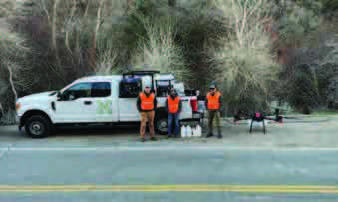
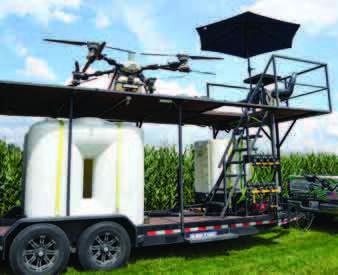
There is no perfect setup that each operator should strive to have. Before we start looking more closely at the critical components on a trailer or truck, we need to understand that the work should dictate what is needed. One pilot might require a top deck to look over a tall cornfield, but another pilot treating a low-growing crop like strawberries or weeds in a pond might not need the extra expense of a platform.
A large-scale efficient drone operator may want 1,000 gallons of clean water for mixing chemicals, cleaning equipment, and washing hands. This would require a trailer that could carry this weight and a heavy-duty truck to pull it. The weight might require the driver to have a commercial motor vehicle license (CDL).
Conversely, an operator managing vegetation under a power line, on the roadside, or in a pond might not need to haul that much water. Instead, they could use a smaller water tank, haul it in the bed of a pickup truck they already own, and land on a small platform on the ground. These examples show that the type of work conducted should drive the selection of the truck and/or trailer and the other equipment. At the same time, you don’t want your operation to be too specialized, limiting you to only treating certain kinds of properties. Many current operators wish they would have designed a more versatile rig able to handle both big and small fields.
Know This
The success of day-to-day operations can depend more on the truck/trailer setup than on the actual drones applying the products.
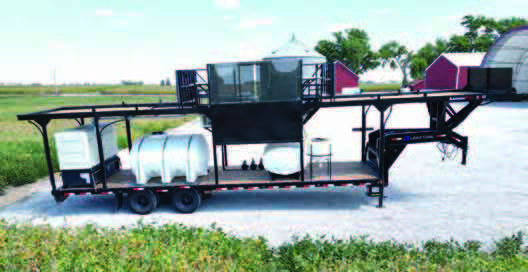
Do you plan to use your truck and/or trailer only for your drone operation, or will you want to utilize it for other purposes? This may affect how you secure tanks, generators, and other necessary equipment.
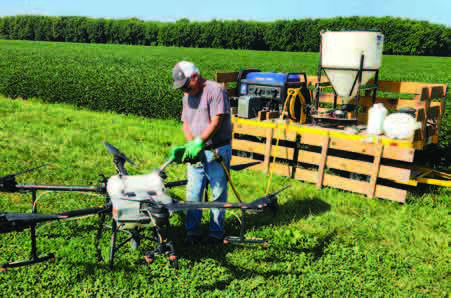
Small, unique operations may desire a setup that can fit in the back of a UTV or a small trailer, in order to access areas that may not require large amounts of product or battery life but cannot be accessed by other equipment.
Common Needs of Drone Setups
Regardless of the drone model or its manufacturer, all spray drone operations share certain needs that impact how a trailer or truck is plumbed and what equipment is carried. The key question “How do I keep my drone spraying continually?” largely comes down to four questions:
- How fast I can change the drone’s battery and charge the battery?
2. How quickly can the spray tank be filled?
3. How can I enhance my visibility while making the application?
4. How quickly can I break down and reset?
Know This
Many operators wish they would have designed a more versatile rig able to handle both big and small fields.
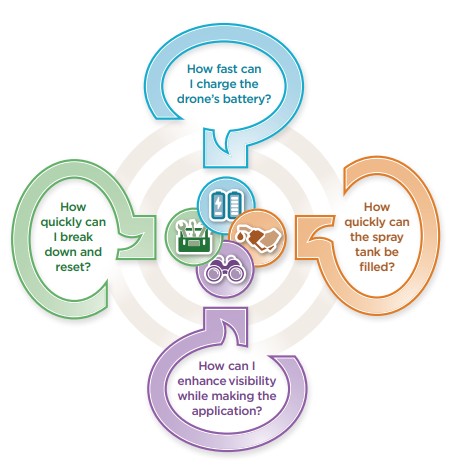
These questions tie directly to equipping a trailer/truck to allow the operational use of a drone to apply pesticides effectively in whichever way the operator deems efficient. If those four things cannot be optimized, then a premium must be charged to make up for those lost minutes. And that premium may be difficult to justify, especially in commercial operations.
Common needs for drone operations that impact trucks and trailers include:
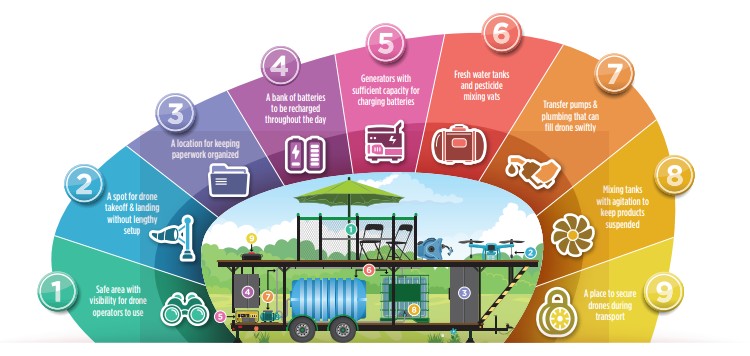
These are not minor points when considering how to equip a trailer or truck. Time must be invested in both preparation and planning focused primarily on one’s goals. For instance, a farmer using a drone to spray fields around the farm might not require a 1,000-gallon tank due to having water nearby. On the other hand, using a drone to spray commercially may require 2,000 gallons of water to keep the drone working continuously all day. If the truck/ trailer is not equipped to handle the desired workload, you will either send it to get more water, causing a pause in operations, or have to purchase a tender truck to bring water and supplies, adding more expense to support the operation. Each time a commercial operation stops to refill the water tanks, it is losing money because the drone is not in the air.
The consensus among midwestern commercial operators working large tracts of farm ground is that a drone should land and take off again within 45 to 90 seconds after landing. As the drone lands, it quickly needs to have its battery replaced and the spray tank refilled. Keeping drones in the air is comparable to a pit crew on a racing team installing four new tires, filling the fuel tank, and washing the windshield to get the driver back on the course without losing much time.
While the drone is spraying a field, the technicians prepare for the next landing. They need to put fuel in the generators, place the spent battery on a charger, add pesticides to a batch tank and get it agitated, and get the charged battery ready to insert when the drone next lands.\
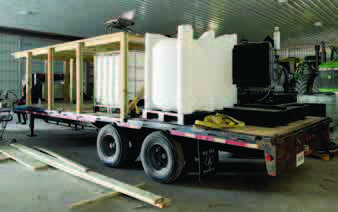
Commercially manufactured drone trailers are available, or one can be constructed by the operator.
Know This
Each time a commercial operation stops to refill the water tanks, it is losing money because the drone is not in the air.
A Trailer and Truck for Today and Tomorrow
A drone truck/trailer should allow the pilot and the person tending the drone to work together as a team to minimize downtime and maximize flight time. It is easy to say we want to fill a drone with product and insert a fully charged battery within 60 seconds of landing; however, this is only possible if the truck/trailer is equipped to keep the drone flying.
Those utilizing trailers and trucks to service their drones have designed and modified them to be selfcontained units carrying everything they need for the day’s work, including generators, extra batteries, water tanks, chemical mixing tanks, battery chargers, and drone repair parts. Carrying a full complement of equipment, parts, and supplies is part of achieving the 60-second turnaround from touchdown to liftoff.
How does the choice of truck and/or trailer help with efficiency? Sometimes, minute details can make a huge difference. For instance, how much time does it take to secure and unsecure drones and equipment when you need to move just a few miles down the road? It is easy to lose 30 minutes in that move if your setup is not designed to pack away quickly. The easier it is to store drones, chargers, and all other equipment, the less time is wasted readying the truck/trailer for the move. It can be difficult to size your truck/trailer setup to be most economical. Sitting down and doing the math can be the difference that leads to a successful enterprise. When comparing different truck/trailer setups, think about the total cost per square foot of space. For example, if your pickup truck costs $60,000, an 8.5-by20-foot flatbed trailer $30,000, and a drone $40,000, plus $10,000 for tanks, generators, and plumbing, then your total cost is around $700 per square foot (32 square feet in truck bed, 170 square feet on trailer). A deckover trailer might double your square footage for the trailer without doubling the cost.
Think long and hard about what you need, whether you are setting up your own trailer and truck, buying a ready-made one, or paying a company to custom-build one based on your specifications. You want to size your equipment to fit your operation with the flexibility to expand or reduce the size of your operation in the future. Oversizing your infrastructure undermines one of the benefits of drones: the relatively low cost of adopting this technology. An operator who overspends on fixed start-up costs will find it difficult to compete with tight economic margins. If the operator is undersized, then they will not be able to realize the gains of the economics of scale. Operators need to develop realistic goals as to what they expect to achieve by speaking to those who have proved to be successful and then purchasing equipment to meet their goals.
Know This
A trailer should allow the pilot & the person tending the drone to work together as a team to minimize downtime and maximize flight time.
You want to size your equipment to fit your operation with the flexibility to expand or reduce the size of your operation in the future.
Changing one component can cause a chain reaction leading to other changes in the spraying setup.
Also, keep versatility in mind. If you can unbolt the drone-specific fixtures and use the truck/trailer for other enterprises during other times of the year, then half of the costs can be allocated elsewhere, and you could more reasonably increase the size of your truck/trailer or realize a lower start-up cost for your spray drone enterprise. The ability to remove drone-related fixtures also makes your truck/trailer more marketable if you find that you need to switch from a trailer to a truck, or vice versa. Likewise, consider the cost of changes to your setup: For example, you may be able to start out with a smaller, cheaper generator, because it is relatively easy to swap a generator for a bigger one later. In contrast, it takes more capital and effort to buy a different drone or a different truck/trailer.
Changing one component can cause a chain reaction leading to other changes in the spraying setup. Consider a time in farming when a 3-row corn head, a couple of 250-bushel wagons, and a single-axle grain truck kept the grain moving from field to bin. Imagine that a farmer decided that a 16-row corn head would speed up his harvest. That single purchase required the farmer to possibly purchase a new tractor, a 1,500-bushel grain cart, two semis to haul the grain to the local elevator, or a larger dryer to deal with the volume of grain being handled. The simple move from a 3-row corn head to a 16-row corn head changed the whole complexion of the operation.
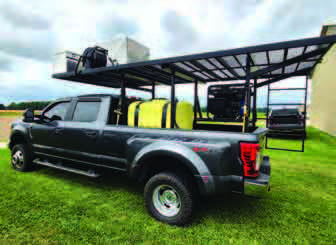
Some operations can use something as simple as this to keep their drones flying.
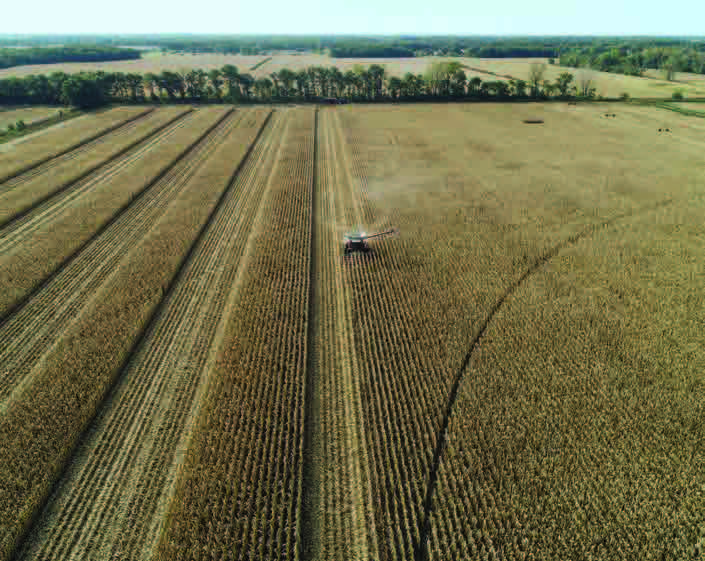
As with farming or any other business, your spray drone equipment needs to fit your operation. If it’s too small, you won’t be able to expand or accommodate greater demand, but if it’s too large, it can be difficult to cover fixed costs that aren’t providing monetary value.
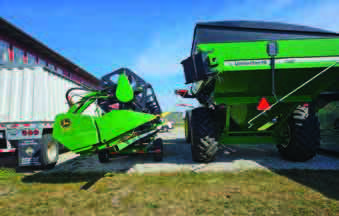
When using drones, the equivalent would be adding a second drone. To support it, changes could include purchasing a second generator, upgrading to high-volume transfer pumps, or revamping how hoses are routed. Needing more water might make a truck obsolete due to space limitations, or an enclosed trailer may no longer be an option due to the weight it would be asked to carry. The current landing platform may not be large enough to land larger drones or even multiple drones. You should consider whether it is realistic to expect your operation to expand, and at what rate of expansion might occur.
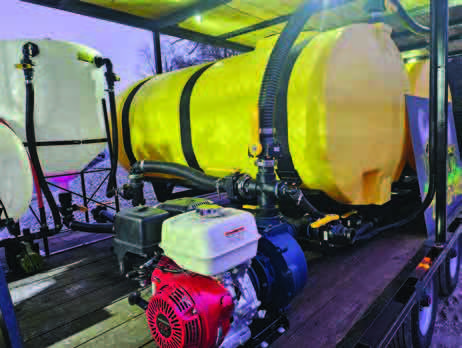
Using a gas-powered pump can provide greater flow without requiring additional electrical demand from a generator. However, you need to consider the noise, and the time it can run between refills, to decide what is right for your operation. Convenient valve locations can improve cleanout time and limit trip hazards that might arise from moving between valves that are spaced farther apart.
For operators in the fragmented portion of America, a truck setup makes more sense than a trailer when one thinks about the day-to-day activity. For those areas an average day will consist of treating a 10-to-20-acre property, then packing up and driving possibly 10 to 30 minutes to the next 20-acre property. These applicators will treat four to eight properties daily on a good day. Drone operators may need to charge a different fee when flying small acreage than when applying to large fields that are more efficient to cover. When you want to expand this kind of truck setup, the ramp-up differs from that for a trailer: There is little space to add more to the truck, so you would likely have to add a second truck.
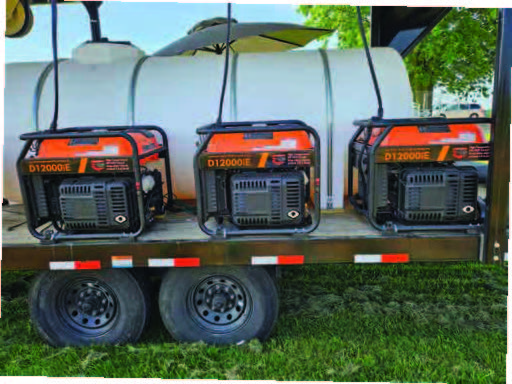
Generators make or break an operation. Do you know what your electrical requirements are? Reading manuals to find the specifications of your battery chargers and pumps will help you decide how big a generator, or how many generators, you need. Some operators prefer one large, powerful generator, while others prefer multiple smaller generators. Contacting a professional electrician might be a good idea.
However, you cannot compromise on some aspects of the truck/trailer, such as having sufficient space for the operator to work safely and, if using a trailer, ensuring you have a truck of sufficient size and quality to pull it dependably. Farmers who are looking to save money by spraying their own fields may want to take a low-cost approach using homemade setups, while contractors who need profitable margins should take a more liberal approach to ensure they can deliver the number of acres needed when called upon. Unhappy customers are not repeat customers.
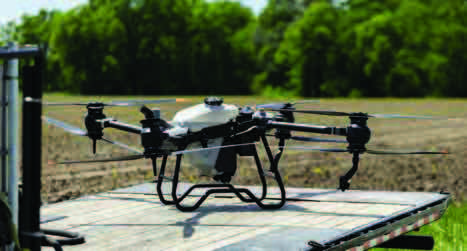
Is your platform large enough for your drone to land consistently without falling off the trailer or truck? You also need enough room to access the tank to fill it. The automated return-to-home function can help, but some human interaction may be necessary to be efficient with landing. Most drones automatically land with the same orientation they had when they took off. If the fill cap is easily accessed before you take off, it will likely be easy to access once the drone lands again.
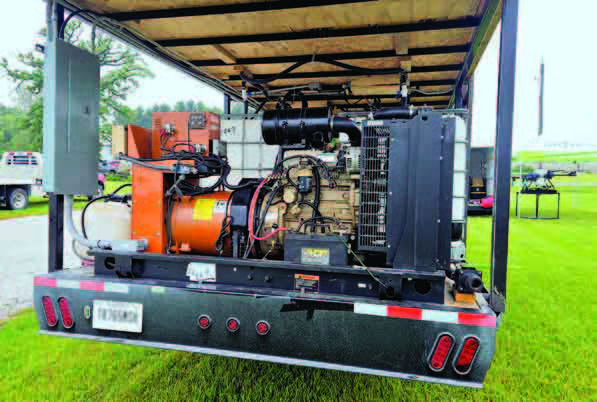
Electrical power is a very important consideration for a drone operation. Fuel economy, fuel capacity, fuel source, noise level, plug-ins, and cost are all aspects that need to be thought about when considering how to invest.
It is important to consider the legal requirements of a drone truck/trailer setup. One key consideration is how much weight a trailer is designed to carry. The extra weight of a diesel generator along with larger water tanks might exceed the trailer’s gross vehicle weight rating (GVWR). A larger trailer might require a new truck with the pulling capacity to move and control the heavier trailer. In some cases, this could cause your GVWR to exceed 26,000 pounds, which might require the driver to hold a valid commercial driver’s license (CDL). The 26,000-pound threshold applies to the GVWR of the truck, the trailer, the combination of the truck and trailer, or the total loaded weight of truck and/or trailer. A state can determine whether farmers require CDLs to operate equipment over the 26,000-pound threshold on their own fields. For instance, Indiana farmers working on their own ground are exempt from CDLs. However, a farmer using the same truck and trailer for commercial purposes requires a CDL when exceeding 26,000 pounds; they lose the exemption when they become a commercial operator working for other farmers or industries.
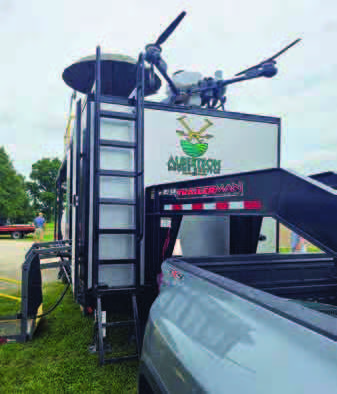
The rails alongside the steps here provide the person going up and down something to securely hold on to.
Also, some drone setups have elevated platforms for the drone to land on, and the operator often spends much of their time on the flight deck. The OSHA rules for the platform are often overlooked: There are rules about ladders used to access the work area and rules about operating safely in elevated work areas. For example, ladders must meet certain load specifications, and 42-inch-high guardrails must be installed on elevated work areas that are more than 4 feet high, or some other fall protection must be provided. (If your work platform on your trailer is already elevated, will the guardrails make you unable to drive under power lines or other overhead obstacles? Or will you need guardrails that can be collapsed when you are driving between operating locations?).
Furthermore, generators can be very loud and may fall under certain ear-protection standards. If your business falls under OSHA oversight, it may be important to look for low-noise generators to avoid ear-protection requirements. Farmers and self-employed individuals may be exempt from OSHA rules, but no one wants to end a 12-hour day by falling off an 8-foot-high platform, and generator noise can be troublesome if you are around it all day. Do you have a plan for what you need the current drone to do and how the truck/trailer will help you to meet your targeted goals, not only now but in the future as well? Spending more today on the truck/trailer and equipment means saving money in the long run if and only if you can achieve the expected return on investment and be profitable in the short term. A setup that works today will likely be retrofitted with new equipment or replaced by another truck/trailer in just a few years as the business expands or as drones change. As drones are sold with larger tanks, you will need capacity to haul more water to keep the drone spraying. While larger drones provide many advantages, they will more than likely also change the dynamics of the water tanks, pumps, and generators.
Take-Home Messages
• Size your generator(s) to suit your power needs throughout your rig. The generator needs to supply enough power to your battery charger(s) to minimize recharge time, run all electric pumps to fill your drone and mix chemicals, and run any auxiliary fans to keep batteries or the operator cool while working. Also, make sure you have sufficient plug-ins for any operator amenities such as a place to charge a phone, power a hotspot, plug in a radio, or other things that may be important to you or your workers over a 12-hour workday. Most drone battery chargers specify how much power they require to optimize battery charging time.
• Size your pumps to refill your drone fast enough to have it land and take off again in less than 60 seconds. If you plan to fill your drone with 10 gallons of chemical mix, then your pump must be rated above 10 gallons per minute (gpm); remember that you also need time to swap out the battery and perform any other tasks. You also need to increase pump capacity if you plan to agitate with the same pump because some of the gpm rating will go toward agitation.
• Have a plan for your water source before building your trailer as this can influence the number of tanks and their size. Also, have a plan for your rinsate before building your trailer as this can impact how many tanks you have or the way you plumb your tanks.
• Be clear on future labor needs when planning your truck or trailer build. Self-employed individuals are often highly motivated and accustomed to long work hours, but when they try to expand their business, it is difficult to find quality labor for seasonal efforts. Think about the quality of labor needed to drive a truck that is pulling a trailer, to have the expertise to operate and troubleshoot a drone, and to obtain the certifications required to apply chemicals. If you can find this person, can you pay them enough while still maintaining your profit margin?
• Do not overlook the safety of your operators during the design process. Elevated platforms are sometimes necessary to maintain visibility of the drone while operating, and they make nice landing and takeoff locations. If you plan to spend your time on the top deck, make sure you have plenty of room to move around without falling off or have proper safety precautions to keep from falling off.
• Plan your truck/trailer to minimize setup and teardown time. Try to plan your rig so that when you are setting up, you either don’t have to move your drone to its takeoff location or have to move it only a few feet. Use straps and tie-downs that are quick to tighten and loosen. Keep battery charging stations near the operator and drone takeoff/landing zone, and minimize the distance from the fill station to the drone.
TAKE-HOME MESSAGES
Make sure you factor these elements into your design when building your rig.
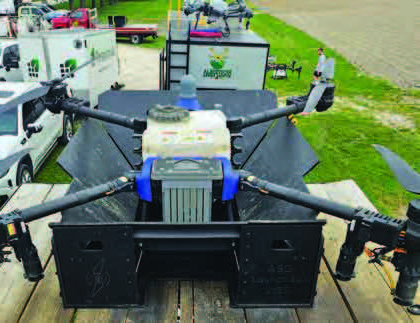 This trailer has an automatic refill system for drones. The male-female couplers allow the product mix to automatically fill the drone.
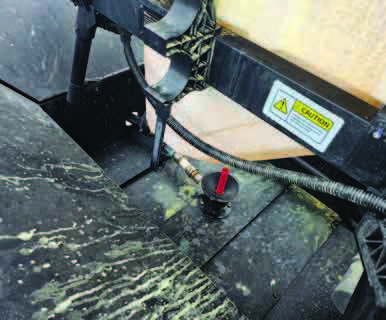 It is expected that within a few years robotic arms will be used to automatically lift the battery, place it in a charger, and put a fully charged battery into the drone. Innovations on the trailer will continue to drive drone operators to be more efficient.
Supporting the Drone with Proper Equipment
The efficiency of a spray drone depends on how effective a trailer or truck is in accomplishing the four basic tasks of storing, launching, landing, and refilling the drone. With average flights taking 7 minutes from launch to landing, the truck/trailer and all its components must meet all operational demands, including charging batteries and filling the tank. It is the sum of all the equipment working together that keeps the drone in the air.
A properly sized generator is the cornerstone of an efficient drone operation.
Generators: Providing the Power to Operate
Generators are the power plant of the spray drone operation, and without a functioning power plant, the operation will fail. The first consideration is, How much power do you need? As society experiments with the transition to electric vehicles, the first question we often ask is, Can our electric infrastructure handle everyone moving to electric power sources? The same questions should be asked about your generator for your spray drone operation. Many of us have generators to power a few necessary items for our house when the power goes out, and it is logical to attempt to use the same generator for the spray drone business. However, often the generator we purchase to power a refrigerator and television is undersized for a drone business.
Whether the goal is to fill the drone’s tank and replace the battery in 60 seconds or 2 minutes, the power-producing generator must keep batteries charged, pumps pushing liquid forward, hoses transporting liquid, agitators mixing products in batch tanks, internet routers connected, and air conditioners running. Starting early in the predawn hours, a generator needs to run all day and sometimes deep into the night.
The generator is often the most difficult piece of equipment to size for the operation. Without prior experience, it is challenging to determine how much power you require. If the generator does not supply enough power, the turnaround time to charge one or multiple batteries becomes too long to maintain continuous operations. When drone pilots are asked what they would change if they could do it over again, many would purchase a more powerful generator. We commonly hear from drone operators that the first generator they selected either failed to keep up with the power demands or had to be replaced often when it did not hold up to the rigors of constant field use. An underperforming generator increased the odds of various problems:
• Batteries took too long to recharge.
• Pesticide products would not completely suspend in the tank.
• Pumps were unable to move product quickly enough from the batch tank to the drone.
• There was not enough power to add more drones to the fleet.
The simple fact is that not all generators are created equal. While some small combustion engine generators can cost $15,000 or more, the majority are priced from $4,000 to $10,000. More powerful generators cost $12,000 to $20,000 when more kilowatts are needed. But when considering what generator to purchase, price alone is not the main selection criterion.
Know This
- The effciency of a spray drone depends on how effective a trailer or truck is in accomplishing the four basic tasks of storing, launching, landing, and refilling the drone.
- Without prior experience, it is challenging to determine how much power you require.
- When drone pilots are asked what they would change if they could do it over again, many would purchase a more powerful generator.
STEPS FOR PURCHA SING A GENERATOR
- Does it deliver the kilowatts needed?
- What fuel do you expect to use?
- Are there additional features you want?
- Can you work around the decibel ratings?
- Do you have a brand preference?
Those that pass this five-point evaluation can then be compared side by side according to price.
Differences in price can depend on the fuel used to power the generator (i.e., gasoline, diesel, tri-fuel), the technology used to reduce noise levels, additional features such as push-button start and stop, and brand preferences. Also consider the heat the generator produces. It is tempting to save money by going with a lower-cost unit. This can be a very costly mistake unless you know the real power the generator produces.
The selection process becomes much easier once you know how much power a generator produces (see next section). You can then compare the different brands and models with similar power ratings along with additional features to help decide which generator best meets the needs of your drone operation and which offers the best price.
There are three basic types of small combustion engine generators used by drone operators: those that produce electricity using (1) gasoline, (2) diesel, and (3) propane. Small drone operations have a fourth option: using an already charged battery as their power source. All generators work well as long as their kilowatt output matches or exceeds the needs of the operating equipment. The generator also needs to have enough outlets in the correct voltage styles (110 and 220 volt) to accommodate items other than drone chargers. Larger and more expensive generators may be able to supply three-phase power, which may be necessary if you choose a high-flow electric pump.
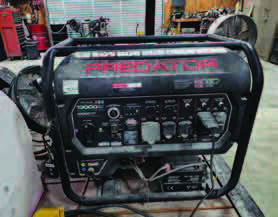 A gas-driven generator generally costs less on the front end, and the lighter weight allows for greater portability.
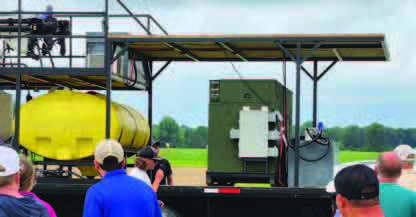 A diesel-powered generator costs significantly more than gas-driven units but is more durable and dependable under field conditions. Their heavier weight makes them less portable.
For generators, one should know a minimum of two numbers regarding kilowatts—peak/starting kilowatts and constant kilowatts. The peak/starting kilowatts is the total kilowatts the unit can produce but can only be handled for a short duration. The other number is the constant running power, that is, how much power the generator can deliver over an extended period. The peak wattage is usually given in large numbers on the side of the generator and in the product listing, but you may have to look up the constant output in the specifications.
The devices powered by a generator, such as pumps, likewise have two different power draws, initial start-up (surge) and constant. As a device powers up for the first time, the wattage needed will typically exceed the constant wattage needed to maintain operation. This is known as a surge. The generator must be capable of handling the surge from the devices as they power on to ensure the unit does not bog down and stall.
Not only should the generator be capable of handling the surge, but it also must be able to deliver enough constant power to maintain whatever devices are utilizing it throughout the day. In layperson’s terms, the total constant running power of all devices hooked up to the generator must not exceed the actual constant running power of the generator.
The wattage is often influenced by the fuel that runs the generator. Consider the following power specifications for a generator that can run on three types of fuel but produces different amounts of power on each:
Peak wattage (watts) : 13,000(Gas) | 12,000 (Propane) | 10,000 (Natural gas)
Constant wattage (watts) : 10,500(Gas) | 9,500 (Propane) | 8,500 (Natural gas)
Because 13,000 will appear prominently on the generator, people might have the mistaken impression that this generator supplies a constant power of 13,000 watts, but it might be as little as 8,500 watts if natural gas is used as the fuel. The latter represents 65% less power than the advertised number. This is why you need to review product manuals before deciding that a generator will work for your specific operation.
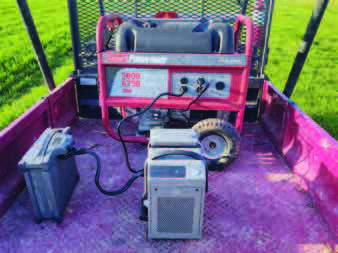
While it is not common, a generator may list two numbers to describe the power produced. This Coleman generator highlights two different numbers related to wattage—6,250 and 5,000. The first is the peak output, while the second is the constant running power. Make the best purchase when comparing generators by using the constant running power.
The ratings in manuals and on generators are most often expressed in watts. But the equivalent in kilowatts is probably a better number to look at. Take the wattage and divide it by 1,000 to get kilowatts. If a generator lists the peak wattage as 9,500, that is 9.5 kilowatts (9,500 divided by 1,000). This keeps you from being impressed by the larger numbers!
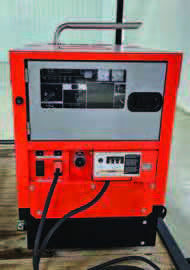
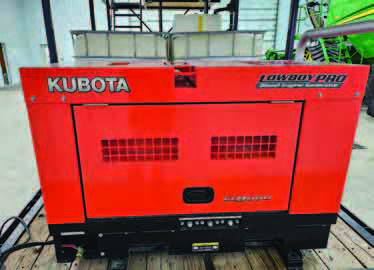 Every generator will have its own specifications for the constant power it can deliver over the course of a day. This Kubota 14,000-watt (14-kilowatt) diesel generator actually delivers 12 kilowatts of constant power.
Newer models of drone chargers can require up to 13 kilowatts of power to fast-charge a battery. Knowing what you need and what constant power the generator can produce eliminates many models from consideration. Knowing the specifications of a generator becomes critical when running more than one battery charger along with one or more pumps. One charger can draw an average of 5,000 watts (5 kilowatts), while fast charging with the same charger requires around 9 kilowatts. Five kilowatts would be the absolute minimum that a generator would have to produce to run a single charger. However, this yields a slow, 20-minute charging time instead of 10 minutes with a generator that provides enough power for fast charging.
A reasonable assumption is that each charger powered by a generator needs 10 kilowatts of constant power, meaning a generator that supplies 28 kilowatts (28,000 watts) of constant power would run two chargers. It is recommended to get a generator that can produce 20% more power than what your calculations show you need for the drone and truck/trailer components. This gives you an extra fudge factor to account for ratings that do not go by the book and allows you to add other equipment as needed.
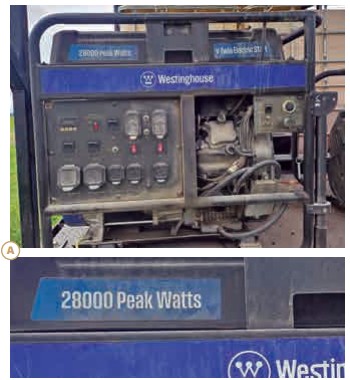
(A) This Westinghouse generator lists 28,000 watts (28 kilowatts) of peak power. Its constant running power is listed as 20 kilowatts in the product’s brochure.
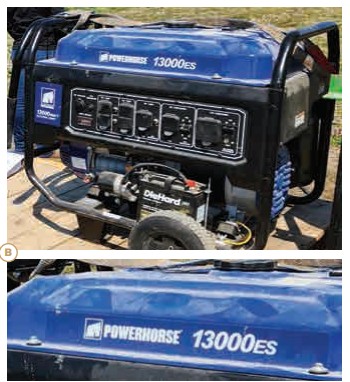
(B) This generator lists 13,000 watts (13 kilowatts) of peak power. Its constant running power is rated at 10.5 kilowatts if it runs on gasoline.
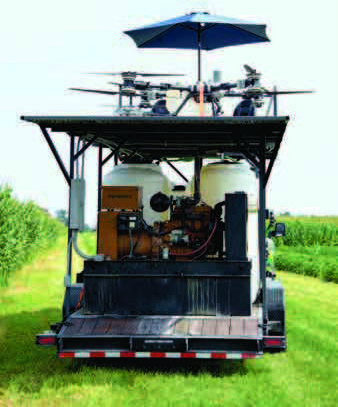
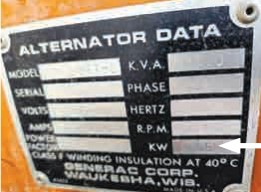 The diesel generator on the back of this trailer is powerful, supplying 35 kilowatts.
Consider the Noise Level
An often-overlooked criterion of generator performance is the noise level while operating. This is important for three reasons: (1) Loud generators make it difficult to communicate among the crew. (2) Employees could suffer permanent hearing loss. (3) Loud noise over extended periods can cause a reduction in situation awareness. Normal conversation is rated between 50 and 65 decibels (dB). Noise levels above 85 decibels can damage a person’s hearing. Remember that the decibel scale is logarithmic, meaning a small change in the number corresponds to a major change in the noise level. One generator manufacturer lists the decibel rating at 67, which is comparable to talking loudly. Two other manufacturers list the decibel level of their generators at 78 (comparable to the noise made by a garbage disposal or blender) and 85 (comparable to a diesel truck or loud vacuum cleaner).
Most often, these “official” decibel numbers are not measured next to the generator but at some distance away. Many of the decibel measurements are taken 23 feet away from the generator. In contrast, drone operators often work within 5 to 15 feet of a running generator. This means the noise level is much louder than specified by the manufacturers of the generators. To safeguard against hearing loss, employees should wear hearing protection when working around generators or place the generator in a place that dampens the noise to acceptable levels without hearing protection. Remember that the decibel level is not the only consideration but also the duration of exposure. For example, it may be acceptable to be exposed to 100 decibels for 15 minutes, while for only 85 decibels, an exposure of eight hours is acceptable. A successful drone operation will be exposed to the generator for much of the day, except during travel times, so be conservative with decibel levels when choosing the generator.
Meters to measure decibel levels can be purchased online fairly cheaply if you are questioning the rating that you find in the manual. There are also phone apps that can provide at least approximate noise levels; the National Institute for Occupational Safety and Health (NIOSH) has released a sound meter app for iPhones (https://www.cdc.gov/niosh/noise/about/app.html).
To combat issues with communications, most drone operations work with personal communication devices (radios with earpieces) or develop hand/arm signals to assist in communication in noise-ridden environments. Last, when you are working in loud environments for extended periods of time, situational awareness can decrease throughout the workday. This presents unique dangers in that operators could fail to hear an inbound drone or vehicle approaching the worksite. Extra safety measures should be in place to ensure safe operations.
PROTECTING ONE’S HEARING
The United States Occupational Safety and Health Administration (OSHA) regulations require companies to implement hearing protection programs for employees. Be sure to familiarize yourself with regulations about hearing thresholds at http://www.osha.gov/noise.
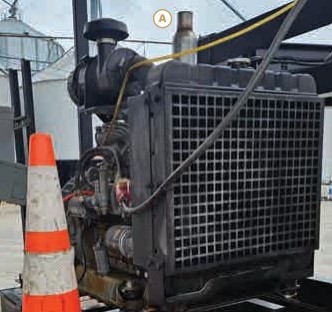 Many of the manufacturers of generators have adapted mufflers to make them quieter. (A) A vertical exhaust sends hot air and fumes directly upward, where the hot exhaust could damage a wood platform and equipment located above it.
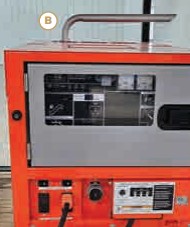 (B) A side-facing muffler is better for diffusing noise and heat away from people and equipment.
Transfer Pumps: Pushing Liquid Through the Plumbing System
Pumps rank a close second to generators in their importance. You can have the best plumbing and the best generator, but the pump is at the heart of the plumbing system that drives the operation. Pump specifications are based on gallons delivered per minute (gpm). This flow rate is determined by the design of the pump and the revolutions per minute that the pump can spin to achieve the desired rate (such as 20 gallons per minute). It is typically expressed on a tag affixed to the pump. The gallons per minute the manufacturer lists on the pump or in the accompanying datasheet is like the Environmental Protection Agency’s gas mileage listed for every car in the showroom. Whether for a car or a pump, the ratings are normally higher than you may achieve in real life, because the flow rates are measured under ideal testing circumstances.
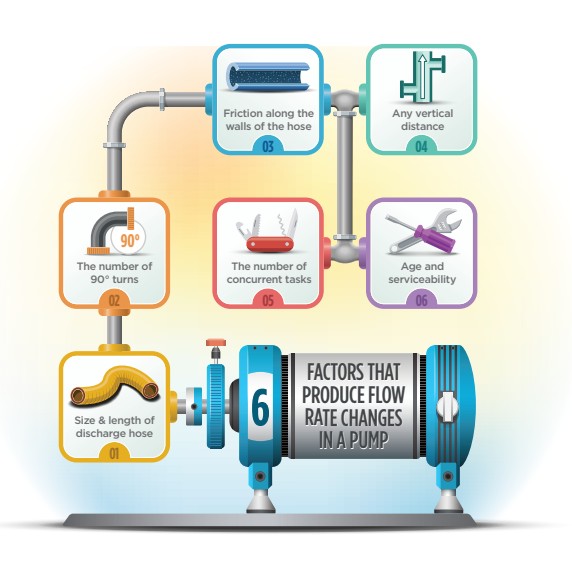
Other factors that can produce minor changes in how many gallons per minute a pump can deliver include:
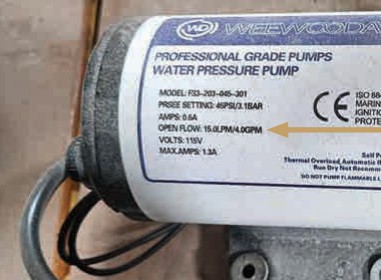 This pump moves 4 gallons per minute and is dedicated to moving fresh water to the batch tank.
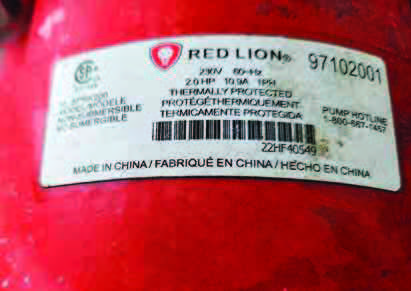 This model of a Red Lion pump can deliver 76 gallons per minute and could take care of the needs of most drone trailers.
The pressure generated by a transfer pump is part of its internal design and is not something a drone operator typically regulates like is done on a boom sprayer. Most choose not to have gauges along the length of the hose to measure pressure. In this case, this is why one should match hose sizes to the inlet and outlet sides of the pump to ensure its performance based on the manufacturer’s design for the unit.
In other situations, an operator might place a pressure regulator on the equipment. But usually knowing the pressure is not as important as it is when calibrating spray equipment like boom and gun sprayers.
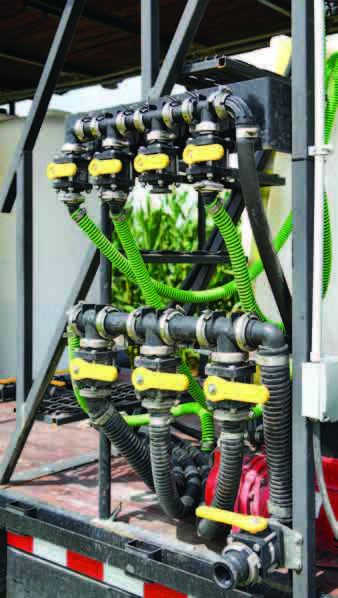
The more the pump is asked to do, the more the flow of the fluid to its final destination is reduced.
Two Make One: Pumps and Engines Form a Unit
All pumps require an attached engine or motor, whether it be gas or electric, as the most common way to push the fluid forward. A pump and the attached engine/motor are often assembled by different companies. For example, one combination might be a Honda gas engine coupled to a John Blue pump or a Briggs and Stratton engine running a Banjo pump. This means the engine selected must deliver the power to run the pump at the stated gallons per minute listed by the pump’s manufacturer.
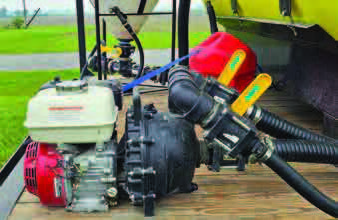
Here a gas Honda engine and Banjo pump form a single unit.
Pumps and engines can be initially purchased as a set. Not only are they properly matched to each other, but buying them together has a lower cost than buying each separately.
It is typical for the pump to wear out long before the engine. When this happens, the pump can in most cases be rebuilt with a kit from the manufacturer. Rebuild kits and a little time in the offseason can save you a lot of money and keep a pump just as strong as a new one. Consider rebuilding pumps every third year as part of a preventative maintenance program. In extreme circumstances, if damage has occurred to the pump, a replacement can be sourced with similar specifications, keeping your flow rate the same.
Engines are rated by wattage, which is often converted to horsepower. The following table converts among watt, kilowatt, and horsepower ratings.
(1 kilowatt = 1.34 horsepower; 1 horsepower = 0.7457 kilowatts)
3,000 watts = 3.0 kilowatt = 4.0 horsepower
4,000 watts = 4.0 kilowatt = 5.5 horsepower
5,000 watts = 5.0 kilowatt = 7.0 horsepower
6,000 watts = 6.0 kilowatt = 8.0 horsepower
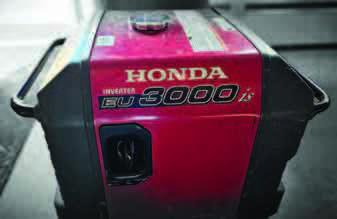 This Honda 3000 gas-powered engine, which produces 3,000 watts (3 kilowatts), is considered a 4-horsepower engine. A popular option is to spend an extra $200 to get an electric start, which makes starting the engine easier than pulling a “rope.”
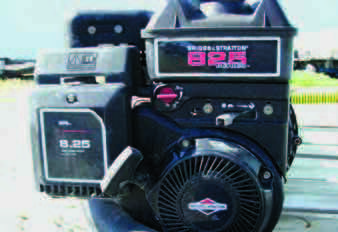 The manual indicates this Briggs and Stratton gas engine has a gross horsepower rating of 8.25 and a net horsepower rating of 6.5.
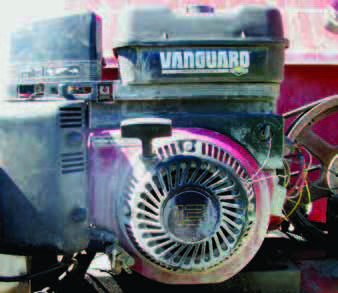 This Vanguard engine has a gross horsepower rating of 13, as marked on the front of the engine.
Small engines have similar problems to generators and pumps when it comes to assigning horsepower ratings. There are two versions of horsepower, known as gross and net. Gross horsepower is the maximum power the engine can produce on a test stand, without any attachments like mufflers, pumps, and other loads placed on it. The more critical of the two ratings is the net power, which provides the horsepower after accounting for accessories. There are manufacturers that do not list the net horsepower in their specification sheets or manuals.
Three Styles of Pumps. Transfer pumps are normally driven by a gas or diesel engine or an electric motor. They can be identical except for what is on the driver side of the pump. In other words, the same pump could be coupled to a gas engine or an electric motor. There are three main types of transfer pumps:
• Battery-driven transfer pumps. The battery basically provides the fuel that drives the electric motor. Batteries allow for greater portability; however, the two main challenges with batteries that limit their use are a low flow rate and the need to recharge the battery numerous times during the day or to charge it constantly with a generator or alternator driven by a motor. Electric pumps driven by batteries may be used for lower-volume transfers. Because of these limitations, this is the least utilized style of transfer pump.
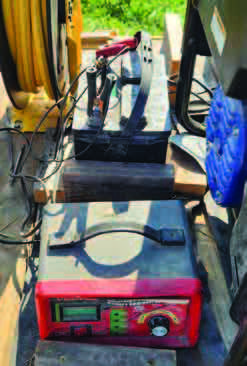
If you use a 12-volt battery to power a pump, you may need a device to convert 120-volt power from the generator to 12 volts to charge the battery.
• Gas-driven transfer pumps. Gas-powered engines bring additional power to the trailer/truck to drive pumps. If the pump is powered by a gas engine, then the generator’s power can be fully utilized for charging the drone’s batteries. Gas-driven pumps are handy because they can be relatively cheap to operate and are widely available if a repair needs to happen or a total replacement is needed. The relatively high flow rates that gas-driven pumps can supply typically suit almost any drone operation, but these pumps can be oversized for certain parts of an operation and can be noisy while running (remember the OSHA noise ratings). This method has minimal drawbacks currently other than the added expense and need to carry around fuel (which is already necessary for a drone operation).
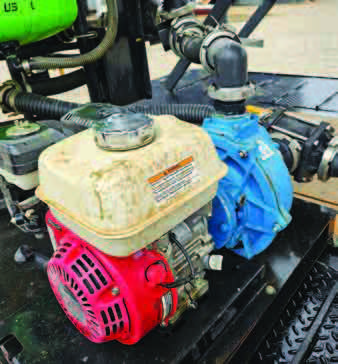
A gas-driven pump.
• Higher-flow electric-driven transfer pumps. These pumps plug into a generator for a direct source of power. Match up the electric motor to the size of the pump to handle the desired flow. It takes a 2-to-5-horsepower electric motor to run a 2-inch pump.
These pumps are generally much quieter to operate and can provide sufficient flow for drone operations. However, their motors can be more expensive and sometimes require three-phase electrical power, which not all generators are equipped to provide. Parts may be more challenging to find, or you may not be able to quickly replace the motor and pump. To use these transfer pumps, (A) you must purchase and maintain a secondary generator dedicated to this, or (B) you will need a primary generator capable of handling this as well as charging your batteries.
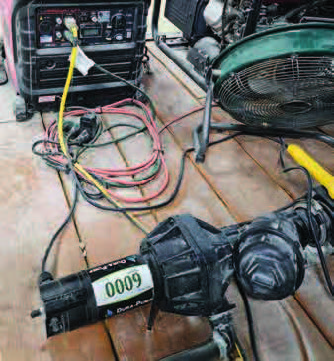
An electricity-driven pump.
Prioritizing a single-phase motor is generally desirable for drone operators. Not only are these cheaper, but singlephase motors run on standard outlets like those associated with generators. A three-phase pump is used primarily in industry requiring a lot of power, or for filling ground rigs with 1,000 gallons of water.
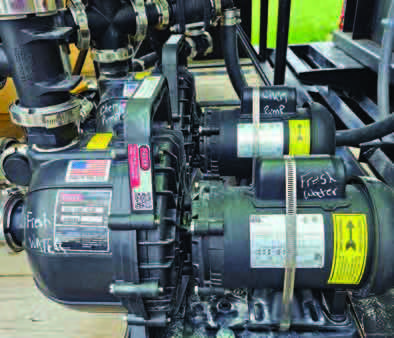
Setting up a number of pumps that are dedicated to specific liquids ensures cross-contamination will not take place.
More Flow Is Not Always
Better Using a transfer pump that pushes out too much flow has its own set of issues when filling a small tank. A pump moving 150 gallons of water a minute into a 20-gallon drone tank creates excess foam and splashing, quickly overflowing the tank. But that same pump would be perfect for quickly filling a 300-gallon batch tank.
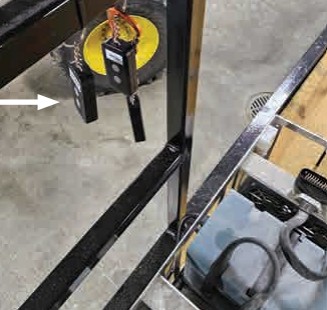
Some electric motors come with a remote control to turn the motor on and off. This allows someone working on an elevated platform a way of operating the motor without having to go back to the lower deck.
More Pumps, More Options
Some operators use a single pump to move fluid to all parts of the drone operation. At a minimum, the pump should deliver 20 gallons per minute if the goal is to fill a 20-gallon tank in a minute. An additional consideration when working with one pump is your cleanout procedures, as these need to be strict and followed thoroughly to ensure no cross-contamination occurs.
Remember that flow rate is impacted by 90° turns, smaller hoses, and multitasking. A 50-gallon-per-minute pump sending 20 gallons to the batch tank leaves 30 gallons to fill the drone within a minute.
Others take the approach of using two or more pumps instead of one. For instance, a separate transfer pump is used to move fresh water over to the batch tank. Additional pumps are dedicated to filling the drone from the batch tank or to running inductors within tanks. For some operations, the extra expense for additional pumps is worth it for the efficiency and safety they bring to the operation.
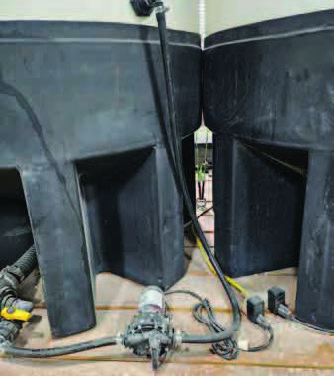
Multiple pumps are often used to help facilitate working more efficiently. Here a 4-gallon-per-minute pump is dedicated to mixing the chemicals in the tank.
Another perk to multiple pumps is reducing the likelihood of cross-contamination. If a single pump is pushing fresh water into the batch tank, then is used to fill the drone, the system would then have product residue throughout its plumbing. A second reason for multiple pumps is that the flow may be acceptable for one application but not another. For example, filling a 300-gallon batch tank could use a high-volume pump, while a 20-gallon drone tank could use a smaller pump. With multiple pumps, you can size the pump to the needs of specific parts of the spray operation. Spending time thinking about the best pump(s) to purchase is worthwhile.
Another consideration when mounting your pump on a truck/trailer is the vibration and roughness of driving down the road and the effects this has on the pump and motor. County roads and even some highways are very rough with numerous potholes, chipped pavement, or pavement ridges that can cause the truck/trailer to vibrate or bounce roughly, potentially fracturing components of the pump and motor. Although these pumps and motors are generally made for challenging conditions, spray drone setups often travel some very difficult back roads that may be gravel, dirt, or not a road at all and may prematurely cause issues that don’t normally occur as quickly with other uses.
When you are bolting down the motor and pump, it may be a good idea to place a thin piece of rubber or other dampening material between the motor/pump and the trailer/truck deck. This can help reduce the impact of a rough road and can also reduce noise while the pump and motor are working during the spray drone operation.
Keeping spare parts on hand for the pumps and motors may be as critical as spare parts for the drone. Electric pumps may be cheap enough to carry a spare unit or at least some extra wire, fuses, or connectors. It is common for electric pumps to have small lead wires and/or connectors “burn up” or blow a fuse protecting the electric motor. Less-thanideal conditions will also cause electric motors and pumps to be jostled around, pulling on wires and/or connections. With pull-start gas-powered engines, it is common for the pull cord to break, or the internal spring to go bad. It is always a good idea to have a spare pull cord on hand (they are typically interchangeable) or to convert the engine to an electric start. Although less common than pull cords going bad, the connection between the engine and pump can shear a keyway or damage a Lovejoy connection that allows the engine to drive the pump. If you are using a gas-powered engine, it may also be handy to have a can of ether for those times it doesn’t want to wake up. Look at the components that make up your motors/engines and pumps and always keep a spare of the critical failure components on hand.
Tanks: Holding the Mixture
Storage tanks are most used to store products and water on trucks and trailers. Tanks have different designs (such as flat-bottom vs. cone-bottom, vertical vs. horizontal), are constructed of different materials (poly, fiberglass, and steel), and can be different colors (green, white, black). Poly tanks are preferred as they have a proven track record of working, are lightweight, and are readily accessible locally.
The main issue with poly tanks is that sunlight penetrating through the tank can cause the buildup of algae. If you can see the level in the tank, that means sunlight can penetrate it. Whether the tank is clear, yellow, blue, or green, the operator must periodically clean it to remove the algal growth.
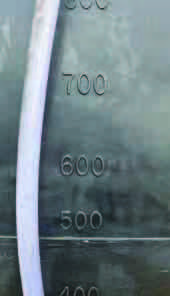
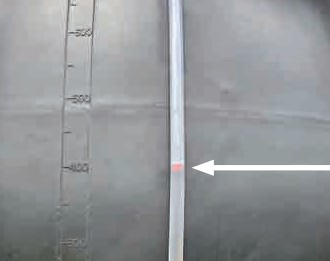
A black tank is preferred by some as it blocks sunlight, which reduces the growth of algae. But the black tank defeats the main reason lighter-colored tanks are selected: being able to see visually how much product is left in the tank. To help with this, a black tank can be fitted at the bottom and top with an elbow and a clear sight gauge in between the two (see photos above). The fluid level is then displayed in the clear tube, where you can match it to the gallon markings on the poly tank. Another option is to place floating indicators in the sight gauge hose that can be easily seen alongside the gallon marks.
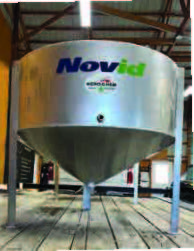
If you choose to use a lighter-colored tank on your trailer, try to limit the amount of sunlight that reaches the tank to limit the amount of algae growth. You may be able to enclose a portion of the truck/trailer to block the sunlight on several sides or arrange other items so that they shade the tank. It is also worthwhile to consider some form of a baffle if you are selecting a tank large enough that the sloshing of water may influence the driver’s ability to control the truck. For tanks used for mixing pesticides, it is best to use a cone-bottom tank instead of a horizontal or vertical flatbottom tank. The cone allows the product to be completely emptied out, and clean water added to remove any remaining pesticide residues.
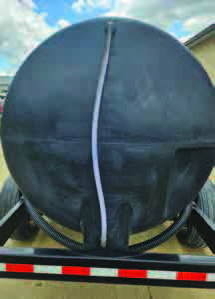
While poly tanks have found a strong foothold in agriculture, there are legitimate concerns that the porous material on the internal surface can trap pesticide residues. The worry is largely that herbicides will be pulled out of the plastic into the tank and sprayed on a crop sensitive to those chemicals.
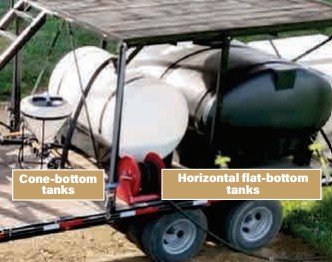 A cone-bottom tank for mixing products along with two horizontal tanks to hold water. Most batch tanks are cone shaped because they can be completely emptied and do a better job with agitation. The black tank would control and prevent the growth of algae.
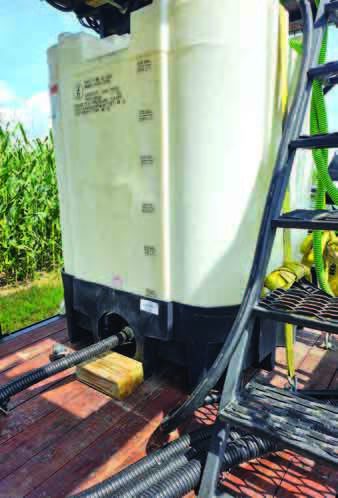 This tank contains a pesticide. The flat bottom would make it difficult to remove any remaining residue without a great deal of effort. These are often used to store clean water, or they are dedicated to a specific product.
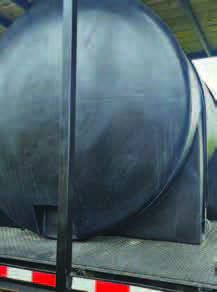 This black tank has an indicator hose with a lightweight red bead that allows a quick assessment of how much fluid is left in the tank.
With poly tanks being the primary tank type used on drone trailers, why is the cross-contamination concern largely unseen? Nearly all the products being applied by agricultural drones are fungicides and insecticides, which do not cause visual symptoms even when sprayed on nontarget crops.
As herbicides are incorporated into the drone business, cross-contamination problems will have to be addressed. With less water in the tank and the use of more concentrated solutions, drone operators may have to take additional precautions to prevent cross-contamination. Some operators will run neutralizing agents through the system and drone, which is a simple procedure to remove unwanted residues in between applications.
Others use stainless-steel tanks, because stainless steel’s smooth surface lacks the pores found in poly tanks. Coneshaped stainless steel tanks come in 60, 100, 120, 150, and 230 gallons, which gives plenty of size options for drone operators. But these tanks will add additional weight and cost.
The next question to discuss is, How do I agitate my mix? Most pesticide products suspend rather than dissolve in water, and when the water in the tank is not being moved, the suspended product can settle to the bottom. To either prevent settling or resuspend product that has settled on the bottom, agitation of the mixture is required.
A common practice is to agitate the tank’s contents by recirculating the fluid inside the tank, pulling it out at the bottom and running it through a hose and back into the top of the tank. While that might be adequate in some circumstances, most of the agitation occurs at the top of tank, which often will not mix the material at the bottom of the tank; it can also produce a lot of foam. A more effective method is to have the agitation take place below the surface of the fluid. An eductor nozzle placed near the middle of a cone-shaped tank with the valves pointing downward toward the bottom provides maximum mixing of suspended materials. This provides an excellent internal current to keep the solution suspended.
MISUNDER STOOD TERMS
There are two words that sound the same but have different meanings. An inductor is a cone-bottom tank used for mixing chemicals and for holding the material that will be transferred into the drone.
An eductor is a nozzle within a tank that employs a high-velocity stream of liquid to mix the products in the inductor tanks.
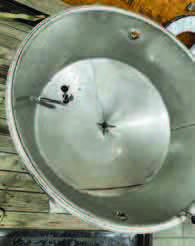
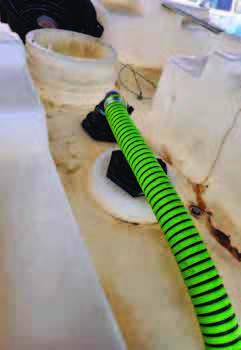 A hose running to the top of the tank to allow for recirculation of the fluid.
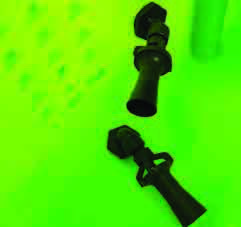 The inside of a tank with two educators to provide current to suspend or resuspend pesticides.
Hoses: Serving as the Arteries
You never appreciate a hose until it ruptures, spilling pesticides on the truck/trailer, coating equipment, contaminating the environment, and endangering workers. This results in work stopping until the spill is remediated, the equipment cleaned, and necessary reporting calls made to government regulatory agencies when applicable. While it is just a hose, it is critical for moving fluid to where it is needed in an efficient and safe manner, like generators and pumps.
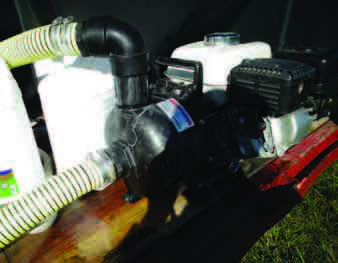
A pump showing its inlet to allow fluid to enter and an outlet to move the fluid forward to its desired destination. In this example, suction hoses are used to pull in and push out the liquid.
Manufacturers build pumps with an inlet and outlet sized to deliver the optimal flow rate. Operators should attach a hose that matches the diameter of the pump’s inlet and outlet to take advantage of the design. In general, smaller pumps that are rated to push 15–18 gallons per minute use a 1-inch-diameter hose. A highcapacity transfer pump used on drone trailers can transfer 150 or more gallons per minute, requiring a 2-inchdiameter hose to allow product to flow freely. It is common for hoses to be made of rubber. Rubber hoses that are under 1¼ inches in diameter are lightweight yet sturdy enough that they can be used on both the inlet (suction) and discharge sides. Larger rubber hoses add weight because fiber and steel braids are added to keep them from collapsing. Even with the reinforcement, larger rubber hoses should generally be used only for discharge, not suction.
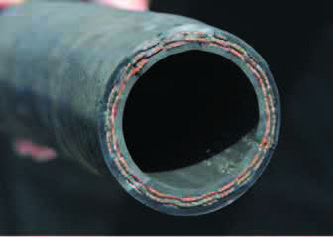
A popular substitution to avoid the weight of a 2-inch rubber hose is a ribbed suction hose made of PVC. These typically are used on both the inlet (suction) and discharge sides of a pump. Rubber and ribbed suction hoses should be inspected frequently and replaced every 1–3 years depending on use. Replacing hoses in the offseason can prevent major accidents during the busy season.
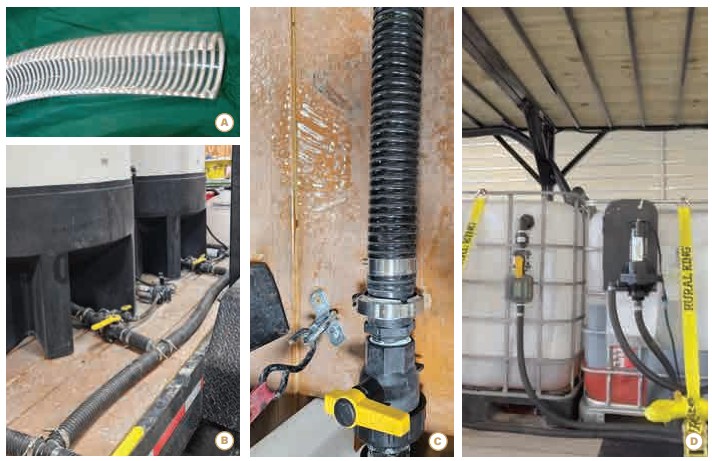
(A) A clear PVC-based suction hose showing the ribs that prevent the hose from collapsing. (B, C, D) Suction hoses in use on drone trailers
Reduce 90° Turns Whenever Possible When plumbing hoses, try to limit the number of 90° plastic fittings, which can restrict the flow. It is always better to use more hose and let that form the bend so that the flow will not be restricted as much as with a 90° plastic elbow.
In addition to reducing 90° elbows in plumbing, consider the valve and connector size in relation to the hose. For example, if you go to your parts store and ask for a 1-inch ball valve, what is the internal diameter of the valve? If it is a standard port, the diameter of the port may be ¾ inch, so if you are sizing all your tubing to 1 inch, you will be restricted to the ¾-inch port size. However, if you ask for a 1-inch full port valve, the internal port size will be 1 inch and will be sized properly for the 1-inch tubing.
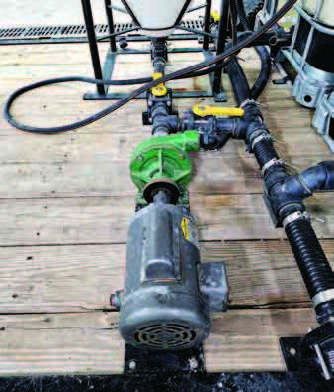
Prepare for Cleaning Out the System
Make sure to plumb your rig for easy cleaning of the hoses, pumps, and tanks. Try to reduce the amount of plumbing that the pesticide has to travel through to be agitated and to fill the drone. Make judicious use of valves from your clean water supply to give you options to clean necessary components of your operation. This may include a separate hose that is plumbed directly to the clean water tank that can be used to wash off the drone or other components of the truck or trailer without cleaning out the hose and plumbing that you use to fill the drone.
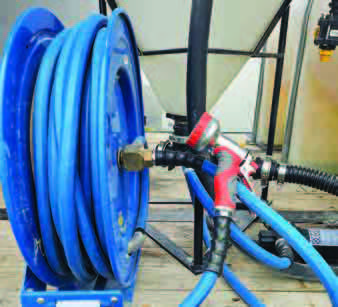
Types of Hose Clamps
Clamps squeeze the hose onto a fitting to keep it from being blown off under pressure. As expected, there are many styles of clamps that can be used to tighten and secure a hose. Standard clamps (aka worm-gear or radiator clamps) and T-bolt clamps are two of the more popular styles used by drone operators. Standard clamps are among the least expensive and most versatile all-purpose clamps in the marketplace. These clamps are especially effective when permanently placed on hoses. The main problem is that removing and refastening standard clamps weakens the metal of the band, which leads to the gears and teeth no longer fitting snugly into the grooves.
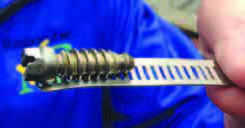
While some prefer to use a single worm-gear clamp, others believe that two clamps provide additional protection. Because the clamp’s screw is straight, the clamp cannot curve around the hose where the screw is found, creating two “corners” where the clamp doesn’t completely tighten at each end of the screw. This can also lead to the clamp being stripped when it is tightened too much. Using two clamps with the screws facing in opposite directions allows the “round-on-round” section (the section where the clamp is as round as the hose) of one clamp to always be beside the screw of the other. While they are more expensive, T-bolt and spring clamps are beginning to see more use, primarily because they are much stronger than the standard clamp.
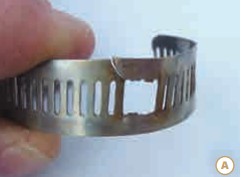 (A) A limitation of standard clamps is that at some point they can be stripped if the screw is tightened too much.
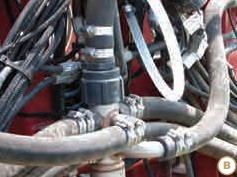 (B) These pressure hoses have two standard clamps with the two screws aligned with each other.
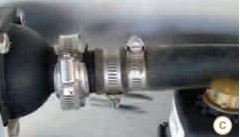 (C) A better method is to have the screws opposite each other, which allows the weaker area around the screw to be offset by a tight “round-on-round” section of the neighboring clamp.
A T-bolt clamp pulls directly against the other side of the clamp, allowing more tension to be placed on it. The hose is completely encircled, allowing for a tighter grip all around the hose. Whatever style of clamp is used, make sure that everything on it is stainless steel, including the bolt, screw, and nut. Because some pesticide products are corrosive, clamps with parts made of mild steel can become corroded and fail.
When assembling hoses or completing maintenance, it is common to put your hoses and connectors together and leave the hose clamp loose until the very end to make sure you don’t need to pull it back apart. Make sure you go around to all the hose clamps before resuming operations and make one final fit check of the hose clamps, so you don’t get a blown hose on first start-up. It is also good to check clamps periodically, as they can work loose.
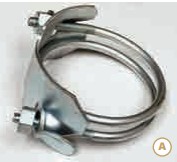 (A) A close-up view of a spring clamp.
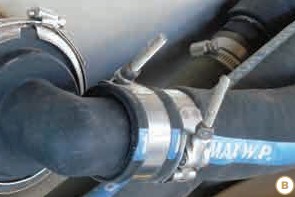 (B) A pair of T-bolt clamps used to keep the hose attached to the fitting.
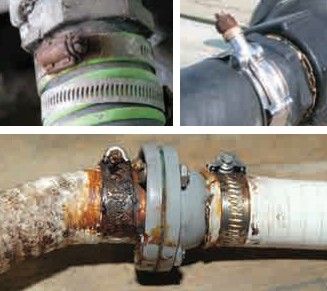 Examples of corroded standard clamps and T-bolt clamps from weather and chemicals.
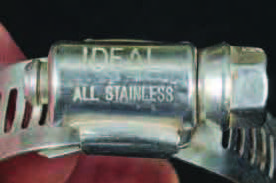 Clamps made entirely from stainless steel are always preferred because they last longer than their counterparts made of mild steel. Stainless steel protects against corrosion, and clamps made of it can be taken on and off with minimal metal fatigue. Just be sure the entire clamp—the band, screw, and housing—is made of stainless steel.
Reducing Clutter on the Deck
Hose reels are far more important than people realize in terms of convenience and safety. In a drone operation, leaving hoses left unrolled on the ground or platform can lead to trips and falls. According to insurance statistics, trips and falls are one of the leading causes of claims being paid for injuries sustained. Given that many people work on elevated platforms when operating drones, a fall from these heights could lead to permanent and/or lifethreatening injuries.
Hose reels provide additional benefits that extend the life of hoses:
The main types of retraction reels include the following: Manual hand-crank reel. This is the least expensive retraction hose reel. The operator must manually turn a handle to retract the hose back onto the reel.
Automatic spring-loaded reel. With these, the operator slightly tugs on the hose to disengage the brake, allowing the hose to neatly retract onto the reel.
Motorized retraction. These reels can use a battery or a generator for their source of power. Some come equipped with a push-button start, a foot pedal, or a remotecontrol device. While motorized retraction reels are more expensive, they simplify the process of handling a hose. So, when might you choose a manual versus automatic hose reel? The important thing to understand is where and how your drone will take off and land. If you plan to take off and land from an elevated surface that needs to be clutterfree area, an automatic reel could be needed. The reels used should be purchased with some forethought so they do not interfere with routine activities. The operator is likely not willing to hand crank the hose for each fill-up, and you can’t have hose clutter that you might trip over.
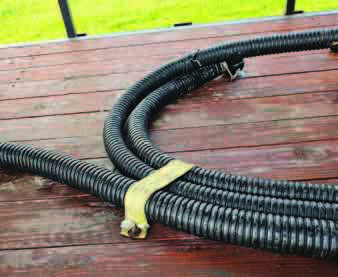
This hose is neat and tidy, but you wouldn’t want to trip over it on the upper deck of a truck or trailer. If you don’t use hose reels, make sure you don’t have to constantly walk over the hose to conduct the operation.
If you plan to land and take off from the ground, leaving the hose out on the ground may not be a big issue as you may have plenty of room to walk and navigate around the hose. This operation is simple, requiring the operator to reel the hose only when packing up to leave the takeoff site. Depending on the rigidity of the hose, winding the hose too tightly can cause slight kinking of the hose, which will slightly restrict the product flow. Obviously, the larger the diameter of the hose reel, the less likely the hose will kink. It is also important to consider the reel adapters used to connect tubing. Sometimes the connector to the hose reel or the supply to the reel is reduced, so your maximum flow rate could actually be restricted by the orifices of the reel itself. Another minor consideration with hose reels is the O-rings used to seal around the rotating parts. If the hose reel is advertised for use with oil and chemicals, the O-rings are likely already resistant to many of the pesticides being used.
Hose reels not designated for chemical usage may have O-rings that are not resistant to common pesticides and chemicals, creating a potential for leaks. Replacing such O-rings with chemical-resistant O-rings is typically easy to do and can prevent a potential leak during light or moderate use. It is also important to get a hose reel that is properly sized for your operation. It may seem like you should get the biggest hose so you don’t run out of length, but there could be extra gallons of pesticide left inside the hose that must be cleaned out when you pack up.
This creates more rinsate, takes time to clean, and creates more exposure opportunity. Think about getting a hose reel that fits your trailer perfectly and then have an additional hose extension on hand that can be connected in a special-use case when the distance needed is longer than anticipated. Hose reels in the marketplace can range in price based on capabilities and brand. Whatever unit is purchased, make sure the reel can accommodate the hose dimensions and length desired.
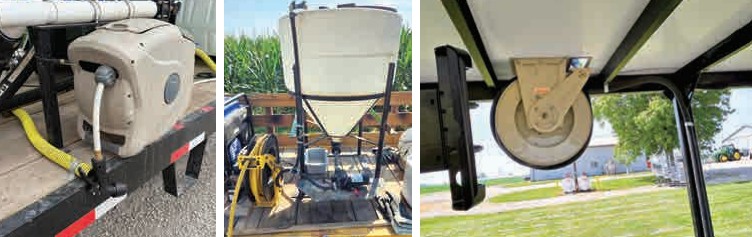
Make sure your hose reel’s diameter is large enough that the hose does not kink when rolled up. Kinking may reduce flow rate and may not be an easy problem to identify when trying to diagnose the cause of a slow refill.
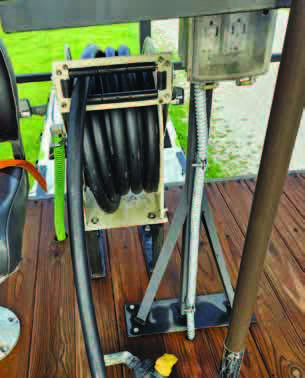 The hose reel has to be matched to the size of the hoses being used to fill the drone.
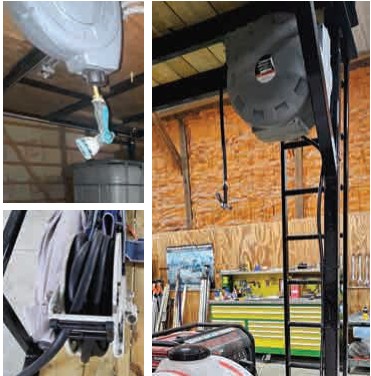 Hose reels for hoses delivering clean water
Measuring How Much
Flowmeters: It is a common practice to use a flowmeter when measuring products into batch tanks. Meters, like pumps, are rated for gallons per minute. In terms of flow rates, the meter and pump should match one another. Pushing a small amount of mix through a flowmeter rated for higher capacities will not yield an accurate reading.
Remember that the drone operator may be working out in the sun, which can make some screens hard to see. Make sure the flowmeter has a screen that can be easily read in all levels of light. It is also important to understand what levels of liquid you might be using and whether a flowmeter is necessary. Flowmeters can be expensive, so it’s not helpful to purchase them unless you really need them. Some pesticide mixtures require a high volume of water and low volume of chemicals. In that case, if your water tank or mix tank has a calibrated sight gauge, simply using that gauge to add water and a graduated measuring cup to measure the pesticide may be sufficient.
If you plan to use bulk tanks for the pesticides, then a flowmeter will likely be necessary, but if most of the products you use will be in 2.5-gallon jugs or smaller, then it is unlikely a flowmeter will be necessary for mixing or applying. Remember that if you use a bulk tank, you will likely need a battery to run a pesticide transfer pump, and that battery will need to be charged. Do not forget that dry flowable formulations may require a scale for weighing the product. Previous publications have noted the inaccuracy of using a volumetric measuring device for products mixed by weight.
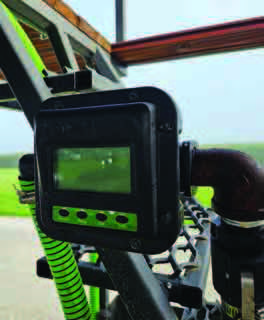
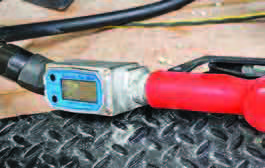 Flowmeters in operation on drone trailers
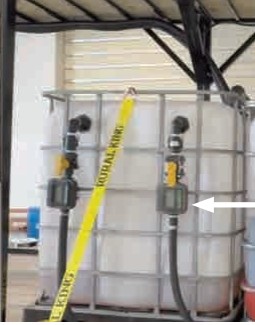 Metering chemical with a flowmeter when going from a larger chemical tank into the mixing tank.
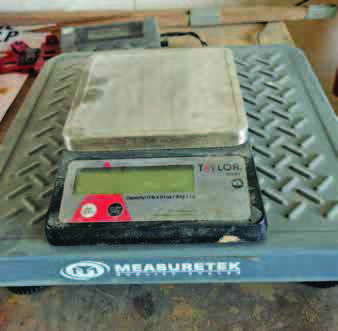
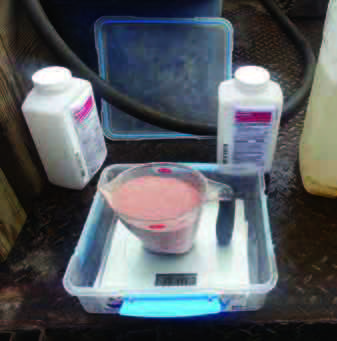 Metering chemical with a flowmeter when going from a larger chemical tank into the mixing tank.
Nozzles: Dispensing the Product
There are two basic product-dispensing nozzles used by drone operators: a gasoline-type and a valve-type dispenser. For smaller drones, either type works. The gasoline-type dispenser nozzle is clean and easy to handle. The main issue is that it takes extra time to fill larger drones due to its restricted orifice, which limits how fast a fluid flows, and often causes lots of foam and air to be put in the tank. Many drones come equipped with push-through gas caps (also known as capless gas fillers) that accept gasoline-style nozzles without having to be unscrewed, like those found on many newer trucks and cars. If not, they can also be purchased aftermarket.
The other advantage to the gas-pump-style handle is that you can continue pumping while you change the battery because the nozzle’s automatic shutoff feature will keep the mixture from overflowing. While most common caps accept the standard ¾-inch nozzle found on most gasolinetype nozzles, some aftermarket lids can accept the 1-inch fill nozzle that is more commonly found on diesel pumps. However, increasing nozzle size does not automatically ensure increased fill speeds as the tubing and connections that supply the nozzle must have the capacity to handle the increased flow. Another advantage to using the gasolinetype handle with the pass-through lid is that the connection is sealed, limiting splash contamination of the person filling the drone.
Valve nozzles have the advantage of dispensing products slightly quicker than a gasoline-type nozzle. This is important for swarm and large-scale operations, which are more concerned about volume. Smaller applicators with smaller properties can afford more downtime; however, large applicators cannot. In this instance, applicators prefer the valve-style nozzle.
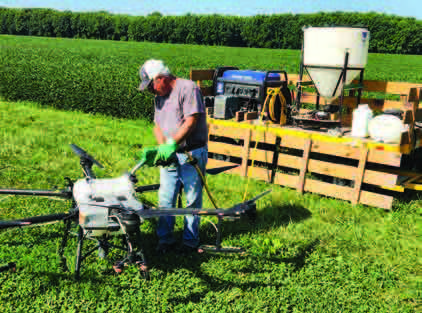 The drone’s tank has been modified with a cap that does not need to be removed when filling the drone, making the process easier, cleaner, and quicker. This is a simple change that many drone pilots have adopted to save time when filling.
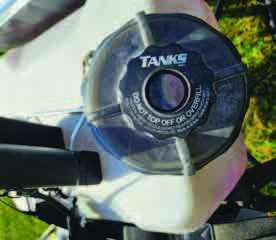
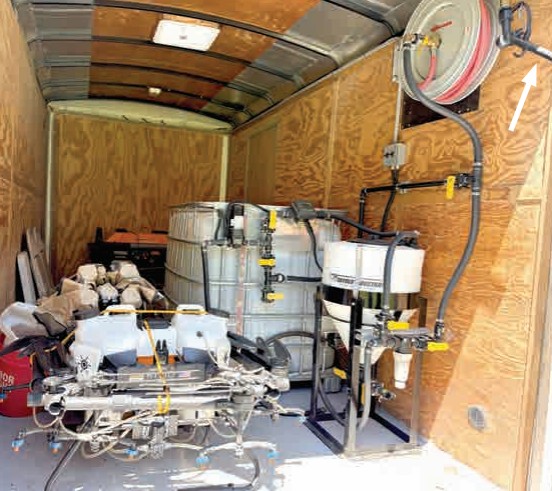 A modified gasoline-type nozzle is used to quickly fill a drone.
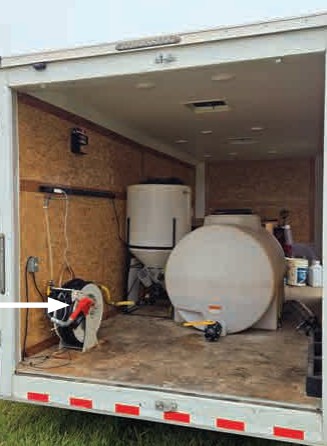
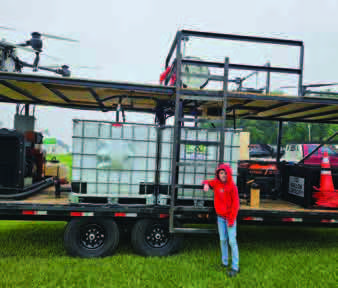 Commercial drone operations using a gasoline-type nozzle to dispense products.
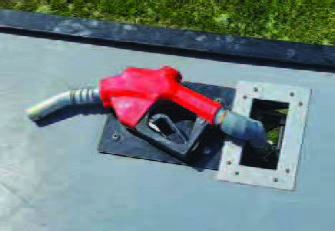 A gasoline-type nozzle that is used to fill a drone. The drone in this operation has a modified gas cap that the nozzle will fit into.
Most drones have a screen filter at the inlet of the product tank to catch any debris or contamination and keep it from entering the drone. If using a lid and nozzle that do not seal well, it may be a good idea to remove the filter on the drone and add a filter just prior to the nozzle. This will catch any debris while limiting exposure to pesticides that might splash back from the filter in the drone. Removing the filter from the drone inlet and placing one on the back side of the nozzle will help maximize your flow rate as the pump will be “pushing” the liquid through the filter. In contrast, the screen on the drone inlet has to accommodate the flow without being pressurized. If your operation has an extra person who is available during fillups to operate the valve, then this is likely the best option. If you won’t have an extra person to help during the filling period, a gasoline-type nozzle that can be left alone will likely be the best option.
Take-Home Messages
• The generator is the life support of the operation. It is essential not to undersize this component of the operation. It must be able to support all electrical devices on the truck or trailer, which may include a battery charger (for your remote control and drone), pumps, a phone charger, fans, an air conditioner, and/or lights.
• Undersized pumps are as bad as an undersized generator. Not generating enough fluid power to agitate the pesticide or fill the drone in an acceptable amount of time loses you time and money. Remember, as you add pesticides and adjuvants, the advertised flow rate of the pump will likely be reduced.
• Tanks, hoses, and connections need to be plumbed for efficiency. Don’t make too many restrictions (90° turns, small ports, nozzle selection) that will reduce the pump’s ability to deliver the desired flow rate.
• Make sure your system can be cleaned efficiently. If you plan to apply for a diverse set of farmers who want different products applied, you don’t want to spend a lot of time cleaning your system.
• Reduce clutter as much as possible. Safety may be cliché, but working on elevated platforms can be extremely dangerous if you are tripping over hoses.
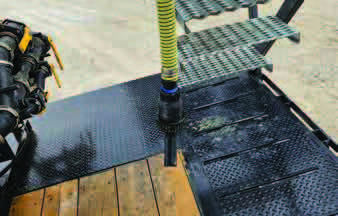
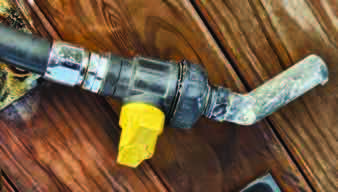 Valve nozzles to fill drones are becoming popular with operators.
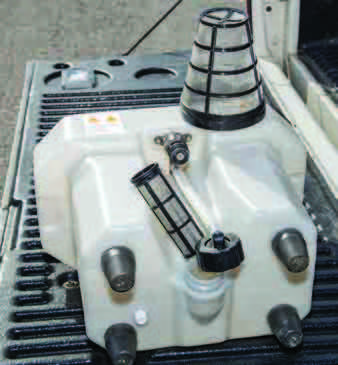
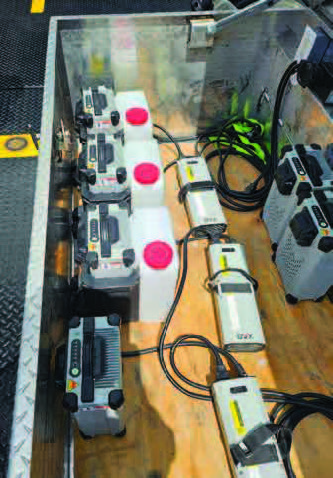 The use of valve-type nozzles can save time over the course of a day if it fits your operation. But make sure a time-saving idea doesn’t cost you time by preventing you from doing other essential tasks while filling the drone.