

Different Styles of Trucks and Trailers for Spray Drones
We previously stated that the truck/trailer is directly connected to how efficient a drone operation can become. Some define efficiency based on a drone landing and taking off in 60 seconds, while others use a different interpretation of efficiency. The 60-second “fill and fly” that a commercial sprayer aims for may not be the goal of a state highway department controlling brush along an interstate or a farmer applying fungicides to their own cornfield. It is the truck/trailer that creates efficiencies and inefficiencies with drone applications. As an example, imagine you start off wanting to do 250 acres a day the first year, while experimenting with the ins and outs of a recently purchased drone. As you approach the halfway point in the season, you realize that you can handle more work and are more efficient than when you started. At that point the goal changes from 250 acres daily to 400-plus acres daily. When this occurs, you realize quickly that your initial setup will not meet your new demands. There is no standard for how to set up or design your trailer or truck. Many people will set up their initial rig but then need to modify it as their business develops, whether to expand the business or to serve a wider range of clients or something else. Some mix pesticide products on the trailer, while others bring a hot load of premixed product and use transfer pumps to fill onboard storage tanks. Plumbing, electrical, and charging stations should be set up to minimize trip hazards and promote an efficient workflow.
Over the past decade, our understanding of what is needed for drone operations has changed dramatically, causing truck/trailer designs to change accordingly. Some would rather use a truck than a trailer, while other companies have a fleet of both trailers and trucks to treat small and irregular fields as well as much larger midwestern agricultural fields. There are so many things to think about, including whether to use a truck or a trailer, what size generator to purchase, and what kinds of areas your customers will want you to treat: agricultural fields, aquatic ponds, rights-of-way, or forestland.
When approaching the design of your truck/trailer setup, be realistic about your goal in utilizing the drone. For most people, the goal could be lumped into one of two categories: saving money or making money. For farmers, the goal may be to save money by applying products themselves, avoiding the expense of hiring a third-party applicator or purchasing a large high-clearance sprayer. This goal should be reflected in the approach to the truck/ trailer: How do you make your setup as frugal as possible while being efficient and effective? For example, a farmer would likely want to use tanks and generators they already own (or that they can use for other purposes throughout the year). And you might have the truck/trailer structure (such as a rack or platform) fabricated from scrap iron by a local machine shop to save money. If your goal is to save money, but you end up spending as much for a spray drone, truck, and trailer as you would for a high-clearance sprayer, then you might be defeating your purpose. In contrast, if your goal is to make money as a contractor spraying for landowners, farmers, or other industrial purposes, you will likely need a truck/trailer setup that is specific to the drone operation.
This unit will be more focused on maximizing efficiency and achieving a professional look to represent the business. With this approach, the business may not be able to afford the small inconveniences resulting from a makeshift trailer with dual-purpose items, such as a less-than-ideal tank size that leaves you 10 acres short of the water needed to finish a job. Commercial operators may need to pay greater startup costs to ensure they can actually deliver the service they are offering. Inconsistent generator performance, tanks that are too large or too small, and trucks/trailers that are not the ideal size for the operator can all make a business less lucrative.
There is no one-size-fits-all proper way to equip a trailer or truck. Here we describe different options, which we term limited-use trailers, enclosed trailers, truck bed inserts, and deckover trailers.
Limited-Use Trailers
Limited-use trailers fit well for smaller jobs where a single drone is used to complete the work. Typically, in fragmented environments you are dealing with tighter areas and less room to move equipment. In these situations, smaller limited-use trailer and truck systems are advantageous. It can make more sense to send out two smaller trailers rather than one larger trailer to do a group of 20-acre fields. Additionally, limited-use trailers are a great entry point as they are rather affordable compared to other options.
Limited-use trailers are typically ideal for do-it-yourself farmers or industrial applications that might not use the drone extensively but only in special cases where a traditional control method is impractical (such as a rightof-way brush control crew that may only periodically use a spray drone). For example, if you have a 500-acre farm and you plan to spray two-thirds of the farm with the spray drone, you will spray only 300–350 acres in a year. If you have a 100-gallon tank you can hot-load from the farm and a trailer big enough to fit the tank and a generator, then you can spray 50 acres in the morning (assuming 2 gallons per acre) and then refill and spray 50 acres in the afternoon. That makes about 3 to 3½ days of spray drone work per spraying pass, so spending $50,000 on a perfect trailer setup probably doesn’t make a whole lot of sense for these operations.
Estimated Cost of Trailer Setup
$2,000–$15,000
Benefits of Limited-Use Trailers
• They are very affordable.
• They are less costly to transport.
• They can more easily get in and out of tight spaces.
• They are efficient for small farms and fields (including specialty crops and test plots), ponds and pastures, test plots, and specialty crops.
• They can be used for other tasks when you are not flying the drone.
• They can easily be pulled by a smaller truck or even an ATV.
Drawbacks of Limited-Use Trailers
• They can’t be used as a landing zone, requiring the drone to land on the ground. This can throw up dust and debris, which can be mitigated by using landing pads or wetting down the area prior to operations.
• You may need a weed eater or brush cutter to make a landing zone.
• You may have more difficulty keeping curious people out of the landing zone.
• They can carry only a limited supply of water and chemicals, so access must be close to the site of application.
• They may have limited utility for highway travel speeds based on the tires.
• They may have limited ability to carry heavy weights.
• Setting up and packing up may be cumbersome and inefficient.
• Supplies and equipment are exposed during inclement weather.
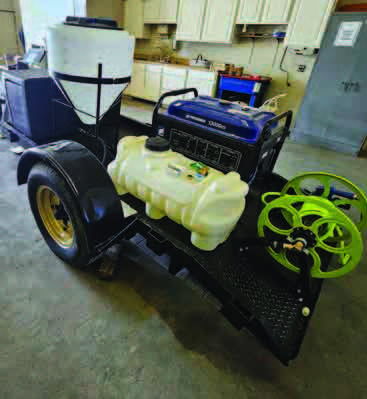
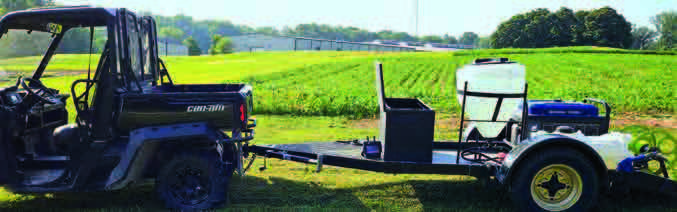
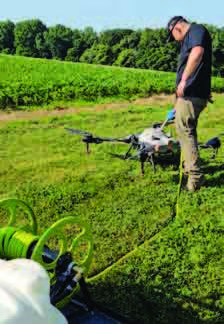 A pesticide can be added directly to the spray tank or to the 60-gallon inductor tank when larger batches are required. A 12-volt electric pump is used to move the water.
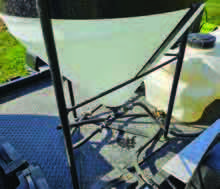
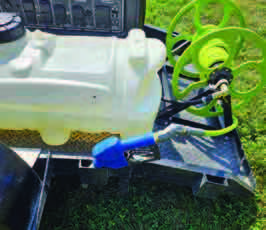 The trailer’s rub rail is used to hold the nozzle in place.
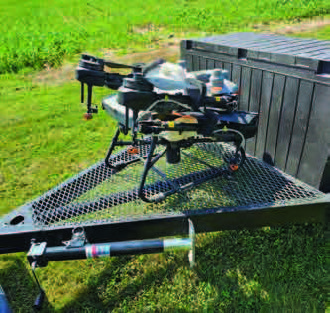 A small spray drone fits well on the front end of the trailer, where it is secured when transported.
LIMITED-USE TRAILERS: EXAMPLE 2
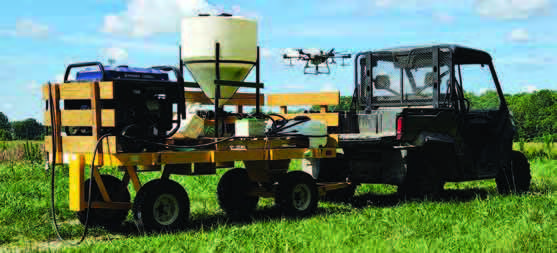
A general view of a limited-use trailer. The outside wooden frame keeps materials and equipment from falling off the trailer.
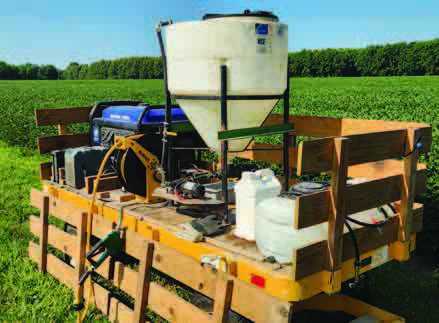 Close-up view of the equipment and supplies on the trailer. It consists of an induction mixing tank, electric generator, batteries and charger, chemical, and clean water tank.
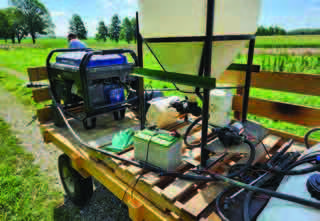 A car battery is used to power an electric pump that pushes water from the clean water tank into the 60-gallon induction mixing tank and then out to the nozzle that is used to fill the drone. This is a “use what you have” approach: It utilizes a 12-volt pump the farm already had. Charging the battery requires an inverter that reduces the 120 volts from the generator. Although not an ideal setup for larger acreage, it is cheap and effective for a small to medium-size farm. Applying 2 gallons per acre, this setup could spray approximately 30 acres with one tank of water. The pump has a capacity of 6 gallons per minute, so it will take minutes instead of seconds to fill the drone. In some cases, the pump can be plugged into the generator, unless the generator is already at maximum capacity from charging the batteries.
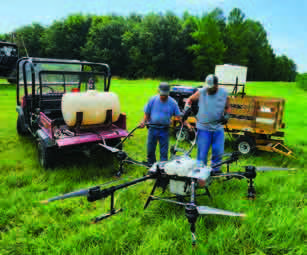 Filling the drone from an auxiliary tank with a premixed pesticide, which is placed on an all-terrain vehicle.
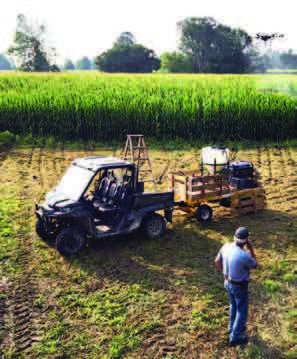 A ladder in the ATV bed serves to raise the pilot high enough to observe the drone as it is making an application. Climbing up and down the ladder multiple times with a controller in your hand is potentially dangerous.
LIMITED-USE TRAILERS: EXAMPLE 3
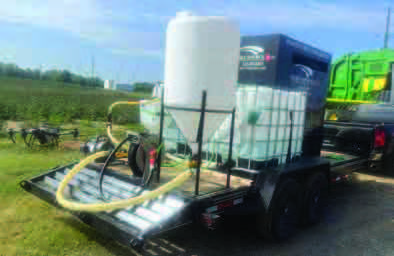
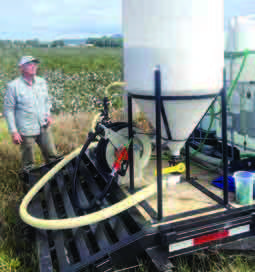
This small, concentrated, and compact trailer has everything needed for spraying larger acreage. This trailer has running lights, signals, and brakes, which allow the operator to go on highways. The diesel generator provides more than enough power to charge batteries for multiple drones.
This is an excellent example of using a larger trailer with double 7,000-pound axles that can carry more weight. This trailer could be close to reaching its gross vehicle weight limit with the combined weights of the two 265-gallon clean water totes, the generator, and the inductor mixing tanks. The larger inductor allows for larger loads of chemical mixtures to be made at one time, which keeps the drone spraying for longer periods of time.
The smaller inductor is where the chemical products are placed before being transferred to the larger tank. Clean water is added to the larger tank, not only creating the diluted mixture but providing a swirling action to mix the products. A higher-output electric pump that can move product through a 2-inch line is plugged into the diesel generator.
Enclosed Trailers
Enclosed trailers are popular as a first entry into the drone business. They allow supplies and equipment to be safely stored out of the weather and can be locked to reduce the threat of theft. When spray drones first began to catch on, enclosed trailers were seemingly the ideal setup for the operation. Enclosed trailers are widely available to purchase, both new and used, and are reasonably priced. At the end of the day, there is no extra effort to unload anything from the trailer, and it can be used as a storage location so equipment doesn’t take up shop space when not in use. The enclosed trailer shades tanks from harmful sunlight and helps keep batteries cooler. However, extra time and effort are required to set up the drone at the application site, and most trailers seem to be packed tight, making it cumbersome to maneuver in the trailer. These trailers often don’t have an elevated platform to keep sight of the drone and sometimes require effort to make a suitable landing and takeoff location.
Estimated Cost of Enclosed Trailers
$3,000–$50,000, plus cost of truck
Benefits of Enclosed Trailers
• A wide selection of enclosed trailers is available locally.
• They are a relatively low-cost option.
• Contents are protected against inclement weather.
• Storage, sorting, and shelving are straightforward.
• Locked doors provide security for equipment, especially when staying overnight or on the road.
• Trucks already in inventory can be used to pull them.
Drawbacks of Enclosed Trailers
• Axles limit the amount of weight carried.
• A limited number of gallons of water can be carried (space and weight).
• Entering fields and farms can be difficult in some locations due to low ground clearance.
• They are not designed to go off-road where the trailer is subject to flexing.
• There is no place for the drone to land except on the ground.
• Heat can be an issue if generators are located in an enclosed trailer.
• Line of sight is difficult to manage over tall crops.
• There is limited space for storing larger drones within the enclosed area.
• Mixing pesticides and storing fuel in the enclosed area can lead to applicator exposure to fumes. Chemical spills can increase this exposure even if you do your best to prevent them.
• Setup and teardown take longer than with other trailer options.
ENCLOSED TRAILERS: EXAMPLE 1
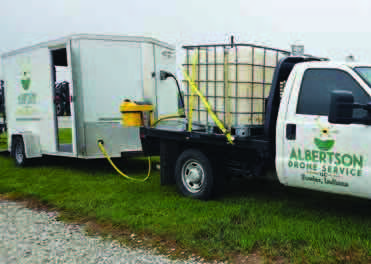 An enclosed trailer provides storage and shelving to allow repair parts, drones, and equipment to be locked up when not in use or protected against bad weather.
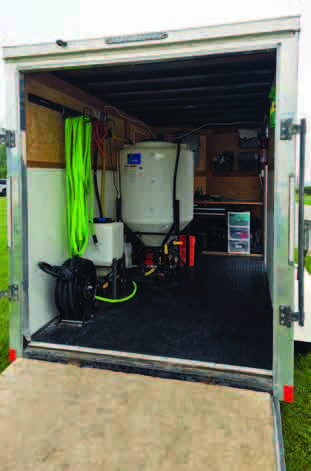
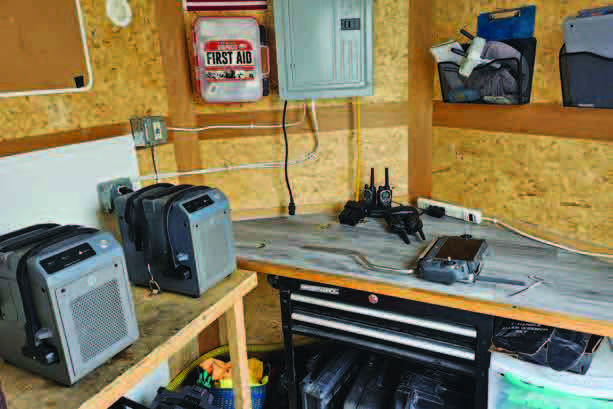
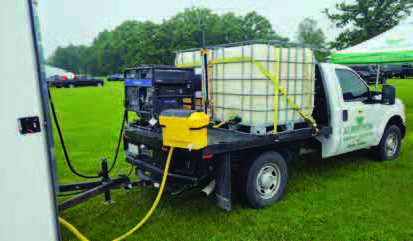 Due to the trailer’s space and weight limitations, the two tanks of clean water and the electric generator are carried on the truck bed.
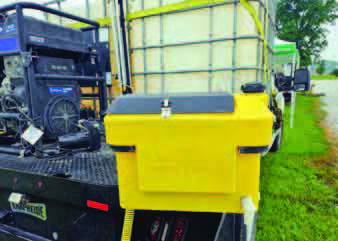 The yellow tank holds clean water to wash hands and clean the drone after the application is completed.
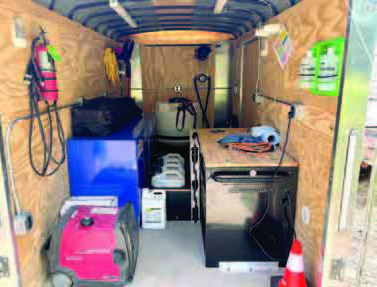 Utilizing the full extent of a drone trailer. With this setup, supplies and a limited amount of water can be carried. It is an ideal setup for smaller jobs.
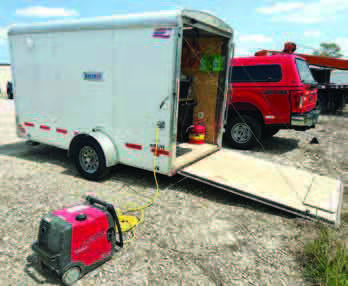 The Honda gas engine is used to power the trailer. Notice the number of electrical outlets in this trailer, which increases its usefulness.
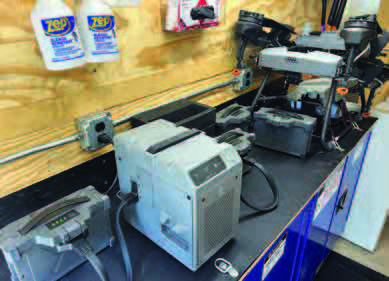
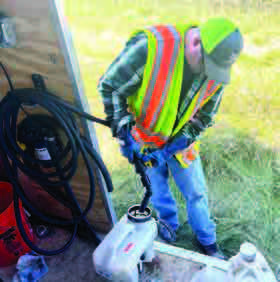 This trailer allows the drones and other critical components to be locked up. Not storing or mixing chemicals in an enclosed trailer lessens applicator exposure. This excellent applicator is wearing the personal protective equipment required both for pesticide use and for roadside work.
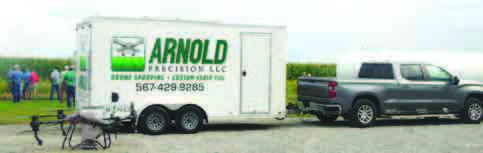
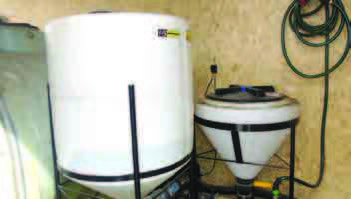
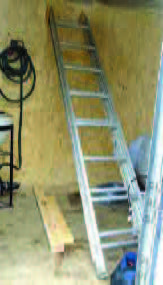 If the ladder is used to get on top of the trailer to achieve line of sight, then the trailer should have a reinforced roof that can handle the weight of a person.
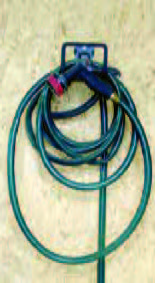 It is important to have a dedicated hose for clean water to rinse off the drone before storing it in the enclosed trailer.
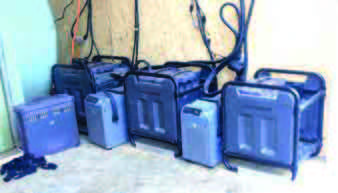 Three coolers, two chargers, and six batteries require a generator that can produce 25 kilowatts of power.
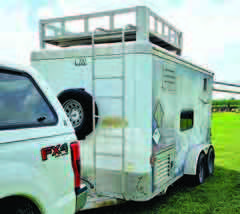 A box trailer that has had its roof modified so the operator can work there and observe the drones making an application.
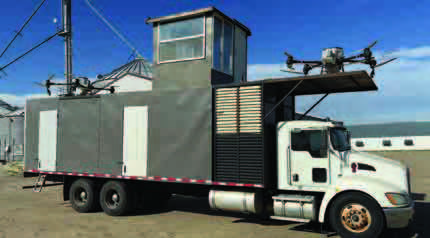 An enclosed trailer provides storage and shelving to allow repair parts, drones, and equipment to be locked up when not in use or protected against bad weather.
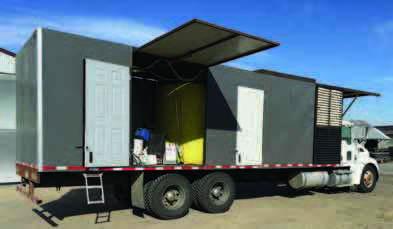 An inside view of the trailer showing a 2,100-gallon yellow clean water tank.
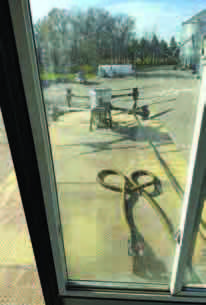 A view from inside the lift looking across the deck toward the drone.
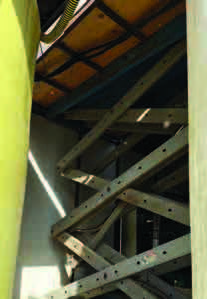 The lift mechanism. The lift is used to bring the batteries and drones to the upper platform.
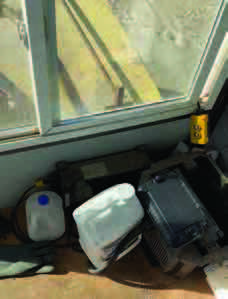 The lift showing the batteries and chargers. Once the day’s operations are complete, the drones are brought back into the lift, which brings them down into the trailer.
Truck Bed Inserts
When working across fragmented rural areas, truck bed inserts are the most convenient option for any drone operation. Spraying environments in these areas are normally rather tight with small access points, making it hard to maneuver a truck-and-trailer combination. Additionally, a lot of spray companies already in business have a truck sitting around that is not heavily utilized, creating an even more affordable entry point. Many operations are now starting to utilize a truck for ease of access and if needed will either bring a water tender trailer to the application area or have one delivered. This allows the operator to set up the truck in a location with good access to complete the mission.
One of the greatest benefits of truck bed inserts is the increased ground clearance compared to most trailers and the ability to make turns and get to areas that are limited in space. Many farms have long access lanes or fields that are along roads where it may be dangerous to park. Drone trucks can pull into much tighter areas than trailers, including small field entrances or long lanes that don’t have a great place for a trailer to turn around. This is especially relevant when significant rain makes farm lanes and roadsides soft. A truck bed insert on a four-wheeldrive truck can likely get around without getting stuck or making the big mess that a trailer might.
The big negative of a truck comes when one considers scaling up this operation. Most of the time, adding a second drone will not really benefit as these setups are working smaller fields and tighter environments. Because of this, scaling up in the fragmented portions of the country may require acquiring additional trucks and inserts, along with pilots to operate them, rather than going out and purchasing an additional drone.
Estimated Cost of Insert Setup
$2,000–$20,000, plus cost of truck
Benefits of Truck Bed Inserts
• They work well for a one-person operation.
• The operator can get in and out of sites easier than when pulling a trailer, especially for tight places like narrow farm lanes.
• Companies can retrofit trucks that are already titled, registered, and tagged.
• They can access difficult places and turn around in fields.
• They have extra clearance for off-road work.
• Carrying weight over axles allows heavier loads to be transported.
• Landing on and taking off from platforms removes the concern over flying debris posed by landing on the ground.
• The platform allows the pilot to see over the crop.
Drawbacks of Truck Bed Inserts
• The limited amount of water that can be carried on a truck requires a water tender or extra time spent refilling water tanks.
• There is limited space for supplies and equipment.
• There may be issues with driving under low power lines or overhanging trees.
• Equipment can be exposed to the environment. Some operators utilize storage boxes on the truck for protection.
• On smaller landing platforms, there is limited room to work around a drone.
• Drone securement in transport can be limited.
• The raised platform brings safety concerns for employees.
• If you must stay overnight, all equipment is exposed unless you use storage boxes for drones and batteries.
TRUCK BED INSERTS: EXAMPLE 1
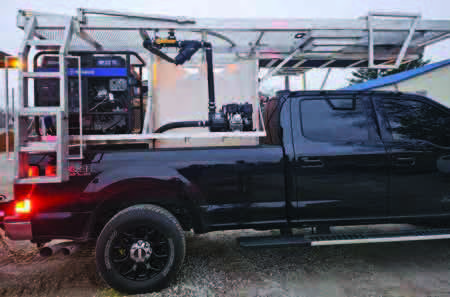
This drone operation works out of the bed of the truck, which carries the electric generator, water tank, and other supplies.
This is a two-person operation with a pilot on the platform and another person on the ground. The drone lands on the ground, where it is serviced. Many truck insert platforms are used to allow for better observation. They are normally too small for a 6-by-6-foot drone to land with enough space between the rotors and the workers. But some inserts do have enough room for the drone to land on top where the pilot is, which allows a single person to conduct the operation from the top of the insert once the generator is running.
The platform shown here is built with expanded metal. A spill when filling the drone on the platform will result in liquids falling into the truck and onto the equipment. Some products used are corrosive, which can cause additional damage. A deck made of polycarbonate or diamond-composite plate metal might be a better option but would increase the weight and cost of the insert.
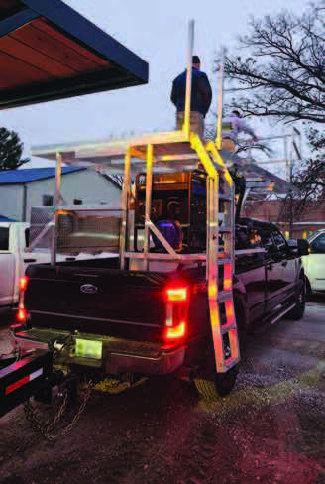
TRUCK BED INSERTS: EXAMPLE 2
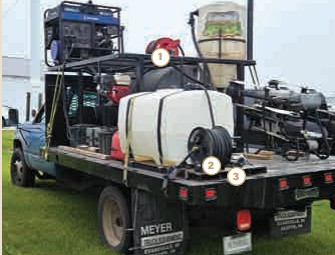
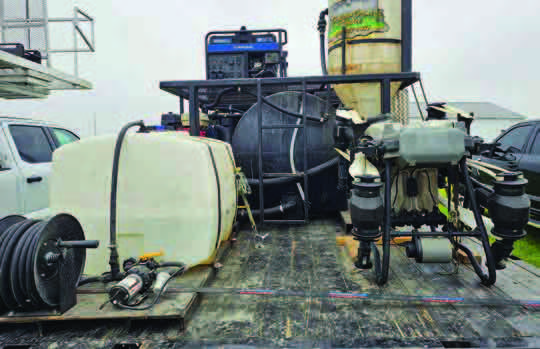
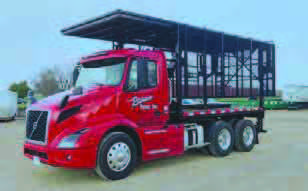
A flatbed truck is a weight-carrying truck, that is, is designed to hold more weight, meaning it can carry additional gallons of water. As a rule of thumb, a single axle with dual tires can carry 20,000 pounds; two axles can carry 34,000 pounds; and a single axle is rated to carry 800 pounds for each width of tread. The extra length of the bed shown here provides more space for equipment and supplies. The hose on the platform (1) is used to fill the drone on the ground. Landing on the ground might be easier given the limited space on the platform. Another hose reel is near the water tank (2). The top tank on the platform is pulling the chemical mixture from the black tank holding the mixture to the drone. An electric pump is used to move fresh water (3). A Honda motor powers the pump transferring product from the chemical tanks.
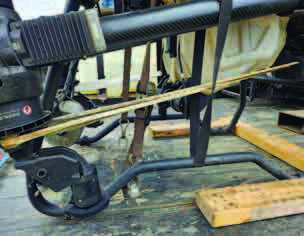
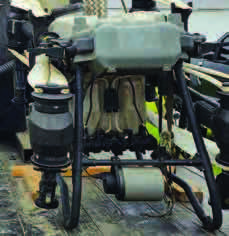 The base of the drone fits into a wooden frame. Straps that fit around the arms help to keep it from moving during transportation.
TRUCK BED INSERTS: EXAMPLE 3
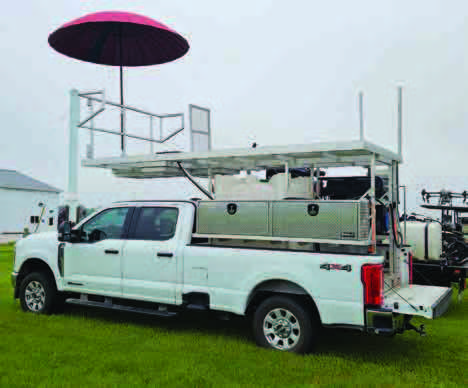
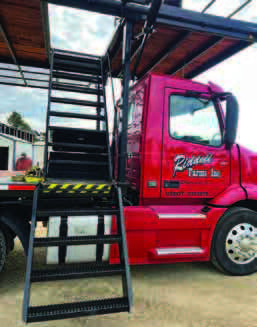
This truck insert has safety structures where the pilot stands: a gatelike protective panel separating the pilot from the drone landing site, to keep them away from the spinning rotors, as well as a railing along the edge to keep them from falling off. The truck has a nice set of storage boxes along the side for supplies and spare parts. The generator is set up to charge the batteries for a single drone. Batteries are charged on the platform, eliminating the need to climb the ladder frequently. There is a hose reel on the top side for filling the drone.
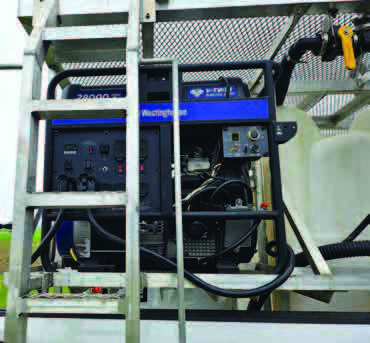
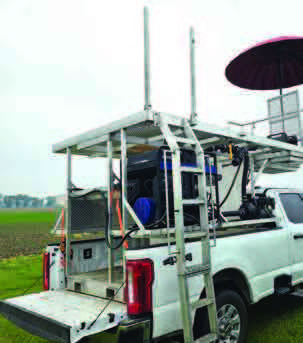 Placing the gas generator within the truck allows for additional room to land the drone on the platform.
TRUCK BED INSERTS: EXAMPLE 4
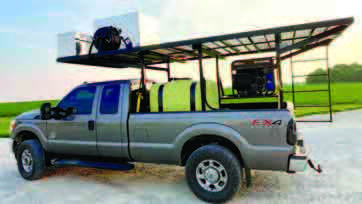
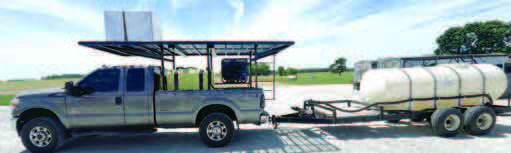
An excellent example of a truck insert that the pilot uses to fly a single drone. The trailer carries extra water to allow the pilot to keep the drone in the air for much of the day. Although the water wagon limits the benefits of the truck bed insert, the wagon can be dropped at a central location near the fields. The truck then moves around the fields, easily entering tight spaces, and returns to the water wagon to refill occasionally.
TRUCK BED INSERTS: EXAMPLE 5
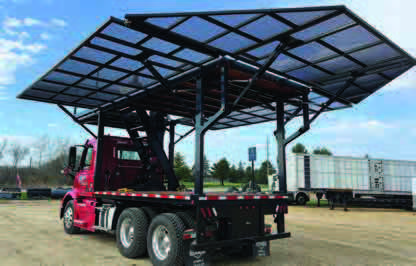
Hydraulic wings allow for a wider platform to land and work around a drone. The truck can go into most fields. The operator can keep the left wing closed when parking alongside the road. The unit can be detached allowing for the truck to be used for other purposes. The drone can remain strapped to the upper deck when traveling from field to field.
Deckover Trailers
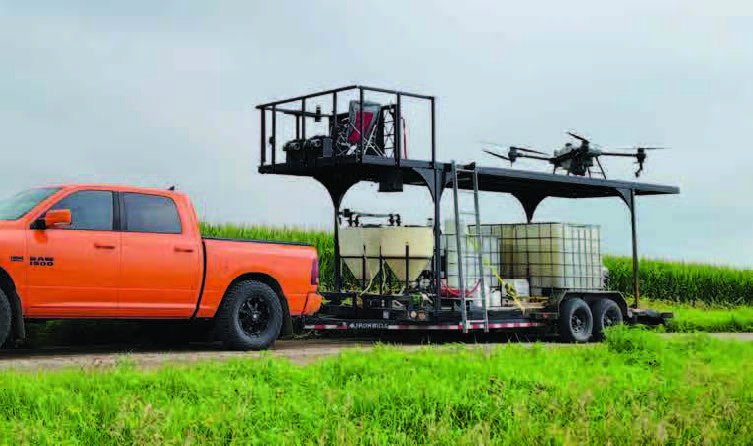
Deckover trailers have become quite popular for commercial operators working the larger acreage of midwestern farms. The longer platform provides more flexibility for pilots to operate more than one drone. The deckover trailer is the best setup for keeping the operator safe, carrying large volumes of product and water, and providing good viewing areas for keeping a line of sight with the drone. Although these trailers are the best for space, loading, and operator line of sight, they are generally the most expensive of the four common setups. These trailers are built for covering many acres and working long hours in a day. These trailers are generally very expensive and very specific to spray drone use but are highly efficient, and an operator can get a good return on the investment if the environment is suited to this setup. However, in a lot of areas this system could be overkill, and your return on investment might be lower.
Estimated Cost of Trailer
$20,000 to $150,000, plus cost of truck
Benefits of Deckover Trailers
• You can fly multiple drones from the platform.
• They offer an excellent line of sight and contact with the drone.
• These trailers can carry heavier weights, including more water and diesel generators.
• Working on the platform keeps the operation and pilots away from cars.
• You can have an enclosed portion to provide a secure spot to store your drone.
• They often require parking alongside roadways, which can lead to traffic accidents.
• They require workers to understand how to safely work alongside moving traffic.
• They need to be fitted with lights, cones, and other warning signs to inform the motoring public.
• They may require handrails or extra safety provisions to be OSHA compliant.
• The trailer length may limit the ability to cross creek beds or swales when accessing fields, due to ground clearance issues.
• They may have issues driving under low power lines or overhanging trees.
• They draw more attention from the motoring public, who at times will park alongside the road to view the drone flying.
• They may require a commercial motor vehicle driver’s license (CDL).
• Typically they are the most expensive option.
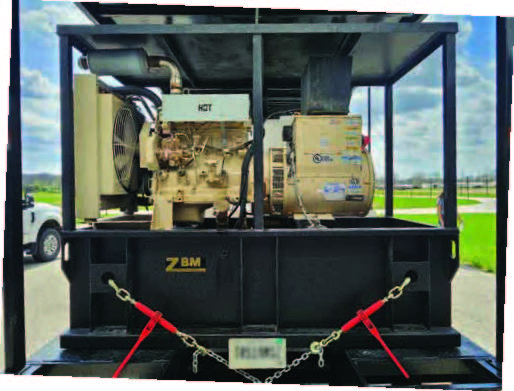
Instead of permanently bolting down the generator, chains are used to secure it to the trailer. The generator can then be removed with a forklift to allow for winter storage or for repurposing it and the trailer for other uses when not making applications.
DECKOVER TRAILERS: EXAMPLE 1
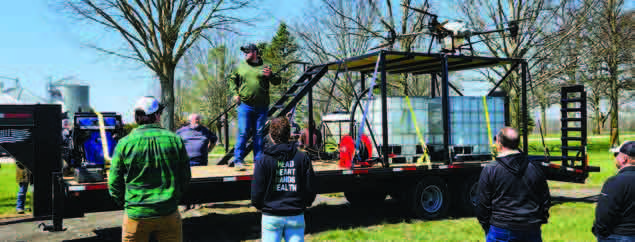
On this gooseneck deckover trailer, the operator uses the deck to sit and view the drone, while mostly landing the drone behind the trailer. However, if there was no landing zone on the ground, the deck would be a backup place for the drone to land if needed, and the operator could stand on the tongue if needed. Landing on the ground requires the pilot to descend to the ground to fill the drone and replace its 30-pound battery (unless working with a second person). Batteries are charged by the generator near the front of the trailer. This placement keeps the generator as far from the work area as possible to reduce the noise.
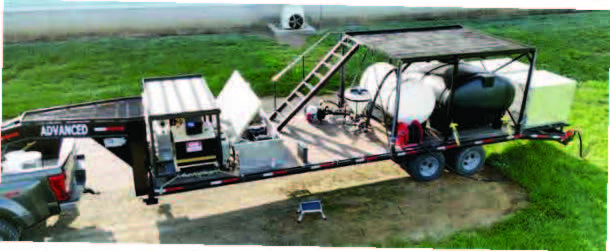
The trailer was designed to make it efficient. A solid composite deck keeps spills from damaging equipment below it. There are handrails alongside the steps leading to the top of the platform. The cooling system is under a cover. There are drone storage boxes in the back. An excellent toolbox in the front of the gooseneck provides a spot to store tools, spare parts, and chemicals.
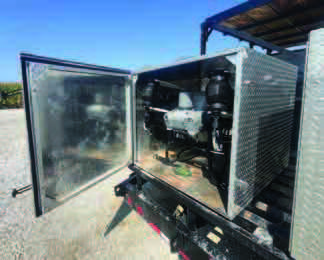
All photos on this page show the same trailer, but the operator modified the equipment to better suit his needs.
DECKOVER TRAILERS: EXAMPLE 2
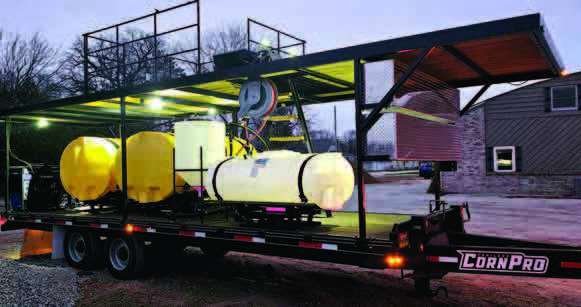
A heavy-duty two-axle trailer designed to carry the additional weight of extra water tanks. The tanks can store enough water to keep the drone flying for extended periods of time. The pilot, working within the framed area in the center, has the option to land the drone on either side of the platform.
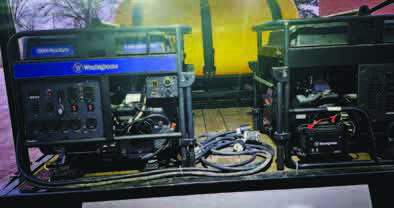 These two generators on the trailer can produce 56 kilowatts of power.
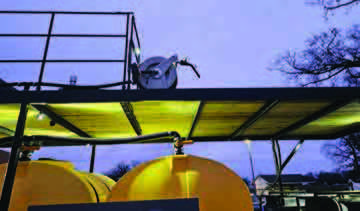 Each side has its own hose reel to fill the drones. Hose reels can reduce clutter and make cleanup and tear down fast, necessary for a drone business.
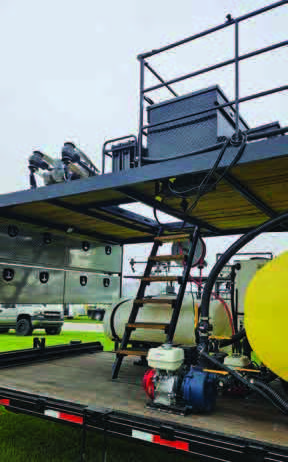 A trapdoor at the top of the stairs opens onto the platform.
DECKOVER TRAILERS: EXAMPLE 3
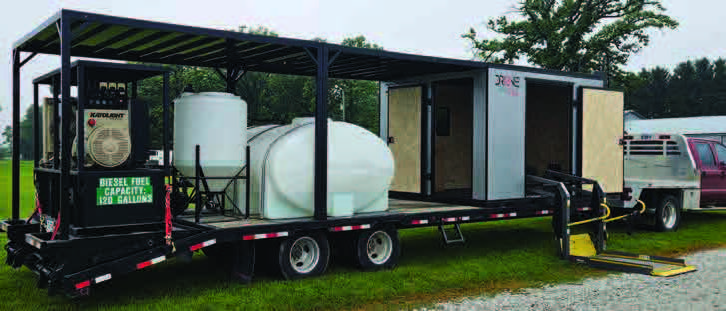
This is a pilot’s upgrade from an enclosed trailer to a deckover trailer. A place for storing tools and supplies was built on the front of the trailer. A large diesel generator powers the trailer and charges the batteries.
DECKOVER TRAILERS: EXAMPLE 4
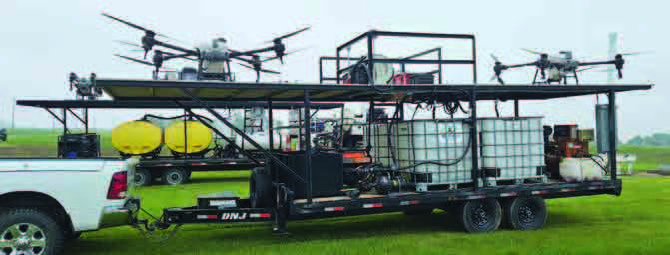
Chargers and coolers are located within the center framework. The diesel generator is placed on the back of the trailer and the fuel tanks in front to spread the weight out.
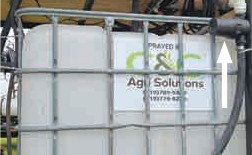
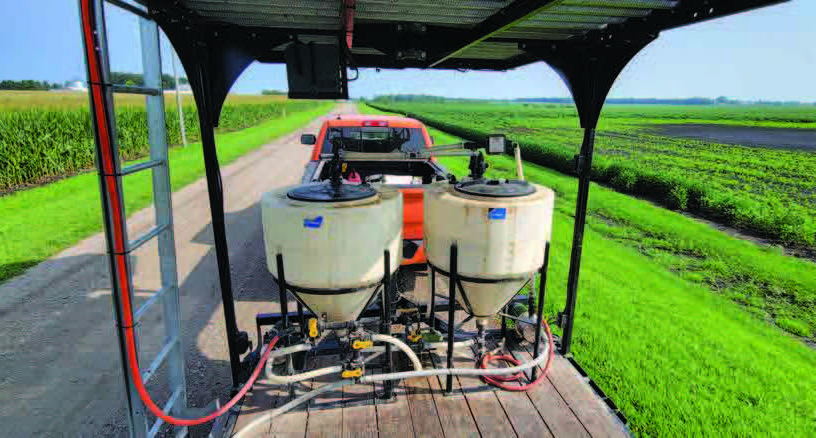
The pesticide mixture is premixed elsewhere and brought to the site, where it is offloaded into the white totes. A filter can be seen (arrow) and valves that control the flow and agitation of the mixture.
DECKOVER TRAILERS: EXAMPLE 5
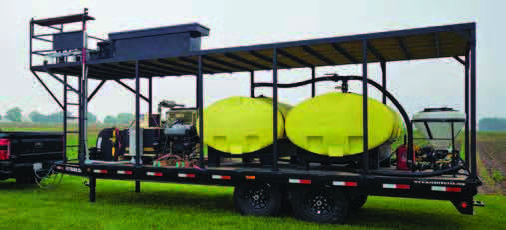
An area for the pilot to work, here located at the end closest to the truck, provides protection against stepping off the edge of the platform. This trailer carries a total of 1,000 gallons of water. On top are two toolboxes where chargers, coolers, and batteries can be kept when not in use.
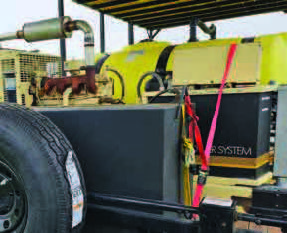 A heavy diesel generator powers the trailer.
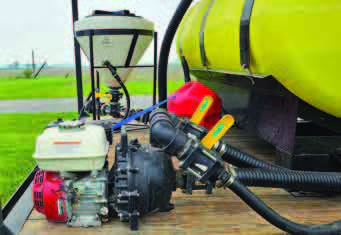 An additional gasoline engine is used to power the pumps.
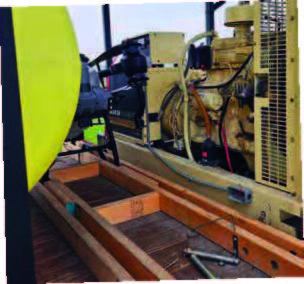 Securing the drone is critical even when moving a short distance. The only problem with this type of securement is that two people will be required to lift it onto the trailer after the job is completed and down again at the next jobsite.
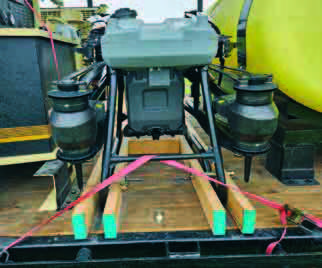 A well-designed storage location for the drone is an important part of a quick setup and teardown, which can be important when spraying smaller fields that require moving the trailer often.
DECKOVER TRAILERS: EXAMPLE 6
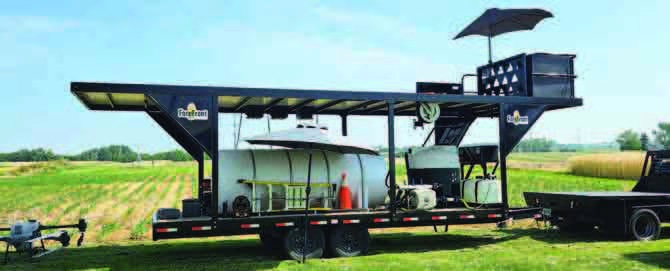
A wide-angle view of a very efficient drone trailer. The pilot works within the area protected by railings to avoid falling off and to protect them from the drone just in case a drone malfunctions.
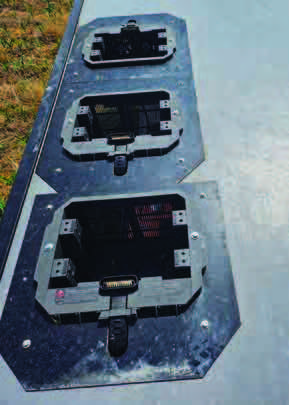
Coolers and the battery chargers are located at the top and side edge of the platform.
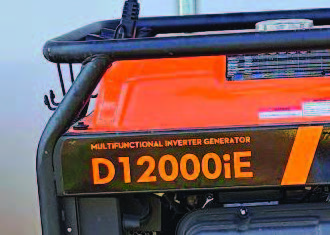
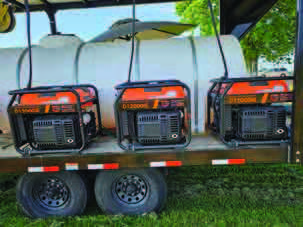 Three gasoline DJI generators are used to power this drone operation.
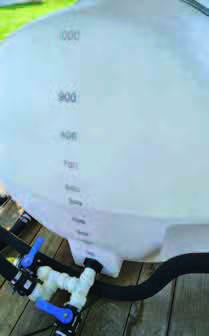 A 1,000-gallon tank could spray 500 acres at 2 gallons per acre.
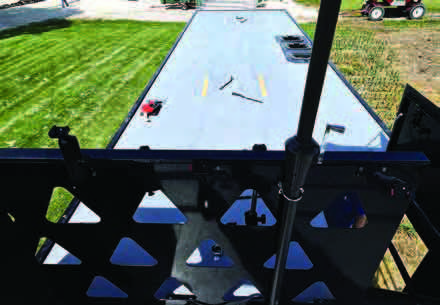 Top view of the trailer’s platform. There is enough space on the platform for two drones to land. This also shows that the filling nozzle and charging stations protrude onto the upper deck so the whole operation can be conducted from there without constantly going from the top deck to the lower deck.
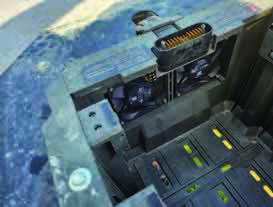 A close-up view of the fans within the cooler used to cool batteries. However, the batteries are not protected from sunlight while charging.
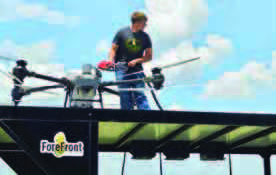
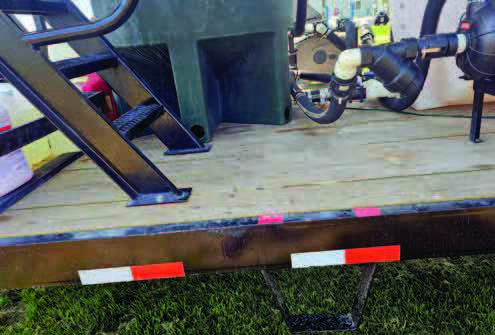 Red tape on the edge of the trailer deck marks the location of the steps for stepping down onto the ground.
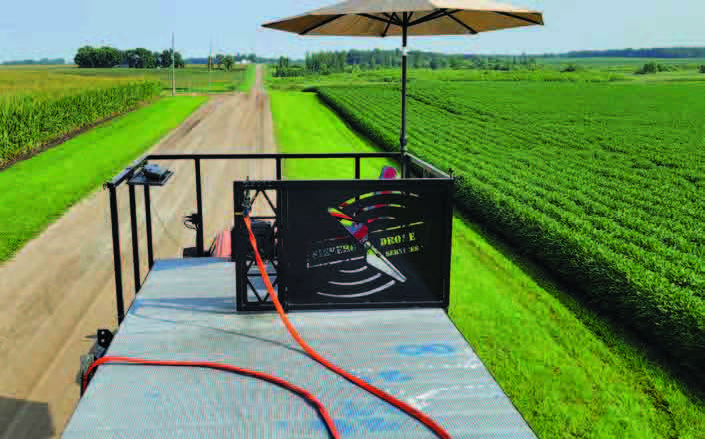
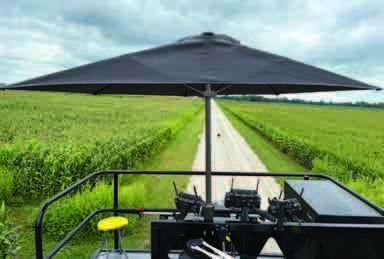 The work area showing the placement of the controllers and the umbrella.
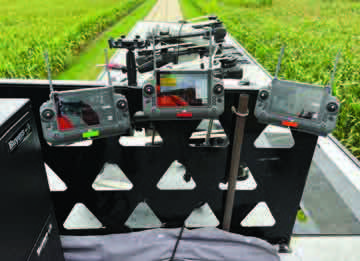 Notice that the umbrella does not have flaps coming down, allowing the drone pilot to clearly see the platform and the drone as it flies over the fields.
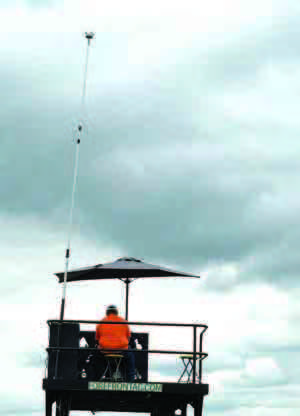 A pilot seated at the workstation. The taller pole allows for the relay to keep a better connection with the drone in fields with less visibility.
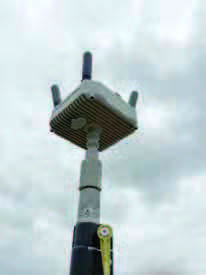
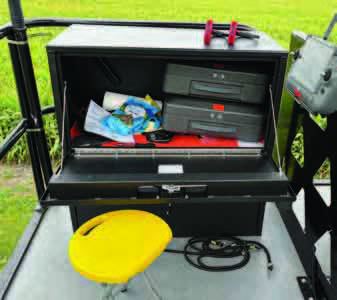 A storage box provides space for additional supplies, controllers, and paperwork.
DECKOVER TRAILERS: EXAMPLE 7
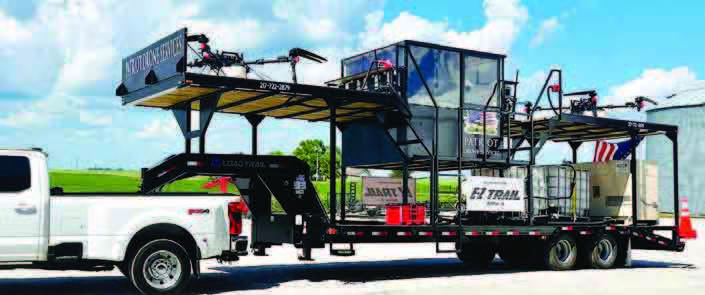
This trailer has a platform designed to handle two drones. The middle is an enclosed area called the command center, which separates the platform into two parts. The pilot walks up one flight of steps and slides the door open to enter the command center.
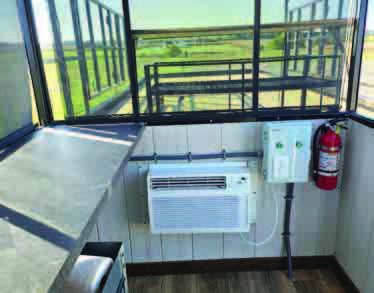
The command center is equipped with an air conditioner and a minifridge. The windows are made of indestructible polycarbonate to keep a drone or a shattered blade from penetrating the center. No pilot or crew member can have consumed any alcohol within 8 hours of the operation, according to federal regulations, and they may not have a blood alcohol content of 0.04 percent or greater, so the mini-fridge is ONLY for food and nonalcoholic beverages.
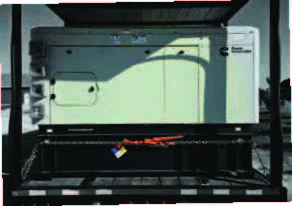 A diesel generator provides power to the entire trailer.
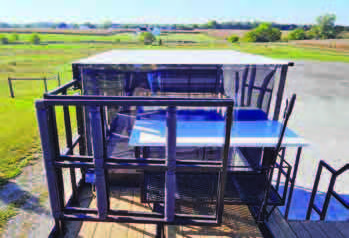 The cart is equipped with battery chargers. When charging, they are under a table, which provides shade to keep the batteries cooler.
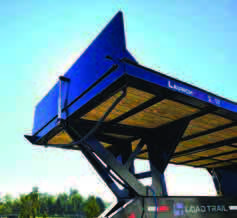 An elevated flap at the end provides a visual cue signaling the end of the platform.
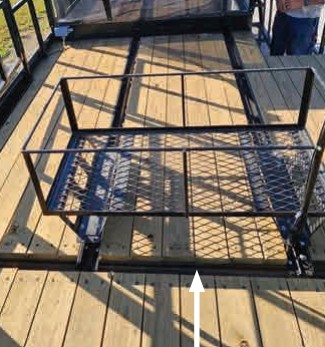 The cart rolls out to the drone with the charged battery. This allows the depleted battery to go directly into the charger, speeding up the operation by 20 seconds. More important, the technician doesn’t have to bend, reducing fatigue. A key advantage to this operation is there is no reason to go out to the end of the platform since swapping the battery and refilling the drone is done in the center. The dark gap between the wooden sections (white arrow) allows spills on the platform to drain to the sides to the trailer.
DECKOVER TRAILERS: EXAMPLE 8
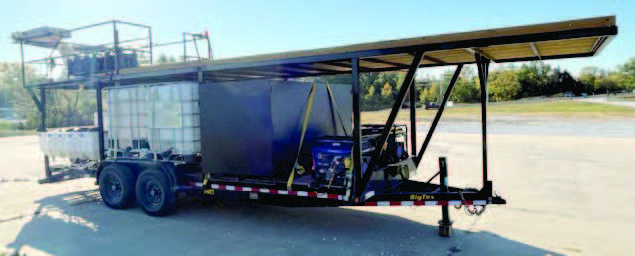
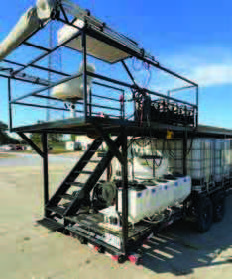
A series of small white totes are part of an auto-mixer. Each tote can contain a specific pesticide that can be metered into the water line running to the application drone.
Safety Concerns with Drones
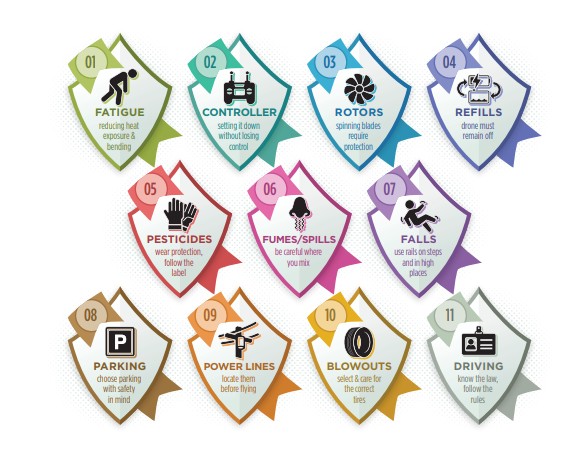
A major selling point for drones is the enhanced safety they can provide during an application. However, incorporating a drone into a spray business adds a new set of safety concerns that most experienced applicators have not previously faced. These specific safety concerns must be addressed so that employees remain safe when working around drones. Long hours, elevated decks that are often homemade, large and top-heavy equipment, chemicals, and spinning rotors are all hazards that require special attention in spray drone operations. The best way to mitigate these hazards is to plan ahead or make adjustments to current trucks and trailers when building your truck/trailer setup to limit fatigue and make operating areas safe and efficient.
Know This
Incorporating a drone into the spray business adds a new set of safety concerns that most experienced applicators have not previously faced.
Fatigue: Reduce Heat Exposure and Bending Motions
Mental stress and physical fatigue resulting from spending long hours in the sun and heat, carrying heavy batteries, and doing a lot of bending can lead to on-the-job injuries. It goes without saying that working long hours in 100° weather requires employees to drink plenty of fluids. Remaining hydrated and eating appropriately will lessen the likelihood of employees suffering from heatstroke. Additionally, an umbrella can significantly reduce an employee’s exposure to the sun. However, most standard umbrellas are not designed to handle the strong gusts generated when a drone approaches and lands on a platform. During landing, wind speeds can potentially exceed 20 mph, which may damage conventional umbrellas. As a result, these umbrellas may require replacement each season, or multiple times a season. To avoid this, it’s a good idea to choose umbrellas that are made to hold up in windy conditions. Consider purchasing an umbrella that has been wind tested and whose manufacturer publishes those numbers as part of the product’s description.
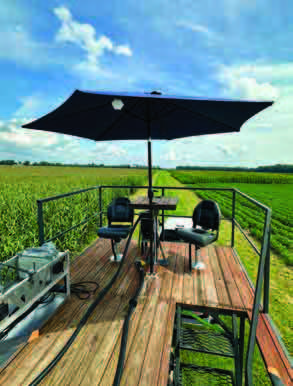
Heat exposure is as much of a risk as anything when it comes to operator safety. A simple umbrella can help make or break a day. Umbrellas should be large enough to cast shade and durable enough to withstand air movement caused by the drone. It is best to use umbrellas that do not allow sunlight to pass through the mesh as some shade cloths do.
Bending and carrying also add up over the course of a day. Think about the wear and tear on the body from the following activities:
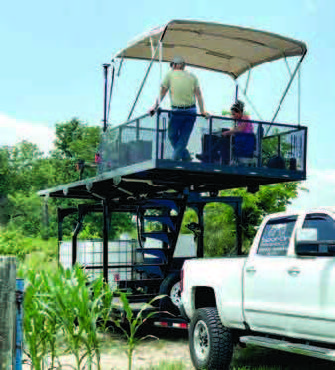
An open canopy, providing shade for the entire operator’s station and batteries.
Remember that these steps are often repeated each time the battery is replaced and the tank filled. Let’s say the operation is doing 200 acres a day and getting 5 acres per tank load. That means it will take 40 fills × 6 bends = 240 bends over the workday. Of those, 160 (four bends per load) will involve lifting a battery: 160 bends × 30 pounds = 4,800 pounds lifted during the workday, or almost 2.5 tons. Anything that can be done to reduce the number of times an operator bends can help alleviate fatigue.
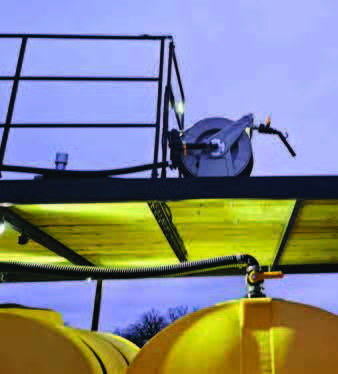
Access to the fill nozzle on the top deck with limited clutter offer a safe and fast way to fill up the drone.
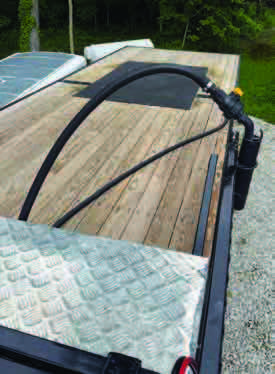 The nozzle used to fill the sprayer has a sleeve that it can be placed into. This will help to prevent a lot of bending during the day
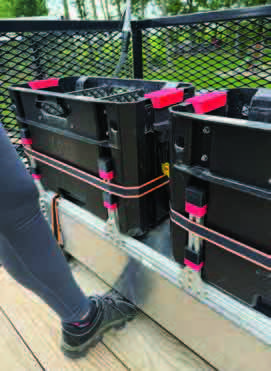 A battery box is elevated to allow this person to get their feet underneath. That allows the operator to lift the batteries straight up using the form that is used by weightlifters. This will help reduce fatigue and back pain. The actual height of the battery box will depend on the height of the individuals handling the drone batteries.
Losing Control of the Drone: Be Careful When Setting the Controller Down
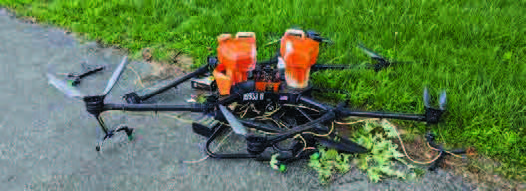
One small mistake while trying to land can end in disaster. Always follow through with the controller until the drone has completely landed.
Landing a drone should always be viewed as a dangerous operation no matter how many times you have conducted this maneuver. It is never a good idea to place the controller down in an unsecured location. When the drone is approaching the landing site, it creates wind velocities that can push an untethered controller off of its resting position. Falling onto a platform can switch the controller out of autopilot and into manual mode. The concern is the controller falling where its sticks are having input, causing the drone to go in whichever direction the input tells it. This can put employees at risk and result in crashes.
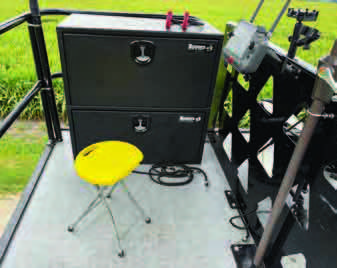
Proper mounting for a controller not in positive hand control. There is a convenient hook for the controller while the pilot fills up the drone or swaps batteries.
Drones are good but not always as good as they need to be. It can be tempting to begin getting the battery and fill nozzle ready before the aircraft has fully landed. It can be especially tempting when the aircraft has successfully landed without issue for a number of consecutive fill-ups. One commercial operator was flying an imagery drone, and the aircraft had finished the mission and was returning home. Since it had landed many times with no issues in the past, the author decided to “scout” the soybeans while it landed on its own. But the GPS signal degraded, and the drone landed about 30 feet to the south in a large tree. Spray drones can have similar troubles, such as unexpectedly missing the landing zone and falling off the trailer, causing significant damage.
Another example from one of the authors is that a friend had been operating an agricultural drone on his farm all day. On the last flight of the day, the operator set his controller down in the landing area. As the drone came in for the landing, the controller flipped onto the sticks and gave input to the drone, causing the drone to fly away and crash into the ground.
Spinning Blades and Jagged Edges: Are You Protected?
When a drone lands on or takes off from narrow platforms, this brings you near spinning blades that can cause injuries. It’s true that injuries like those shown in the photograph happen infrequently, but they unfortunately occur. While it takes only seconds for someone to be severely injured, these can be life-changing events for that person. In the worst-case scenario, this could lead to years of headaches involving insurance companies, attorneys, and courts.
Due to the risks, it is important to have as much separation between you and a drone as possible. Separation from the drone is not the only requirement: Consider a drone crashing into a trailer, causing the rotors to split and shatter. In this instance separation alone would not protect the operator. More thought should be given to protecting the operator, and others involved, in a worst-case situation.
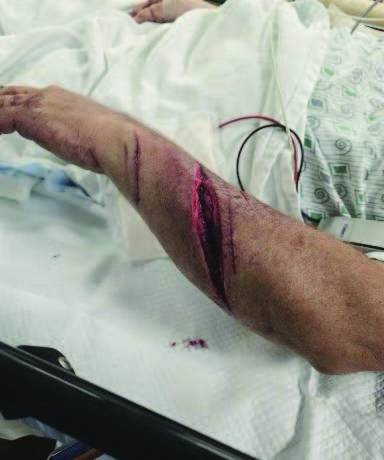
Many spray drones have the capacity to carry full-grown humans. With that capacity comes a great amount of force from the rotors to keep it in the air. Encountering a spinning rotor can be life changing if not life threatening.
These accidents are most likely to happen when someone approaches the aircraft to change batteries or fill the drone before the rotors have fully stopped. With some drones, after the aircraft lands, it takes an extra few seconds before the rotors stop spinning. If you are working in pairs, it may be a good idea to have a phrase or word the pilot says to signify the rotors have stopped spinning and it is safe to approach the aircraft.
Refills: The Drone Must Remain Off
Older drone models and even a few newer ones do not have an internal backup battery. When the spent battery is replaced with a fully charged one, the drone has to reboot its internal systems. Completing this process requires 30 to 90 seconds. Once it is complete, the drone is now energized and ready to be engaged by the pilot.
A potentially dangerous procedure is to try to save time by first removing the spent battery and replacing it with a charged battery. While the drone is rebooting, the person then fills the spray tank. Then, by the time the drone is refilled, the drone itself has nearly completed its reboot procedures. However, this means the person is technically working within an energized environment throughout the refill procedure. If the rotors were to power on, the person would be in the danger zone, which has the potential to lead to serious injuries.
Conversely, many of the newer models have an internal battery that keeps the drone from going through the reboot process. Typically, that stored power is not enough to activate the drone’s rotors but ensures the drone is continuously on.
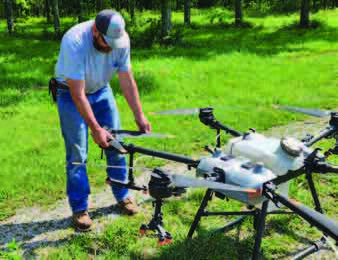
Make sure the power is shut down when inspecting blades.
It is best to balance efficiency and safety, but each situation may be unique. Carefully think of the most likely safety breaches of your operations, and do your best to address or avoid those hazardous situations. Fill-ups and battery changes can also create issues with the battery/drone connector if you are not careful. With many spray drones, the battery plug is protected when a battery is fully installed; however, when the battery is pulled out, the plug can be exposed to splashes from the pesticide being transferred into the drone, or to seeds or dust from spreading seed or fertilizer. These can cause the fins to rust or corrode, or can block the connector pins from fully connecting to the battery. Try to limit any potential contamination of the connector by limiting the amount of time the battery is out of the drone and limiting any splashing or dust when filling up the drone.
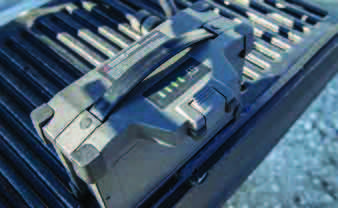
Inserting a fully charged battery, like this one, can cause the drone to power up
Pesticides: Follow the Label and Wear PPE
Many using spray drones seem to think they are exempt from having to wear the personal protection equipment (PPE) required by pesticide labels. Drone operators handling these products and drones need to follow the same PPE requirements as those using ground rigs. Not wearing the required PPE while mixing pesticides or filling the drone negates the safety gained by removing the crew from the application zone.
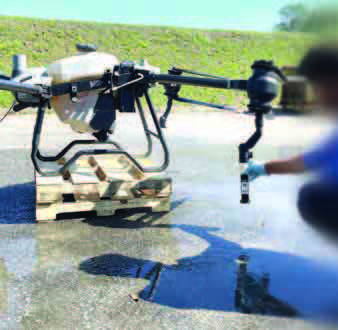
Regular cleaning and rinsing of the drone can keep chemical residues at a minimum, making transport and setup safer for the handlers. PPE only helps if worn appropriately. Wearing long sleeves is great; rolling up those sleeves, as this operator has done, creates risky exposure. Utilize PPE, and utilize it appropriately.
Due to the style of application, the drones themselves are often contaminated with pesticide residue. Placing a drone that has not had its external surface rinsed inside an enclosed trailer or lifting it onto a trailer between jobs can create even more contact points with pesticide residues found on its surface. Because of this, it is important to wear basic PPE (gloves, long-sleeved shirt, long pants, eye protection, and closed-toe shoes) to reduce exposure to pesticide residues anytime you come in contact with a unit that has been utilized for application.
The most common contamination likely occurs if the drone pilot who operates the controller also changes the battery or fills up the drone. If they don’t wear gloves while filling up the drone or changing batteries, then the controller likely has pesticide residues on it as well. So even if they wash their hands after filling up, if they touch the controller, they are contaminated again. It is common for the operator to take a drink or eat a snack while the drone is in the air, but if chemical residues are on the controller, they are likely getting on the snack or drink. If the pilot is doing the filling and battery swap, it may be best to use some oversized, chemical-resistant gloves that can be easily slid on before reaching for the battery or fill nozzle and then easily slid off when switching back to the controller.
Eye protection seems to take a back seat with applicators; however, safety glasses are a critical component in protecting one’s eyes. Landing on the ground generates a lot of debris as the drone’s downforce will forcibly throw dirt, debris, and small rocks into the air. Drones leak, and as much as we try to avoid contact with chemistry, a leaky nozzle as a drone leaves a workspace can create drift that can easily impact the eyes. When working on the ground, safety glasses are a must-have at all times, whether operating or loading the aircraft.
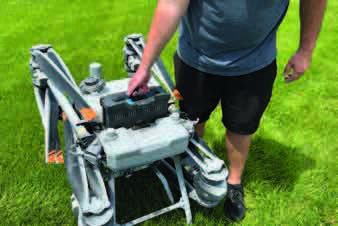
Pesticide residues will likely cover the drone after every operation, requiring proper PPE while handling the drone and its components. The unit has clearly been utilized for work, but the handler has no PPE on whatsoever.
Know This
Drone operators handling products and drones need to follow the same PPE requirements as those using ground rigs.
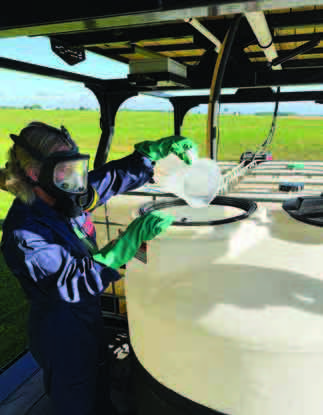 Pesticide labels vary on what is required when handling the product.
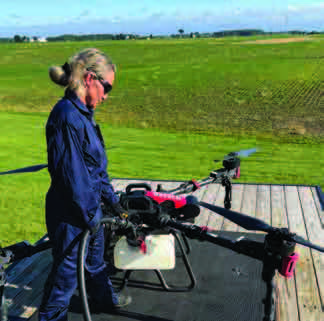 Often more PPE is needed when mixing the product(s) than when dispensing the products into the drone.
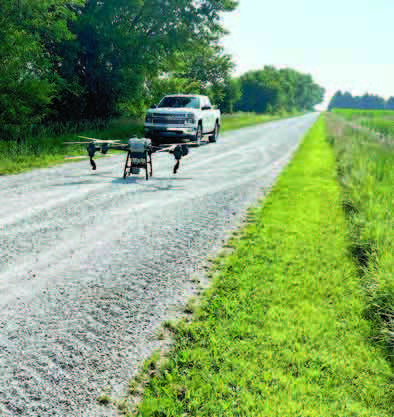 Farm lanes that are mostly gravel and dirt create a lot of dust and debris that can fly into the operator’s eyes when the drone is landing or taking off. Proper eyewear is essential. To help avoid dirt and debris, sites like this can be wet down before beginning operations. This will not stop all dirt and debris issues but does help.
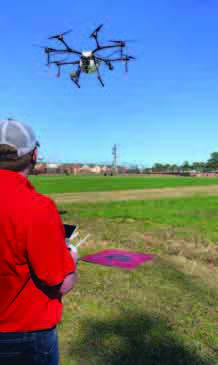 Keeping an eye on the drone while it is landing and taking off can be difficult if turbulence from the drone cause dust and dirt to get in the eyes of the operator. Utilizing a landing pad in certain environments can help reduce the risk of flying debris and damage to the aircraft.
Fumes and Spills: Be Careful Where You Mix
Products with volatile components release fumes, especially when temperatures increase, and spills and splashes do happen, despite our best efforts to avoid them. Fumes and spills are particularly concerning in an enclosed trailer: It is important to mix outside of any enclosed area so that fresh air will dilute the fumes and limit your exposure. If you must mix in an enclosed trailer, try to have two doors on opposite ends of the trailer (side door and rear door) open with a fan moving air in through one door and out the other to increase the frequency of air exchanges in the trailer and limit fume exposure.
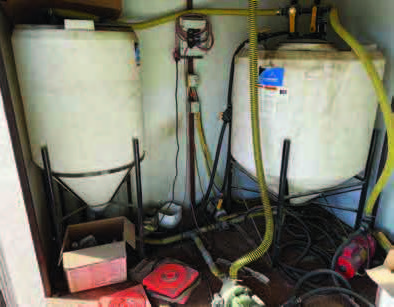
Chemical batch setup inside trailer. Be cautious when utilizing this method to avoid additional exposure risks. Mixing chemicals inside enclosed trailers can cause fumes to irritate the handler. Ensure proper ventilation if your tanks and chemical jugs will be opened inside.
Secondary considerations for the mixing environment relate to the decking material of a trailer. Wood decks are perfect for absorption of pesticides, creating a secondary exposure risk that can continue for an extended duration. This is worst in an enclosed trailer, where fumes can accumulate, but also a problem for other trailers: If that untreated wood is exposed to moisture, the water has the potential to move absorbed product out of the wood again. Should this occur when you are parked in the wrong area, you could have a really bad day. To assist with this, operators suggest sealing the wood with a light-colored garage floor coating or a nonskid material used on boats to help reduce absorption of chemicals.
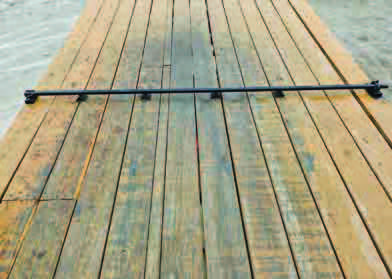
Chemical spills can soak into wood decks, and these decks can also become slippery when wet. Adding a coating to keep chemicals from soaking into the wood and adding nonslip surfaces are best practices when building your truck/trailer setup.
Building a platform out of diamond plate decking is also another option, but that material really heats up in full sun. To reduce this, operators have applied a light-colored grip paint to the deck to cool the platform. This also provides anti-slip properties and protects the platform. But diamond plating can also be heavy and harder to replace over time.
Falls: Put Handrails Along Steps
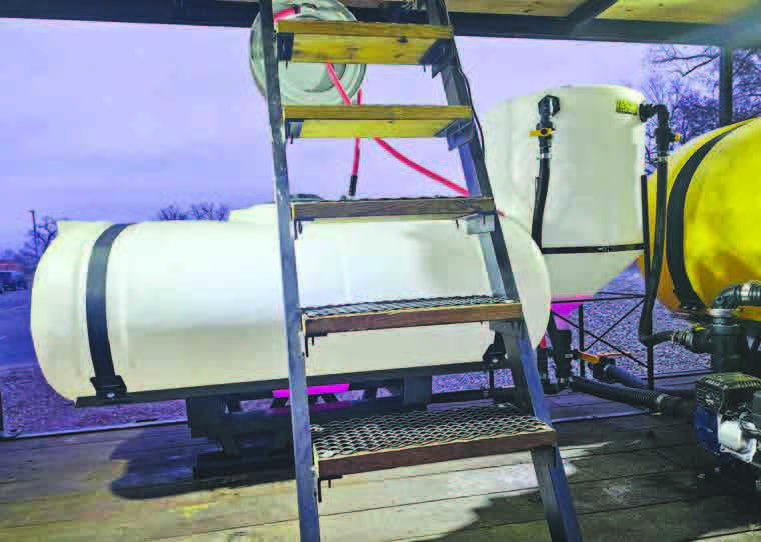
A ladder without handrails leading to the observation platform is an injury waiting to happen. On the positive side, these wood steps with expanded metal will help with foot grip when going up and down the steps.
Slips, trips, and falls are prevalent in every work condition, even on a drone trailer. As shown earlier in this publication, most truck/trailer setups have some upper platform or raised area that the operator and handler must access. When handrails are not present alongside a ladder or steps, that presents an added risk to the individual and could cause some interesting balancing acts. This is especially true if a person is carrying batteries and controllers up to and down from the upper platform. Additionally, it might be beneficial to put grip strips on steps to prevent slipping as steps get wet. OSHA requirements relating to steps can be found at
http://osha. gov/sites/default/files/publications/osha3124.pdf.
It is also very important to install guardrails around the operator station when working on an elevated deck. A small misstep along the side of a trailer can cause a broken limb or much worse if the operator falls from the top deck of a trailer or truck. These accidents increase in incidence as operator fatigue increases throughout the day.
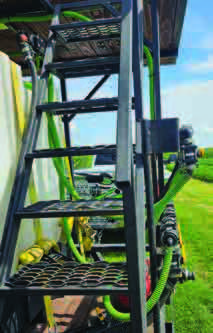
A handrail on the right side provides support when going up and down the steps. Another handrail on the left side would be a great addition.
Roadside Parking: Be Selective When Parking
Many farm fields have narrow and sharp lanes leading off the highway that make it nearly impossible to pull a larger trailer into the field. This requires the trailer to be parked alongside the road and the drone launched from there. Parking along a road places the public and crew in a precarious and often dangerous position. This is especially true in the early morning and late evening hours when work is being conducted in low-light conditions. Working alongside a roadway puts drone workers at risk, because they are not trained like highway department employees.
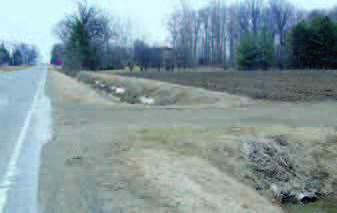
Typical entry into a farm field in a central state. Although this field entrance is wide for easy access, if a crop were growing in the field, a long truck and trailer might not be able to fit entirely off the road, requiring the drone operation to be conducted with at least a portion of the setup on the edge of the road.
Drone operators should focus on chapter 6 of the manual, “Temporary Traffic Control.” It provides practical tips for working safely along roadways.

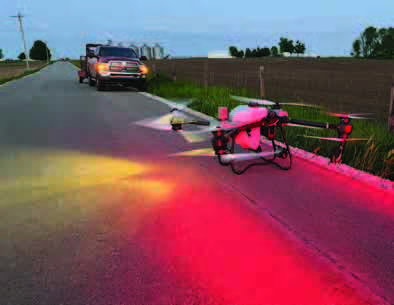 Night operation on a roadside. This is one of the most dangerous operations drone applicators can conduct currently. Lights on the drone make it easy to see in the dark, but don’t forget about the lights for your truck/trailer, especially when parked on the road.
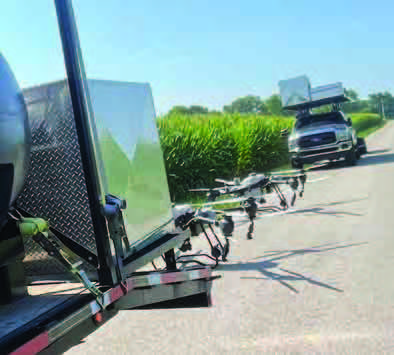 A two-drone swarm operation parked on a road due to limited access. Parking along a road can be a hazard to the operator as well as to passing vehicles. Parking two trucks and trailers in a row can make it difficult for cars to see around both rigs to pass. If you must park on the road, make sure vehicles can safely get around you, and be careful not to accidentally walk into traffic.
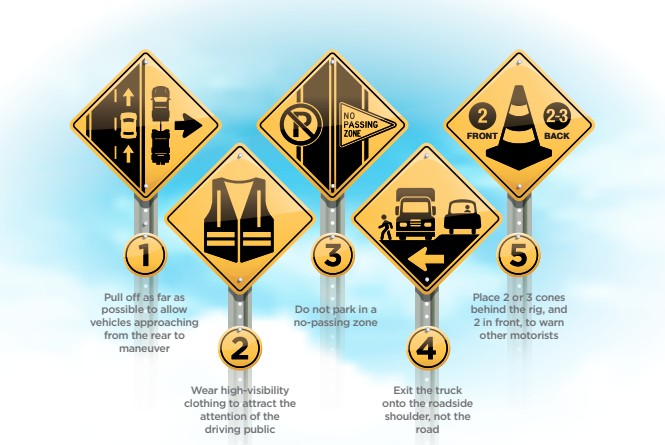
Consider the following safety tips for working along a road:
• Pull the truck/trailer off as far as possible to allow vehicles approaching from the rear room to maneuver.
• Wear high-visibility clothing to attract the attention of the driving public.
• Do not park a trailer or truck in a no-passing zone. Drivers needing to move around you might be forced to cross the double line markings on the road, which could create dangerous situations with oncoming vehicles.
• Drone employees should always exit the truck onto the roadside shoulder, not the road.
• Place two or three cones behind the rig and two in front to warn those approaching that you are parked there.
In addition to cones, some drone operations use flashing lights or strobe lights attached to the top decks to provide additional warnings to drivers approaching the parked equipment. For working at dusk and dawn, blinking red lights seem to work better in catching the attention of motorists.
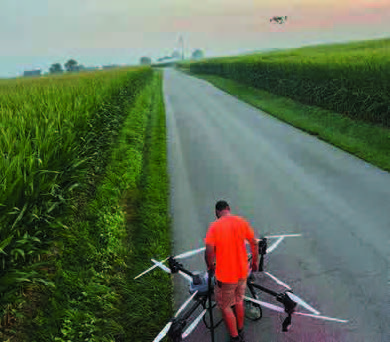
Wearing high-visibility orange is important when operating on or near roads. At least this person has on a high-visibility shirt and glasses on this photo, but they aren’t wearing PPE. Both PPE and visibility are part of any good operation. Even if you wear proper PPE, don’t forget that drivers may not be paying attention; avoid putting yourself in a bad position along the roadside.
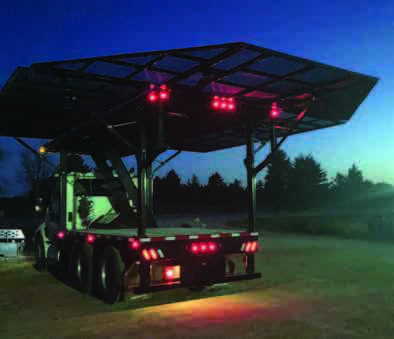
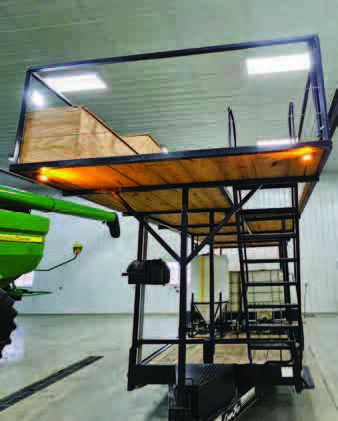
The wide deck allows for plenty of workspace for refilling the drone and swapping batteries. Red lighting helps to reduce the effect of light blinding someone during night operations.
These dangerous situations can be limited when planning the spray order for the day. Know which fields will require you to park on the road, and try to complete those fields during the daylight. If you must start or end your day in the dark, do so on fields where you can pull off the road completely. Also, think about the rain forecast: If ground conditions become soft, you may have to park on the road more often. If there is a good chance of significant rain in the forecast, try to knock out the fields on more dangerous roads before it rains. Then, when it is wet, do the fields where you can pull off further into farm lanes or park along less dangerous roads. This is not always possible, especially if you don't want to skip over customers who have been on the list for a while, but planning and thinking ahead can sometimes work out and make a safer operator environment.
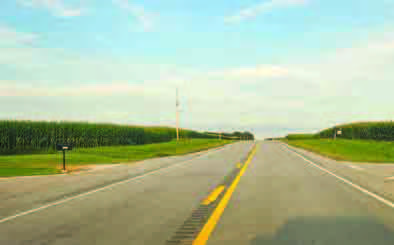
Avoid parking in a no-passing zone as this can put you and the driving public at increased risk when they have to cross the line to miss your trailer and truck.
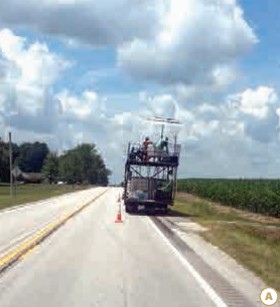 Paying attention to where you park is an important part of being a responsible driver. (A) Can you see that if you had parked on the other side, you would have forced people to pass in a no-passing zone? Who would have been at fault if this created a head-on accident?
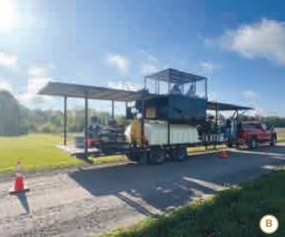 (B) Using cones is necessary on any road if you want to protect the driving public and reduce your exposure to lawsuits. Today these gravel roads seem as dangerous as the interstate as the traffic moves at highway speeds even these roads were not built for that.
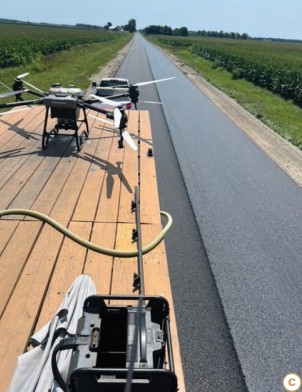 (C) This road is being repaved: The drop-off between lanes could cause a driver to lose control of their vehicle as they approach the drone trailer.
Power Lines: Locate Them Before Flying
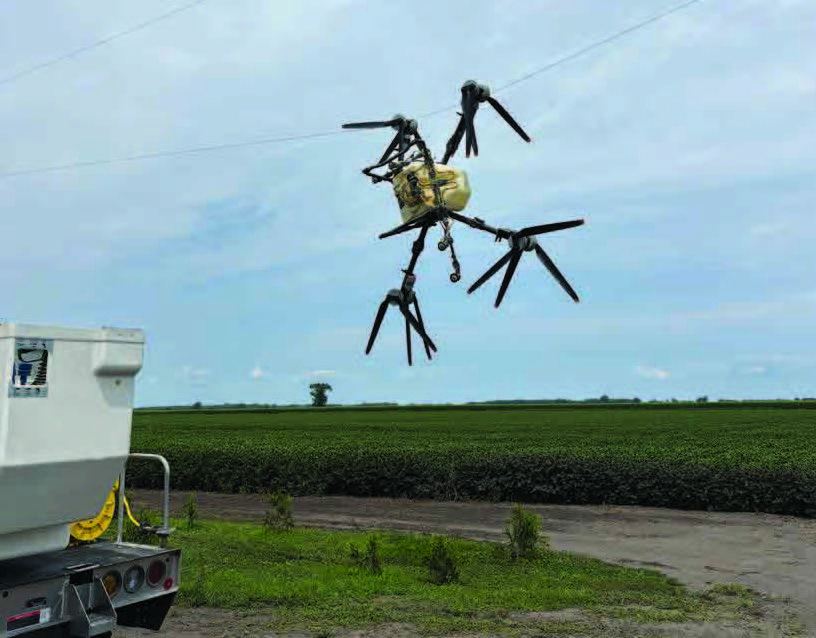
Power lines are ubiquitous across rural landscapes to the point that we almost forget they are there. When working near power lines, extra care must be taken as the drones are sent out on a spray mission. Try to mitigate the hazards posed by power lines as much as possible. If possible, park on the opposite side of the road from the power line to create space when launching and landing. In addition, drones should maintain a minimum of 15 feet of separation from all distribution lines, which are typically 35 kilovolts and below. For high-voltage transmission lines (60 to 765 kilovolts), a separation of 25–35 feet should be utilized depending on the situation and the voltage of the line.
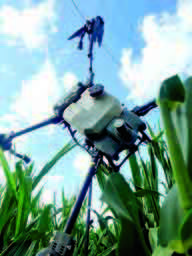
Extreme care must be taken when working around power lines and wind farms.
Blowouts: Size Your Tires for the Trailer Weight
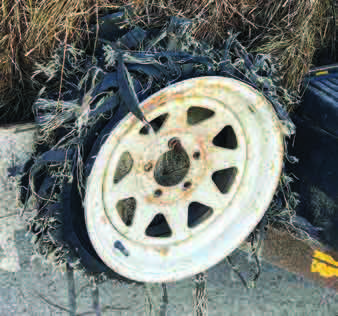
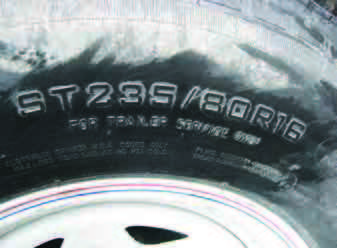
An often overlooked and underappreciated component of trailers is the tires that carry your investments. A trailer tire is designated by the letters ST (special trailer). This designation indicates the tire is designed to be used on cargo, utility, and boat trailers. These tires feature reinforced sidewalls to handle the weight and stress. The two primary factors determining how much load a trailer can handle are the gross axle weight rating (GAWR) and the capabilities of the tires.
Especially when purchasing used vehicles or trailers, you should inspect the tires for age, wear, or weather cracking. At least once a year, you should jack up the trailer or truck and check for wheel bearing issues. This also allows you to spin the tire around to inspect all areas of the tire.
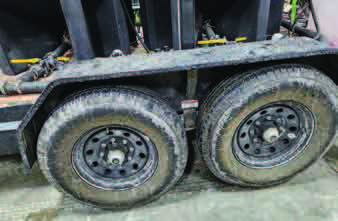 Consider the amount of money you plan to make in one day of flying. That’s how much you would lose if you have a tire blow out and can’t work that day. Make sure your equipment is in good working order before the season begins.
Driving: Know the Law and Follow the Rules
As larger equipment and supplies like water tanks are put on a trailer or truck, the weight obviously increases. This raises serious questions about the trailer and/or truck: Are they built to support the additional weight based on the gross vehicle weight rating (GVWR)? Trucks and trailers are designed to carry a maximum amount of weight, given as the GVWR. The established GVWR includes the weight of the trailer and truck and can be found on the driver’s door or on the tongue of the trailer. Things to consider:
• Are the weights of the generators and water tanks evenly distributed?
• Is the equipment properly secured on the lower and upper platforms?
• Are the tires sized to carry the expected loads?
• Are the axles rated to carry the expected loads?
Another question to ask is whether the driver requires a commercial motor driver’s license (CDL). A DOT officer could put the driver and truck/trailer out of service for not having a CDL when it is required. Drone operators operating commercially should try to stay under the 26,000-pound GVWR threshold. Finding an operator with a CDL is difficult enough, but paying them what that driver’s license commands is generally not practical for those operating a spray drone business.
Conclusion
The spray drone industry is rapidly evolving and becoming an integral part of our agricultural society. What was a novelty just a few years ago is almost commonplace in some regions, almost as if we are in the times when the first mass adoption of tractors on farms occurred. Like those early tractors almost a hundred years ago, many unknowns accompany this new technology, and experience, research, and trial and error are required to operate a successful spray drone operation. Hopefully this publication encompasses some early experiences and research to help you as an operator learn about an integral part of the operation: the truck and/or trailer. Although new drones are constantly being released on the market, and rules for flying spray drones are changing, the information in this publication will likely stay relevant since the methods used to get the operation out to the field will likely fit many spray drone platforms.
The key aspects of the spray drone operation that must be considered are getting the operation out to the field, packing enough water and product for your operation, reducing time spent refilling the tank and swapping batteries, making it back home safely, and taking account of the cost to maximize each of these components. Remember to be realistic about your original investment, and understand if you are wanting your drone operation to save money or make money. From there you can begin building a truck and/or trailer setup that will suit your goals.
Drone technology is in its infancy, only scratching the surface of what will be possible as advances by the military are commercialized by industry. When observing drone technology, one could directly compare it to global positioning systems (GPS) in that both are technological advancements that come directly from the military. When GPS was first commercialized, it was nearly unattainable for the average person financially and had limited uses in the pre-GPS infrastructure of society. Today everyone has a GPS system capable of tracking their every movement, built into their everyday phone. Similarly, the drones of today will fail in comparison to the drones of tomorrow. As the drones advance, the drone pilots and companies of today must be ready to change and advance as well.
Views and opinions differ on what constitutes an efficient trailer or truck, and how to equip it to maximize the time the drone spends in the air. Numerous factors will and should drive the decision on what type of equipment you need. These factors include the landscape itself (fragmented acreage vs. continuous), budget, desired total acreage, target pest, volume needed based on labeling, and size of operation and expansion potential, to name a few. Overall, you should put more time into planning as this can save you headaches and gain you profits in the future.
Ask Before You Do
You have thought everything out, examining all facets of what you think the drone trailer needs. You’ve penciled out the costs. A bank loan gets you ready to find a trailer, a truck, and the necessary equipment.
This is the perfect time to hold off making those purchases. Your best investment is to ask others in the drone business a very simple question:
“If you could do it over again, what would you do differently?”
Their ideas and suggestions may influence the type of truck/trailer you purchase, and the equipment you will put on it. In the long run, their advice will save you time and money if you avoid repeating what others wish they had notdone to begin with.
The end goal and desire of any setup is to keep the drone in operation. To do this, the system at a minimum must be able to charge batteries, hold chemicals, hold clean water, and push that material to the unit. In the beginning, operators started with as little as a flatbed trailer with a few tanks. Do not be overwhelmed when looking at all the photos and think you have to go and invest heavily in a heavy-duty truck and trailer, as sometimes the best option for your environment may not be that. Do understand that whatever you utilize will need to meet those minimum requirements and will most likely be responsible for holding and keeping safe equipment ranging from $20,000 to $100,000 in value. With that in mind, it’s a good idea to think about the safety of this equipment, especially as people begin to understand the value of these units.
Drone technology and the truck and trailer setups trailers used to support drones have come a long way and will continue to evolve over the next decade. As these technologies evolve, we will see new use cases that will also continue to push the technology, creating the unique time we are in today, in which we are seeing traditional trade/practices impacted by technology at a level never anticipated. Fly smart, fly legal, and fly safe.
ACKNOWLEDGMENTS
Thanks to Dawn Minns for graphic design, Adduci Studios for illustrations, and Kim Miller for editing. Thanks to Jeffrey Boyer, Purdue University, who provided valuable comments and suggestions that improved this publication.
Disclaimer
This publication is intended for educational purposes only. The authors’ views have not been approved by any government agency, business, or individual and cannot be construed as representing a perspective other than that of the authors. The publication is distributed with the understanding that the authors are not rendering legal or other professional advice to the reader, and that the information contained herein should not be regarded or relied upon as a substitute for professional consultation. The use of the information contained herein constitutes an agreement to hold the authors, companies, or reviewers harmless for liability, damage, or expense incurred because of reference to or reliance upon the information provided. Mention of a proprietary product or service does not constitute an endorsement by the authors or their employers. Descriptions of specific situations are included only as hypothetical case studies to assist readers of this publication and are not intended to represent any actual person, business entity, or situation. Reference in this publication to any specific commercial product, process, or service, or the use of any trade, firm, or corporation name is for general informational purposes only and does not constitute an endorsement, recommendation, or certification of any kind by Purdue University. Individuals using such products assume responsibility that the product is used in a way intended by the manufacturer and misuse is neither endorsed nor condoned by the authors nor the manufacturer.
Reference in this publication to any specific commercial product, process, or service, or the use of any trade, firm, or corporation name is for general informational purposes only and does not constitute an endorsement, recommendation, or certification of any kind by Purdue Extension. Individuals using such products assume responsibility for their use in accordance with current directions of the manufacturer. October 2026