REEport Directions for Final Reports -Grants
RETURNING USERS: Log in to NIFA’s reporting portal at portal.nifa.usda.gov using your Purdue email address and the password you created when you activated your account.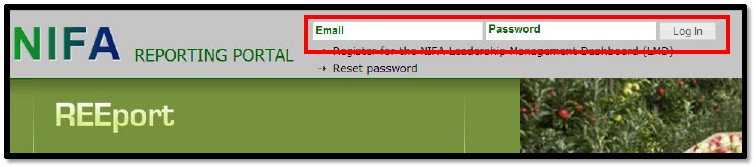
FORGOTTEN PASSWORD (or first time users): If you have forgotten your password or if this is your first time using the NIFA Reporting Portal, go to the website at portal.nifa.usda.gov, click on Reset Password, then follow the instructions on the next screen.
Please Note: If the system tells you that your email address is not recognized, please contact Julie Estrada at 494-6047 or estradaja@purdue.edu to troubleshoot the issue.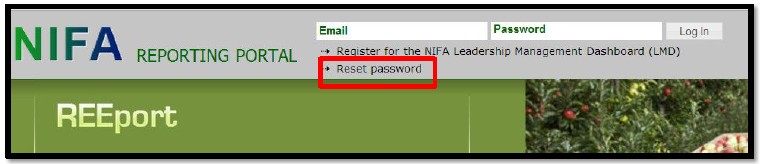
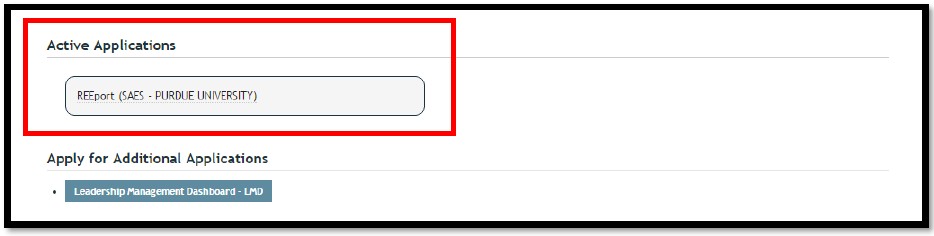
After you’ve logged on, click on REEport (SAES – PURDUE UNIVERSITY) under Active Applications near the bottom of the page.
Please Note: If you do not have REEport (SAES – PURDUE UNIVERSITY) under active applications or you only have REEport (PURDUE UNIVERSITY) without the SAES, please contact Julie Estrada at 494-6047 or estradaja@purdue.edu. You must use the SAES (State Agricultural Experiment Station) portal.
Chrome and Safari Users: You may get the following warning if you are using a browser other than Internet Explorer or Firefox, but REEport will still work with other browsers such as Chrome or Safari. Just click OK to continue.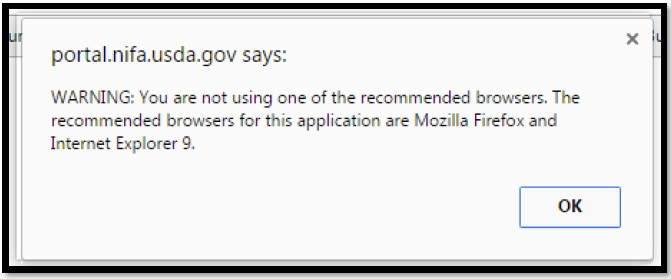
Click on the Final Report icon or Progress Report at the top menu bar.
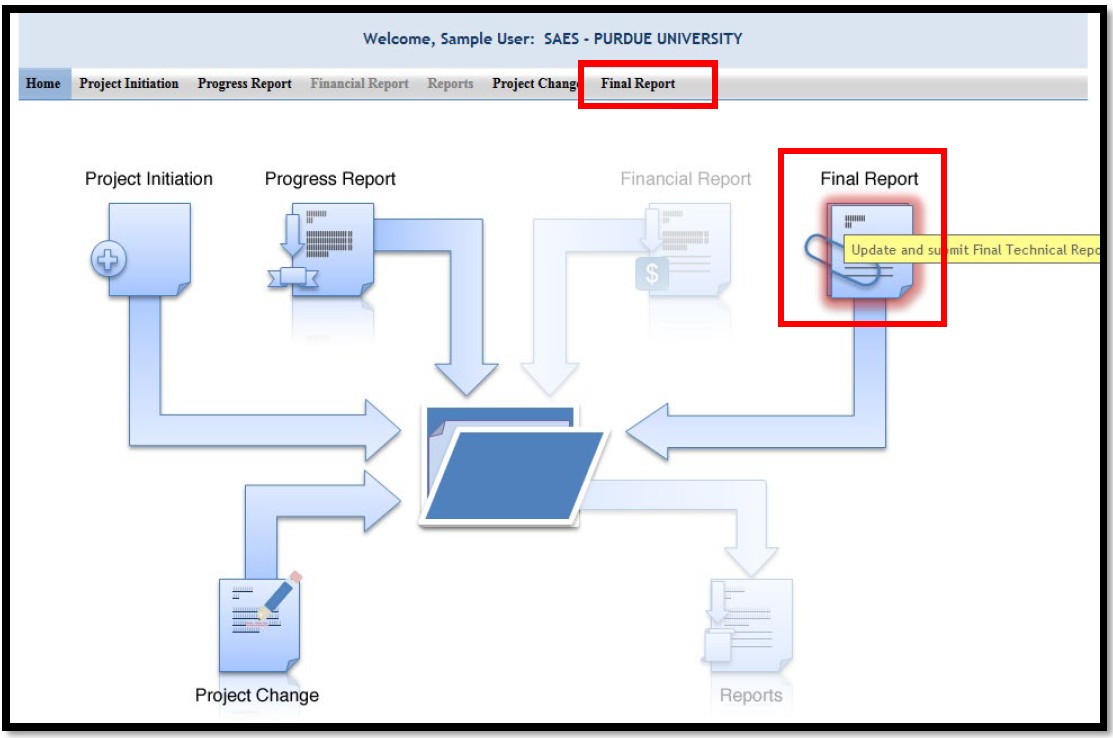
The Final Reports page will open.
Do not enter anything in the search fields!
Instead, Look in the Final Reports in Draft folder (by clicking on the folder icon) to find your project.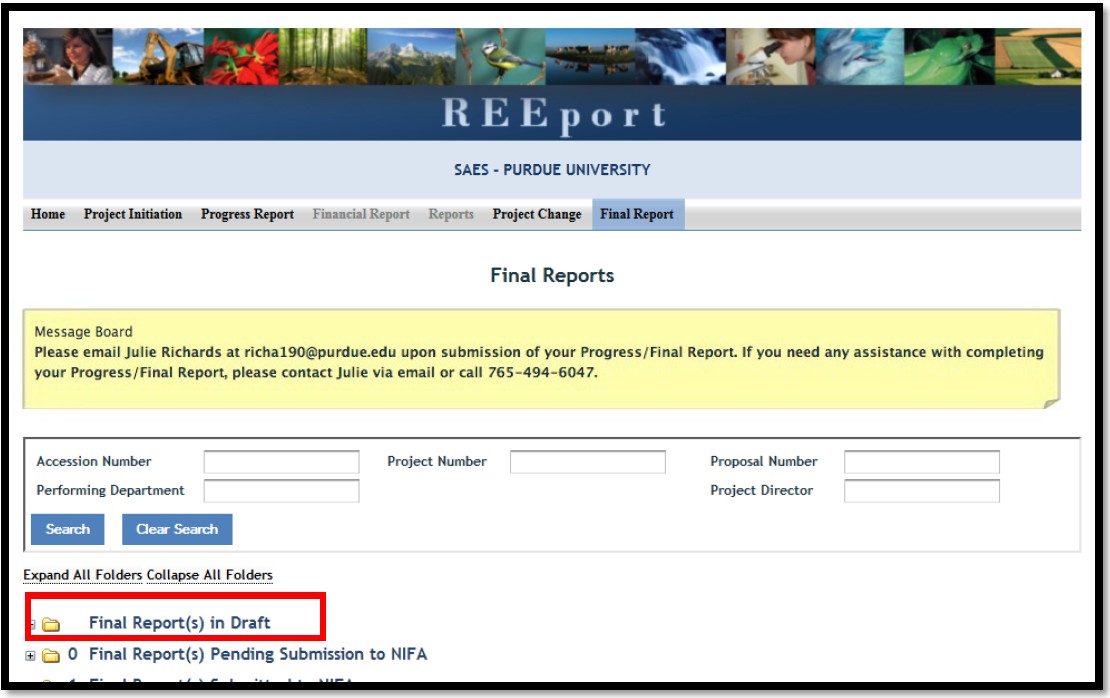
To begin completing your final report, open the report by clicking on the title of the project (or any other underlined text except “PDF”).
Cover Page
There is nothing to enter on the cover page. Just check the title to be sure you clicked on the correct report.
It would be a good idea to make a mental note of the reporting period start and end dates on your cover page. The reporting period will be referred to several times within the report.
Click Next.
Helpful Hint: You can view your original Project Proposal (federal formula projects only) and all Past Progress Reports for this project by clicking either of those options at the top. You may find it helpful to have those open in another tab or window when completing your current report.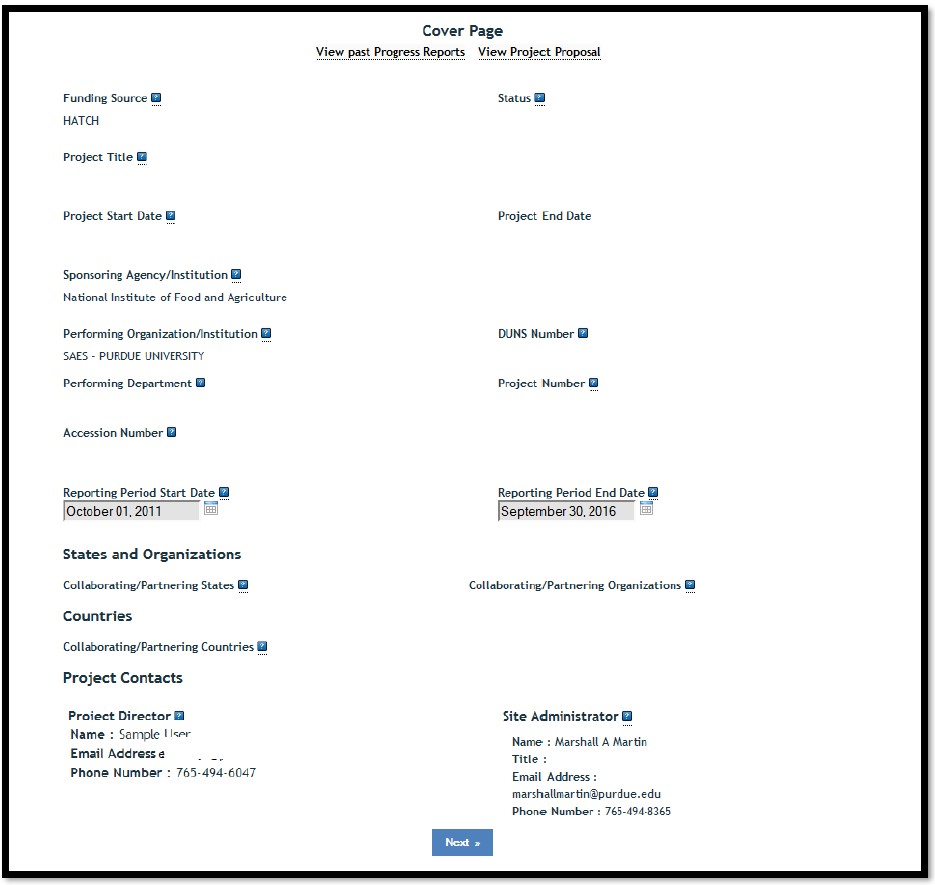
Participants
Project Director: Your name and contact information should be listed here.
Co-Project Directors: These fields are pre-populated from Grants.gov and the approved project initiation in REEport. These fields are non-editable for NIFA Competitive awards. If any of these fields are incorrect, email the REEport Help Desk at Electronic@usda.gov. In this email communication, please include the award or accession number, field name(s), and correct data.
Actual FTEs for this Reporting Period: If you have a 20% research appointment, and all of your research time is dedicated to the research in this proposal, you would put 0.2. Adjust the numbers accordingly if your research time is split between two or more projects. For Co-PDs, grad and undergrad assistants, etc., just calculate their time in the same way. To help you decide which row to put each in, click on the blue question mark in the REEport application.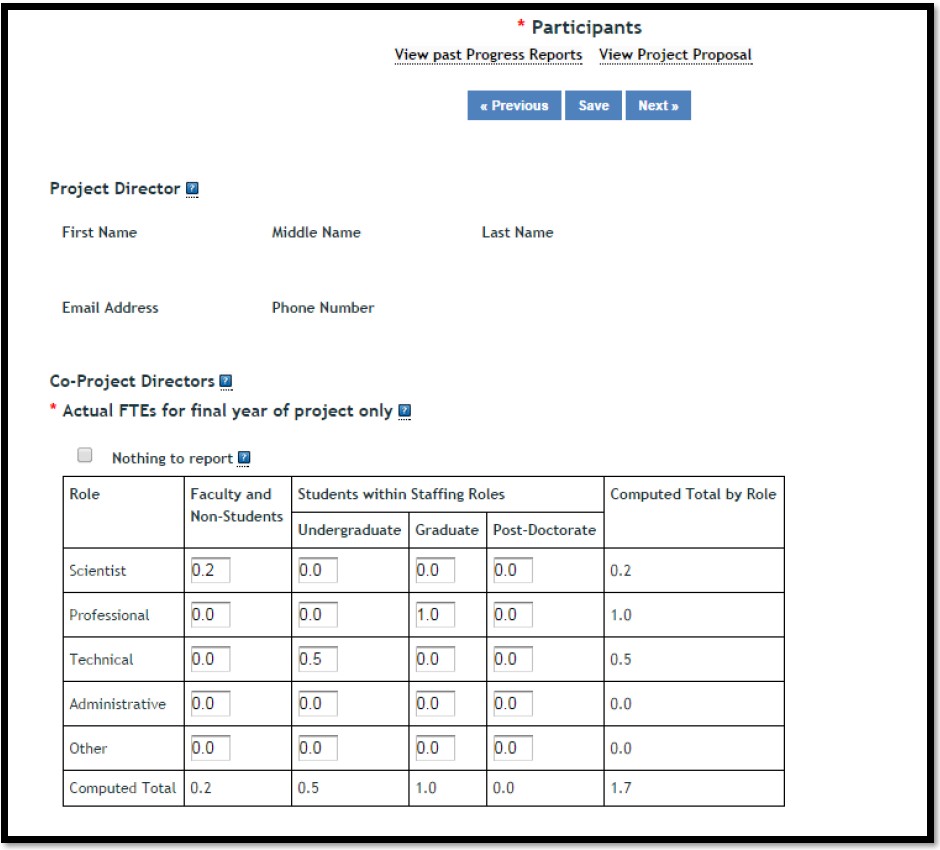
Participants (continued)
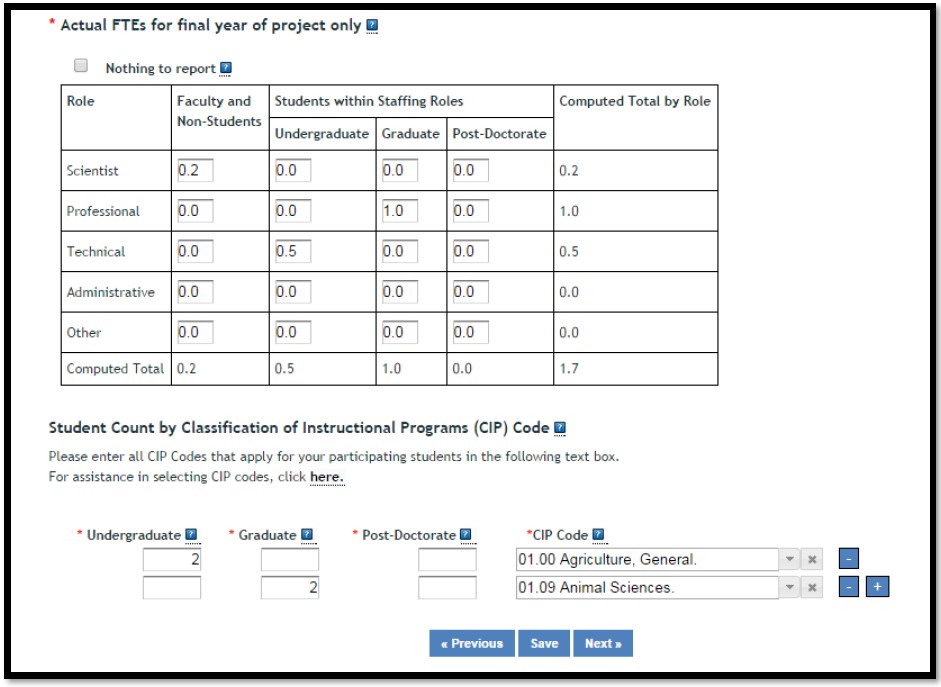
Student Count by Classification of Instructional Programs (CIP) Code: If any Student FTEs are reported, then it is now required to enter any applicable CIP codes, and vice versa. The data entered into the Undergraduate, Graduate, or Post-Doctorate CIP fields, are the Number of Students that worked on the project, and therefore must be whole numbers. The CIP code chosen should reflect the student’s major field of study. For a full list of CIP codes to pick from, click here.
Click Next.
Example:
In the example below, you will see that we listed 1.0 for graduate students and 0.5 for undergraduate students in the Actual FTEs for final year of project only table. Therefore, it was necessary to show two things in the CIP Code section:
- How many actual students do the FTE numbers represent
- What is the major field of study for each of the students
 Target Audience
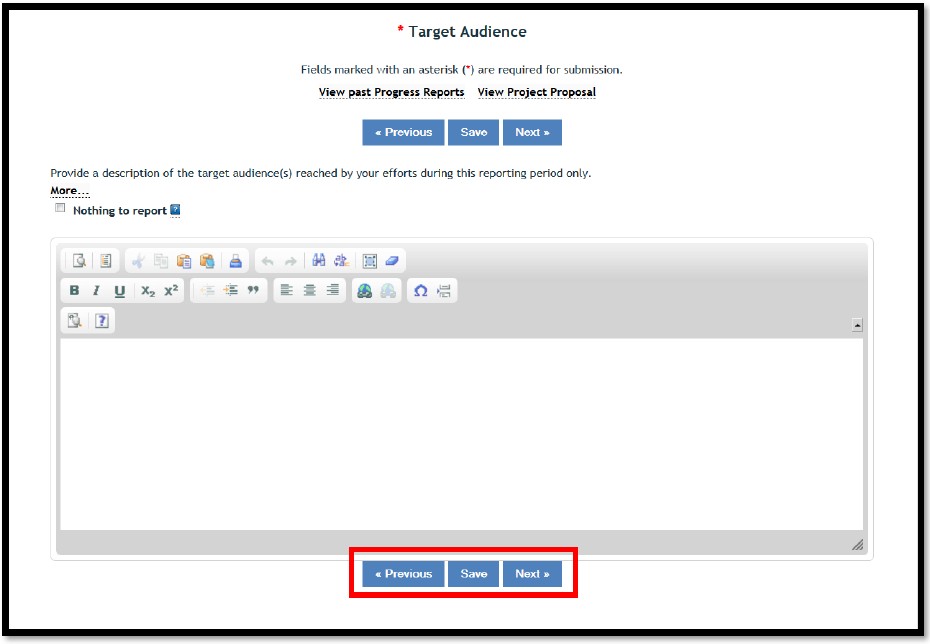
The target audience(s) you describe on the final report should include the audience(s) that were focused on over the entire length of the project.
Target audiences include individuals, groups, market segments, or communities that will be served by the project. The description should include why you are targeting these particular group(s). The purpose of this section is to answer the question “to whom does your work/research matter and why?”
Click Next.
HELPFUL HINTS: Clicking on Previous or Next automatically saves your progress as you move forward or backward in the system. Clicking Save, saves your work on that page, while keeping you on that page.
 Products
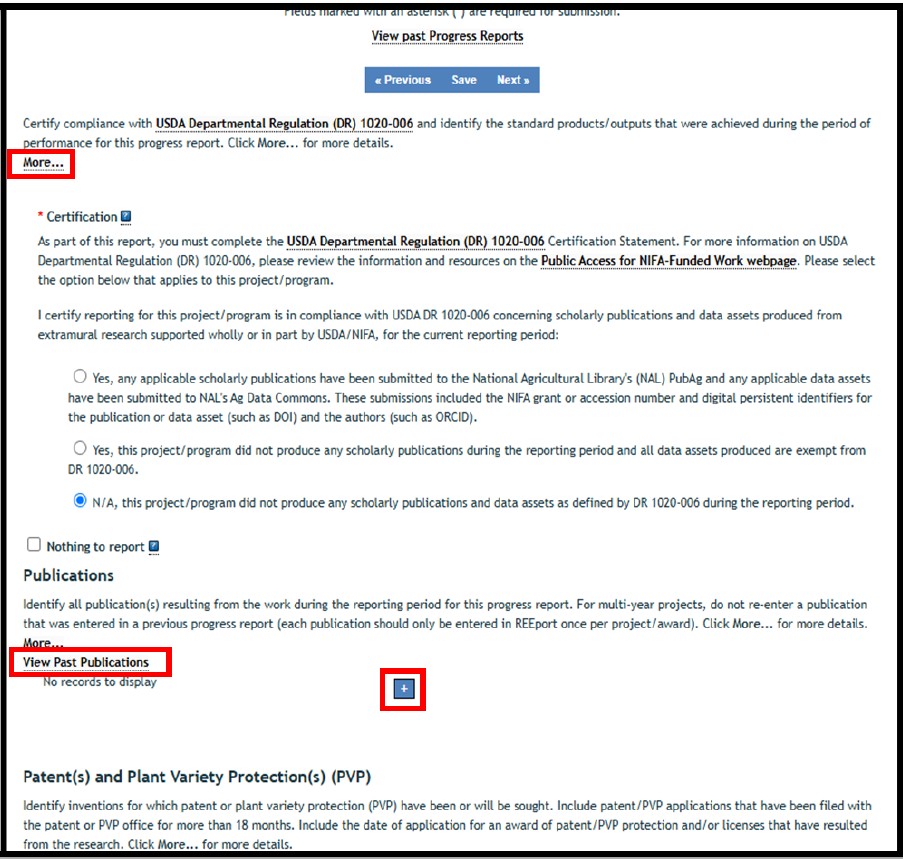
 Publications: Standard products/outputs includes only major publications, patents, and applications for plant variety protection (PVP). Other types of products/outputs achieved, such as data assets, newsletters, workshops, webpages, etc., should be reported on the "Other Products" page of the Final Report.
Report only the major publication(s) resulting from the work under this project/award. If there is a publication that occurred any time throughout the life of the project thus far but that you have NOT YET INCLUDED on a previous progress report, then you should include it here (click View Past Publications if you aren’t sure if you’ve reported a publication already). There is no restriction on the number. However, agencies are interested in only those publications that most reflect the work under this project/award.
List one product at a time. To add more products, click the blue “+” button.
Patent(s) and Plant Variety Protection(s) (PVP): Identify inventions for which patents or plant variety protection (PVP) has been or will be sought. If you do not have any to list, leave this section blank.
Click Next.
HELPFUL HINT: Click on the “more…” button for more information about what is being asked of you in this section.
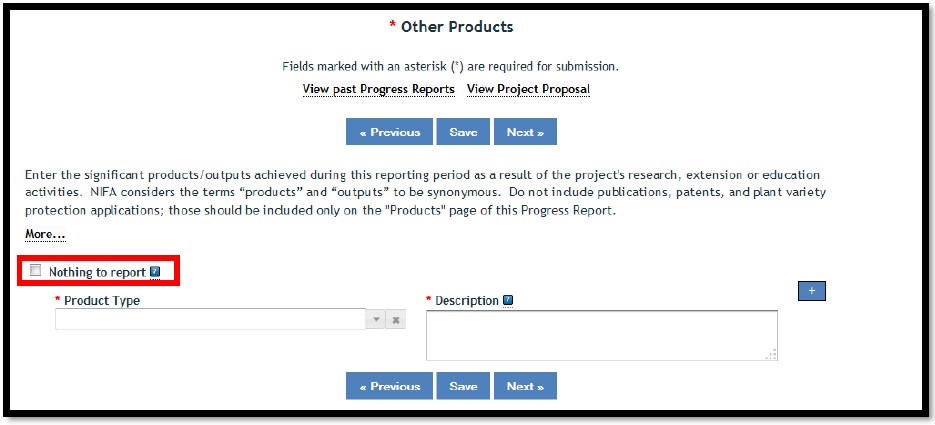
 Other Products
Use the drop down menu to see the full list of other products to choose from.
If you do not have any other products to list, check the box next to Nothing to report.
Click Next.
What was accomplished under these goals?
In this section, NIFA defines Accomplishments as outcomes and impacts achieved as a result of the project and the results of the activities/experiments that led to the outcomes and impacts.
- Relevance – issue/problem your project addressed
- Response – for each goal/objective list major activities completed, data collected; and summary statistics and discussion of results/findings
- Outcomes – Describe the key outcomes or other accomplishments realized (this should be about one page of text)
- Impact – Who or what was most immediately helped by your work, and how?
It is imperative that this portion of your report be written in plain, non-technical language. Most people who will read your FINAL REPORT are not technically trained or educated in your field of expertise, so it should be written in a manner that is meaningful to readers, stakeholders, USDA administration, and congress.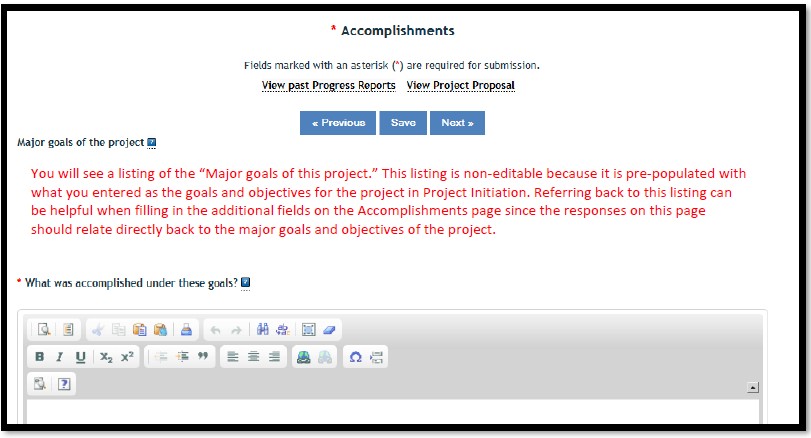
What opportunities for training and professional development has the project provided?
Describe opportunities for training and professional development provided to anyone who worked on the project or anyone who was involved in the activities supported by the project.
Accomplishments (continued)
How have the results been disseminated to communities of interest?
Describe how the results have been disseminated to communities of interest. Include any outreach activities that have been undertaken to reach members of communities who are not usually aware of these research activities for the purpose of enhancing public understanding and increasing interest in learning and careers in science, technology, and the humanities. For this section, think back to whom you described in the “target audience” section of the report. That was where you described the WHO part of the equation. In answering the above question, you should be describing the HOW part of the equation – how did you reach your target audience. What efforts helped you reach communities that are interested in or who will benefit from your work?
What do you plan to do during the next reporting period to accomplish the goals?
This is the final report, so there is no “next reporting period” to accomplish project goals. Therefore, you should check the “nothing to report” checkbox.
Click Next.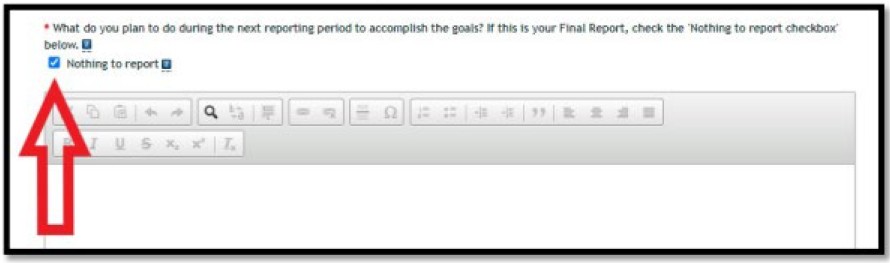
Changes/Problems
Describe major changes and/or problems in the project, including the plan, approach, methods, timeline, and objectives. Include a clear reason(s) for why these changes were made. If applicable, provide special and/or additional reporting requirements specified in the award Terms and Conditions.
Major changes include:
- major problems or delays that may have a significant impact on the rate of expenditure;
- significant deviations from research schedule or goals;
- unexpected outcomes;
- or changes in approved protocols for the use or care of animals, human subjects, and/or biohazards encountered during the reporting period.
If you had none of the above, click the box for "nothing to report."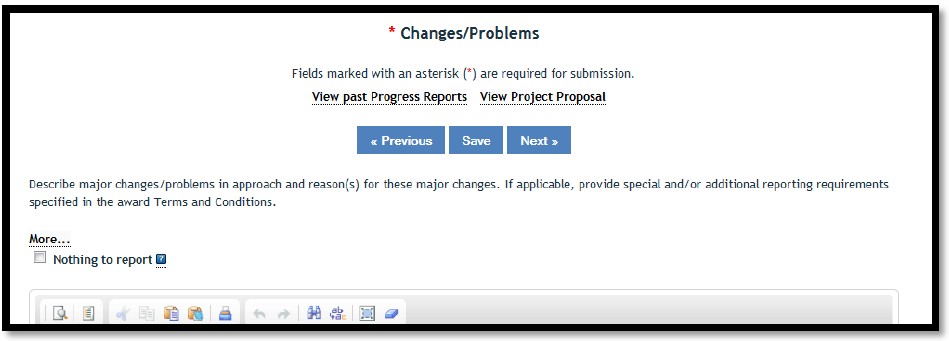
Submit Final Report for Review
If you have completed all required sections, your screen should look like the top picture.
We recommend that you save a PDF copy for your records by clicking on Review in PDF Format and then saving a copy to your computer.
Click on Submit for Review.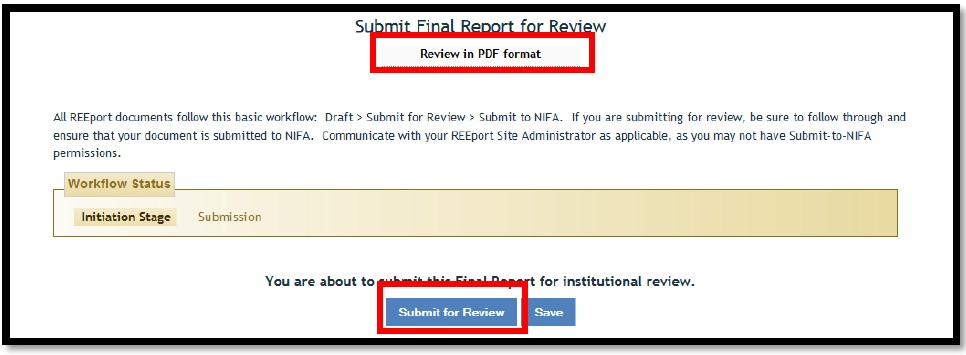 Please Note: If your screen looks like the bottom picture, you must complete all of the sections that are listed before you’ll be able to submit your report for review.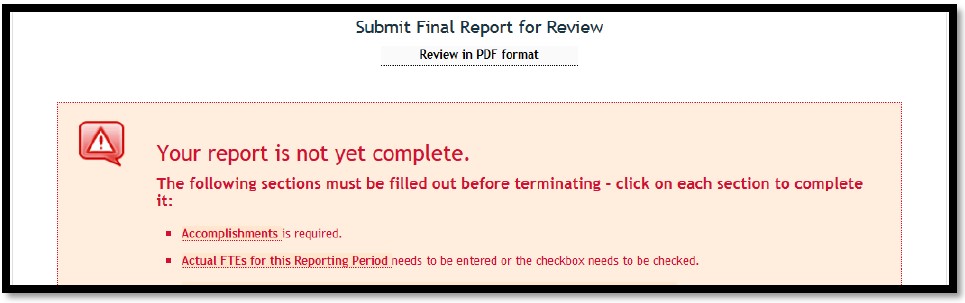
Once you click Submit for Review, you will be redirected to the Final Reports page.
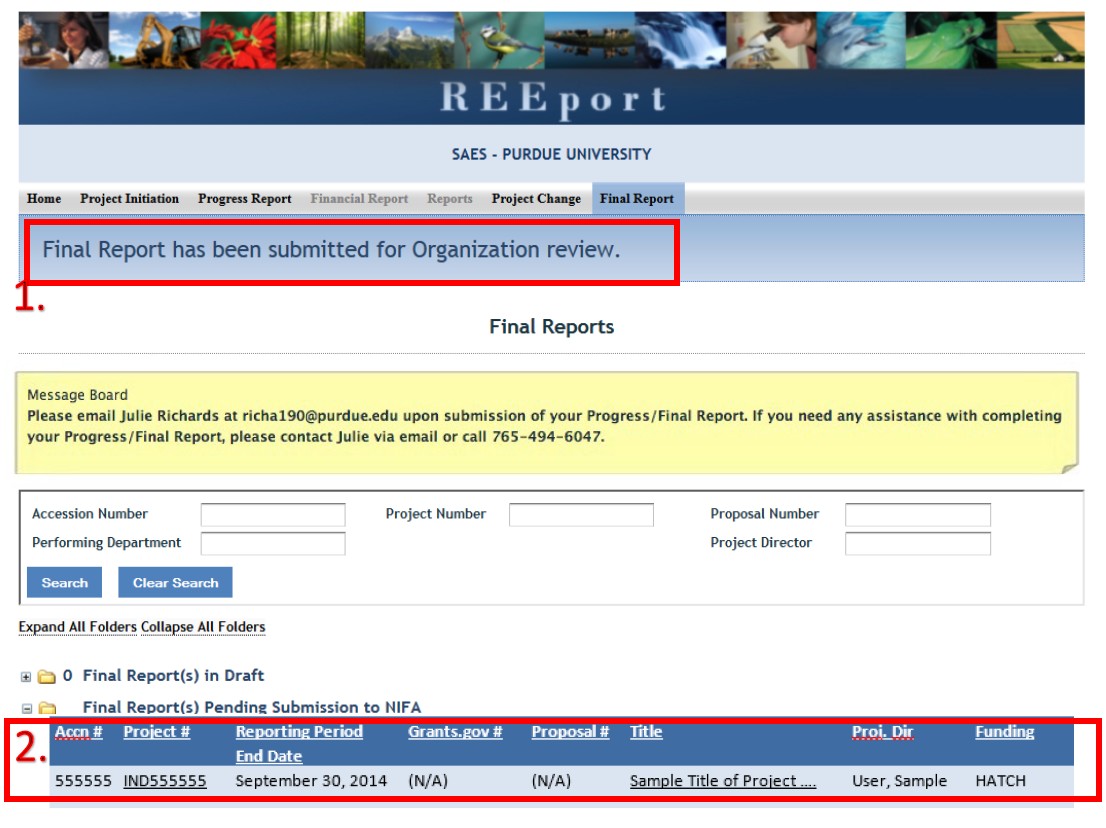
There will be two indications that your final report has been properly submitted for organizational level review.
- The blue announcement text above Final Reports should read, Final Report has been submitted for Organization review.
- Your report should have moved from the Final Report(s) in Draft folder to the Final Report(s) Pending Submission to NIFA folder.
IMPORTANT: You should email Julie Estrada at estradaja@purdue.edu to notify ARGE that you have submitted your report for review. ARGE will then review your report and submit it to USDA-NIFA.
Thank you!