

PLANT SCIENCES AND PHENOTYPING
Purdue University has integrated space for the cultivation and analysis of plants, supporting a broad range of applications in plant science, crop breeding, agricultural engineering, molecular biology and plant pathology.
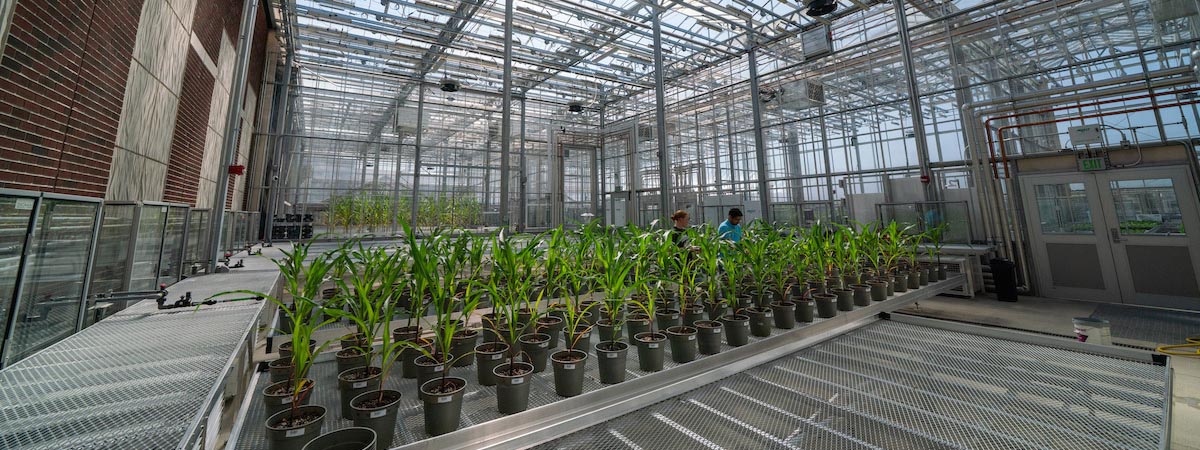
INSTITUTE FOR PLANT SCIENCES GREENHOUSE
Nine new state-of-the-art greenhouses in the Lilly Life Science Ranges, totaling 18,754 square feet of flexible space, feature:
FOUR-SEASON TEMPERATURE CONTROL
Air-conditioned and heated facility with automated monitoring and control of temperature, humidity and CO2 levels.
LIGHT INTENSITY CONTROL
Dimmable LED grow lights and retractable shade curtains maintain ideal light levels in each room.
ISOLATION GREENHOUSES
Two isolation greenhouses allow researchers to work with pathogen and insect pests while avoiding their spread to other greenhouses.
GREENHOUSE PHENOTYPING EXPANSION
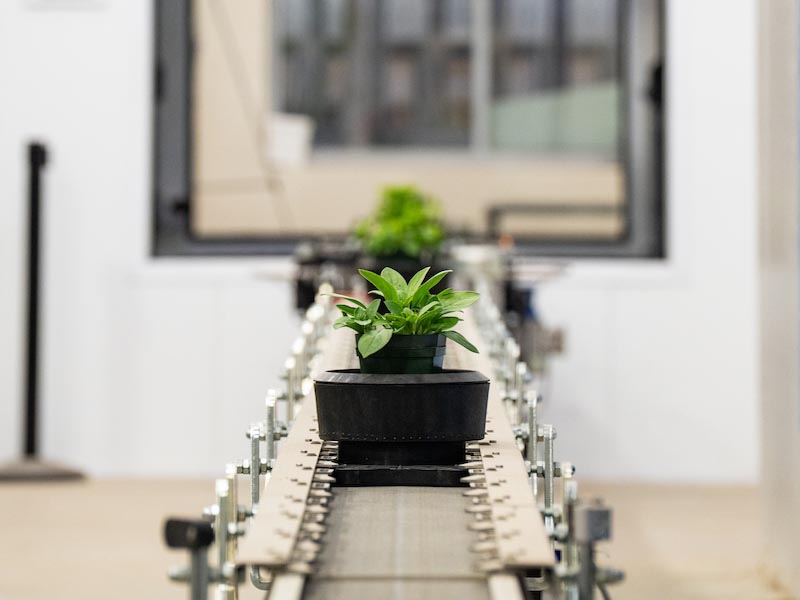
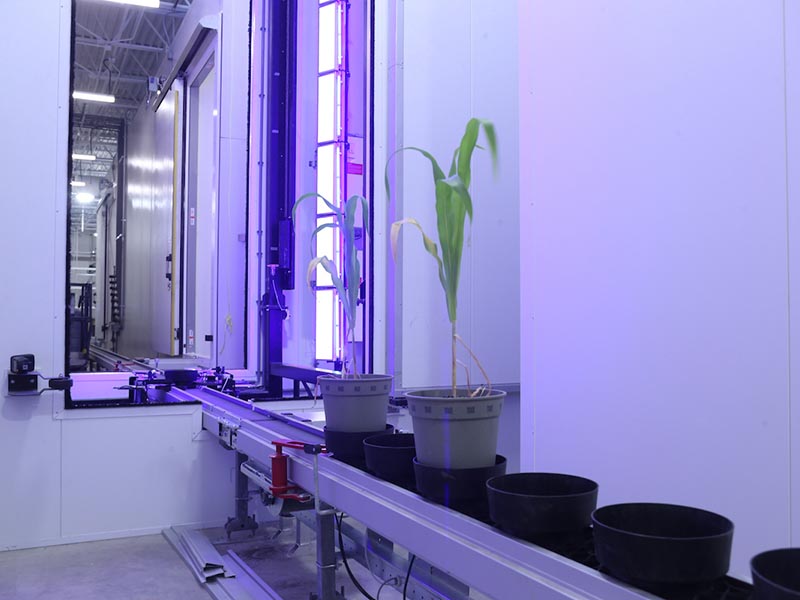
Phenotyping equipment can be custom built or added to some greenhouses. In addition, a central conveyor loop provides easy access to the Ag Alumni Seed Phenotyping Facility.
TEACHING GREENHOUSE
(for faculty, instructors and lab coordinators)
Teach plant identification, propagation and more in the teaching greenhouse. Flexible benching allows the ability to create stations or highlight plants of interest.
TEACHING SPACE
To coordinate use of teaching space:
John Cavaletto
Teaching Laboratories Coordinator
cavalett@purdue.edu
GREENHOUSE SPACE
To reserve greenhouse space:Mike Woodard
Senior Greenhouse Manager
woodar15@purdue.edu
AG ALUMNI SEED PHENOTYPING FACILITY (AAPF)
The AAPF employs a unique automated system that facilitates plant growth and high-throughput plant measurements in complex plant traits assessment. As researchers increasingly have access to relatively inexpensive genotypic data, they need quantitative phenotypic data to complement this information. The AAPF can bridge this gap to help explain gene function, providing insight into nutrient use efficiency, soil-plant-atmosphere continuum dynamics, and how biotic or abiotic stresses, such as drought stress, impact plant growth.PLANT GROWTH AND PRECISION IRRIGATION
Two fully automated Conviron® growth chambers for more than 600 plants can provide precise environmental control over:
- air temperature
- humidity
- light intensity
- CO2 level (with the capability in CO2 enrichment in both chambers)
IMAGING AND MEASUREMENT
The facility possesses three fully automated imaging systems:- The RGB imaging system acquires color images, automatically segments the images, and extracts predefined parameters to quantify plant growth over time, leaf color and other morphological traits.
- The Hyperspectral imaging system has a scanning range in both the visible to near-infrared (VNIR) band (400-1000 nm) and the short-wave infrared (SWIR) band (1000-2500 nm). It employs a sensor-to-plant principle, with linear scanning mechanisms carrying the top- and side-view cameras to scan a plant in the imaging booth. This creates optimal, repeatable lighting conditions for image acquisition by shielding external light.
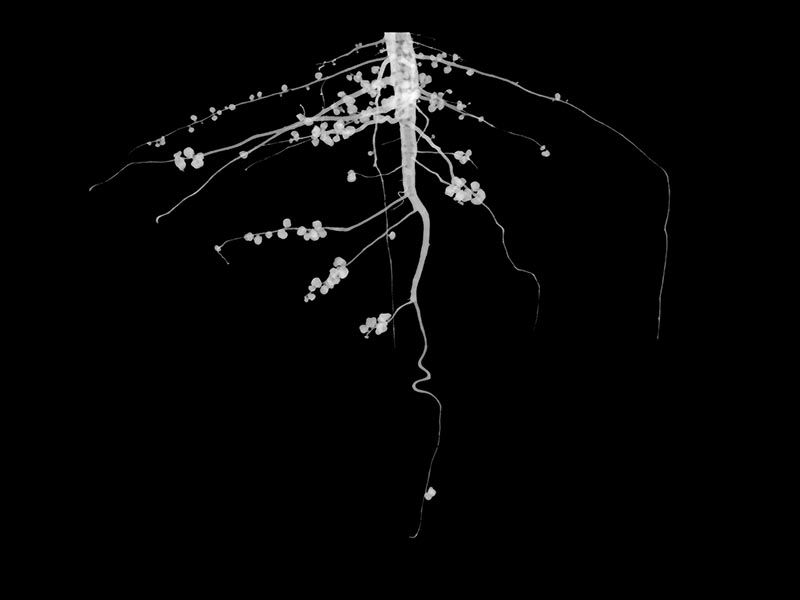
- The X-ray computed tomography (CT) scanner enables 3D non-destructive observation of the root and/or shoot in high temporal and high spatial resolutions. With this system, researchers can assess root growth and architecture over an extended period of time to determine how a plant's roots respond to a changing environment. This system also enables high-throughput phenotyping of seed kernels of different crops (e.g. wheat, barley).
DELIVERABLES FROM AAPF
Based on the user's requirements, we can provide the following data:
- Raw data collected
- Hyperspectral image, RGB image, X-ray CT image
- Phenotypic data spreadsheets which include genotype/hybrid, treatment, and phenotypic trait information extracted from the acquired images
- Exploratory data analysis of phenotypic traits
- Key phenotypic features or dimensionality reduction results
- Classification, regression or clustering results
- Figures and images that enable/facilitate visualization of the results
- Choose the programming language for data analysis depending on the analyst's experience
- Share learning resources, such as articles, papers and links, to help clients understand the data processing pipeline and methods
- Clearly communicating the goals of the experiment and analysis to the facility's team.
- Providing the AAPF team with clear and complete data on genotype/hybrid and treatments.
PLANT GROWTH AND PRECISION IRRIGATION
Two fully automated Conviron® growth chambers for more than 600 plants can provide precise environmental control over:
- air temperature
- humidity
- light intensity
- CO2 level (with the capability in CO2 enrichment in both chambers)
IMAGING AND MEASUREMENT
The facility possesses three fully automated imaging systems:- The RGB imaging system acquires color images, automatically segments the images, and extracts predefined parameters to quantify plant growth over time, leaf color and other morphological traits.
- The Hyperspectral imaging system has a scanning range in both the visible to near-infrared (VNIR) band (400-1000 nm) and the short-wave infrared (SWIR) band (1000-2500 nm). It employs a sensor-to-plant principle, with linear scanning mechanisms carrying the top- and side-view cameras to scan a plant in the imaging booth. This creates optimal, repeatable lighting conditions for image acquisition by shielding external light.
- The X-ray computed tomography (CT) scanner enables 3D non-destructive observation of the root and/or shoot in high temporal and high spatial resolutions. With this system, researchers can assess root growth and architecture over an extended period of time to determine how a plant's roots respond to a changing environment. This system also enables high-throughput phenotyping of seed kernels of different crops (e.g. wheat, barley).
DELIVERABLES FROM AAPF
Based on the user's requirements, we can provide the following data:
- Raw data collected
- Hyperspectral image, RGB image, X-ray CT image
- Phenotypic data spreadsheets which include genotype/hybrid, treatment, and phenotypic trait information extracted from the acquired images
- Exploratory data analysis of phenotypic traits
- Key phenotypic features or dimensionality reduction results
- Classification, regression or clustering results
- Figures and images that enable/facilitate visualization of the results
- Choose the programming language for data analysis depending on the analyst's experience
- Share learning resources, such as articles, papers and links, to help clients understand the data processing pipeline and methods
- Clearly communicating the goals of the experiment and analysis to the facility's team.
- Providing the AAPF team with clear and complete data on genotype/hybrid and treatments.
If you would like to access these collections/facilities for corporate research, please contact Strategic Partnerships for Agricultural Research and Collaboration.
SPARC