

Transgenic and Cloned Food Animal Guidelines Purdue University
Transgenic and Cloned Food Animal Guidelines for Purdue University
Overview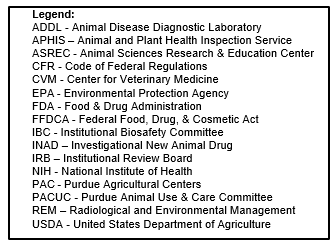
These guidelines provide a framework that Purdue University faculty, staff, administrators, and students should follow to facilitate any activity involving transgenic or cloned food animals (See definition below). These guidelines are meant to ensure complete compliance with all pertinent Federal guidelines associated with any activity conducted with transgenic and cloned food animals plus provide specific information on guidelines and procedures unique to Purdue University. Activity with transgenic food or cloned animals pertains to any use for which the University has legal responsibility. This includes, but is not limited to, activity conducted on the West Lafayette campus, at the Animal Sciences Research Center (ASREC),
or at any Purdue Agricultural Centers (PACs). The information contained in this document reflects guidelines and requirements found in various Federal agency regulatory documents plus input from Purdue University administrators, faculty, and regulatory officers. It is intended to be an evolving document, and will be updated as Federal guidelines and/or Purdue University activities necessitate revisions in this document.
- Scope: These guidelines for use of transgenic or cloned food animals at Purdue University are intended as a communication device for faculty, students, technicians, unit managers, and administrators. While the primary focus is intended for on-campus facilities and research farms associated with the Schools of Agriculture and Veterinary Medicine, the guidelines also may apply to research, testing, and educational activities conducted by other schools, Centers, Institutes, and units associated with Purdue Collaborative research with other universities may also require adherence to these guidelines.
- Purpose for the Guidelines: To facilitate activities with animals that typically could enter the human food chain, but cannot under current Federal guidelines if one or more transgenes are involved in the modification of the The intent is to meet all appropriate internal and external regulatory requirements, e.g., FDA, EPA, USDA-APHIS, REM, IBC, PACUC, and IRB.
Definition of Transgenic and Cloned Food Animals
A food animal is defined as a member of the species that are currently raised in the United States in commercial production systems for human consumption. Specifically, this includes cattle, swine, poultry, sheep, goats, and food fish such as catfish and trout. For the purpose of these guidelines, a transgenic animal is defined as an animal that has been experimentally manipulated to integrate recombinant DNA into the genome (chromosomal DNA) of their somatic cells or germ cells (germ cell precursors or cells that produce gametes). A cloned animal is defined as one produced from a somatic nuclear transfer.
(Note that non-transgenic food animals that have received injections of foreign DNA and/or other biologics may also be regulated under Federal animal drug regulations.)
These guidelines DO NOT cover laboratory animals, including those which may be consumed for food such as rabbits and guinea pigs. The guidelines do not include laboratory animal species even if they are in the same class of animal as a food animal. Thus, zebra fish and button quail would not be considered food animals for the purposes of this document. Also excluded are companion animals such as dogs or cats, exotic animals such as reptiles, native wildlife species such as deer and elk, aquatic invertebrates, and insects. However, the final determination of a transgenic or cloned food animal must be made by the appropriate Federal regulatory agency.
Federal Requirements
Many components of the federal government might have jurisdiction over some aspect of animal biotechnology. Currently, regulation of transgenic and cloned food animals resides in the FDA’s Center for Veterinary Medicine (CVM) http://www.fda.gov/cvm/biotechnology/biodrugs.html. Investigators planning such projects need to submit a request to the FDA CVM for determination if the activity needs to be performed under the authority of an investigational new animal drug exemption (INAD) or a similar provision. The INAD regulations are published in the Code of Federal Regulations, Title 21, Part 511.1(b). As part of the INAD submission, those conducting this type of research must document their plans regarding the disposition of all investigational animals after their participation in the study is completed. This is important in the case of animal species commonly used for food. Another requirement of 21 CFR §
511.1 is that the sponsor provide current monitoring studies. [21 CFR 511.1(b)(8)(ii)]1
The animal drug provisions of the Federal Food, Drug, and Cosmetic Act (FFDCA) best fit transgenic animals that have transgenic traits now being investigated and developed. The genetic modification of food animals to produce a human biologic (e.g., vaccine) or human or animal drug; or to optimize the nutritional value of derived food products; or to increase growth rate, reproduction, carcass characteristics or resistance to disease are the same as animal drug claims and can fall under the provisions of the FFDCA.1
The statutory food safety requirements for animal drug residues in genetically modified or cloned animals are the same as those for other animal drugs. Food products produced from genetically modified or cloned food animals must be as safe as those from non-transgenic animals; and the sponsor must demonstrate safety of the animal products before the animal can enter the food supply.1
It needs to be emphasized that while there are procedures to request approval to enter transgenic or cloned animals into the food or feed supply, to date, FDA HAS NOT PERMITTED THESE ENGINEERED ANIMALS TO BE PLACED INTO THE HUMAN FOOD SUPPLY. FDA has only allowed
animals from genetic engineering investigations to be rendered for incorporation into animal feed in limited circumstances. These limited circumstances do not include permission to render animals from an INAD approved process.2
Purdue University Approval of Transgenic and Cloned Animal Research
All activities involving the creation of transgenic animals must receive approval from the Institutional Biosafety Committee (IBC) prior to the start of any work. Information about the approval process may be obtained from the Researcher’s Guide, Biological Safety located at: http://www.adpc.purdue.edu/PhysFac/rem/home/files/researchers.htm
All research, educational, and testing activities involving the use of vertebrate animals (and changes to ongoing activities) conducted at or sponsored by Purdue University must receive approval from the Purdue Animal Care and Use Committee (PACUC) prior to initiation. Information about the approval process may be obtained on the PACUC website at: http://www.purdue.edu/Research/ORA/animals/animals-main.shtml
If the FDA CVM determines that an INAD submission is required prior to initiation of research involving creation of transgenic or cloned food animals, the Director of University Research Administration in the Office of the Vice President for Research must be notified prior to submission of the INAD documentation to FDA CVM.
Containment of Transgenic and Cloned Food Animals
Containment of transgenic and cloned food animals is critical to prevent spread of potentially harmful organisms into the environment. The level of containment should be consistent with the potential for physical, environmental or economical damage if such organisms escape. Similar concepts are utilized when determining containment level for pathogenic organisms, i.e., working with smallpox requires a much higher level of containment than working with chicken pox. Laboratory animals are all assumed to be physically contained due to the experimental nature of research projects to prevent environmental harms. Food animals, however, may present the same environmental risks as laboratory animals and in addition may present human health risks because they may be consumed, i.e., humans normally do not consume mice or zebra fish, but do consume sheep and tilapia. Regulatory overview of transgenic and cloned food animals by the FDA requires that such issues be clearly defined and containment methods be addressed prior to approval.
All experimenters utilizing genetically modified or cloned food animals (any animal or animal product normally consumed or rendered) must submit a request to the FDA in writing for an INAD approval. The request will address potential harms (human and environmental) from possible release or consumption of such animals, and methods to contain and dispose of such animals and their offspring. Upon approval, the letter and all containment methods and disposal issues must be clearly stated in an amendment to PACUC and IBC protocols, should be clearly posted on the facilities, and copies sent to appropriate department heads and farm and unit managers. (Note that FDA requires approval by an institutional animal care committee and IBC before approval. To avoid an impossible circular approval process, the PACUC and IBC must approve a protocol conditional on FDA approval).
As a guideline, the FDA considers all animals which are offspring of transgenic animals to be transgenic regardless of whether they carry the actual transgene. The concern of the FDA is that other gene elements or fragments may have been incorporated in the genome during the transgenesis process and cannot be tested for because they are unknown. As such, all progeny of transgenic animals must be contained and disposed of as if they were transgenic. In order to prevent accidental and possible unknown matings with transgenic animals, such animals should be biologically contained (physically neutered and verified), or physically isolated from non-transgenic animals. When possible, transgenic animals, particularly large animals, should be identified with distinctive tags for quick visual verification that transgenic animals have not escaped and mixed with non-transgenic animals. All of these recommendations are subject to review and approval by the FDA.
Disposal of Cloned and Transgenic Animals and Tissues
When a cloned or transgenic animal is euthanized or dies, the entire carcass shall be clearly tagged and disposed of to avoid its use as food for human beings or animals, unless food use is specifically authorized by an appropriate Federal agency. For disposal, all tissues from such animals will also be double bagged and tagged. Disposal shall be by incineration unless other means are specifically authorized in writing by the cognizant Federal agency. Dead transgenic and cloned animals and tissue shall be kept in a secure area, a locked freezer if feasible, until transportation for incineration has been arranged. Methods to move the transgenic animal carcass from the point of containment to the incinerator shall be determined by PACUC and IBC during the approval process. The ADDL (Animal Disease Diagnostic Laboratory) shall have prior notification that a transgenic animal/carcass or its tissues are to be delivered to the ADDL. A permanent record shall be maintained at the ADDL of the experimental use and disposal of each animal or group of animals.
Marketing
Under current U.S. Food and Drug Administration protocol, no transgenic or cloned food animals may enter the food chain. Furthermore, all such animals, upon death or when euthanized during the course of the research activity, must be properly incinerated.
Authorization
These guidelines were generated from input from faculty, staff , and administration across several departments in the Schools of Agriculture and Veterinary Medicine. Because of expected Federal regulatory changes and advances in transgenic knowledge, these guidelines will be reviewed annually. Changes will be communicated to faculty, staff, and administrators through the Office of Agricultural Research Programs.
Approved on this day: 6/25/2004
Dr. William R. Woodson, Director Agricultural Research Programs
1Animal Biotechnology: Science Based Concerns . Committee on Defining Science-Based Concerns Associated with Products of Animal Biotechnology, Committee on Agricultural Biotechnology, Health, and the Environment, National Research Council. 2002. http://www.nap.edu/catalog/10418.html
2 CVM Letter to University of Illinois at Urbana-Champaign, September 29, 2003