

Crop and Plant Transgenic Research Management Guidelines for Purdue Agricultural Centers
Date: 3 February 2003 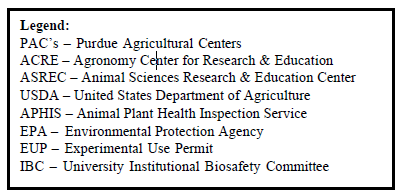
Overview:
These guidelines provide a framework that staff at the Purdue Agricultural Centers (PAC’s, ACRE, and ASREC) and researchers should use to facilitate field studies utilizing conventional and transgenic crops and/or plants. The implications of undertaking studies with transgenics at the field level are numerous, and these guidelines do not nor cannot address all issues related to such work. However, they will provide valuable information to all who work with or deal with the products of transgenic crops and/or plants. Much of the following information was derived from a “Farm Level” Transgenic Subcommittee made up of faculty and staff from several departments within the School of Agriculture.
Purpose for Guidelines:
To maintain locations where novel research and demonstration work can be performed while meeting environmental, good neighbor, good agricultural practice, and crop marketing responsibilities and considerations at the Centers.
Definition of Transgenic Crops and Plants:
For the purpose of these guidelines, the term “transgenic crops and plants” (or “transgenics”) means any plant or resulting seed manipulated by recombinant DNA technology to express a gene encoding a novel trait.
Transgenic Studies at Agricultural Research Centers:
For Center Staff and Researchers:
To continue to provide for novel research and demonstration field studies with transgenics at the Centers, the following issues must be addressed before such studies can be initiated at the field level:
- Documentation of Research Requests. Whether transgenic or conventional, prior to commencing with fieldwork, ALL research requests must be communicated to the Superintendent/Unit Manager of the Center where the work is to be Study needs and restrictions must be noted in each PAC “Request of Research” form (see attachment).
- Proper approvals for pre-commercial transgenic field research. Any field study with a pre-commercial transgenic crop or plants requires that a United States Department of Agriculture – Animal Plant Health Inspection Service (USDA – APHIS) Permit and an Environmental Protection Agency (EPA) Experimental Use Permit (EUP) to be secured prior to planting such a study at the Center(s). In addition, internal approval must be secured from the university’s Institutional Biosafety Committee (IBC) utilizing IBC Form 1A. Copies of approved permits and forms or information related to such permit application must be provided to the Superintendents/Unit Managers at Center planning meetings. Superintendents/Unit Managers must keep a copy of the approved permits and IBC form as part of their records for the field(s) where the transgenic crop or plants will be planted.
- Documentation of Technology Agreements.
- Researchers must provide copies to the Superintendents/Unit Managers of the Centers of any written technology agreements for the use of transgenic seed or plant material provided by industry, purchased from industry, or secured from other parties for use in their studies at the Centers. Such agreements must be approved by the Office of Contracts & Grants and/or the Director of Purchasing.
- Requests by Superintendents/Unit Managers for commercial transgenic seed or plant material for their own bulk production that require the signing of a technology agreement must be forwarded to their departmental business office for review, approval, and Under no circumstances are Supe rintendents/Unit Managers allowed to sign any documents, agreements, etc. for such transgenic seed or plant material. (Exception: As a result of a “Research License” from Monsanto Company in the fall of 2002, Roundup Ready®, YieldGard Corn BorerTM, and Bollgard® Technology Agreements can be signed by PAC Superintendents or Center Coordinator (for ASREC)).
- Field Level Requirements with Transgenic Field Studies. The organization and placement of research and demonstration studies and bulk production with transgenic crops and plants at the Centers must be done in accordance with the following guidelines:
- “Set Back” Requirements – Researchers and Superintendents/Unit Managers will follow APHIS-permit required set back distances for all pre-commercial trans Similarly, Researchers and Superintendents/Unit Managers will follow set back distances for commercial transgenics that are stipulated by industry and are in accordance with best agricultural practices. For specified set back distances, Superintendents/Unit Managers will have the authority and are expected to place studies and bulk production in areas that do not compromise neighboring farm crops and/or other studies at their Center. “Set back” requirements that are very restrictive may prevent the study from being conducted at a particular Center.
- Neighbor Notification – Superintendents/Unit Managers will notify neighboring farmers of the existence of transgenic field studies involving pre-commercial crops/plants using a standardized notification letter that will be available from the Office of the Director of Agricultural Research Written notification will also be mandatory for studies involving pre-market release technology agreements for commercial transgenic “open pollinated” field corn. Neighboring farmer notification will stress Purdue University’s adherence to all APHIS, EPA, university and industry stipulations including stated “set back” requirements.
- In-Field Study Management – The principal investigator (faculty or staff member) will be responsible for maintaining his or her transgenic study(ies) according to the technology agreements and/or permit requirements. Failure to adhere to protocol requirements may jeopardize other field studies and will result in a review of field efforts by his/her Department Head and the Office of Agricultural Research
- Completion of Field Studies – The principal investigator (faculty or staff member) of a transgenic study will be responsible for the disposal of plant material or movement of crop out of the field according to the technology agreement and/or permit Superintendents/Unit Managers must be notified BEFORE plant material or crop product is harvested from completed research or demonstration studies. If there is marketable grain from a particular transgenic study, the principal investigator will work with the Superintendent/Unit Manager to determine whether the transgenic grain must be handled and stored separately (identity-preserved) and how best to move the grain to sale without compromising other commodities produced at their Center. Failure to adhere to this requirement will result in a review by his/her Department Head and the Office of Agricultural Research Programs.
For Superintendents/Unit Managers:
The long standing policy for marketable grain produced at Purdue Agricultural Centers has been that the Center receives the income from all commodities produced at their particular location. It is from such sales that the Centers are able to defray the cost of providing inputs, equipment, and expertise for the undertaking of field studies. With transgenic field studies and/or bulk production, the movement of commodities such as corn and soybeans to market has been complicated by the fact that certain buyers of such commodities are now placing restrictions on the type of transgenics that they will purchase. To maintain current market opportunities and minimize the risk of market loss or legal misrepresentation of grain produced at the Centers, Superintendents and Farm/Unit Managers should be aware of the following guidelines:
Guidelines for Marketing Transgenic Commodities
- Superintendents/Unit Managers will make a concerted effort to document movement of harvested transgenic grain from the field to on-site storage facilities and/or to Records should at a minimum include: Field ID, Crop Variety/Hybrid, Transgenic Trait, Harvest Date, Handling Treatment (e.g., from field directly to storage bin A, from field directly to market, from field through receiving system and dryer to storage bin A), Market/Sale Date, Transportation Information (e.g., delivered with PAC Truck, delivered by trucking company ABC), Elevator Ticket(s) and Sales Receipt with Buyer Contact Information. Proper planning and continual communication with researchers is critical to preserving the identity of all grain or plant material as it moves from the field to markets.
- Superintendents/Unit Managers will have knowledge of any marketing restrictions for businesses that they sell and deliver grain to. The primary issue of concern is the delivery of grain (primarily corn) that contains transgenic material that may have full S. food and feed approval but may not be accepted by all domestic processors and exporters. An excellent resource is the web site (asta.farmprogress.com) provided by ASTA that helps growers locate grain handling facilities that have indicated a willingness to purchase, receive, and handle genetically enhanced corn products that have full U.S. registration for food and feed use, but are not yet approved for import into the European Union. Any verbal restrictions should be noted and adhered to in the spirit in which it was presented. Written agreements or documents for doing business with an elevator or other market destination will be forwarded to our internal Office of Contract & Grants for review. Under no circumstances should Superintendents/Unit Managers sign any documents, agreements, etc. guaranteeing any level of non-transgenic purity for grain produced at their particular Center.
- Superintendents/Unit Managers will make every effort to seek information from neighboring farmers in order to document any transgenic crop production near their particular Center. If such production occurs, reasonable attempts should be made to protect our research investment in field studies that stipulate certain levels of genetic purity (e.g. open pollinated crops).
- Superintendents/Unit Managers are ultimately responsible for grain that moves from their fields to the market. Therefore, if there is any doubt as to the genetic make-up or purity of grain produced from field studies or bulk production areas, all grain from such an area (with sensitivity to any and all set-back restrictions) will be treated as transgenic and will be marketed accordingly.
Conclusion
The mission of the Purdue Agricultural Centers is to provide locations and expertise for the development of ideas and research that will benefit producers and others involved in agriculture and other land use issues. Novel studies and ideas are furthered at the Centers, and adhering to these guidelines will allow for continual work with transgenic crops and plants, while still providing for marketing opportunities for commodities produced at the Centers.
Authorization
These guidelines were generated from input from faculty and staff across several departments in the School of Agriculture. Because of constant changes and advances with transgenic technology, these guidelines will be reviewed annually and changes communicated to faculty and staff through the Office of Agricultural Research Programs.
Approved on this day: February 4, 2003
Dr. Randy Woodson, Director Agricultural Research Programs