Edge Feathering
Edge Feathering at Southeast Purdue Ag. Center
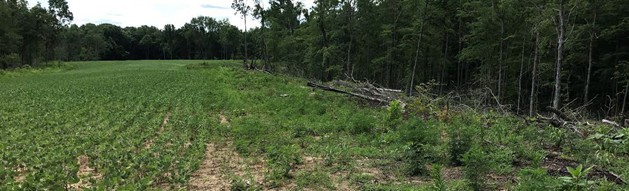
You may notice that some of the trees adjacent to crop fields at the Southeast Purdue Ag Center have been removed. You may even think some of the areas look messy and unsightly, but that is how they are meant to look. These areas are being managed to provide habitat for wildlife using a technique called edge feathering.
Weedy and shrubby fence rows once dotted the agricultural landscape of Indiana. These fence rows provided habitat for a variety of wildlife species like northern bobwhite and eastern cottontails.
Unfortunately, as the fence rows began to disappear so did wildlife that depended on them for food and cover.
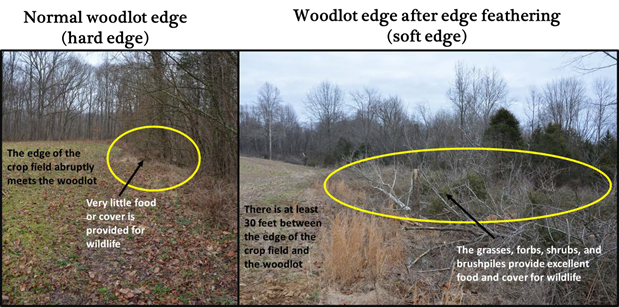
Edge feathering is a habitat management technique used to mimic the cover and food found in fence rows. Edge feathering is used around crop fields to increase food and cover for various wildlife species including, northern bobwhite, ringneck pheasants, white-tailed deer, and eastern cottontail. Food and cover are created by removing large trees adjacent to the crop field to allow smaller trees, shrubs, grasses, and forbs (broadleaf plants) to grow in their place. When you remove large trees, more sunlight is able to reach the forest floor allowing other plants to grow vigorously!
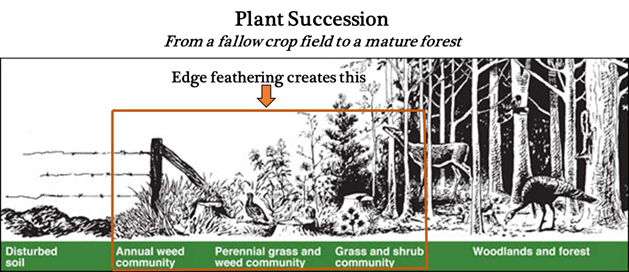
(Image adapted from University of Missouri Extension - http://outreach.missouri.edu/publications/DisplayPrinterFriendlyPub.aspx?P=G9494)
Edge feathering is a way of setting back plant succession. Plant succession is the orderly change in plant composition over time. For example, when a crop field is left fallow it will first be colonized by annual grasses and forbs, then by perennial grasses and forbs, and shrubs and small trees with invade the site creating shrubby cover needed by many wildlife species. Eventually the fallow field will turn into a forest. Edge feathering and other disturbances are used to maintain the edge of the field in early successional or weedy stages, those that are dominated by grasses and forbs as well as some shrubs. This creates excellent habitat for northern bobwhite, eastern cottontail, white-tailed deer, small mammals, and songbirds. Additionally, removing the trees helps decrease the amount of competition for sunlight and nutrients that crops face along field margins, potentially increase crop yields at the edge of the field.
Edge feathering creates excellent habitat for a variety of wildlife species because it creates a soft edge as opposed to a hard edge around crop fields. A soft edge between a crop field and woods is one that slowly transitions from crop field to mature forest by incorporating different stages of succession and therefore different plant communities. A hard edge is one that lacks this gradual transition and instantly goes from crop field to mature forest.