

Purdue University Has a Long History of Crop Production Work in Jennings County
Purdue University was organized in 1869 as the land grant university for Indiana. The intent of the federal land grant college program was “to teach such branches of learning as are related to agriculture and the mechanic arts”. Agronomy, agricultural engineering and agricultural economics were some of the first areas of agricultural study at Purdue. In 1911 the soil fertility work of the Chemical Department at Purdue was combined with crops work of the Agronomy Department to become the Soils and Crops Department. Also, in 1911, some of the first agricultural experimental fields were established throughout the state of Indiana including Jennings County.
The first Purdue agricultural experiments conducted in Jennings County were started in 1911 at the North Vernon Experimental Field which was located 2 miles east of North Vernon on the typical flat slash cropland of the area. This 4.5 acre experimental field was on property currently owned by Gene Hankins. This field was used for tile drainage work, lime and manure application and commercial fertilizer work. In the 1912 Annual Report of the Purdue Agricultural Experiment Station the Soils and Crops Department reported that they were frequently called upon to investigate crop production practices and keep the farmers informed in order to answer the constant stream of question coming from them. They were asked to provide data for agricultural lecture trains, farmer institutes, district short courses, and educational exhibits and demonstrations. One later report from the North Vernon Experimental Field showed that the land that had been tile-drained, limed, manured and a treated with a complete fertilizer on a corn, wheat and clover rotation produced excellent yields for all the crops. From 1911 to 1924 the corn averaged 75 bushels per acre, wheat 23 bushels per acre and clover hay over two tons per acre. This treatment, although considered expensive, had more than three times paid for itself in increased yields.
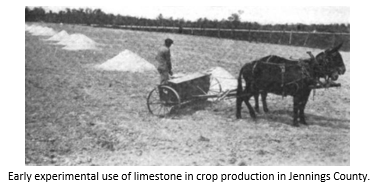
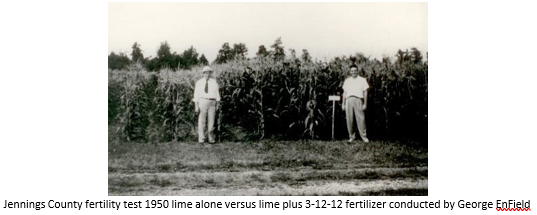
Further expanding Purdue’s field research, in 1920 the Jennings County Experimental Field was established on 40 acres of poorly drained land 4 miles north of North Vernon. The Purdue Agricultural Experiment Station in cooperation with the Board of Commissioners of Jennings County created the Jennings County Experimental Field. This is the same land that is now occupied by the Jennings County Fairgrounds. Some of the same types of experiments were conducted on the new Jennings County Experimental Field that had been done on the North Vernon Experimental Field. One report showed that tile-drained land gave an increase of 17.2 bushels of corn per acre the first year over untiled land receiving the same fertilization. In 1923 tile installation cost $50 per acre but tile-drained land, however, gave enough higher yields to justify the large expense and returned the cost in a few years. Liming and fertilization experiments continued to be very important.
In 1977 Purdue created the Southeast Purdue Agricultural Center (SEPAC) in Jennings County just west of Butlerville. That research operation is still active today and encompasses nearly 2500 acres. Once again one of the main objectives of the establishment of this research farm was to do crop production work and especially tile drainage work on the poorly drained soils of Jennings County. An extensive set of drainage plots were established but this time involved more modern technology of plastic tile and laser equipped installation equipment. Once again the use of manure, cover crops and crop rotations was studied in relation to tile drained soils. Additionally water quality studies became an important part of the drainage experiment.
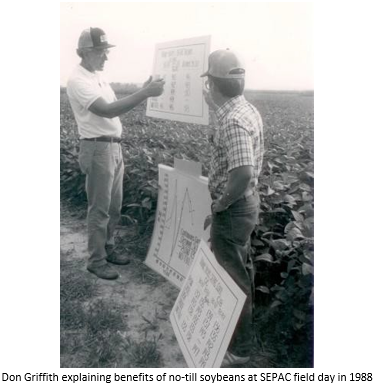
No-till farming has been studied extensively at SEPAC. Research conducted by Don Griffith from Purdue University in the 1980’s showed tremendous benefits to using no-till farming practices to both corn and soybeans. In a corn/soybean rotation, no-till corn yielded 11 bushels per acre more than chisel plowed ground and no-till drilled soybeans yielded 10 bushels per acre more than chisel plowed ground. Almost all of the crop production work including fertility and weed control studies done at SEPAC since the mid 1980’s has been done using no-till practices.
 The North Vernon Experimental Field, the Jennings County Experimental Field and the Southeast Purdue Agricultural Center are all examples of the commitment Purdue University has made to the people of Jennings County. These also are great examples of the intent of the federal land grant college program.