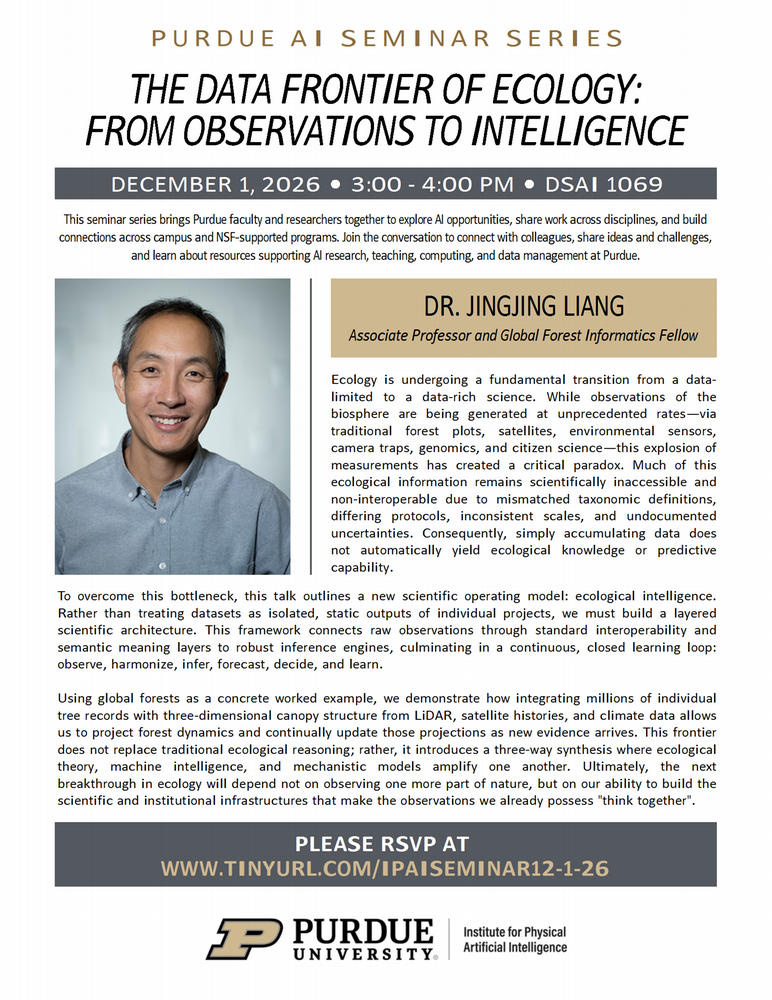
Purdue AI Seminar Series - Dr. Jingjing Liang - Ecological Intelligence
Join us on December 1st, from 3:00 PM to 4:00 PM at DSAI 1069, in attending "The Data Frontier of Ecology: From Observations to Intelligence," a seminar from Dr. Jingjing Liang, Associate Professor and Global Forest Informatics Fellow.
Ecology is rapidly transitioning from a data-limited to a data-rich science. In this seminar, Dr. Liang will discuss how advances in data collection, interoperability, machine intelligence and ecological modeling are transforming our ability to understand and forecast complex environmental systems. Using global forests as a case study, he will demonstrate how large-scale ecological observations, LiDAR, satellite data, and climate information can be integrated into a continuous learning framework that supports scientific discovery and decision-making.
This presentation will be of interest to researchers working in AI, data science, environmental science, agriculture, engineering, computing and related disciplines seeking new opportunities for interdisciplinary collaboration.
Interested attendees are encouraged to register with the registration form.
We hope you will join us for this engaging discussion, and encourage you to share the invitation with colleagues and members of your research groups who may be interested.
Poster Text:
Ecology is undergoing a fundamental transition from a data-limited to a data-rich science. While observations of the biosphere are being generated at unprecedented rates—via traditional forest plots, satellites, environmental sensors, camera traps, genomics and citizen science—this explosion of measurements has created a critical paradox. Much of this ecological information remains scientifically inaccessible and non-interoperable due to mismatched taxonomic definitions, differing protocols, inconsistent scales and undocumented uncertainties. Consequently, simply accumulating data does not automatically yield ecological knowledge or predictive capability.
To overcome this bottleneck, this talk outlines a new scientific operating model: ecological intelligence. Rather than treating datasets as isolated, static outputs of individual projects, we must build a layered scientific architecture. This framework connects raw observations through standard interoperability and semantic meaning layers to robust inference engines, culminating in a continuous, closed learning loop: observe, harmonize, infer, forecast, decide and learn.
Using global forests as a concrete worked example, we demonstrate how integrating millions of individual tree records with three-dimensional canopy structure from LiDAR, satellite histories and climate data allows us to project forest dynamics and continually update those projections as new evidence arrives. This frontier does not replace traditional ecological reasoning; rather, it introduces a three-way synthesis where ecological theory, machine intelligence and mechanistic models amplify one another. Ultimately, the next breakthrough in ecology will depend not on observing one more part of nature, but on our ability to build the scientific and institutional infrastructures that make the observations we already possess "think together".