

Student’s research explores maritime shipping of agricultural commodities
W
hen a ship ran aground and blocked the Suez Canal for six days in March, stranding more than 400 ships at one of the world’s busiest waterways, Manuel Jimenez stayed attuned to its impact.
Jimenez’s research at Purdue focuses on maritime shipping and international trade. The topics reflect his upbringing in Bogotá, Colombia, where his father operated a firm that exported flowers to the United States.
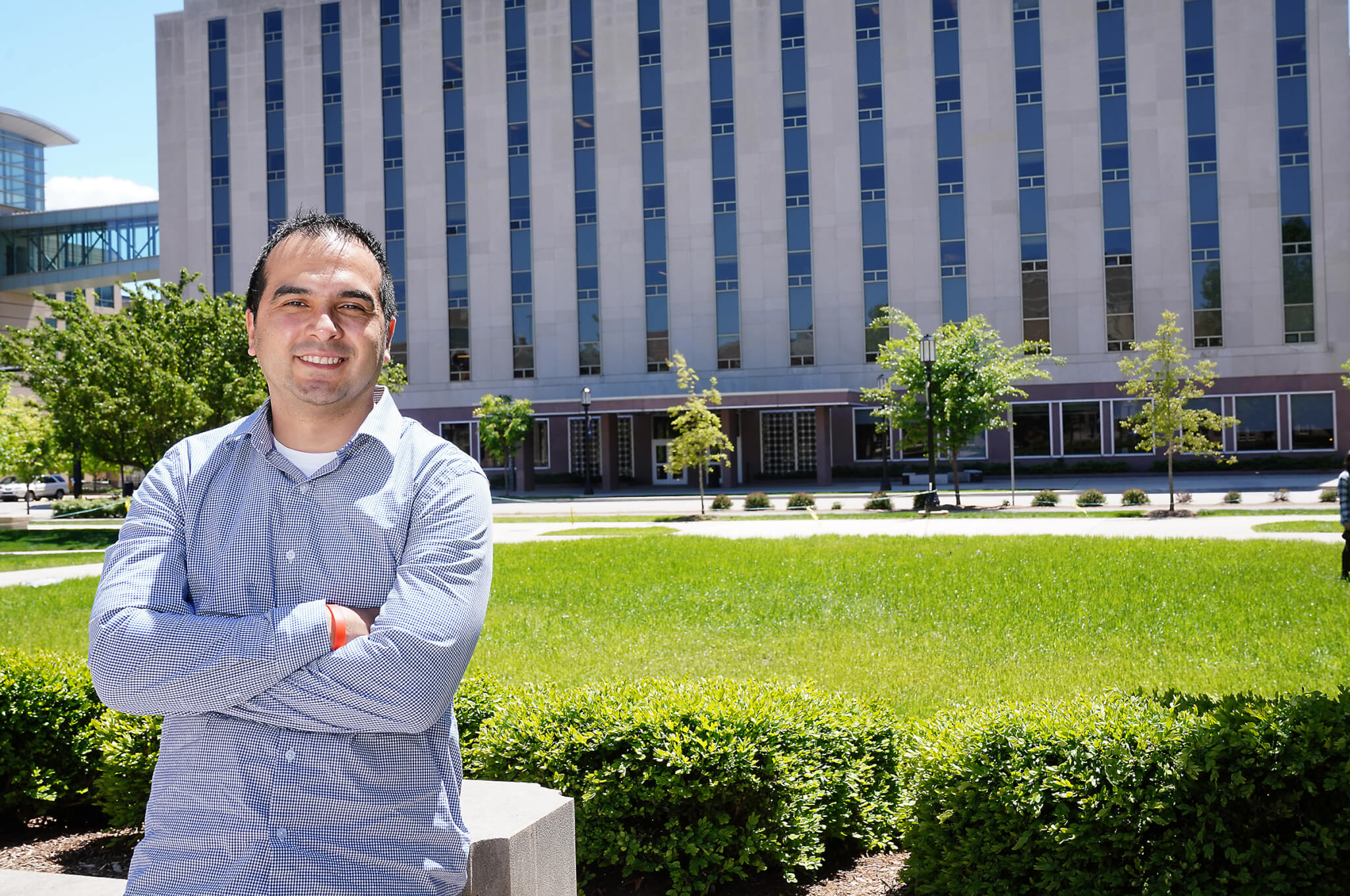
After earning bachelor’s and master’s degrees in economics at Los Andes University, Jimenez spent five years as an economic researcher at Asociación Nacional de Instituciones Financieras.
As he monitored and analyzed the impact of international trade on Colombia’s agricultural sector, Jimenez realized the country was not capitalizing on population growth.
“People were growing exponentially, but agricultural production was not,” Jimenez explained. “I was trying to become an expert to contribute, but I needed more preparation, a more global perspective.”
Through visiting his sister, who studied chemical engineering at Purdue, Jimenez was drawn to the agricultural economics department’s reputation for top-tier applied research.
Jimenez began classes at Purdue in 2014, completed a second master’s degree and began doctoral work in 2016 under the guidance of Russell Hillberry, professor of agricultural economics.
“Maritime shipping is critical for global supply chains, including agriculture,” said Jimenez. “Agricultural commodities are highly dependent because they are heavily-traded products. They typically have high weight-to-value-rations which makes other modes of transportation uneconomical.”
Jimenez’s research examines international cargo shipping, global value chains and trade costs. In one project, he studied carriers’ market power by measuring the margins they charge for shipping products to the United States. In another, he quantified the welfare benefits of shipping hubs and the intermediate transit through them, easing global trade and connecting much of the world.
Jimenez recently assisted in Hillberry’s International Agricultural Trade course (AGEC450) and in Macroeconomic, Trade and Policy Environment of the Food System (AGEC682). His efforts earned him the department’s teaching assistant award and a nomination for the 2020-2021 College of Agriculture Graduate Student Excellence in Teaching award.
Jimenez expects to complete his Ph.D. next summer and plans to find a research position with an international agency or private research institute in the United States or a developing country.
Featured Stories

The Office of Indiana State Chemist (OISC) is warning Indiana residents about an illegal...
A prominent protein on most human cells may be key to unlocking the code that makes humans...
Ava Hoskins, a double major in aquatic sciences (fisheries concentration) and natural resources...
Ashlynn McLaughlin, a senior aquatic sciences major with a concentration in marine and freshwater...

For Brody Cox, preparing for the Indiana State Fair began long before he entered the show...
Carolyn Foley, a long-time member of the Purdue Forestry and Natural Resources (FNR) and...