

Beauty and power beneath the surface
A tree-shaped curio sits atop a bookshelf in Anjali Iyer-Pascuzzi’s office. It looks ominous, but turn the tree upside down and its bare branches transform into a beautiful, intricate root system replica.
Perhaps this curio symbolizes a larger issue in plant science research — the vast untapped potential of roots.
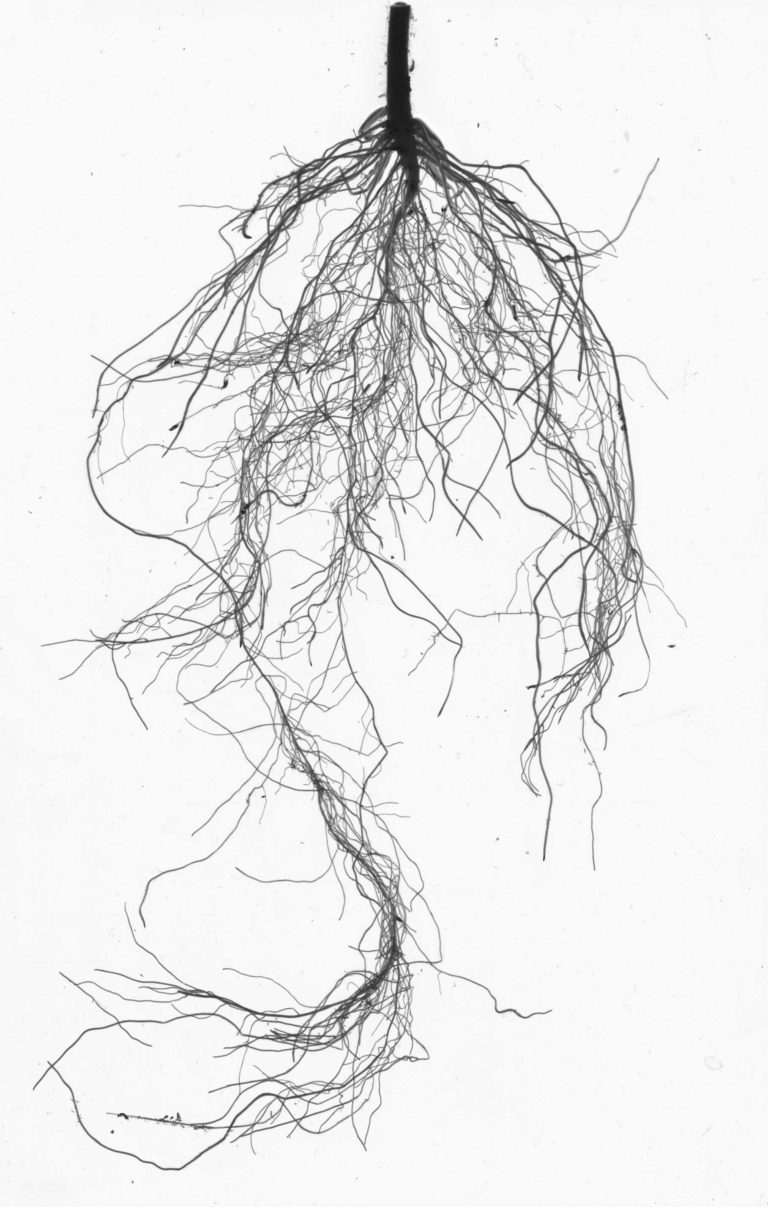
“Roots are important to agriculture, and they have not been as well studied,” says Iyer-Pascuzzi, assistant professor of botany and plant pathology at Purdue. “One way to improve crops is by improving roots, and there’s a lot we don’t understand about that.”
Iyer-Pascuzzi’s lab focuses on mechanisms of disease resistance in roots to soil-borne pathogens. She looks at the relationship between tomato and a bacterial pathogen called Ralstonia solanacearum, which is common in the hot and humid southeastern United States. This devastating bacterium causes over 90 percent of disease outbreaks in tomatoes.
“Because it’s a soil-borne pathogen, Ralstonia is difficult to control,” says Iyer-Pascuzzi. “When it gets into a plant’s roots, it prevents water from moving to the shoot, and the result is called bacterial wilt. The infected plant looks like it’s been under severe drought, even if it hasn’t.”
There are tomato varieties resistant to Ralstonia, but nobody wants to eat them, says Iyer-Pascuzzi. The resistant varieties lack the horticultural traits that susceptible varieties have. In other words, resistant tomatoes aren’t delicious like those you find in the grocery store.
Most of the research that’s been done on bacterial wilt has focused on above-ground symptoms or on the bacterium itself. Not a lot of research is focused on root immunity, which is where Iyer-Pascuzzi’s lab comes in.
Iyer-Pascuzzi uses imaging systems to see where bacteria are in a root. She’s discovered that bacteria take longer to get to the xylem, where they live, in resistant plants. By the time the bacteria arrive, the plant has already activated its defense responses. But what takes the bacteria so long to get there? Does it have to do with the strength of the root, or is it based on gene expression differences? These are the questions that Iyer-Pascuzzi tries to answer.
Her lab collaborates with other researchers to address this issue. While Purdue is focused on the plant side of the relationship, a group in Wisconsin works on the bacterial side. And because it’s dangerous to expose Indiana soil to Ralstonia, another group in Florida conducts tests in already-infected Floridian soil.
One hypothesis Iyer-Pascuzzi’s lab has formed relates to root architecture, or how branches are organized in a root system. The hypothesis is that lateral branching patterns are important for root immunity.
“We have some preliminary data that shows that roots of resistant plants produce more lateral branches after they’ve been inoculated, but we don’t know whether this is directly related to resistance or not,” says Iyer-Pascuzzi. “It’s a hard question to answer because every time you grow a plant in soil, you have to pull the roots out of the soil system, and the roots get damaged.”
A new computed tomography root scanner, donated to Purdue’s Controlled Environment Phenotyping Facility by Ag Alumni Seed, will help Iyer-Pascuzzi’s lab solve this problem. The new imaging system, expected to be operational in 2019, will allow researchers to view a root before and after a stress, like drought or bacteria, is applied, without damaging it. Seeing how the root changes during this process will help Iyer-Pascuzzi understand what traits are important for Ralstonia resistance.
Disease resistance is not controlled by just one gene; it’s a collaboration of multiple genes. If researchers can identify those specific genes, then tomato breeders can use them to create resistant varieties. And because tomato is closely related to other crops also affected by Ralstonia, like potato and eggplant, it’s possible that this research could be applied to those crops in the future.
But roots aren’t just powerful and packed with potential for agricultural productivity. They’re also beautiful. Much like the curio on Iyer-Pascuzzi’s bookshelf, the beauty and importance of roots may be hard to see at first.
“Roots aren’t boring,” says Iyer-Pascuzzi. “They are dynamic. They respond to the environment. They have this outside structure, but if you look inside, they’re shockingly beautiful.”
Featured Stories

Maksym Chepeliev, a leading international scholar recognized prominently for his work in...

In recent years attendees at Purdue Agriculture alumni, donor, and faculty and staff events have...

The Office of Indiana State Chemist (OISC) is warning Indiana residents about an illegal...
A prominent protein on most human cells may be key to unlocking the code that makes humans...

In the September Purdue University/CME Group Ag Economy Barometer survey, 52% of respondents...

Purdue University’s College of Agriculture recognized nine alumni at the Distinguished...