

Behind the Research: Chloe Richard
About the feature
Many people are involved in the remarkable range of programs, services and facilities that undergird research in the College of Agriculture. Collectively they’re integral to the college fulfilling its research mission. “Behind the Research” explores their individual roles. Each academic year, we profile six people whose work supports the College of Agriculture’s global reputation for developing innovative, multidisciplinary solutions to challenges and then putting those solutions into action.
Chloe Richard, Horticultural Crops Research Manager, Meigs Horticultural Facility
- Helps researchers create better processes for the future of farming, including new technology.
- Shares her passion for promoting careers in agriculture to youth by leading farm tours for young people from learning communities, university groups, local grade schools, youth groups and others.
- Current projects include implementing an online database for daily farm tasks to replace notebooks with an archive of previous work and securing a spray drone, including completion of the required certifications and license.
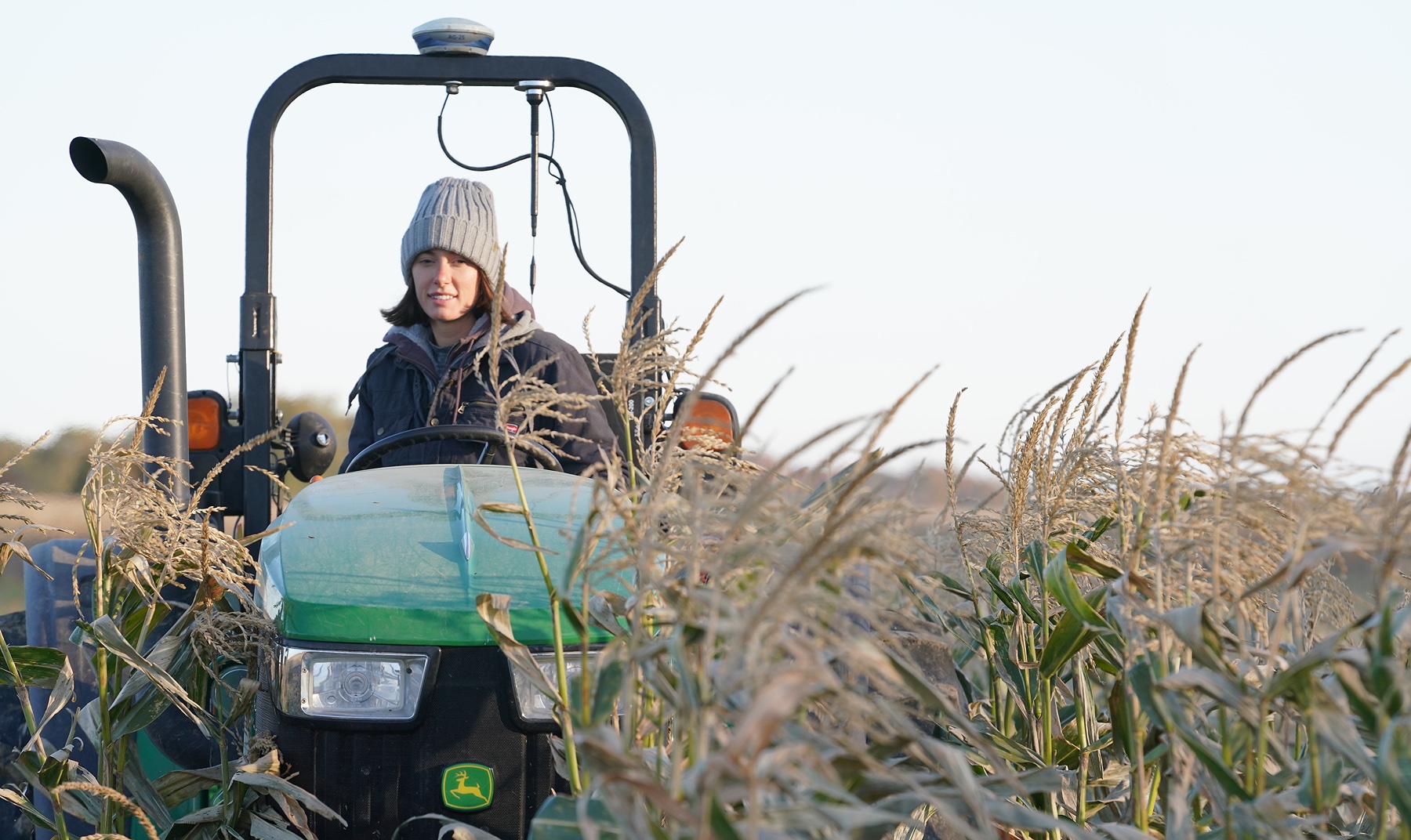
Just three years out of school, Chloe Richard is the youngest person profiled to date in the Behind the Research series. As horticultural crops research manager at Meigs Horticultural Facility, part of Throckmorton-Purdue Agricultural Center, “I’m putting myself out there and working long hours to learn what I need to learn,” she says.
“A workday isn’t eight hours, not anymore. Waking up in the morning and having that mindset makes me go above and beyond.”
She attributes her work ethic to her farm background and working multiple jobs. Richard came to Purdue for undergraduate study from her family’s dairy farm in Rochester, Indiana. She graduated in 2019 with a degree in agricultural systems management, a minor in horticulture and farm management, and a certificate in entrepreneurship. “I was intrigued by the mechanical side of the major,” she says. “I knew I wanted to grow crops, but I also wanted to be more well-rounded.”
That balance took her to Miami, where she worked for nearly three years at Costa Farms. There she was promoted from grower to manager of a 5-acre trial garden, which included collecting weekly data on the ornamental plants, and preparing a show garden for the company’s Season Premier.
Richard returned to Purdue to join the staff of the Meigs Horticultural Facility in May 2022, attracted by the opportunity to expand her knowledge. “I wanted to learn how to grow fruits and vegetable crops and work with the researchers in different departments,” she explains. Not surprisingly, the idea of working with equipment and large machinery also appealed to her.
Today Richard is responsible for managing the land and equipment to grow research crops at the farm, which includes an apple orchard, vineyard, specialty crops and cover crops. She oversees fertilization and irrigation as well as groundskeeping and machinery maintenance. Richard credits “a great team helping me” to accomplish the many tasks.
More broadly, “the sole purpose of my position is to support professors, students and the College of Agriculture,” she adds. “Everything I do is for the benefit of Purdue research and those completing the research.”
Richard especially enjoys collaborating with researchers from up to eight College of Agriculture departments — faculty members, postdocs, graduate students, undergraduates and visiting scholars.
Well before planting season, she meets with project leaders to discuss what they want to plant. She draws out a plan for their review, creates and cultivates the beds, and grows out all research crops. Important tasks include scouting all crops biweekly, creating and executing pesticide application schedules for each plot, and ensuring the project leads have all equipment necessary for collecting data and harvest. “There are a lot of moving parts for this position, but luckily I have the best team of colleagues and researchers supporting me.
“I really like that it’s always different research, and we’re always faced with a new challenge,” she says. “That’s the most exciting part of my job.”
Richard and her team are busiest from spring to early fall when crops are active. Her greatest challenge, she adds, is keeping an eye on everything so every aspect of the farm runs smoothly and everyone is kept well informed.
As she approaches her first full year on the job, Richard plans to keep learning and putting in the hours. “Although I’m relativity new in my position, I have big plans for the future of Meigs Horticultural Facility,” she says.
Featured Stories
For Brody Cox, preparing for the Indiana State Fair began long before he entered the show...
Carolyn Foley, a long-time member of the Purdue Forestry and Natural Resources (FNR) and...

In the September Purdue University/CME Group Ag Economy Barometer survey, 52% of respondents...
Purdue University’s College of Agriculture recognized nine alumni at the Distinguished...
Keep your eyes peeled across Indiana for the newly minted Purdue Forestry and Natural Resources...
“Being at Purdue has changed my thinking entirely,” says Mingyu Zhao, a third-year...