

Making a difference with a tap on an app
The SAWBO app shares Extension knowledge with a global audience
Every morning, Barry Pittendrigh, Purdue’s John V. Osmun Endowed Chair in Urban Entomology and Director of the Urban Center, sits down with his coffee and taps open the back-end data display associated with an application. On his phone screen is a map covered in dots. There are clusters over Southeast Asia, Africa, Latin America and beyond.
These dots represent the impact of a new app from SAWBO (Scientific Animations Without Borders), a digital library of extension information in the form of animated videos. Pittendrigh and Julia Bello-Bravo, an assistant professor of agricultural sciences education and communication, launched the application last year after working on SAWBO since 2011. The app takes the basic idea behind extension – sharing research and innovation with stakeholders in the community – and scales it globally. It has been downloaded by approximately 200,000 users, reaches 1,000 users a day and is being used around the globe to share research for development (R4D) knowledge.
“We wanted a way to take the expert knowledge you find on campuses like Purdue, package it, and make it accessible to people across hundreds of languages,” Pittendrigh says. “It seemed like an insurmountable task. But history is loaded with examples of inaccessible things that become accessible – just think of where we have gone from Alexander Graham Bell’s first phone call to cell phones found in some of the remotest places on the planet.”
To make R4D knowledge accessible, Pittendrigh, Bello-Bravo and the SAWBO team have created a system for choosing research that’s most relevant to people in the Global South, turning it into simple, actionable advice, and putting that advice in video form. The new app makes this digital library even more accessible – anyone with an Android device can access how-to videos literally in the field (an iPhone version is coming soon).
There are currently over 200 videos covering topic areas ranging from using solar grain dryers to preventing dengue fever to processing cheese. Video is a more accessible format than written words, since 800 million people worldwide have low literacy skills, Bello-Bravo and Pittendrigh say. And the use of animation as opposed to live action filming makes the content more scalable across communities, cultures and languages.
“Animation is cross-cultural and can reach wide target audiences,” Pittendrigh says. “Walt Disney figured that out a long time ago.”
“You can also easily do cultural adaptations,” Bello-Bravo adds. “If people want a different background, we can change the background.”
On any given morning, a dot on the SAWBO map may represent a farmer in the Democratic Republic of Congo learning to vaccinate his cattle against East Coast Fever, a landowner in Laos learning techniques for greater rice yield, or a gardener in Peru learning about drip irrigation. The topics were chosen in consultation with experts and local stakeholders worldwide. All of these people get to watch the video in their own language.
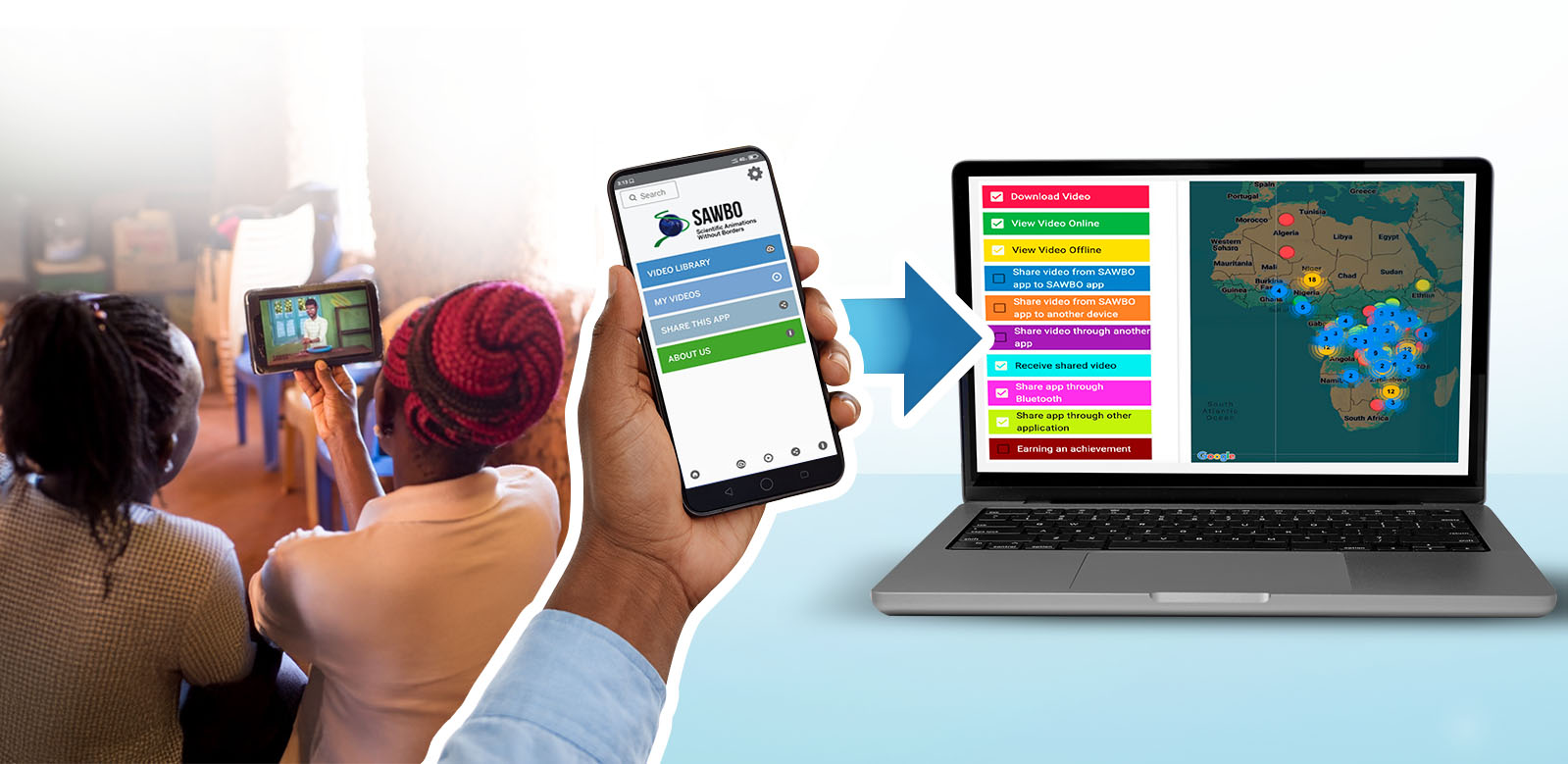
“The videos enable users to have impacts in their community,” Pittendrigh says.
SAWBO videos are free to use. Users might be organizations, such as NGOs, government ministries of agriculture, hospitals or TV stations, or they might be individuals. In many cases, the SAWBO team has no idea who is using the app – and that’s a success. Pittendrigh points out a dot on the SAWBO map over eastern Chad, near the border with Sudan. From what they can determine there appears to be a refugee camp there, Pittendrigh says. He doesn’t know who is using the app there, but someone accessing it in a remote area is exactly the point of the app.
“We have a system and a pathway where we can take research for development information knowledge and put it into the app, and people can draw upon the videos in the app in any part of the world, for very low cost – only the price of internet service,” Pittendrigh says. “It is a system to scale research for development educational content globally in a profoundly cost-effective manner and it is available for people want to pull this information.”
SAWBO videos have been translated into some 300 languages. Some are major world languages – French, Spanish, Arabic, Portuguese, Chinese – while others are regional languages spoken by perhaps only a few hundred thousand. The translations are done partly via grant funding and partly through volunteer efforts.
“I want to emphasize the role of volunteers,” Bello-Bravo says. “When we have funding, we can pay translators. But sometimes people are interested in translating videos into the language of their own communities; we do training for people who want to volunteer.”
Purdue has been an especially supportive environment to develop the app, Pittendrigh says. “Purdue has a long tradition of being globally engaged, especially in the College of Agriculture,” he says. "There’s a network of globally engaged faculty who help drive research and collaborations around the world, and that’s very helpful in terms of creating new content. For example, we have worked with Dr. Laura Ingwell in the Department of Entomology to create content on rearing of black soldier flies from food scraps for use in animal feed.”
The team’s ultimate goal is for the information in the videos to be so readily accessible and so thoroughly shared that it becomes “common knowledge” in local communities, Pittendrigh says.
“People at the bottom of the socio-economic pyramid globally still have a right to knowledge,” says John Medendorp, Urban Center Associate Directory and Strategy Development Specialist with SAWBO. “But our societies have classically not been willing to spend the money to get knowledge into people’s hands. If a society is not willing to spend resources, then we’re going to have to drive costs down dramatically so we can try to make the barriers to access almost non-existent.”
The right to knowledge promoted by the SAWBO app is the topic – and the title – of a new book by Bello-Bravo, Pittendrigh and colleagues Anne Namatsi Lutomia and John William Medendorp. The Right to Knowledge: A Learning-Systems Approach for the Sustainable Development Goals, offers tangible steps on how to make knowledge available to everyone, even those with the least resources.
“When drought occurs, our drip irrigation video becomes far more popular,” Pittendrigh says. “When cholera outbreaks occur, we see spikes in our cholera video. When we get out of bed and have our coffee, we can see the global impact we’re having.”
Featured Stories
The Office of Indiana State Chemist (OISC) is warning Indiana residents about an illegal...
A prominent protein on most human cells may be key to unlocking the code that makes humans...
Ava Hoskins, a double major in aquatic sciences (fisheries concentration) and natural resources...
Ashlynn McLaughlin, a senior aquatic sciences major with a concentration in marine and freshwater...

For Brody Cox, preparing for the Indiana State Fair began long before he entered the show...
Carolyn Foley, a long-time member of the Purdue Forestry and Natural Resources (FNR) and...