

Jingxian An - Postdoctoral Scholar Feature
My research centers on public health through food science — whether developing healthier food formulations with alternative proteins and fibers, or protecting supply chains from pathogens like HPAI. Both approaches serve the fundamental goal of ensuring people have access to safe, nutritious foods.
- Jingxian An, postdoctoral researcher in Food Science
The Path Here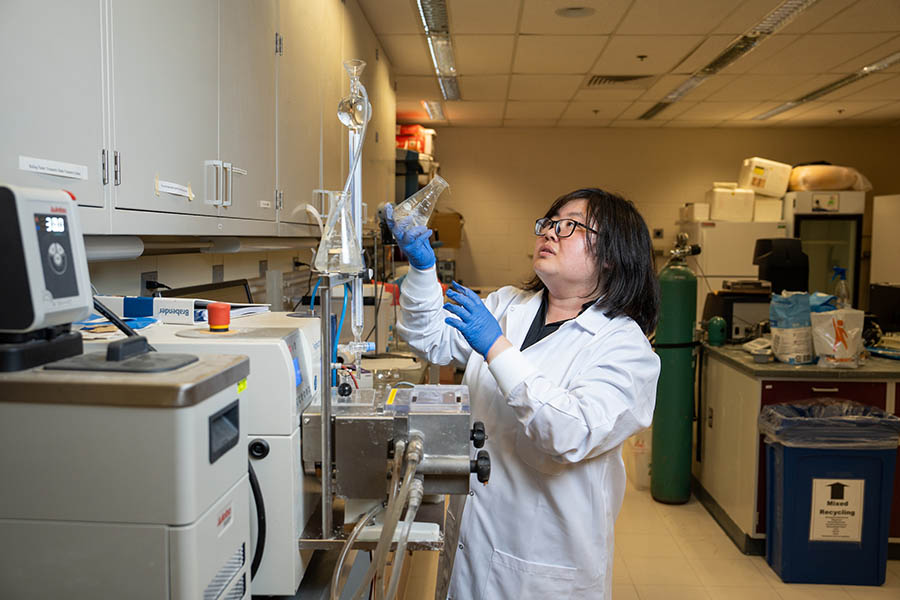
Jingxian An has always been interested in the science of what people eat and drink, whether pharmaceuticals, alcohol or food. As an undergraduate and master’s student in pharmacy, she studied traditional Chinese medicine. Her master’s thesis looked at the analgesic and anti-inflammatory abilities of dried cattail pollen, commonly used to stop bleeding and relieve swelling and pain. Later, in her PhD studies at the University of Auckland in New Zealand, she focused on pinot noir wines, testing whether machine learning could predict wine quality and wines’ extrinsic cues, such as vintage and provenance.
As a postdoc in Purdue’s Department of Food Science, she studied flours, incorporating machine learning tools to figure out how to add proteins and dietary fibers to wheat flour without degrading the taste and texture of the final product. Recently, she started working on a major project sponsored by the USDA on addressing the challenge caused by highly pathogenic avian influenza (HPAI).
“Really, I’ve been working with things that affect what people consume this whole time, whether it’s medicine, wine or flour-based foods, or tackling issues like HPAI that influence food accessibility and the pricing of essential proteins like eggs and chicken,” An says.
The Work
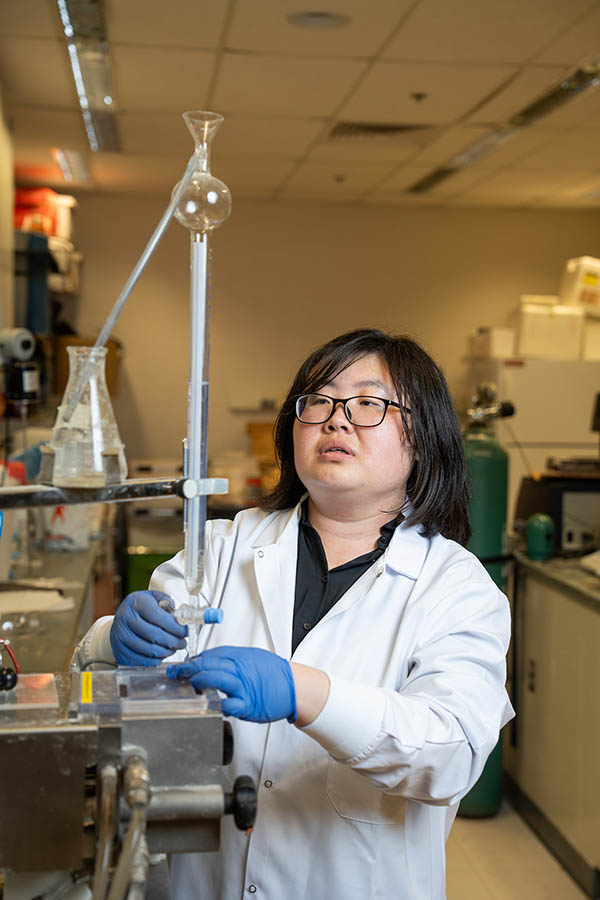
“My research centers on public health through food science — whether developing healthier food formulations with alternative proteins and fibers, or protecting supply chains from pathogens like HPAI,” An says. “Both approaches serve the fundamental goal of ensuring people have access to safe, nutritious foods.”
Working with Professor Yuan Yao at Purdue’s Whistler Center for Carbohydrate Research, An has applied her machine learning research to making baked goods healthier.
“There’s growing public interest in at least partially replacing starch with protein and dietary fiber for health benefits, but these systems are incredibly complex,” she says. “When you start substituting ingredients, the interactions between protein, fibers, starch, oil and water are really complicated. They all work together to affect products’ texture, taste and functionality.”
In the year since An arrived at Purdue, she's built two main databases. The first contains more than 2,000 flour-based formulations and their mechanical properties, such as texture. Creating these formulations uncovered some interesting phenomena, she says. For example, different protein sources can share surprisingly similar mechanical properties, and plant-based fibers commonly found in supermarkets can produce significant — and unpredictable — changes to dough. But the same fibers, physically treated, can be incorporated with fewer and more predictable changes to the final product.
An’s new HPAI project with Yao brings her full circle, from the pharmaceutical science of her undergraduate and master's years to infectious disease research. An says her food work and HPAI drug work share a theme: improving ingredients and advancing formulations.
“The HPAI project addresses critical public health challenges by developing drug formulations to prevent avian influenza transmission, ensuring both food supply security and reduced zoonotic disease risk,” Yao says. “This work will deepen our understanding of how formulation parameters such as stability, bioavailability and delivery mechanisms directly influence therapeutic outcomes in biological systems.”
Future Plans
An is open to both industry and academia in the future.
“Wherever I end up, I’ll definitely be using machine learning to solve complex problems in food and pharmaceutical systems,” she says.
In the meantime, she likes walking around downtown, hanging out with lab colleagues and enjoying the flexibility of postdoc life.
“My schedule isn’t fixed,” she says. “Sometimes I prefer to do experiments at 4 p.m., sometimes in the morning.”
More Postdoctoral Scholars
It wasn’t until she was actually in a veterinary hospital, attempting to give an injection...
At an age when most kids are still learning long division, Caroline Rose Alukkal was already...
Terry Torres Cruz’s path to mycology — the study of fungi — has been guided by...
When Zeus Mateos-Fierro arrived in Indiana, he’d never seen a watermelon field in his life....

Many of us remember our high school lessons in genetics – drawing Punnett squares,...