Horticulture & Landscape Architecture
Agricultural & Biological Engineering
Engineering space to breathe: How novel carbon dioxide sensors could improve air circulation in space and life on Earth
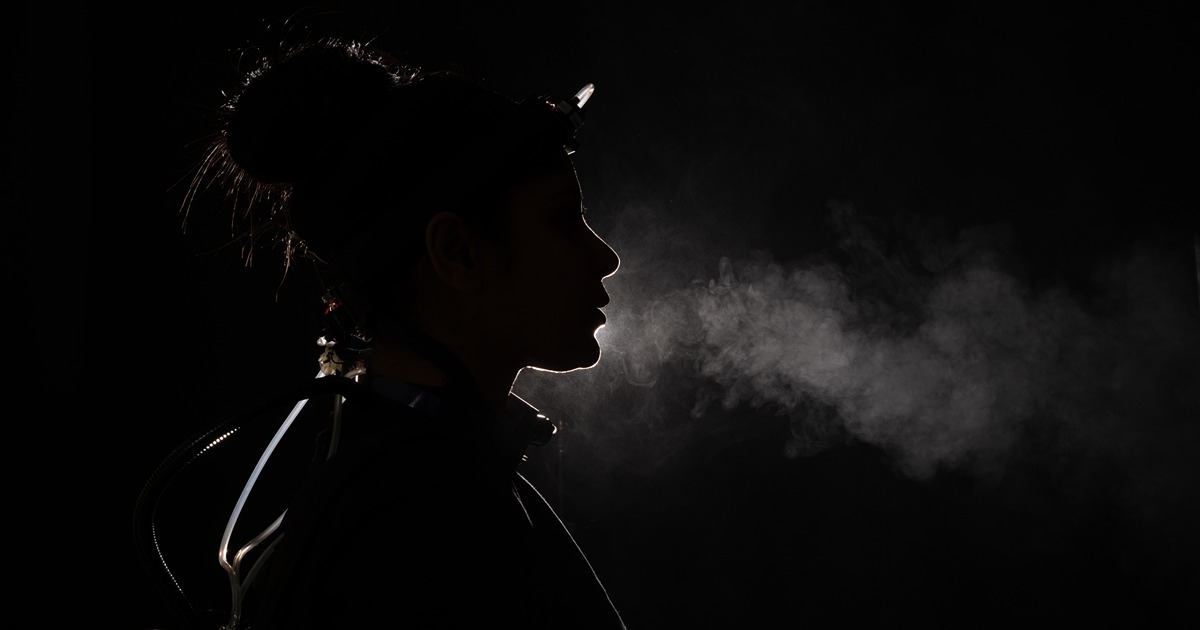 On Earth, gravity pulls exhaled carbon dioxide out and away from peoples’ faces so they do not breathe it back in. In the microgravity of space and the moon, air moves more slowly and carbon dioxide does not move away from astronauts’ faces when they breathe, putting them at risk for increased carbon dioxide exposure. (Purdue University photo/Joshua Clark)
 WEST LAFAYETTE, Ind. — NASA’s new generation of Artemis missions will take humanity back to the moon and beyond. Marshall Porterfield, professor of biological engineering and space biophysics at Purdue University, in an effort to solve a physical problem of space exploration, recently published research focusing on human respiration under microgravity.
“On Earth, the air around the body flows up, bringing fresh oxygen to the face and taking the carbon dioxide up and away,” Porterfield said. This phenomenon, called buoyancy-driven convection, doesn't exist in the microgravity of space and the moon. “In microgravity, carbon dioxide ends up being trapped in front of your face. You end up being trapped in your own bubble of carbon dioxide.”
In his paper published in npj Biological Physics and Mechanics, Porterfield notes that despite the Environmental Control and Life Support System regulating bulk air exchange, astronauts have long complained about the quality of the breathing atmosphere on space shuttles and the International Space Station.
While the safe limit for carbon dioxide is 1,000 parts per million (ppm), the International Space Station is able to scrub its level down to only 2,000 ppm at the minimum. Excess carbon dioxide causes shortness of breath, fatigue, headaches and confusion. Current sensors in spacesuits cannot measure carbon dioxide fast enough to treat the situation, leaving astronauts strained under a dangerous brain fog that makes it difficult to complete tasks.
Porterfield and the Polytech Capstone Plus team have built faster carbon dioxide sensors using air pumps to actively check the air every millisecond and mounted them in a helmet, a device called Atmospheric Redox Exchange Systems (ARES). This patent-pending technology has been licensed to Vayus, and the Capstone Plus team is working on the second iteration of the device.
Porterfield and his collaborators outlined in the paper studied this air cycle using ARES, thermal cameras and computational fluid dynamics models to show how a breath moves around a person in different environments.
These computational fluid dynamics models use thermal imaging to show how humans’ breath travels in the air at different degrees of gravity, “1g” representing Earth and “0g” is the moon.
Applications on Earth
Porterfield said engineered environments like the International Space Station can use the new carbon dioxide sensors to circulate air in a targeted fashion, sending stronger air flows to the places and people most overwhelmed by carbon dioxide. Some spaces on Earth — like planes and high-rise buildings — may also have elevated carbon dioxide and could benefit from better informed air circulation.
In his work as part of NASA’s Lunar Effects on Agricultural Flora project, Porterfield’s research team will use the computational fluid dynamics models to look at boundary layers on leaves grown in space — the thin layer of air around leaves where gas exchange and transpiration happens. As carbon dioxide in Earth’s atmosphere increases, this layer may be disrupted similarly to how it will be under microgravity. Understanding the change now could help humanity prepare its farms and forests for the future.
In addition, Porterfield and his lab are using the new carbon dioxide sensors and a blood test they created to collaborate on a multiple sclerosis study with Thomas V. Walker — co-founder and CEO of Vayus O2, certified personal trainer and 25-year survivor of critical multiple sclerosis. Walker has surpassed the life span and quality that many doctors thought possible, and he credits his strength in part to a carbon dioxide-informed style of exercise he developed with Porterfield's expertise and tools. The blood test analyzes how mitochondria — the organelle in cells responsible for taking up oxygen and converting it into energy — respond to different toxins, like carbon dioxide.Walker's experience fighting his illness and Porterfield's new technologies are lead to the discovery the links between environmental stressors and disorders like multiple sclerosis and Parkinson’s disease.
About Purdue Agriculture
Purdue University’s College of Agriculture is one of the world’s leading colleges of agricultural, food, life and natural resource sciences. The college is committed to preparing students to make a difference in whatever careers they pursue; stretching the frontiers of science to discover solutions to some of our most pressing global, regional and local challenges; and, through Purdue Extension and other engagement programs, educating the people of Indiana, the nation and the world to improve their lives and livelihoods. To learn more about Purdue Agriculture, visit this site.
About Purdue University
Purdue University is a research institution ranked among the top 10 public universities in the United States. More than 111,000 students study at Purdue across multiple campuses, including more than 57,000 at our main campus locations in West Lafayette and Indianapolis. As a land-grant university committed to affordability and accessibility, Purdue’s main campus has frozen tuition 14 years in a row, enabling more students than ever to graduate debt-free.
Writer: Lindsey Berebitsky, lberebit@purdue.edu, 765-749-5296
Media contact: Devyn Ashlea Raver, draver@purdue.edu
Sources: Marshall Porterfield, porterf@purdue.edu
Agricultural Communications: Maureen Manier, mmanier@purdue.edu, 765-494-8415
Journalist Assets: Publication quality images and videos can be obtained at this link