

How do PFAS affect gut health?
An estimated 60 million to 70 million Americans suffer from digestive diseases. Recent research suggests that PFAS can make matters worse.
PFAS pollute waterways and accumulate in the fish swimming there. Your seafood, food wrappers, drinking water and skillets all likely contain these “forever chemicals.” As a result, most Americans have PFAS accumulating in their body.
PFAS, per- and polyfluoroalkyl substances, are human-made chemicals with strong bonds that make them useful for creating durable, nonstick and fire-resistant coatings. But the very reason people use them is what has made them dangerous in our environment and to human health — those chemical chains are difficult to break apart and metabolize.
PFAS have been shown to increase risks to immunity, reproductive health, developmental delays, cancer and other health issues, but little is known about how they affect gut health. Weicang Wang, assistant professor of food science at Purdue, found himself curious about the impact of PFAS on inflammatory bowel disease, also known as colitis.
“There were some prior traditional toxicity studies showing PFAS are bad for human health, with the most severe effects in the liver and kidney.” Wang said. “The key knowledge gap for this project was to see if PFAS exposure affected intestinal mucus defense barriers and the gut microbiome, especially when coupled with colitis.”
Mucus and mucus-producing cells line many membranes across the human body to form a protective barrier against germs and prevent anything from leaking outside an organ. Keeping these mucus layers intact in the gastrointestinal tract is important for the immune system, and when damaged, an individual may experience inflammation or illness.
PFAS makes colitis worse. If it changes the gut microbiome — increasing bad bacteria and decreasing the good guys — and damages the mucus defense barriers, PFAS will make things worse when colitis really comes.”
- Weicang Wang, assistant professor of food science
Key Takeaways
- PFOA exposure exacerbated tissue damage in the colon when coupled with colitis, but not alone. After exposure, PFOA bioaccumulates in plasma and the colon.
- PFOA increased pro-inflammation markers in the colon, including the accumulation of white blood cells called neutrophils, pro-inflammatory proteins called cytokines and enzymes that cause oxidative stress.
- PFOA disrupted the gut microbiome without the presence of the disease — decreasing beneficial bacteria and increasing the inflammation-associated bacterial populations.
Physical damage from PFAS
The human gut is lined in a barrier of tight junction proteins (which provide a waterproof seal) and goblet cells (cup-like cells that produce a mucous lining). Together, they keep the gut wall linked together and prevent the leakage of harmful bacterial products, such as endotoxins. Colitis itself damages these proteins and cells, but exposure to PFOA greatly increases those gaps in the gut barrier. PFOA exposure also resulted in shorter colons and weight loss.
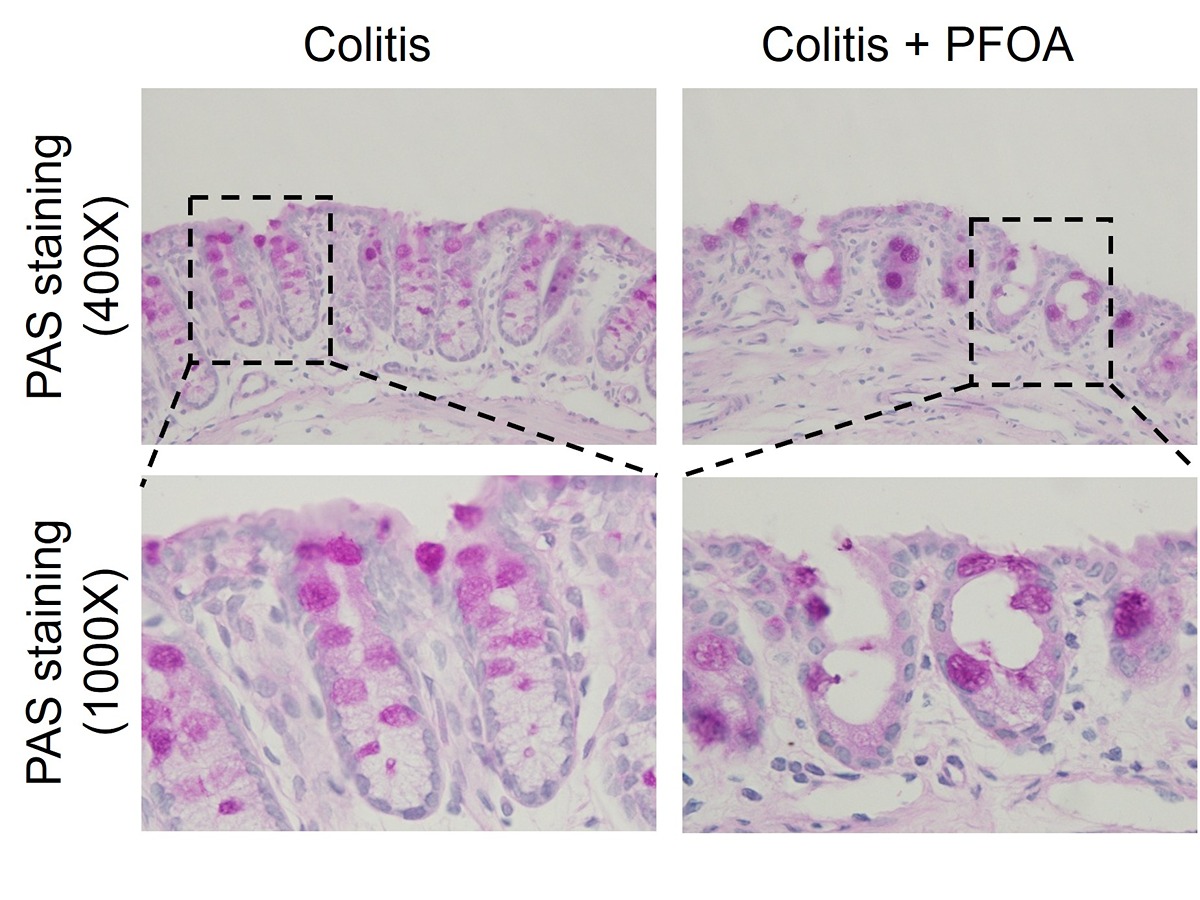 , opens larger image Under the microscope, the researchers observed fewer mucus-producing goblet cells in the colons of PFOA-exposed mice.
Wang collaborated with Chongli Yuan, professor of chemical engineering, and Qingfei Zheng, assistant professor in the Borch Department of Medicinal Chemistry and Molecular Pharmacology, and found that PFOA in the gut impacted the body’s immune system. More neutrophils — a type of white blood cell — accumulate in the gut in colitis and are overactive, causing inflammation. Under PFOA exposure, the team found even more neutrophils present in the gut, as well as more pro-inflammatory cytokines — proteins secreted by immune cells that also cause inflammation — and a greater gene expression for enzymes that can cause oxidative stress.
Metabolic and microbial changes from PFAS
The human gastrointestinal system is filled with bacteria. Most are beneficial and critical for breaking down food into nutrients and fuel. Diet and environmental exposures can reshape the gut microbial community. Wang and his team found that dietary PFOA exposure altered the composition of the gut microbiome in mice, even before colitis was induced.
“It was interesting to see that PFOA can disrupt the gut microbiome even before colitis develops and can make intestinal inflammation and barrier damage worse during disease,” Cheng said.
PFOA exposure greatly reduced the populations of Bifidobacterium and Dobosiella, both important for gut barrier health and immunity. Conversely, three bacteria populations related to inflammation and overgrowth in the gut — Clostridium-related lineages, Romboutsia and RF39 — were all bolstered by PFOA exposure.
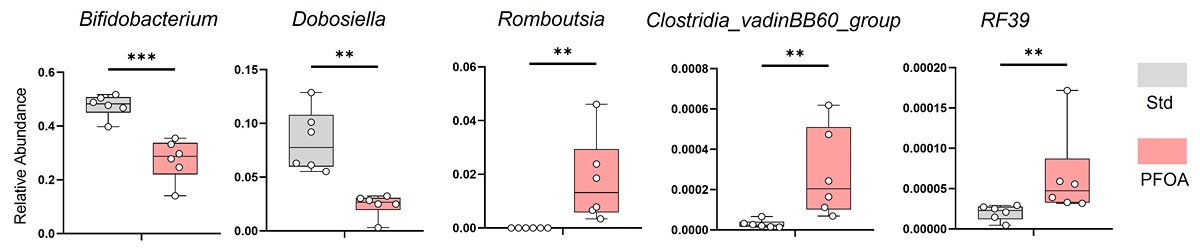 , opens larger image PFOA exposure decreased the relative abundance of beneficial Bifidobacterium and Dobosiella populations and increased the relative abundance of inflammatory Clostridium-related lineages, Romboutsia and RF39.
Christina Ferreira, a research assistant professor at the Bindley Bioscience Center, collaborated with Wang, Cheng, Yuan and Zheng and found elevated levels of amino acid metabolites, some of which are markers for inflammation and stress to the microbiome. Ferreira also confirmed that PFOA accumulates in both plasma — a liquid part of blood — and colonic tissues of mice exposed to dietary PFOA.
“As a graduate student, this project taught me how valuable it is to combine toxicology, immunology and microbiome research to understand how environmental exposures affect health,” Cheng said. “I hope our findings will help raise awareness of the potential effects of PFAS on gut health and inspire new strategies to protect the gut barrier and beneficial bacteria from PFAS."
Cheng is first author on the team’s recent paper, "Perfluorooctanoic acid exposure disrupts gut microbiota and aggravates experimental colitis," published in Environmental Pollution.
According to our data, PFAS damage both the host gut and the gut microbiome, so we must address these two parts. We need some strategies to make our gut barrier stronger and protect it. Or, if I were a consumer, I would look for ways to supplement the good bacteria in my gut with something like yogurt or probiotics.”
- Weicang Wang, assistant professor of food science
Featured Stories

One hundred years ago, fish and shellfish were frequent visitors to dinner plates around the...

In Purdue’s Department of Food Science, researchers are taking on issues of food and health...

PFAS, or per- and polyfluoroalkyl substances, are a group of chemicals used to make consumer...