

Intro to Trees of Indiana: Black Locust
The classic and trusted book "Fifty Common Trees of Indiana" by T.E. Shaw was published in 1956 as a user-friendly guide to local species. Nearly 70 years later, the publication has been updated through a joint effort by the Purdue Department of Forestry and Natural Resources, Indiana 4-H, and the Indiana Department of Natural Resources, and reintroduced as "An Introduction to Trees of Indiana."
A printed copy of the full publication is available for purchase for $7 in the Purdue Extension Education Store. The field guide helps identify common Indiana woodlot trees.
Each week, the Intro to Trees of Indiana web series will offer a sneak peek at one species from the book, paired with an ID That Tree video from Purdue Extension forester Lenny Farlee to help visualize each species as it stands in the woods. Threats to species health as well as also insight into the wood provided by the species, will be provided through additional resources as well as the Hardwoods of the Central Midwest exhibit of the Purdue Arboretum, if available. 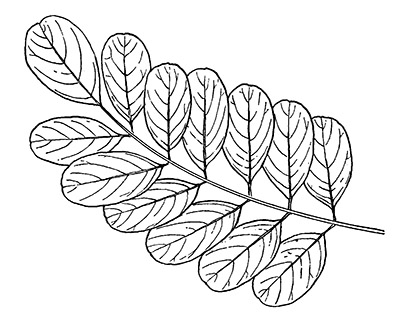
This week, we introduce the black locust or Robinia pseudoacacia.
This tree has compound leaves that are eight to 10 inches long, made up of seven to 17 small rounded leaflets arranged alternately on the twigs. The black locust has thorns on the twig where the buds and leaf stems branch off and also on the limbs and trunks of young trees. The bark is a light to medium gray marked by very rough, long running ridges. An orange coloration can be seen when scraping the bark surface.
In the spring, black locust produces long hanging clusters of fragrant white flowers. It is a member of the broad legume family and its fruit resembles a bean, with brown or black pods that are approximately three inches long and very thin and papery.
According to the Hardwood Lumber and Veneer Series, black locusts are a shade intolerant species, which was originally found from Pennsylvania to southern Indiana and Oklahoma and south to Georgia and Louisiana. It grows best on moist, rich soils or those with limestone origin, but it can be found on a wide variety of soil sites, including badly eroded ones.
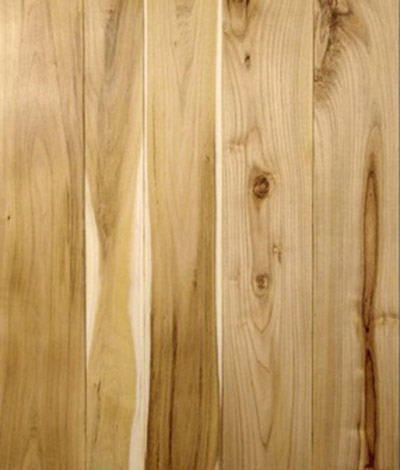 The wood weighs 48.2 pounds per cubic foot, comparable to oak and slightly less than hickory. It is a strong, dense wood, with strength exceeding most of the oaks and comparable to hickory.
Black locust has been planted extensively for fence posts, firewood and erosion control across the state. It also was used for railroad ties before the advent of modern wood preservation and treatment processes. The wood may be used for electrical insulator pins, tree nails in ships, mine timbers and frames. Black locust also has been used for medicinal purposes and its flowers are used to create perfumes and jams.
According to the Morton Arboretum, the black locust has invasive traits that enable them to spread aggressively, but there is insufficient research to declare them so pervasive that they can’t be recommended for planting. This species also is highly susceptible to ice damage and may have weak wood and branch structure.
Other Resources:
Hardwood Lumber and Veneer Series: Black Locust
Morton Arboretum: Black Locust
The Wood Database: Black Locust
Purdue Plant Doctor
Native Trees of the Midwest, The Education Store
Shrubs and Woody Vines of Indiana and the Midwest, The Education Store
Investing in Indiana Woodlands, The Education Store
Forest Improvement Handbook, The Education Store
ID That Tree, Purdue Extension-Forestry & Natural Resources (FNR) YouTube playlist
Woodland Management Moment , Purdue Extension-FNR YouTube playlist
Featured Stories

Carolyn Foley, a long-time member of the Purdue Forestry and Natural Resources (FNR) and...

Purdue University’s College of Agriculture recognized nine alumni at the Distinguished...

Keep your eyes peeled across Indiana for the newly minted Purdue Forestry and Natural Resources...

Senior wildlife major Madison Medley spent her summer as a natural resource intern with Hamilton...

Addy Ellis, a sophomore aquatic sciences and political science double major, spent the summer as...

Zachary Feiner, who earned his PhD from FNR in 2015 and spent two additional years in West...