October 24, 2025
Factors Impacting Long-Run Planning
By Michael Langemeier & Anil Balchhaudi


Farmers wear a multitude of management hats which can make it difficult to resolve short-run issues or problems, and make long-run strategic plans. In the parlance of farm management textbooks, you want your farm to do things right (related to tactical or day-to-day management) as well as to do the right things (related to strategic management). A strategic plan provides a roadmap of where your business may be heading in the next five to ten years, and is particularly important for farms that have one or more family members transitioning into the operation and/or one or more family members that are transitioning out of the operation. Without a strategic plan, transitioning into or out of a business can cause hiccups to the success of the business as well as complicate retirement plans.
Both short-run and long-run planning are important to farms. Some farm goals, such as profit maximization, may be short-term in nature. Other farm goals, such as conservation, and asset and management transitions are more long-term in nature. A recent survey of 400 U.S. producers was conducted in late February 2025 to assess individual farm goals, producer sentiment, farm growth, succession plans, sustainability and risk preferences, resilience, and adoption of conservation practices. Farm goals included the following: stable income, conservation, profit maximization, farm transfer, and debt reduction. A previous article focused on farm goals and their tradeoffs (Langemeier, 2025). This article focuses on short-run and long-run planning.
Long-Run Planning & Farm Goals
Each survey respondent was asked on a scale from 1 to 5, where 1 is “always prioritize short-term goals” and 5 is “always prioritize long-run sustainability goals”, whether they prioritized short-term financial gains over long-term sustainability goals. Figure 1 presents the survey results. Approximately 15% of the respondents focused on short-term financial gains while 57% of the respondents focused on long-term sustainability goals. Prioritization varied by farm goal. For example, approximately 75% of the respondents that chose conservation as their most important goal prioritized long-run planning. Likewise, approximately 63% (64%) of the respondents that chose farm transfer (reduction in farm debt) as their most important goal prioritized long-run planning. In contrast, only 37% of the respondents that chose profit maximization as their most important goal prioritized long-run planning.
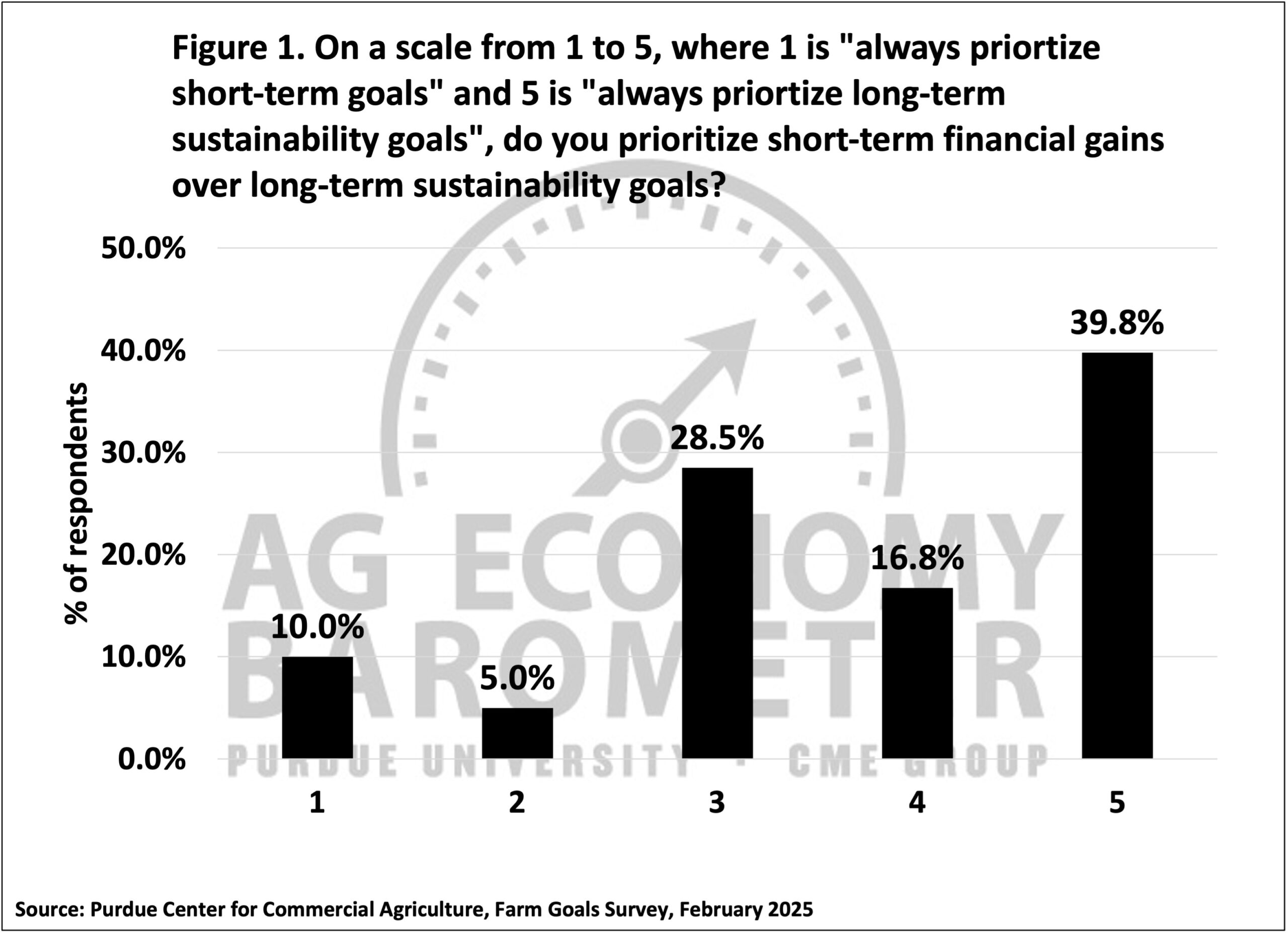
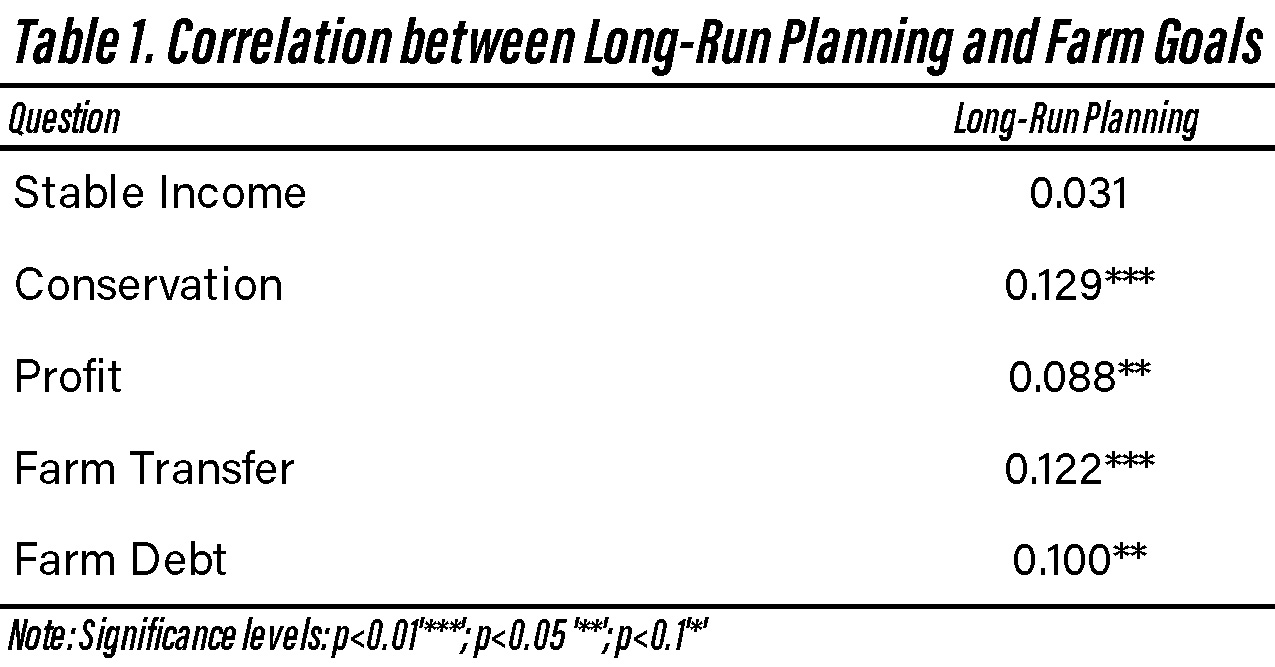
Table 1 presents the correlations between long-run planning and each farm goal. Long-run planning was significant and positively related to conservation and farm transfer at the 1% level, and significant and positively related to profit maximization and the reduction in farm debt at the 5% level. Thus, prioritization of long-run planning is related to multiple farm goals.
Long-Run Planning, Producer Sentiment, & Farm Characteristics
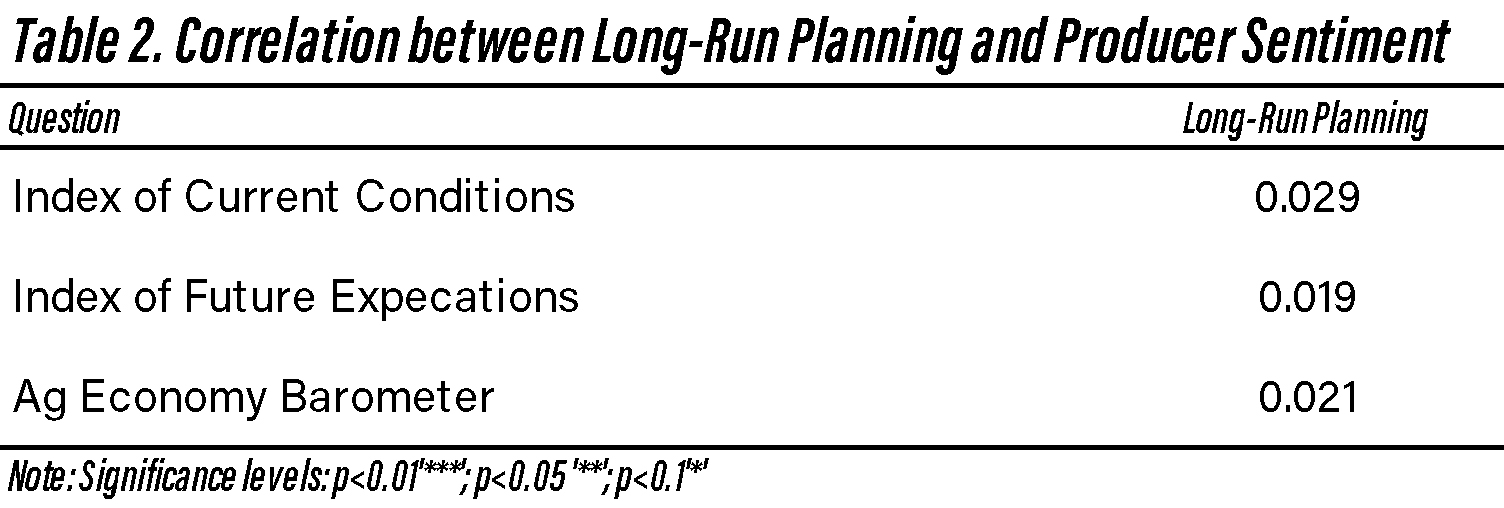
Table 2 presents the relationship between farm growth and three producer sentiment indices: Index of Current Conditions (ICC), Index of Future Expectations (IFE), and the Ag Economy Barometer (AEB). There was not a significant relationship between long-run planning and producer sentiment.
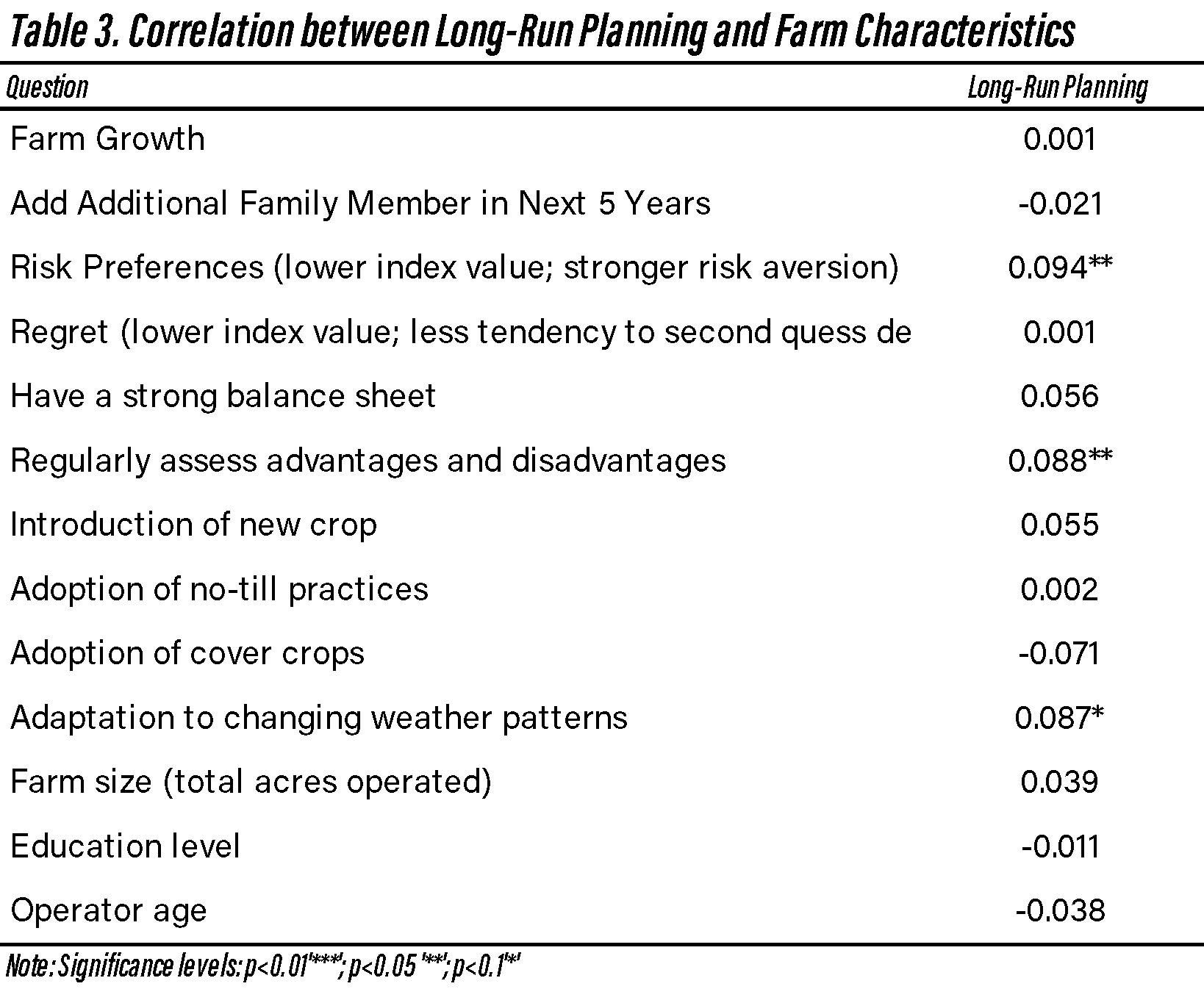
Correlations between long-run planning and selected farm characteristics are displayed in table 3. A positive and significant correlation was found between long-run planning and risk preferences. Among respondents prioritizing short-term goals, 35.0% were classified as less risk averse, compared to 45.1% of those prioritizing long-run goals. This indicates that operators that were less risk averse tended to focus more on long-run planning. The correlation between long-run planning and agility (i.e., assessment of advantages and disadvantages) was positive and significant at 5% level of significance. Among respondents with short-term priorities, 61.7% reported regularly assessing their advantages and disadvantages, compared to 76.5% of those with long-term priorities. This underscores that farms with long-term sustainability preferences are more likely to evaluate their advantages and disadvantages than those focused on short-term goals. Likewise, the association between long-run planning and adaptation to changing weather patterns was positive and significant at the 10% level. In terms of adapting to changes in weather patterns, respondents were given the following choices: installed tile drainage, installed irrigation, planted cover crops, changed crop mix, adopted no-till, changed crop varieties, and changed planting dates. Approximately 27% of the respondents answered this question affirmatively. The three most common changes, in order, were changed planting dates, installed tile drainage, and changed crop varieties.
Conclusions
This article presents results from a recent survey pertaining to farm goals, and discusses the relationships between long-run planning, farm goals, producer sentiment, and farm characteristics. Even though approximately 15% of the respondents focused on short-term financial gains, long-run planning was positively related to each of the five goals: stable income, conservation, profit maximization, farm transfer, and reduction in farm debt. Respondents that focused more on long-run goals tended to be less risk averse than respondents that focused on short-term financial gains. Also, there were positive relationships between long-run planning and agility, as well as long-run planning and adaptations to changing weather patterns.
Citation
Langemeier, M. “Farm Goals.” Center for Commercial Agriculture, Purdue University, July 23, 2025.
TAGS:
TEAM LINKS:


RELATED RESOURCES
UPCOMING EVENTS
Join educators from across the Midwest to build skills for communicating soil health concepts on Nov. 4-5, 2026. In the field, we’ll evaluate the relationship between soil health and water management focusing on irrigation and edge of field practices. The in-service will have both classroom and on farm demonstrations.
The Land of Opportunity: A Conference for Farmland Owners will be held at two locations on October 5 and October 6, providing farmland owners with valuable information and resources to help them make informed decisions about their land. The conference will feature keynote presentations, educational breakout sessions, and networking opportunities designed specifically for those who own, manage, or have an interest in farmland.