March 26, 2026
Extracting Value from Precision Agriculture Technology is Difficult
by Chad Fiechter


Fiechter, Chad, Brady Brewer, Jennifer Ifft, and Michael Boehlje. “Farm Efficiency and Precision Agriculture Technology.” Journal of Agricultural and Applied Economics (2025): 1-23. https://doi.org/10.1017/aae.2025.10029
Precision agriculture technology (tools like automated guidance, yield monitors, grid soil sampling, section control, and variable rate application) is widely seen as a path toward more efficient, more profitable farming. Yet farmers themselves often struggle to identify exactly what financial return they get from these investments. In a recent study, we examined whether using these technologies actually made Kansas farms more efficient at generating gross revenue, and for what type of farms the benefits are most likely to show up.
What We Found
On average, precision agriculture technology does not broadly improve farm efficiency. Across the seventeen technology combinations we studied, most were not associated with meaningful gains in the ability to generate revenue relative to costs. The added expense of adopting these tools was not offset by higher revenue.
Two exceptions stand out: automated guidance, and the combination of yield monitors with grid soil sampling. Automated guidance works largely on its own once installed, requiring little learning to unlock its benefits. Yield monitors and grid soil sampling, by contrast, generate information that farmers must learn to act on. These two technologies have been commercially available for many years and farmers have likely learned how to extract value. However, this finding suggests that emerging information-generating technologies may have long-run potential, but to fully realize that potential, farmers will experience a learning process.
Less efficient farms gain the most from precision agriculture technology. Farms in the lower end of the efficiency distribution saw meaningful gains from several technology combinations, while highly efficient farms saw little to none. This finding suggests a catch-up effect, where technology helps close management gaps that better-run operations have already addressed.
What We Measured and How
Using detailed financial records from 570 individual Kansas farms participating in the Kansas Farm Management Association throughout a 21-year time period (2002–2022), we measured farm efficiency as the ability to generate gross revenue while minimizing costs. This definition of efficiency captures both what a farm produces and what it spends to produce it. A farm that adds revenue through technology but also adds costs may see no net gain in efficiency.
To estimate efficiency, we used a method called data envelopment analysis (DEA), which compares each farm to the best-performing farms in the same year. This produces four efficiency scores: overall efficiency (the broadest measure), pure technical efficiency (how well inputs are converted to outputs), scale efficiency (whether the farm is operating at its optimal size), and allocative efficiency (whether the farm is using the right mix of inputs). We then examined whether adopting different bundles of precision agriculture technology was associated with changes in these scores within the same farm over time.
Precision Agriculture use on Kansas Farms
Figure 1 reports the growth of reported use of precision agriculture technology within our data. By 2022, automated guidance was reportedly used by nearly 80% of farms in our data sample. Yield monitors were used by more than 60%, section control by approximately 50%, grid soil sampling by 40%, variable rate fertilizer by more than 20%, and variable rate seed by 15%. These reported usage rates are similar to adoption rates in USDA data (https://www.ers.usda.gov/publications/pub-details?pubid=105893) and the CropLife-Purdue Precision Agriculture Dealership Survey (https://ag.purdue.edu/idaas/precision-agriculture-dealer-survey.html).
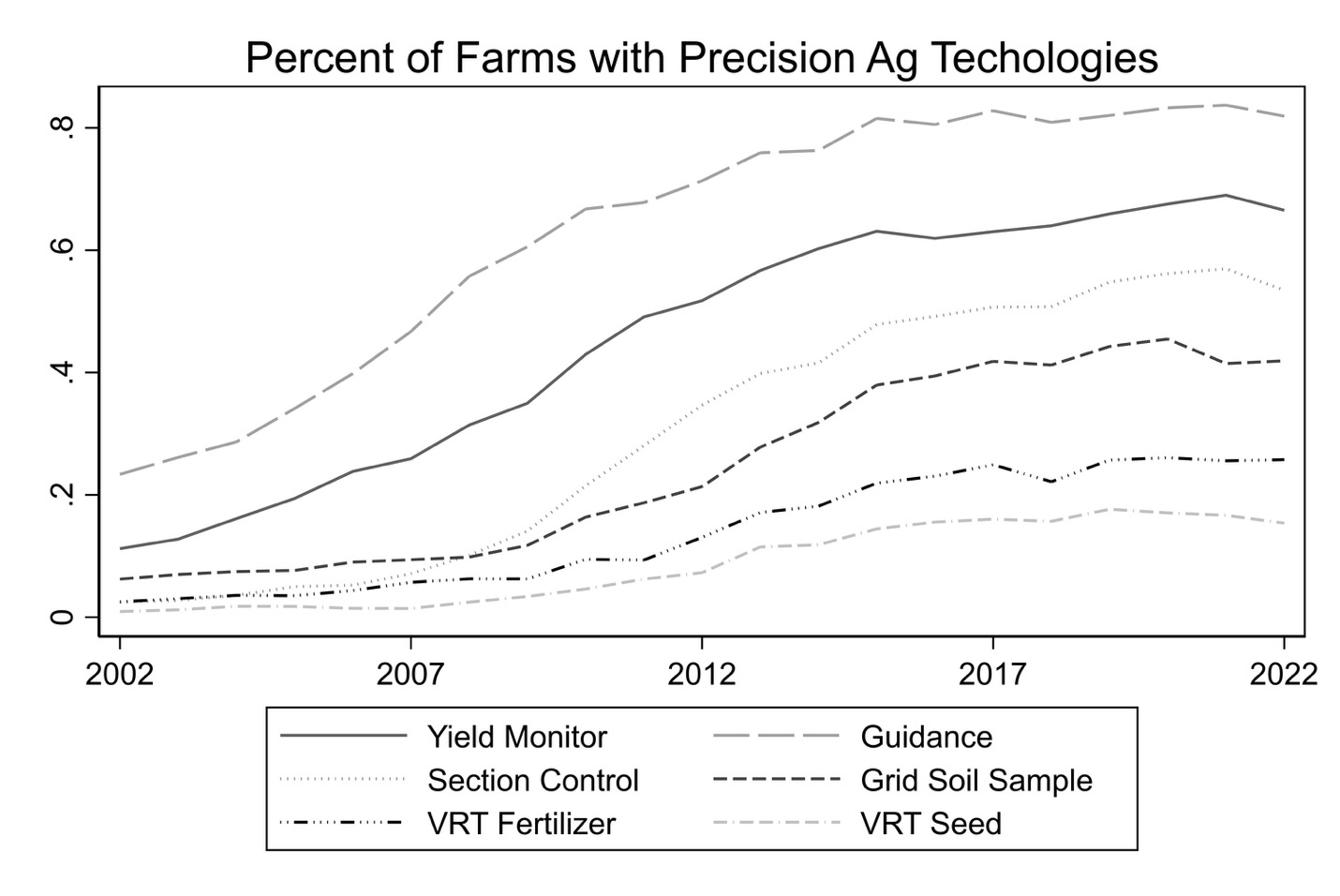
Figure 1: Reported usage of Precision Agriculture Technologies
What the Efficiency Data Tell Us
Figure 2 reports the efficiency metrics from our analysis and provides a visual to understand what the efficiency scores reveal about Kansas farming more broadly. Overall efficiency is widely variable across farms and years. This result is expected: our output is gross revenue, and farms differ enormously in size, crop mix, and market exposure. For our analysis, we aren’t interested in how close farms are to the most efficient, but rather whether they are moving toward the most efficient farm over time.
Pure technical efficiency (the ability to convert inputs into output) tells a more encouraging story. Farms cluster more tightly on this measure. We know from the data that farms are getting more efficient each year, and this result suggests that Kansas farmers, as a group, are broadly improving their ability to get more output from a given set of resources.
Scale efficiency is much more variable and appears to shift substantially by year. This observation likely reflects the reality that weather and prices shape whether a farm’s resource set (its land, equipment, and labor) is well-matched to conditions in any given season. In good years, a farm’s scale may be well-suited; in poor years, the same resources may feel oversized or misallocated. This result suggests that scale efficiency is not purely a management outcome but is also tied to external uncertainty.
Allocative efficiency (how well a farm balances land, labor, capital, and variable expenses) is relatively stable. Year to year, the allocative efficiency metrics suggest that farms maintain a relatively consistent mix of resources. This consistency suggests that the fundamental business strategy of how to balance resources does not shift dramatically in response to short-term conditions. We believe this observed insensitivity to short-term conditions is a reasonable reflection of how farm operations are actually managed.

Figure 2: Farm Efficiency Measures by Year
Main Finding: Technology Broadly Doesn’t Move the Needle
Across the seventeen technology bundles we examined, only two were associated with a statistically meaningful increase in overall efficiency on average: guidance alone and the combination of yield monitors and grid soil sampling. For the remaining fifteen bundles, including many common combinations of multiple technologies, we found little evidence of efficiency gains.
This result does not mean precision agriculture technology has no value. It does mean that the added costs of most technology bundles are not, on average, overcome by the revenue gains they generate. Taken broadly, well-managed farms do not appear to have a strong financial reason to rush adoption.
Why These Two Bundles? A Learning and Complexity Story
The two bundles that do show gains offer an instructive contrast. Automated guidance is an embodied technology. Once installed, it works largely on its own. It reduces overlap, lowers fuel costs, and enables more consistent field passes. The learning curve is short, and the efficiency gains appear to follow relatively directly from adoption.
Yield monitors paired with grid soil sampling are different in nature. These are information-intensive technologies: they generate data about spatial variation in yield and soil characteristics, but the value of that data depends entirely on whether farmers can interpret it and act on it effectively. These technologies have existed for decades, yet many farms are still working out how to translate the information they provide into better management decisions.
This distinction between plug-and-play (embodied) technologies and information-intensive ones points to a broader principle: the return to precision agriculture is not just a function of whether you own the equipment, but whether you have the knowledge and systems to use it.
Less Efficient Farms Benefit Most
When we examine farms in the lower quartile of efficiency (those with the most room to improve), five of the seventeen bundles are associated with meaningful efficiency gains, most of them involving four or more technologies used together.
This pattern is consistent with a catch-up effect: precision agriculture technology appears to offer the greatest returns to farms that are managing their resources in the least efficient manner. For these farms, the information and automation provided by technology may help close gaps in management that farms that are more experienced or better resourced have already addressed through other means. One key caveat: these less efficient farms with precision agriculture technology were still well behind the most efficient farms.
Implications
Extracting value from precision agriculture technology is not a straightforward task. Each operation needs to examine technology adoption with appropriate skepticism. For example, if your operation is already well-managed, you should feel no financial pressure to adopt precision agriculture technology. Don’t let technology be a distraction from the intentional management of farm operations.
Lastly, financial returns are not the only reason to adopt. Many operators report benefits from technology that are difficult to quantify. If these increases in lifestyle or comfort are large enough and farms have the financial resources to acquire these technologies, adoption should be considered a logical decision.
TAGS:
TEAM LINKS:

RELATED RESOURCES
UPCOMING EVENTS
Join educators from across the Midwest to build skills for communicating soil health concepts on Nov. 4-5, 2026. In the field, we’ll evaluate the relationship between soil health and water management focusing on irrigation and edge of field practices. The in-service will have both classroom and on farm demonstrations.
The Land of Opportunity: A Conference for Farmland Owners will be held at two locations on October 5 and October 6, providing farmland owners with valuable information and resources to help them make informed decisions about their land. The conference will feature keynote presentations, educational breakout sessions, and networking opportunities designed specifically for those who own, manage, or have an interest in farmland.