April 28, 2026
Indiana Herbicide Program Costs Through the Lens of Geography
by Madisen (Carns) Stephens, under Chad Fiechter’s research direction


The costs of corn and soybean herbicide programs across Indiana are not uniform, and understanding their differences requires considering geography. While it may seem that herbicide programs should be similar across the state, comparing locations reveals that they are shaped by differences in environment, weed pressure, and management history. These factors create a gradient across Indiana that directly influences both the structure and intensity of herbicide programs, and in turn, the costs. For this project, we analyze enterprise budgets from Purdue Agriculture Centers across Indiana to compare and contrast their herbicide programs. We are particularly interested in the interaction between pre-emergence and post-emergence herbicides, because of the challenges related to herbicide resistant weeds.
Historically, pre-emergence herbicides were the foundation of weed control systems. However, with the introduction of glyphosate-resistant crops in the mid-1990s, many growers shifted toward post-emergence programs due to their simplicity and flexibility. The percentage of soybean acres treated with glyphosate increased from approximately 25 percent in 1996 to 95 percent in 2006 (U.S. Department of Agriculture Economic Research Service [USDA ERS], 2016), reflecting widespread reliance on post-emergence herbicide systems. Over time, this heavy reliance contributed to the development of herbicide-resistant weeds. As a result, weed management systems have shifted back toward more diversified approaches, incorporating both pre- and post-emergence herbicides to maintain effective control.
A significant challenge with choosing a herbicide program is the unknown effects of resistant weeds. Any weed escapes can have short-run effects like increased harvest difficulty, but also long-run effects like adding to the soil seed bank. The fact that decisions today can change outcomes in future seasons is important for contextualizing costs. Because resistance develops when the same type of herbicide is used repeatedly, many programs rely on multiple modes of action; different ways herbicides affect plant growth, to help reduce selection pressure and maintain long-term effectiveness. Although less expensive programs may achieve sufficient short-run control, they may increase long-run costs.
In cases where herbicide resistant weed pressure is lower, there may be an opportunity to reduce herbicide input costs. Typically, the post emergence programs are less costly, but introduce a measure of operational risk. These programs are more sensitive to timing and environmental conditions. Delays due to weather or other factors can significantly reduce effectiveness. Farmers may choose to address this operational risk by incorporating residual control components.
One specific herbicide that needs to be addressed due to resistance challenges is glyphosate. In areas where glyphosate remains effective, programs tend to be simpler and less costly. However, as resistance becomes more prevalent, programs must incorporate additional herbicides to maintain effective control. While this challenge increases complexity and cost, it is necessary to sustain long-term weed management.
The strategy of integrating pre- and post-emergence herbicides is particularly important for managing herbicide resistant weeds. Due to extended emergence periods and more unpredictable patterns, gaps in weed control can result in significant escapes and allow these weeds to establish and spread. Once established, these weeds are considerably more difficult to control in any cropping system. Farm operators prefer to maintain control overlap between residual activity and post-emergence applications.
Figure 1 reports the per acre costs for pre and post emergence herbicides for Purdue Agricultural Centers in the North, Central, and South regions of Indiana. Herbicide costs range from approximately $49 to over $62 per acre. The cost of herbicide programs is the highest for the Northern Indiana Purdue Agricultural Centers at $62 per acre, followed by the Southern Centers at $57 per acre, and least expensive for Purdue Agricultural Centers in Central Indiana. We believe that these differences are related to the degree to which these regions experience herbicide resistant weeds. Producers in places with higher herbicide resistance are more likely to prioritize investment in multi-season control.
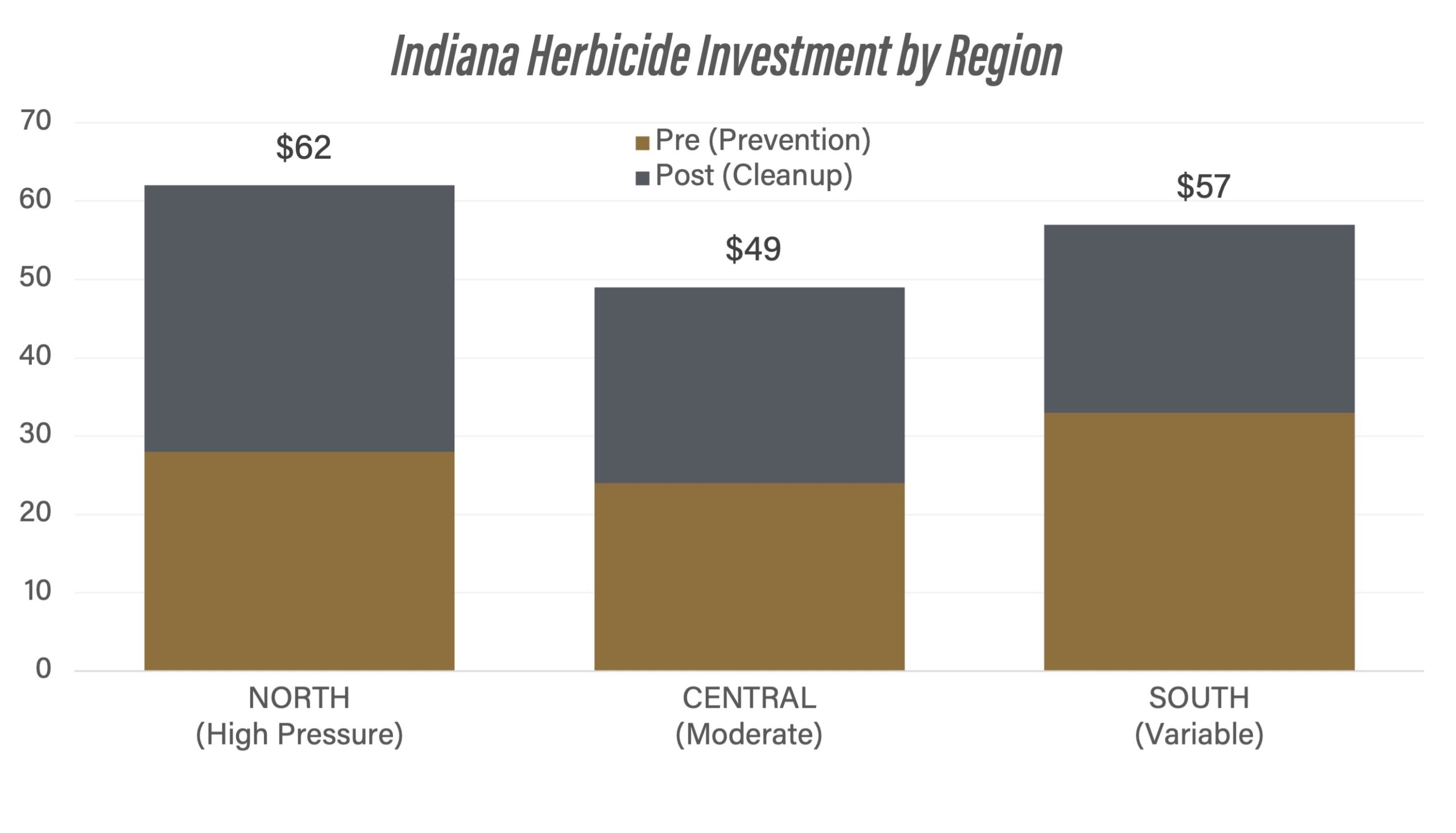
Figure 1. Herbicide costs per acre for pre and post emergence applications for North, Central, and South Indiana in dollars per acre. Note: Authors calculations from Purdue Agricultural Centers’ Enterprise Budgets 2026 [AI use disclosure]
Figure 2 reports the pre- and post- herbicide costs for corn production across Indiana. Common herbicides in the pre-emergence application utilize active ingredients such as acetochlor, atrazine, glyphosate, mesotrione, 2, 4-D, and glufosinate. Some of these herbicides are meant for residual control while others are focusing on the burndown aspect in early season applications. As for post-herbicides, we see glyphosate, mesotrione, s-metolachlor, glufosinate, and others. Post-herbicides see the most variation across the agriculture centers as the application is more dependent on the choice of pre-emergence herbicide. The goals for these herbicides are to control what may have escaped after your first pass or has since emerged in the field. For the reader with a weed science inclination, the herbicides most observed on Purdue Agricultural Centers can be categorized as having HRAC Mode of Action 1, 4, 9, 10, 15, and 27. (Herbicide Resistance Action Committee, 2026)
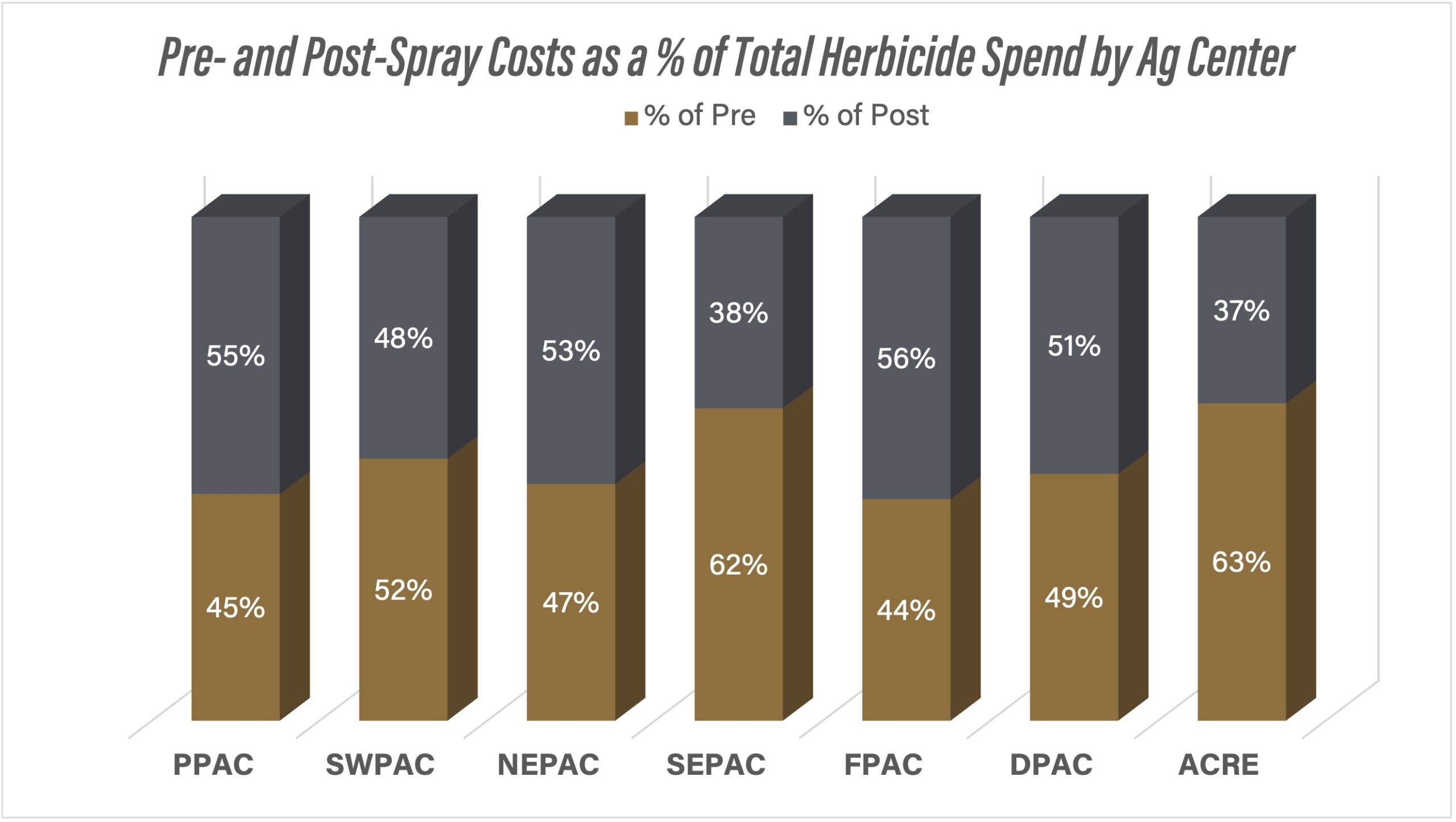
Figure 2. Proportion of herbicide input expenses allocated to pre and post emergence products across Purdue Agricultural Centers. Note: Authors calculations from Purdue Agricultural Centers’ Enterprise Budgets 2026
A pattern emerges when moving from northern to southern Indiana. First, in northern Indiana, particularly at locations such as Valparaiso (PPAC) and Fort Wayne (NEPAC), herbicide programs tend to target herbicide resistant weeds while spending more dollars per acre amongst their pre- and post- applications. These areas often have relatively heavy soils and a longer history of pressure from weeds like waterhemp. In many cases, there are dense populations of weeds such as Canada Thistle, Giant Ragweed, Marestail, Waterhemp, and others. As a result, programs in this region rely heavily on residual herbicides and prioritize herbicide programs with multiple modes of action for weed control. Different modes of action target different key plant biology processes to ensure weed death, using multiple modes allows for more consistent weed control results as the weeds do not have multiple resistance traits. The goal of these choices is not only to control existing weeds but to prevent future emergence and reduce the risk of further resistance development. The herbicide programs in these areas prioritize early-season weed control.
Second, in central Indiana, including sites such as Lafayette (ACRE) and Muncie (DPAC), herbicide programs use a balanced combination of herbicides with residual control and post-emergence control. Soils in this region are generally more productive than other areas in Indiana. Atrazine continues to play a significant role in regional herbicide systems. This feature suggests that resistance pressure, while present, is not as severe or widespread. Relatively less herbicide resistance pressure allows for slightly greater flexibility in program design.
Third, Southern Indiana presents a distinct set of different challenges. Locations such as Columbus (SEPAC), Bedford (FPAC), Vincennes (SWPAC), and French Lick (SIPAC) are often characterized by lighter, more variable soils and warmer conditions. These factors contribute to extended weed emergence patterns, particularly for common lambsquarters, burcucumber, and various grass species. Rather than a single emergence event, multiple flushes of new weeds can occur throughout the growing season. Grass pressure, especially in southwestern Indiana, is a key difference in this region and requires herbicide programs that effectively manage both grass and broadleaf species.
This exercise demonstrates that Purdue Agricultural Centers are pursuing herbicide programs for corn and soybeans that do not center around a sole product or application. Instead, these producers use a combination of herbicides that accomplish comprehensive weed control. Our comparison highlights how the cost of herbicide programs differs and how these costs will likely change to manage emerging herbicide resistant weeds. Understanding the challenges associated with weed control is a key factor in regional competitiveness of corn and soybean production. For the interested reader: Figure 3 is an information graphic synthesizing the analysis presented in this article.
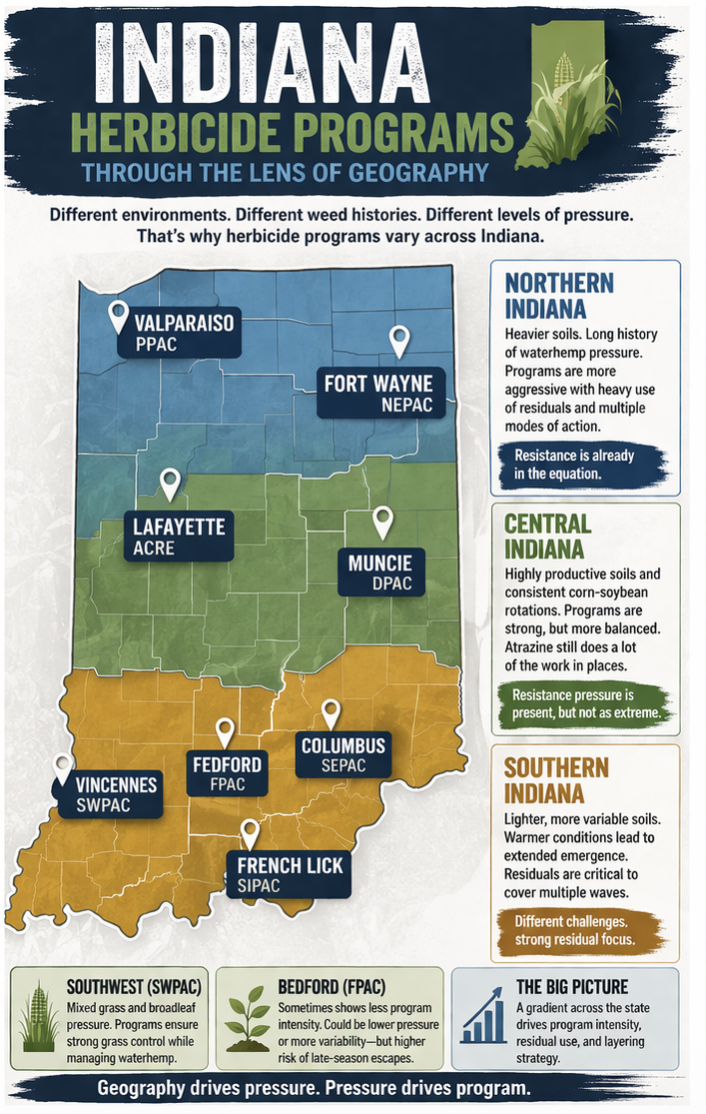
Figure 3. Information graphic comparing and contrasting herbicide programs for corn and soybean production on Indiana Purdue Agricultural Centers. Source: Purdue Agricultural Center Enterprise Budgets for 2026 [AI use disclosure]
For Further Reading
U.S. Department of Agriculture, Economic Research Service. (2016). U.S. corn and soybean farmers apply a wide variety of glyphosate resistance management practices. https://www.ers.usda.gov/amber-waves/2016/april/u-s-corn-and-soybean-farmers-apply-a-wide-variety-of-glyphosate-resistance-management-practices
Herbicide Resistance Action Committee. (2026). HRAC global herbicide mode of action classification. https://hracglobal.com/tools/2026-hrac-global-herbicide-moa-classification
TAGS:
TEAM LINKS:

RELATED RESOURCES
UPCOMING EVENTS
Join educators from across the Midwest to build skills for communicating soil health concepts on Nov. 4-5, 2026. In the field, we’ll evaluate the relationship between soil health and water management focusing on irrigation and edge of field practices. The in-service will have both classroom and on farm demonstrations.
The Land of Opportunity: A Conference for Farmland Owners will be held at two locations on October 5 and October 6, providing farmland owners with valuable information and resources to help them make informed decisions about their land. The conference will feature keynote presentations, educational breakout sessions, and networking opportunities designed specifically for those who own, manage, or have an interest in farmland.