

centers & Long-Term Initiatives

Center for Global Soundscapes
The Discovery Park Center for Global Soundscape’s mission is to support discovery, learning and engagement activities that lead to the preservation of Earth’s natural acoustic heritage. From soundscapes in the desert, the tropics, to vernal ponds of the estuaries, and the planet’s megacities, the Center for Global Soundscapes is advancing our knowledge of nature and society.

Hardwood Ecosystem Experiment (HEE)
Forest management in the eastern United States is faced with many modern challenges. Professional foresters have an innovative set of management options for the maintenance of healthy forest ecosystems. As populations of some forest organisms decline, restrictions on landowners may increase because species become classified as endangered or threatened (e.g., the Indiana bat), while increasing populations of other species (white-tailed deer, invasive plants) create economic and ecological challenges. To address these issues, the HEE, a long-term, large-scale experimental study of forest management and its impacts, was initiated in 2006.
Hardwood Tree Improvement and Regeneration Center (HTIRC)
The mission of the HTIRC is to advance the science and application of tree improvement, management and protection of hardwood forests, with emphasis in the Central Hardwood Forest Region (CHFR). With 15-plus partners this research includes: developing hardwood (oak and walnut) molecular markers for use in determination of genetic quality and population structure of current natural forests and plantations; developing vegetative and tissue culture propagation technologies for use in genomics research and mass propagation systems for superior trees; developing nursery guides for production of quality seedlings and forest management guides for regeneration and reforestation of degraded agricultural land and riparian zones; and conducting research on breeding and selection programs for black walnut, black cherry and northern red oak.
Illinois-Indiana Sea Grant Program (IISG)
With climate change upon us, as well as a host of other concerns, such as population growth, aquatic invasive species, contaminated waters and loss of natural habitat, the southern Lake Michigan region faces many challenges. Illinois-Indiana Sea Grant (IISG), with its unique mandate to bring the latest science to those who can best use the information, serves a critical role in empowering people to solve problems in sustainable ways.
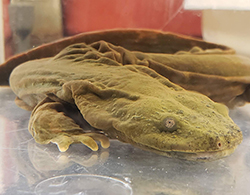
Help the Hellbender
Eastern hellbenders are the largest salamander in North America. Hellbenders have been rapidly declining since the 1980s due to various factors, including poor water quality, loss of habitat, and diseases like chytrid fungus and ranavirus. Populations are so low that they cannot rebound on their own, and require our help. Conservation efforts include captive breeding and rearing in order to head start populations and increase survivorship.
Institute for Digital Forestry
The Institute for Digital Forestry (iDF) is leveraging digital technology and multidisciplinary expertise to measure, monitor and manage urban and rural forests to maximize social, economic and ecological benefits. The team is working to harmonize four key components of digital age technology – Internet of Things (IoT), Big Data, Artificial Intelligence (AI), and Edge and Cloud Computing.
Tropical Hardwood Tree Improvement and Regeneration Center (TropHTIRC)
The TropHTIRC is a collaborative research, development and extension partnership. Established in 2010, TropHTIRC’s mission is to advance the science of tropical hardwood tree improvement, regeneration and conservation genetics. Our goal is to develop and disseminate knowledge to foster sustainable tropical hardwood forestry, production of forest products, restoration and maintenance of genetically diverse ecosystems. We work with a diversity of partners to increase knowledge and develop strategies for breeding, conservation, utilization, silviculture and marketing of tropical hardwoods.
The Cooperative Research Unit program was established in 1935 to enhance graduate education in fisheries and wildlife sciences and to facilitate research between natural resource agencies and universities on topics of mutual concern. The Indiana Unit has been approved to be the 43rd unit of its kind, as part of the USGS Cooperative Research Unit program founded in 1935. The Indiana Cooperative Fish and Wildlife Research Unit is a partnership with the U.S. Geological Survey, Department of Interior, U.S. Fish and Wildlife Service, Purdue University, Indiana Department of Natural Resources, and the Wildlife Management Institute.
View All FNR Partners
The Department of Forestry and Natural Resources is actively collaborating with government & non-government organizations on a number of outreach and continuing education opportunities.
PartnersLearn More About Our Research
FNR is organized and staffed to deliver programs addressing the land-grant mission of learning, discovery and engagement in natural resources. The department boasts 31 tenure-track, two clinical and two research faculty members. Faculty expertise covers the core disciplines to deliver undergraduate degrees in Aquatic Sciences, Forestry and Wildlife. In addition, FNR faculty have strong expertise in interdisciplinary ecology, natural resources social science and wood products.
View our nine research areas along with our world-class faculty.
The Department of Forestry and Natural Resources maintains an impressive collection of state-of-the-art research and education facilities. These labs, green houses, and educational facilities are a fundamental component that enables our faculty and students to learn, make new discoveries, and engage our clients in using these discoveries to sustain our nation’s ecosystems and natural resources.
The mission of the Department of Forestry and Natural Resources is to develop and disseminate knowledge in the natural resource sciences associated with the protection, management, and sustainable use of terrestrial and aquatic ecosystems. One way the department accomplishes our mission is by owning and managing 24 properties located throughout the state to provide opportunities for research, extension, and education that achieves sustainable use of our natural resources.