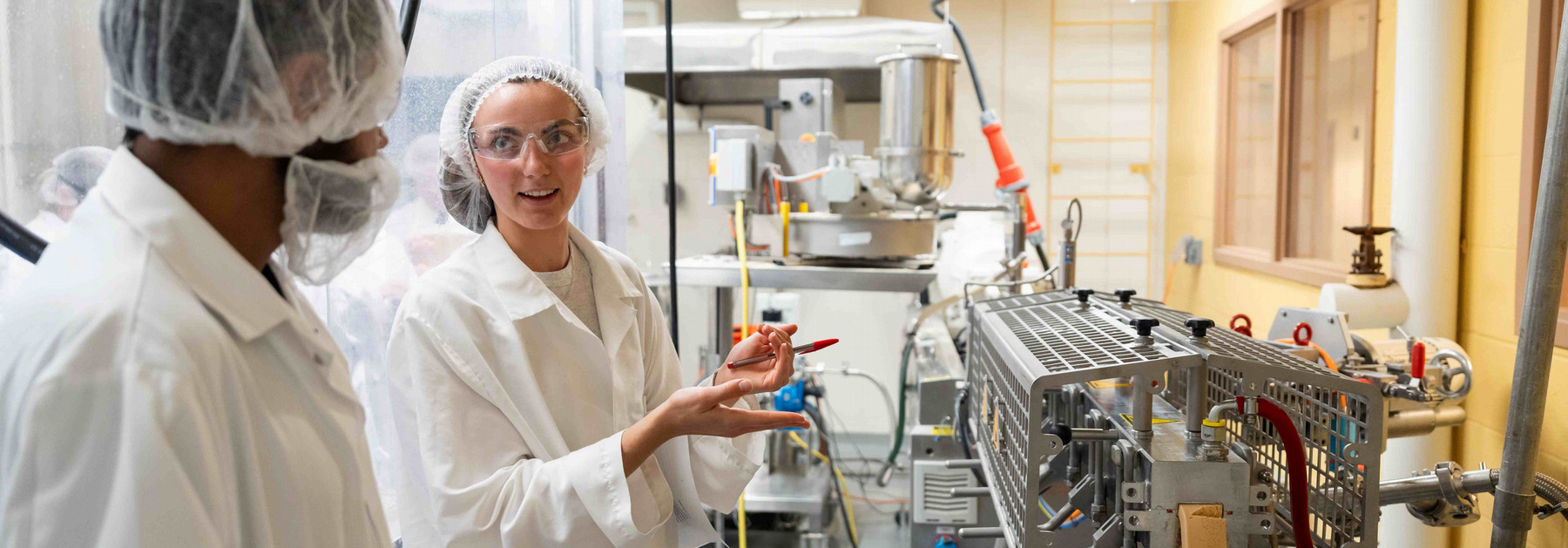
Sustainable Food Manufacturing Technologies Certificate
Sustainable Food Manufacturing Technologies Certificate
Purdue University’s fully online, self-paced professional certificate is designed for food industry professionals who want to strengthen their technical foundation, modernize plant operations, and lead sustainable manufacturing initiatives.
Whether your work touches production, quality, operations, engineering, or supply chain, this certificate helps you expand your skillset and understand how today’s technologies shape efficient and responsible food manufacturing.
Are you ready to learn about sustainable processes and principles?
Register Today!Are you ready to learn about sustainable processes and principles?
Register Today!Is this certificate right for you?
Purdue’s online Sustainable Food Manufacturing Technologies certificate consists of six modules designed for flexible learning. You’re encouraged to complete one module every two weeks, though you may progress at your own pace. Access to the course is available for one year, so you can revisit materials as needed.
Each module includes:
- Expert-led video lessons covering essential food safety topics.
- Supplemental readings and resources including glossaries, graphics and industry insights.
- Downloadable slides to support study and review.
- Quizzes and assessments to reinforce key concepts and ensure comprehension.
The food industry is shifting toward more efficient, sustainable, and resilient manufacturing practices. Companies are investing heavily in:
- Resource and energy reduction
- Smarter equipment and technologies
- Improved product consistency
- Waste reduction and by-product utilization
- Supply chain sustainability and transparency
Professionals who understand modern processes and sustainability principles are increasingly valuable. This certificate helps you build that blend of skills.
- Designed specifically for working professionals
- Based on real-world manufacturing practices
- Taught by Purdue Food Science faculty with industry experience
- Flexible schedule — learn on your timeline
- Earn a Purdue University certificate and digital badge
This program is ideal for professionals in:
- Food manufacturing and plant operations
- Process engineering
- QA/QC and regulatory roles
- R&D and product commercialization
- Sustainability and ESG
- Supply chain and continuous improvement
- Food manufacturing management
Also a great fit for early-career engineers or those transitioning into food manufacturing roles.
Course Syllabus
Why We Process Foods?
Engineering Essentials in Food Manufacturing
Session 1: Basic Engineering Concepts in Foods
Session 2: Material Balance
Session 3: Energy Balance
Session 4: Fluid Dynamics
Session 5: Heat Transfer
Virtual Lab: Demo walk through a food processing line, showcase various engineering concepts used in this processing line.
Effective Mechanical Unit Operations in Food Manufacturing
Session 1: Mixing Introduction of unit operations. Safety training.
Session 2: Homogenization & Emulsification
Session 3: Centrifugation
Session 4: Filtration & Membrane Separation
Virtual Lab: Demonstration of Mixing, Homogenization, and Emulsification Techniques. Case study on membrane separation.
Optimizing Thermal Processes
Thermal Unit Operations in Food Manufacturing
Session 1: Thermization & Thermal Pasteurization
Session 2: Ultra-pasteurization & Sterilization: Canning
Session 3: Refrigeration & Freezing
Session 4: Microwave & Radio Frequency (RF) & Infrared
Virtual Lab: Fluid milk processing: role of various unit operations, flow diagram. UHT & retort demonstrations.
Sustainable Mass Transfer Processes
Mass Transfer Unit Operations in Food Manufacturing
Session 1: Evaporation + Humidification
Session 2: Dehydration
Session 3: Extraction
Session 4: Extrusion
Session 5: Frying
Virtual Lab: Demonstration of spray drying and extrusion equipment.
Emerging Nonthermal Technologies in Food Manufacturing
Session 1: High Pressure Processing (HPP)
Session 2: Pulsed Electric Field (PEF)
Session 3: Light-based Treatments (UV, LED, PL)
Session 4: Irradiation & Cold Plasma Treatments
Virtual Lab: Demonstration of nonthermal processing technologies in practical applications. Comparative analysis with thermal technologies.
Sustainable Manufacturing & Supply Chain Management
Fundamentals of Sustainable Manufacturing Management
Session 1: Materials used in Food Processing
Session 2: Principles of equipment and facility design
Session 3: Controls & Automation
Session 4: Life Cycle Analysis & Techno-feasibility Analysis
Virtual Lab: Hygienic design of food processing plant. Plant cost. Waste processing. Different packaging used in various foods.
Why We Process Foods?
Engineering Essentials in Food Manufacturing
Session 1: Basic Engineering Concepts in Foods
Session 2: Material Balance
Session 3: Energy Balance
Session 4: Fluid Dynamics
Session 5: Heat Transfer
Virtual Lab: Demo walk through a food processing line, showcase various engineering concepts used in this processing line.
Effective Mechanical Unit Operations in Food Manufacturing
Session 1: Mixing Introduction of unit operations. Safety training.
Session 2: Homogenization & Emulsification
Session 3: Centrifugation
Session 4: Filtration & Membrane Separation
Virtual Lab: Demonstration of Mixing, Homogenization, and Emulsification Techniques. Case study on membrane separation.
Optimizing Thermal Processes
Thermal Unit Operations in Food Manufacturing
Session 1: Thermization & Thermal Pasteurization
Session 2: Ultra-pasteurization & Sterilization: Canning
Session 3: Refrigeration & Freezing
Session 4: Microwave & Radio Frequency (RF) & Infrared
Virtual Lab: Fluid milk processing: role of various unit operations, flow diagram. UHT & retort demonstrations.
Sustainable Mass Transfer Processes
Mass Transfer Unit Operations in Food Manufacturing
Session 1: Evaporation + Humidification
Session 2: Dehydration
Session 3: Extraction
Session 4: Extrusion
Session 5: Frying
Virtual Lab: Demonstration of spray drying and extrusion equipment.
Emerging Nonthermal Technologies in Food Manufacturing
Session 1: High Pressure Processing (HPP)
Session 2: Pulsed Electric Field (PEF)
Session 3: Light-based Treatments (UV, LED, PL)
Session 4: Irradiation & Cold Plasma Treatments
Virtual Lab: Demonstration of nonthermal processing technologies in practical applications. Comparative analysis with thermal technologies.
Sustainable Manufacturing & Supply Chain Management
Fundamentals of Sustainable Manufacturing Management
Session 1: Materials used in Food Processing
Session 2: Principles of equipment and facility design
Session 3: Controls & Automation
Session 4: Life Cycle Analysis & Techno-feasibility Analysis
Virtual Lab: Hygienic design of food processing plant. Plant cost. Waste processing. Different packaging used in various foods.
Core Engineering and Processing Principles
A solid introduction to the science behind modern food manufacturing:
- Mass, energy, and momentum balances
- Fluid flow and heat transfer
- Key food properties that influence processing decisions
Essential Unit Operations for Food Productions
A practical look at essential equipment and processes, understand how these processes shape product quality, safety, and sustainability:
- Mixing, emulsification, homogenization
- Centrifugation and filtration systems
- Pasteurization, UHT, sterilization, and aseptic processing
- Evaporation and concentration systems
- Industrial drying and dehydration
- Membrane separation technologies
- Extraction and fractionation
Nonthermal and Emerging Technologies
Explore new tools shaping the future of manufacturing:
- High pressure processing (HPP)
- Pulsed electric field processing (PEF)
- UV and light-based interventions
- Cold plasma
- Food irradiation
Sustainable Manufacturing and Operations
Learn how to integrate sustainability into production systems:
- Life cycle concept: systematic evaluation of sustainability
- Resource and energy efficiency
- Waste management and value recovery
- Systems thinking for manufacturing
- Supply chain sustainability and risk management
Core Engineering and Processing Principles
A solid introduction to the science behind modern food manufacturing:
- Mass, energy, and momentum balances
- Fluid flow and heat transfer
- Key food properties that influence processing decisions
Essential Unit Operations for Food Productions
A practical look at essential equipment and processes, understand how these processes shape product quality, safety, and sustainability:
- Mixing, emulsification, homogenization
- Centrifugation and filtration systems
- Pasteurization, UHT, sterilization, and aseptic processing
- Evaporation and concentration systems
- Industrial drying and dehydration
- Membrane separation technologies
- Extraction and fractionation
Nonthermal and Emerging Technologies
Explore new tools shaping the future of manufacturing:
- High pressure processing (HPP)
- Pulsed electric field processing (PEF)
- UV and light-based interventions
- Cold plasma
- Food irradiation
Sustainable Manufacturing and Operations
Learn how to integrate sustainability into production systems:
- Life cycle concept: systematic evaluation of sustainability
- Resource and energy efficiency
- Waste management and value recovery
- Systems thinking for manufacturing
- Supply chain sustainability and risk management

Investing in and scaling up sustainable solutions through partnerships is a top trend in 2026 food industry.

The median salary for food science professionals entering the field is $77,000.

Investing in emerging technologies is driven by the need to improve production efficiency and data-driven decision-making.
Investing in and scaling up sustainable solutions through partnerships is a top trend in 2026 food industry.
IFT Science and Policy Initiatives Report
The median salary for food science professionals entering the field is $77,000.
IFT’s 2022 Career and Compensation Survey Report
Investing in emerging technologies is driven by the need to improve production efficiency and data-driven decision-making.
Food Technology’s 2024 Technology Trends Survey
Featured Faculty

Hanyu Chen

Jen-Yi Huang

Dharmendra Mishra
Frequently Asked Questions
Many employers provide tuition assistance or professional development funds for job-related courses, so be sure to check with your HR department. Purdue University occasionally offers promotional discounts for noncredit courses. Contact Purdue Food Science Online Academy at FoodSciOnline@purdue.edu to explore scholarship and discount opportunities.
You will connect with peers and industry professionals through online discussion activities and question and answer sessions. The course may also feature guest lectures from leading experts, allowing you to network with experts in the field of food science.
While this noncredit course does not include job placement services, individual career coaching from Purdue faculty and professional network can be made available upon request. Completing this certificate can also expand your professional network, giving you access to those who work in the food processing and technology fields.