

About Us
Our lab investigates how plant-based bioactive compounds and dietary fibers support gastrointestinal health. We focus on the role these compounds may play in managing conditions such as Inflammatory Bowel Disease (IBD), chronic inflammation and gut bacterial dysbiosis. Our goal is to develop evidence-based dietary strategies that not only promote gut health but are also well-tolerated by individuals living with IBD and related disorders.
The Reddivari lab is ever-expanding and changing! We are a unique combination of graduate researchers, undergraduate mentees, visiting scholars, and staff members. Interested in joining the Reddivari Lab or learning more? Reach out to Dr. Lavanya Reddivari via email at lreddiva@purdue.edu.
Contact Us
Lavanya Reddivari, Ph.D.
lreddiva@purdue.edu
745 Agriculture Mall Drive
West Lafayette, IN 47907
Driving Discovery
Driving Discovery
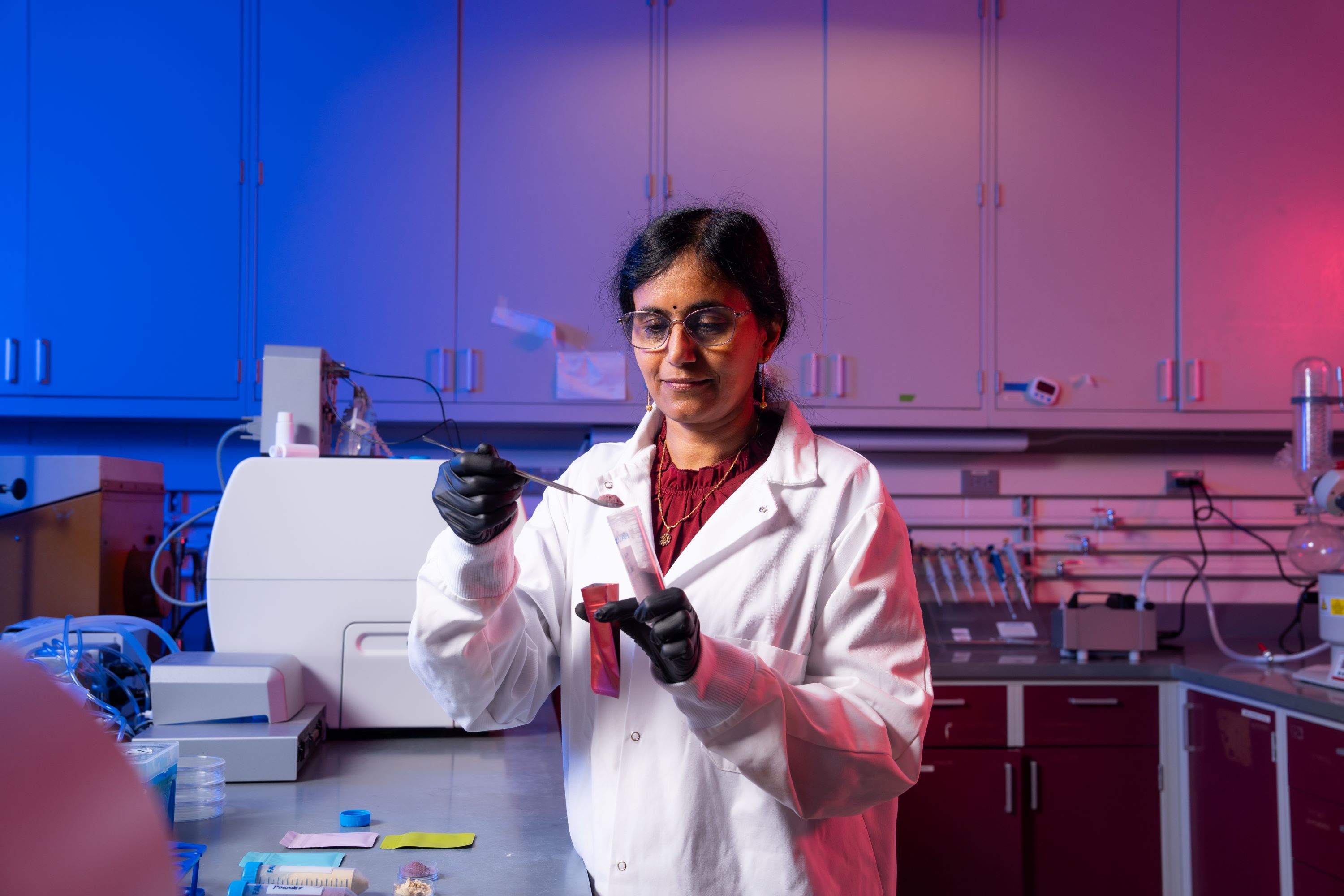
Growing up in India, Lavanya Reddivari's mother remedied colds with warm milk with turmeric and black pepper. The associate professor now studies how food may be used as medicine and can be modified to help patients with digestive diseases.
Explore the ResearchResearch Areas
Our research consists of evaluating how dietary fiber’s distinct physicochemical properties determine tolerance levels in normal/diverse and dysbiotic gut bacterial environments. Since it is known that patients diagnosed with Ulcerative Colitis (UC) exhibit fiber intolerance symptoms and have an altered gut microbiome, we aim to identify fibers that are well-tolerated by UC patients and that can produce beneficial metabolites, despite dysbiotic conditions.

Inflammation is a normal part of our body’s defense system and is beneficial when we are sick and when our body is fighting against pathogens. Inflammation, although it serves a purpose when we are sick, can also be a negative side effect of a variety of diseases such as Ulcerative Colitis and Crohn’s Disease. In the Reddivari lab, we focus on inflammation concerning digestive system disorders and investigate various natural options to alleviate the inflammation caused by these disorders. Currently, research is being performed in the lab on the role anthocyanins, phlobaphenes, and fibers can play in treating gastrointestinal disorders.
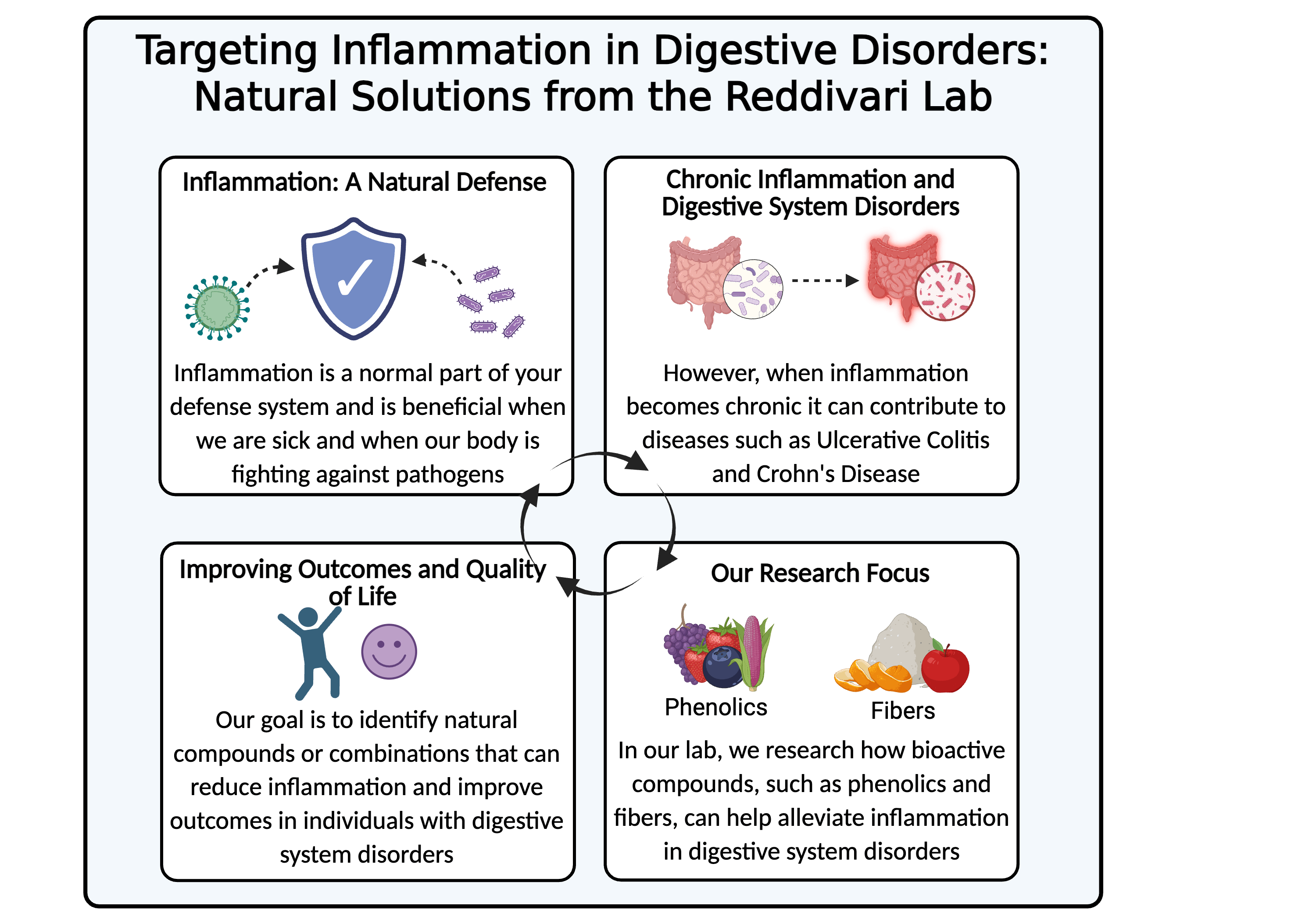
Our research focuses on understanding the gut bacterial metabolism of flavonoids and their impact on low-grade inflammatory diseases. Our lab uses microbiota transplantations and germ-free animal models to understand how variations in the gut microbiota influence the bioactivity and bioavailability of flavonoids. Furthermore, we research how flavonoids influence host bacterial composition, metabolism and their inflammation.


Principle Investigator

Dr. Lavanya Reddivari
Dr. Reddivari joined the Purdue Food Science faculty in 2018. Her research focuses on plant food bioactive components and gut bacterial metabolism in health and low-grade inflammation-driven chronic diseases. The goal is to develop food-based strategies to counter diseases such as ulcerative colitis, Crohn’s disease and colon cancer. Dr. Reddivari’s lab is specifically interested in understanding sources of variation in the content and composition of anti-inflammatory bioactive compounds in plant foods; how plant bioactive compounds influence the composition of gut microbiota; how gut bacteria influence the bioavailability and bioactivity of bioactives; and how bioactives and their gut bacterial metabolites suppress colonic inflammation, maintain gut barrier integrity and alter the inflammatory potential of gut microbiota.
Graduate Students

Paola Andino Carbajal

Rahmi Azzahra

Sarah Quino
Staff

Sarah Martin
Sarah Martin is a Laboratory Specialist in the Reddivari Lab, where she supports research investigating the role of bioactive compounds in digestive system disorders. She earned her M.S. in Food Science from Purdue University in 2025. During her master's research, Sarah investigated strategies to enhance anthocyanin stability through interactions with dietary fibers. She now contributes to research aimed at understanding how bioactive compounds influence digestive health and support the prevention and management of gastrointestinal disorders.
Visiting Scholars

Carmel Even
Carmel Even is a Registered Dietitian and a PhD student in the joint Bar-Ilan University–Tel-Hai University program. She received her B.S. and M.S. in Nutritional Sciences from Tel-Hai University. She conducts her PhD research in the Nutrition & Human Health Lab at the MIGAL Galilee Research Institute, where Dr. Faiga Magzal serves as Principal Investigator and Prof. Snait Tamir is Head of the Laboratory. Her research focuses on understanding how functional dietary compounds modulate the gut microbiota and microbial metabolism using in vitro fermentation models. Her current PhD research investigates the effects of prebiotics and phenolic compounds using in vitro fecal fermentation models inoculated with samples from children with autism. In addition to her doctoral research, she collaborates on projects investigating other functional dietary compounds and their effects on the gut microbiota across different populations and health contexts.
Selected Publications
2026
Elevated circulating bile acids driven erythrocyte osmotic resistance marks hepatobiliary disease
Gut microbiome drives glycodeoxycholic acid-mediated attenuation of hypertension
Wheat fiber mitigates colitis via non-SCFA microbial metabolite-trained intestinal macrophages
2025
Human-associated gut bacterial dysbiosis affects the anti-colitic activity of 3-DF and 3-HF
Ulcerative Colitis but Not Dextran Sodium Sulfate–Induced Colitis–Associated Microbiota Promotes Early Biomarkers of Colitis in Interleukin-10 −/− MiceRecent Awards and Recognition
- Lavanya Reddivari: 2024 Purdue Food Science Outstanding Graduate Educator
- Paola Andino: 2025 Kirleis Graduate Student Award
- Sarah Martin: 2025 B.J. Liska Outstanding Graduate Teaching Assistant Award, 2024 Travel Award
- Edward Moncada: 2024 IFT Carbohydrate Division First Place Oral Competition, 2024 Kirleis Graduate Student Award, 2023 Young Investigator Underrepresented in Nutrition
- Jose Haro: 2023 Young Investigator Underrepresented in Nutrition, 2024 BJ Liska Outstanding Graduate Teaching Assistant Award
- Vignesh Nathan: 2022 BJ Liska Outstanding Graduate Teaching Assistant Award
Alumni
Edward Moncada, PhD 2025, R&D Scientist II at Chobani
Kayla Roy, PhD 2025, Senior Product Developer at PepsiCo
José Haro Reyes, PhD 2025, Lead researcher at Agriculture Innovation National Institute
Wenyi “Chloe” Fu, MS 2021, PhD Student at University of Florida
Haotian Chang, Visiting Scholar, Graduate Student at the University of Florida
Lin Chen, Visiting Scholar
Vignesh Nathan, PhD 2025, Senior R&D Scientist at NutriScience Innovations
Heather Milliron, MS 2025, Lead Food Scientist at Monogram Foods
Shiyu Li, Post-Doc 2023, Professor at Xianghu Lab, China
Binning Wu, PhD 2020, Project manager at Creative Biogene
Enrique Bogran, Intern, Graduate student at Texas Tech University
Veda Krishnan, Visiting Scholar