

Monthly dashboard created to better conceptualize ag job market
Any undergraduate inching closer to graduation thinks about possible jobs. Searching by specific job titles or particular skill sets, job seekers will apply for several, casting their resume out to find the best fit for their interests.
But Doug Abney, a graduate student in agricultural economics, said upon completing his bachelor's degree, he wasn't simply curious about a potential first job for himself. He wanted to know what the entire agricultural job market looked like.

Abney said his goal was to create an Ag Jobs Dashboard that would provide a monitoring system to validate the current job market and see what was available around the United States in real time. The idea of scraping the entire internet, roughly five billion gigabytes of data, for open jobs within one area of the labor market would be daunting to many, but Abney said from the start of collecting data to the final steps in creating the dashboard only took him about 10 months.
“When I started my grad program, creating a dashboard for this felt like more of a fluke idea, but my research role was to collect data on how skills and salary compare over time,” he said. “I wanted to see where the ag job market was going,”
Brady Brewer, assistant professor of agricultural economics, said Abney’s dashboard takes a snapshot of the current ag job market, differing from the five-year report released by the USDA offering a projection of what the job market could look like.
“The USDA ag jobs report gives a high-level overview of the ag market while we go much more granular in our analysis,” Brewer said. “Our dashboard is updated monthly to reflect the current market.”
“Doug has identified a needed niche that is going to be valuable to a lot of people,” said Nathan DeLay, assistant professor of agricultural economics.
Analyzing the salary of each employment posting as well as the job categories within the agricultural sector is leading to more applicant qualifications to study, such as proficiency in a particular computer program or level of education. Abney said when he was completing his undergraduate degree, he frequently heard from ag professionals that drones would be the “next big thing” in their field. The dashboard now allows him to find truth among active trends.
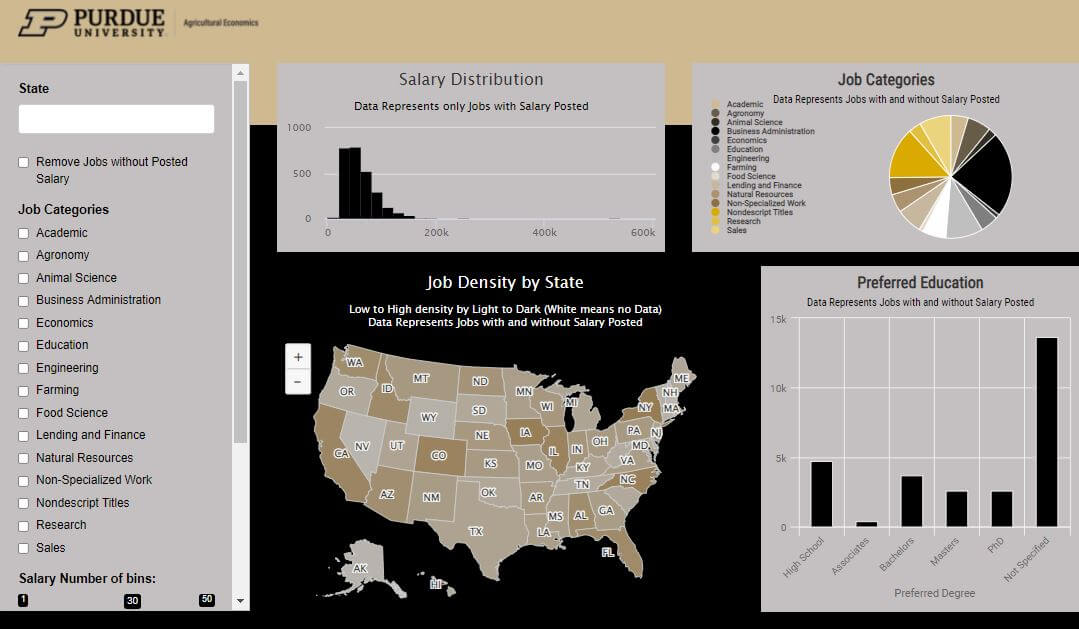 A screenshot of the Ag Jobs Dashboard
 “Something I am interested in looking at down the road is the tradeoff among ag jobs of experience over education,” he said. “Kids can grow up on a farm and gain tons of experience, and graduate from high school knowing exactly how to do various jobs. I am really interested in seeing what the comparisons are for jobs of that nature in terms of pay compared to entry level jobs for applicants with degrees. Getting to that point with the dashboard is still a little way down the road.”
Abney, DeLay and Brewer are continuing to analyze where the dashboard can be taken in terms of data analysis.
“This dashboard is something we plan to continue indefinitely, so long as we have the resources,” Brewer said. “There are a lot more topical things we plan to look into, so this is going to continue to evolve.”
Featured Stories

In the September Purdue University/CME Group Ag Economy Barometer survey, 52% of respondents...

Purdue University’s College of Agriculture recognized nine alumni at the Distinguished...

“Being at Purdue has changed my thinking entirely,” says Mingyu Zhao, a third-year...

Philip E. Nelson, named Indiana State Fair Tomato King at age 15 for exhibiting 24 perfect...

In 1951, Purdue University faculty members traveled more than 4,000 miles from West Lafayette,...

Concealed within the molecular machinery of petunia flowers are metabolic, genetic and cellular...