Biochemistry
Purdue team announces new therapeutic target for breast cancer
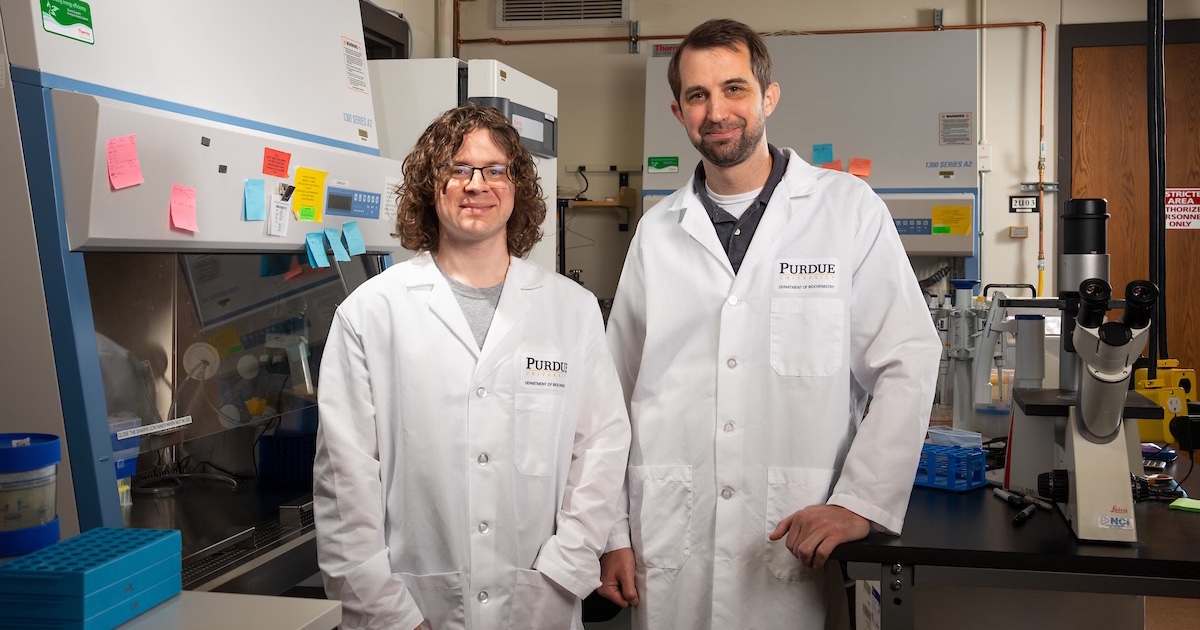 , opens larger image Graduate student Addison Young (left) and Kyle Cottrell, assistant professor, both in Purdue’s department of biochemistry. Young and Cottrell have reported discovering a new therapeutic target for triple-negative breast cancer in the journal RNA.
 WEST LAFAYETTE, Ind. — A Purdue University team led by Kyle Cottrell has discovered a new therapeutic target for triple-negative breast cancer.
“Triple-negative breast cancer is a particularly deadly form of breast cancer that currently lacks targeted therapies,” said Cottrell, an assistant professor of biochemistry and member of the Purdue Institute for Cancer Research. Cottrell, biochemistry graduate student Addison Young and their co-authors describe the discovery in the journal RNA.
The laboratory research spotlights double-stranded ribonucleic acid (dsRNA)-binding proteins. “Generally, people are taught in high school biology that RNA is single-stranded. That’s not entirely true,” Cottrell noted. Human cells contain many double-stranded segments of RNA, as do viruses.
“We have proteins that can recognize those double-stranded RNAs,” Cottrell said. When cells detect that they’ve been infected with a virus, “they activate various pathways to stop the viral infection.” But these dsRNA-sensing pathways present a problem when they are activated in the absence of a viral infection. “They have to be kept at bay most of the time. We don’t have a great understanding of how that works.”
RNA is a molecule that plays key roles in cellular and viral processes, including protein formation. DsRNA-binding proteins and dsRNAs in human cells attract keen biomedical scientific interest because of their many connections to autoimmune and neurodegenerative disorders, Cottrell said. They have even been implicated in the aging process.
“As you age, your cells lose the ability to block some of these sensing pathways. They start activating dsRNA sensing pathways and cause inflammation.”
Viral mimicry has helped fuel increased research interest in the role of dsRNA-binding proteins in cancer. When cells activate viral mimicry, they look as if they’ve been infected with a virus. The process creates a cellular state that has helped some new cancer immunotherapies to work better, Cottrell said.
In this latest work, Cottrell’s team tracked the activity of a dsRNA-binding protein called PACT, for protein activator of interferon-induced protein kinase. This work and studies published this year by two other groups show that PACT suppresses another protein called RNA-activated protein kinase, or PKR.
 , opens larger image Graduate student Addison Young (left) and Kyle Cottrell, assistant professor, both in Purdue’s department of biochemistry. Young and Cottrell have reported discovering a new therapeutic target for triple-negative breast cancer in the journal RNA.
 Previously conflicting findings led to a controversy over PACT’s role in PKR regulation. “Our evidence goes to the side that it’s been a suppressor, not an activator,” Cottrell said, which more firmly established that as PACT’s role in triple-negative breast cancer.
“PKR is a double-stranded RNA sensor. It’s a protein that exists in all of your cells and can detect when a cell is infected with a virus. It does that by sensing the double-stranded RNAs that come from the virus.”
The RNA paper builds on previous work from Cottrell’s group regarding two other proteins that act much like PACT. “They are suppressors of double-stranded RNA sensing. Their job is to block activation of double-stranded RNA sensors like PKR,” Cottrell said.
The team identified both PACT’s role in triple-negative breast cancer and the proteins that play similar roles because they all might serve as viable therapeutic targets.
Some cell lines depend on PACT while others don’t. The researchers used the gene-editing tool CRISPR-Cas9 to remove PACT from the cells to see which pathways became activated or not.
“Cells can look a certain way because they’re infected with a virus. They can activate certain pathways because they’re infected with the virus to help fight that off. Or we can mimic that by changing something in the cells. We did that here,” Cottrell said.
“Triple-negative breast cancer in particular seems to be quite sensitive to depletion of PACT, so it might be one of the better cancers to target for it. But there are definitely opportunities in other cancer types,” Cottrell noted. The disease could especially benefit from target-specific therapies to replace chemotherapies that broadly hit all dividing cells, healthy and diseased alike. “You get terrible side effects with those.”
The paper also highlights the importance of dimerization, the fusion of two separate molecules, called monomers, to regulate protein activity. Therapeutic targets for cancer and many other diseases are often enzymes — proteins that speed up chemical reactions. But PACT isn’t an enzyme. Consequently, drug designers cannot inhibit its function by blocking its activity.
“We have to come up with some other way to prevent it from functioning. We found that PACT is a dimer. Two monomers of PACT come together, and if they don’t dimerize, then it can’t function. So, if you could block the dimerization, then you could inhibit its function in cells.”
Cottrell plans to probe the unknown details of how dimerized PACT inhibits PKR. He would like to find a molecule that inhibits PACT dimerization as a therapeutic. “We’re working toward that now,” he said. “But beyond that, there are basic science questions on how the cell prevents activation of PKR or other double-stranded RNA sensors.”
This work is part of Purdue’s One Health initiative, which brings together research on human, animal and plant health, and was supported by the Ralph W. and Grace M. Showalter Research Trust Award, the National Institutes of Health, the Purdue Institute for Cancer Research, and the Department of Biochemistry in Purdue’s College of Agriculture.
About Purdue Agriculture
Purdue University’s College of Agriculture is one of the world’s leading colleges of agricultural, food, life and natural resource sciences. The college is committed to preparing students to make a difference in whatever careers they pursue; stretching the frontiers of science to discover solutions to some of our most pressing global, regional and local challenges; and, through Purdue Extension and other engagement programs, educating the people of Indiana, the nation and the world to improve their lives and livelihoods. To learn more about Purdue Agriculture, visit this site.
About Purdue University
Purdue University is a research institution ranked among the top 10 public universities in the United States. More than 111,000 students study at Purdue across multiple campuses, including more than 57,000 at our main campus locations in West Lafayette and Indianapolis. As a land-grant university committed to affordability and accessibility, Purdue’s main campus has frozen tuition 14 years in a row, enabling more students than ever to graduate debt-free.
Writer: Steve Koppes
Media contact: Devyn Ashlea Raver, draver@purdue.edu
Sources: Kyle Cottrell, kacottre@purdue.edu
Agricultural Communications: Maureen Manier, mmanier@purdue.edu, 765-494-8415
Journalist Assets: Publication quality charts and images can be obtained at this link