

Two prestigious awards, one global mission
Bryan Pijanowski, professor in Purdue University’s Department of Forestry and Natural Resources (FNR) and director of the Center for Global Soundscapes, is a leading voice in soundscape ecology—a field he helped define. His scholarship in soundscape ecology, landscape ecology and geographic information science has opened new ways of understanding biodiversity and the relationship between people and nature through sound.
In recognition of his contributions, Pijanowski has been awarded both the 2026 International Association for Landscape Ecology – North America (IALE-NA) Distinguished Landscape Ecologist Award and Purdue College of Agriculture’s 2026 Lowell S. Hardin Award for Excellence in International Agriculture.
“What these awards do is showcase the importance of sound across so many dimensions of our lives. My hope is that this encourages us to step away from the noisy distractions of the built world and instead reorient our senses, our thoughts and our sense of care for the natural world."
- Bryan Pijanowski
Pijanowski listens to ecosystems by combining technology with human perception. His work explores how we experience places through our senses, particularly sound, and how shifting sonic signals in the environment shape the meaning we derive from ecological change.
“Bryan Pijanowski has been a longtime innovator in the field of landscape ecology,” said Tomas Höök, professor and department head of the forestry and natural resources department. “His more recent work that focuses on measuring and studying soundscapes has proven to be an innovative way to bridge landscape ecology and sound ecology for a multifaceted perspective on environmental systems and how they are changing.”

Pijanowski's journey to soundscape ecology
Having grown up playing multiple musical instruments and listening to music, Pijanowski developed an early fascination with sound. That interest took root at Hope College—where he pursued a degree in biology—when he was introduced to ornithology.
“When I was in college, I learned that birders often identify birds by call,” recalled Pijanowski. “I was always fascinated by the fact that simply listening to a part of the natural world was in tune with my interest in music.”
About two decades later, his curiosity evolved into broader scientific questions: How could he study both natural systems with animals and human-influenced environments through a common lens? What universal variables could tie them together? One day the answer clicked: sound.
“As I began to listen more and talk to colleagues who were thinking along similar lines, we realized that there might be a science behind all of this,” said Pijanowski.
Pijanowski began leading specialized conference sessions that highlighted a shared need among researchers: a clearer framework to define soundscape ecology. That momentum led him to develop and contribute to several scientific papers that articulated the field, including a landmark publication in the Oxford University Press journal, Bioscience, that is now included in academic curricula across disciplines such as ecology, ethnomusicology, humanities, musicology and psychology. A follow up article appeared in Springer Nature and been recognized as one of the top 40 milestones in the 89-year history of landscape ecology.
2026 IALE-NA Distinguished Landscape Ecologist Award
Connecting soundscapes to One Health

Pijanowski has written three books, published nearly 200 peer-reviewed articles and served as executive producer of the educational film, Global Soundscapes: A Mission to Record the Earth, which is currently screening in the United States, Canada and Germany. Since 2012, he has also served as an associate editor for Landscape Ecology.
His most recent research frames links environmental, animal and human well-being. Central to this work is the dual nature of sound in human experiences: the adverse, unhealthy effects of noise pollution and the healthy, restorative benefits of natural soundscapes. Pijanowski’s latest efforts have focused on how increasing human exposure to natural sounds can serve as a simple yet powerful intervention in an increasingly noisy world.
“My recent foray is into thinking about sounds of nature as a restorative value to human health and especially how it improves our mental health. I’ve been doing some work in sound and connecting it to One Health that explores this concept in a lot more detail."
- Bryan Pijanowski
Pijanowski continued, “No one has looked at this important dimension of One Health, which is unbelievable—nature sound exposure has very well known, multiple benefits to the well-being of both humans and even to animals.”
This work is part of Purdue’s One Health initiative, which brings together research on human, animal and plant health.
Purdue One HealthAn early adopter of artificial intelligence, Pijanowski began developing his own neural networks in the 1990s. Today, as these technologies continue to transform society, they have enabled him to ask more complex scientific questions by expanding what can be measured and understood about the natural world. With the help of AI community research tools, Pijanowski and his students have quantified animal biodiversity patterns between organically certified fruit crop systems and those that are managed using conventional agricultural management practices.
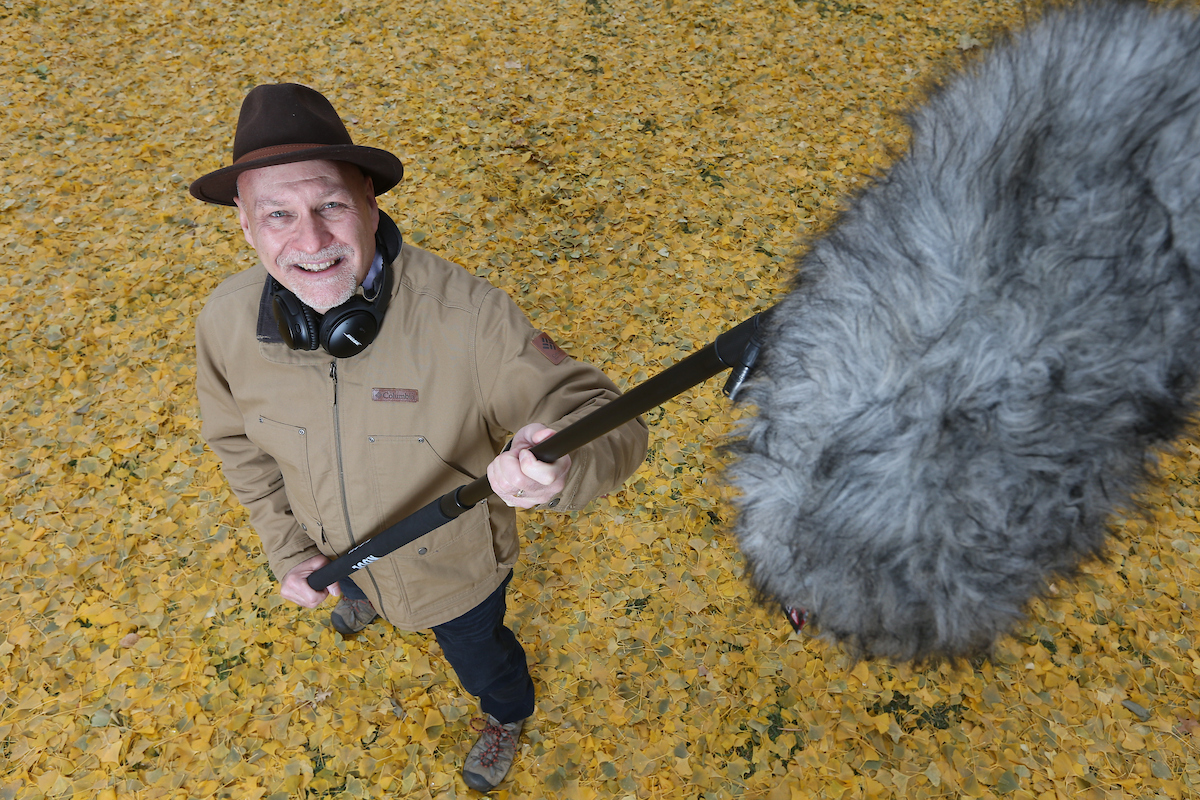 Pijanowski listening to the sounds of nature using technology (Photo taken in 2018 by Purdue Agricultural Communications).
 “Technology shortcuts the distance from the initial idea to asking the question and finding the solutions or answers. It truly helps you complete the discovery cycle a lot faster."
- Bryan Pijanowski
Pijanowski was awarded the Distinguished Landscape Ecologist Award, the most prestigious honor bestowed by the International Association for Landscape Ecology, North American Regional Chapter (IALE-NA), at the annual meeting’s awards ceremony. This award recognizes outstanding scientific achievements over a decade or more and honors individuals who have advanced the field through research, quantitative approaches, or application to conservation and management.
"The people who have previously received this award are scholars whose work I have found both deeply influential and inspirational,” said Pijanowski. “I’m moved and honored by this.”
2026 Lowell S. Hardin Award for Excellence in International Agriculture
Making some noise around the world
Guided by two core philosophies shaped by his mentors—“think big” and “always give back”—Pijanowski’s research has taken him to continents and ecosystems across the globe. These include both terrestrial—from grasslands, deserts to forests—and aquatic systems, such as coral reefs, kelp forests, ponds, wetlands and streams. During these research efforts, he always collaborates with and seeks guidance from local community members and stakeholders.
“Before I knew it, I found myself in East Africa with colleagues, and it just kept growing,” said Pijanowski. “I was then asking questions like, Can the sounds of melting glaciers in Patagonia possess important signals of environmental change? Are the logging activities in the paleotropical rainforests of Borneo decreasing animal diversity? Are the sonic practices of Mongolian herders, like the deeply spiritual long song, reflective of their connection to nature? Are the multitude of temporal patterns – called rhythms of nature – that exist in tropical ponds in the jungles of Costa Rica, indicative of their health?”
 Part of the Mongolian research team, including those from Purdue, local student researchers and Nutag researchers (e.g., local indigenous herder community members) gathered for a local Naadam event in 2022 (Photo provided by Bryan Pijanowski).
 This expanding scope led him to seeking to understand where distinct sound signals emerge, what they reveal about a place and how they can be used to assess environmental health. Pijanowski set an ambitious goal to study every major ecosystem on Earth. So far, Pijanowski has studied 29 of the world’s 32 major ecosystems, underscoring his dedication to assessing global environmental health.
“My lifetime checklist is about to be complete. I know where I need to go and what I need to do to complete this moonshot research. If I do this well and preserve the same experimental design, I will have established a sonic baseline for the Earth—one that will allow future generations to ask: How are the sounds of the Earth changing?”
- Bryan Pijanowski
He added that this archive could become the Earth’s acoustic fossils, especially for places which have been radically transformed.
Pijanowski is also working to bring the sounds of these special places around the world to broader audiences so they can understand why environments such as Mongolia’s grasslands at night and Borneo’s streams are so calming to the human ear. In partnership with the Purdue’s Department of Agricultural Communications, a SoundscapeVR platform has been developed that transports people to the virtual reality world of Mongolian energy-giving sites and the vibrant soundscapes of Borneo, with the aid of Meta Quest glasses. Despite the logistical challenges of international fieldwork, he remains driven by the scientific and societal rewards of the work.
“I’m excited about using the very latest virtual reality technology to transport people to these rare and remarkable remote places that I have been fortunate to visit myself," said Pijanowski.
In recognition of his international contributions, Purdue’s College of Agriculture will present Pijanowski with the 2026 Lowell S. Hardin Award for Excellence in International Agriculture.
Named in honor of Professor Lowell S. Hardin, the award was established in 2020 to celebrate his legacy in international agriculture and his many years of service in support of international activities in the Purdue’s College of Agriculture. Over the course of his career, he became a great mentor, wise counselor, trusted confidant and innovative leader to many Boilermakers. Since his passing in 2015, Hardin’s legacy has continued by honoring Purdue Agriculture faculty who make significant international contributions in research, education and outreach.
“Pijanowski’s international research is distinguished by its scientific rigor, global impact and collaborative reach,” said Gerald Shively, associate dean and director of International Programs in Agriculture. “His work connects environmental change and human activity in ways that inform both science and policy worldwide, making him a clear choice for the Hardin Award.”

"Although during his career Lowell Hardin maintained a strong focus on improving agricultural livelihoods and food security, his overall perspective on human wellbeing was extremely broad. I think he would be especially pleased to see his legacy linked to Pijanowski’s work. Recognizing Pijanowski’s work in this way is also indicative of how we define our responsibility to humanity and the planet here in the College of Agriculture at Purdue.”
- Gerald Shively
“Any of us who have found success owe it to those with experience who have guided us through a complex path,” said Pijanowski. “You must navigate life by relying on others not only for their knowledge, but also for their inspiration and support—both emotional and intellectual. I am grateful to receive this recognition.”
A ceremony and reception honoring Pijanowski will be held on Tuesday, May 5, 2026, from 3 to 5 p.m. Eastern in Pfendler Hall, Room 241. A demonstration of SoundscapesVR will be featured during the ceremony.
Featured Stories

For Brody Cox, preparing for the Indiana State Fair began long before he entered the show...
Carolyn Foley, a long-time member of the Purdue Forestry and Natural Resources (FNR) and...

In the September Purdue University/CME Group Ag Economy Barometer survey, 52% of respondents...

Purdue University’s College of Agriculture recognized nine alumni at the Distinguished...
Keep your eyes peeled across Indiana for the newly minted Purdue Forestry and Natural Resources...
“Being at Purdue has changed my thinking entirely,” says Mingyu Zhao, a third-year...