

Aquaponics outreach touts jobs, nutrition and waste reduction
The U.S. imports 90% of its seafood from abroad, racking up a $17 billion trade deficit. Global food miles add more to its cost. These miles — traveled from source to point of consumption — contribute nearly 20% of the carbon emitted into the atmosphere across the food supply chain.
Alternatively, creating local, eco-friendly aquaponics farms that grow seafood and plants together can help people eat better, reduce environmental costs and provide jobs. When Blue is Green (BiG) curriculum, published by Purdue University researchers in August 2025, outline these benefits.
A major goal of the BiG project was to create, pilot and publish education materials that foster a workforce prepared to support blue food — also known as seafood — supply chains. Launched in 2023, the project is co-led by Purdue with Ohio State University. BiG outreach efforts include stakeholder engagement to identify barriers and opportunities for blue foods and aquaponics.
The educational outreach objective encompasses college lectures, the high school curriculum, and evaluation. The curriculum targets students in grades 9 through 12 who study biology, environmental science and food science. All activities in the curriculum meet Next Generation Science Standards and Agriculture, Food, and Natural Resources Standards.
“In Indiana, we do have some aquaculture farmers,” said Ohio State’s Jen-Yi Huang, who leads the BiG project. “Aquaculturalists currently grow fish or shrimp only. “There’s some potential interest in adding hydroponics into their operations to turn aquaculture into aquaponics.”
The BiG team developed an interactive aquaponics virtual reality tour that provides an interactive and immersive experience for students, consumers, and conference attendees alike. Students participating in Purdue’s 4-H Academy are among those who have experienced the tour, developed by Arni Bhunia, the technician in Yaohua “Betty” Feng’s Food Safety Human Factor Lab.
The annual Aquaponics Association conference has become a regular stop for BiG team members. In 2024, the BiG team hosted a booth and conducted a focus group session. In 2025, they led educational sessions, hosted a discussion on using virtual reality in aquaponics, and presented their research assessments for Midwest producers to inform and support their operations.
Purdue College of Agriculture Professor Natalie Carroll developed the curriculum in collaboration with a dozen faculty members and graduate students from six academic units in the colleges of agriculture and engineering. “I worked with the researchers of the topic area to develop the activities and make sure everything was technically correct. Then started the process of review, pilot test, revise, pilot test, have teachers evaluating, testing with students,” she said.
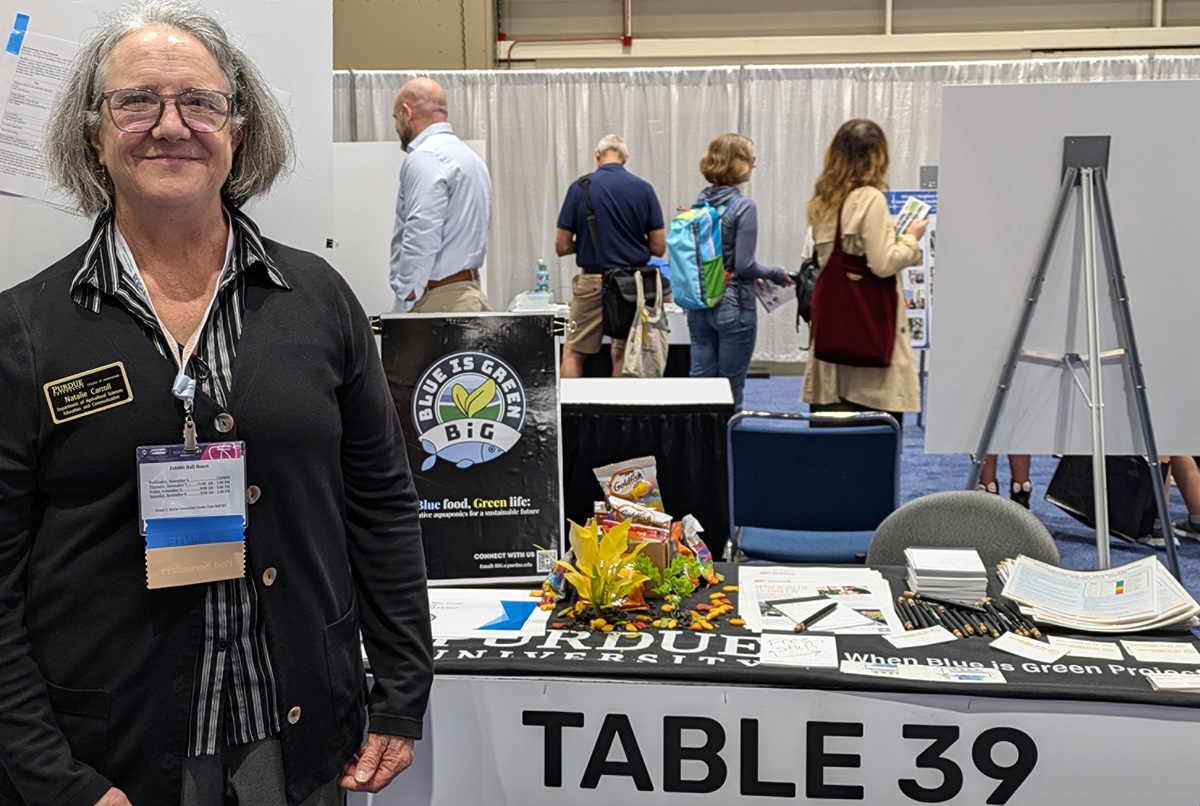 , opens larger image Natalie Carroll, professor of agricultural sciences education and communication and agricultural and biological engineering at Purdue. Carroll led the development of the When Blue is Green curriculum for students in grades 9 through 12. (Photo provided by the When Blue is Green Project)
 The curriculum consists of learning activities rather than lessons for specific classes. When conducting training sessions or presenting at conferences, Carroll advised teachers to take what they need from the curriculum’s PowerPoint slide decks. “They can add to it, make changes so it works for their classroom, and they seem to get it,” she said.
The BiG team has also shared the curriculum at meetings of the National Science Teachers Association and the Hoosier Association of Science Teachers. Other venues include the Indiana State Fair and the Aquaponics Association Conference.
All outreach materials, including the curriculum, worksheets and PowerPoint slides, are available on the BiG website under the For Teachers tab (right-hand side). Materials include BiG Snippets, an educational video miniseries developed by BiG research project manager Anna Catherine Yerian that explores various aspects of the BiG project. Additional resources are available under the Learning Resources tab at the BiG website.
Like the aquaponics research itself, writing a curriculum with BiG’s multiple dimensions presented its own complex challenges. “I first wrote it like all 4-H curricula, using the 4-H template and learning activities, then pilot tested the material for middle schoolers and high schoolers during two campus events.” It quickly became clear to Carroll that the curriculum needed adjustments.
Several teachers reviewed early drafts of the curriculum during the Fall 2024 semester. They tested the revised curriculum a year later. The curriculum comprises detailed lesson plans, worksheets, and customizable PowerPoints for each topic.
“First, I had teacher reviews and then we pilot tested it last fall with five science and ag teachers,” Carroll said. By early 2026, she had presented the curriculum and distributed aquaponics kits for the classroom to dozens of teachers.
One of the curriculum’s educational activities involves having students set up an aquaponics system with goldfish and basil. Common aquaponics species are African catfish, barramundi, carp, Nile tilapia and rainbow trout. The lesson plan recommends goldfish for the classroom because of their greater tolerance for relatively low water quality and ability to survive in a wide temperature range. Basil is a common aquaponics crop, along with lettuce, tomatoes and cucumbers.
Back on campus, five Purdue BiG project members have added an aquaponics lecture to their course offerings. These faculty members teach juniors and seniors in ag systems management, civil and construction engineering, sustainability engineering and environmental engineering, forestry and natural resources, and food science. New lectures have also been added to two graduate-level classes in civil and construction engineering.
Purdue’s Evaluation and Learning Research Center surveyed students in these classes to assess what they have learned. “We are seeing some increased awareness and interest,” Carroll said
“There’s nothing like trying it with real students to find out what you need to change.”
Featured Stories
For Brody Cox, preparing for the Indiana State Fair began long before he entered the show...
Carolyn Foley, a long-time member of the Purdue Forestry and Natural Resources (FNR) and...

In the September Purdue University/CME Group Ag Economy Barometer survey, 52% of respondents...
Purdue University’s College of Agriculture recognized nine alumni at the Distinguished...
Keep your eyes peeled across Indiana for the newly minted Purdue Forestry and Natural Resources...
“Being at Purdue has changed my thinking entirely,” says Mingyu Zhao, a third-year...