

Disturbance Ecology Comes to Life on Spring Break Trip
Every other year, the FNR 53600/53601 Ecology of Natural Disturbances class takes a spring break trip to 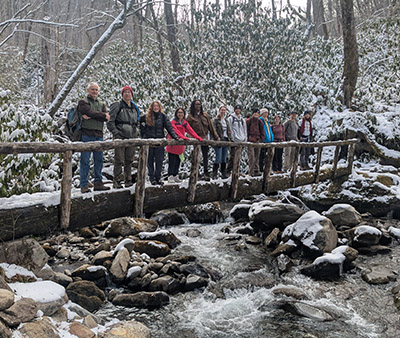 Great Smoky Mountain National Park to see their classwork come to life.
The group travels to Gatlinburg, Tennessee, for an excursion filled with hiking, visits with natural resource professionals and more.
After arriving in Gatlinburg on March 14, the group spent the following day hiking up Alum Cave Trail to the top of Mount Le Conte. They then hiked down Trillium Gap Trail to Roaring Fork. There they viewed and discussed Anakeesta slate, spruce-fir forests, balsam woolly adelgid, acid deposition, heath balds and beech gaps.
On Monday, students visited Cades Cove and Twin Creeks Science and Education Center to look at the natural history collections. They discussed deer herbivory effects, ecological restoration and stream monitoring and were introduced to park entomologist Dr. Becky Nichols.
Tuesday saw the group travel to Lynn Hollow and hike on Goldmine Loop Trail. There they discussed fire history and prescribed fire and met with fire ecologists Matt Wood and Rob Klein.
On Wednesday, the class hiked up Maddron Bald Trail to the Albright Grove Loop. There they viewed and discussed old-growth forest, forest succession of former agricultural land, long-term forest monitoring and hemlock woolly adelgid. They also met with ecologist Troy Evans, before driving up to Newfound Gap.
“While hiking and exploring the Smokies, there is so much information to soak up,” Austin Marshall said. “As we climbed in elevation the communities often shifted dramatically. Unique soils provided rare and specialized niches that allowed for patches of beautiful rhododendrons, lichens and clubmosses. Mountain peaks were often dominated by old stands of Fraser fir, which had been heavily impacted by the woolly adelgid. Pests, wildfire and disease were the most important aspects of our exploration in the mountain range. We discovered how the tragic Chimney Tops wildfire vastly improved the distribution of yellow pine as it requires that intense-stand replacing fire. Old growth was an interesting topic that we explored as we ventured into stands that had remained untouched by management in the past few hundred years, dominated by large hemlocks and massive remnant tulips that reached up to six feet in diameter. Human influence was a reoccurring theme, especially in Cade’s Cove, where we visited sites that had been developed by human settlement yet returned to a more historical state by the Park Service.”
The trip was not only enjoyable to Marshall for its educational value, but also the adventures it provided.
“Ecology and hiking are my passion and this trip provided plenty of both, but the highlight was the people,” Marshall shared. “Traveling, eating, hiking and hanging out with everyone made the entire trip worth it. Whether we were arguing on the van rides to pass the time or playing games back at the lodge, I made some amazing friends and had many laughs. Dr. Saunders and Dr. Jenkins made amazing meals for us and some nights we explored Gatlinburg in search of some good food!”
Stephanie Willsey said seeing the ecosystems and disturbance effects in person added to the knowledge she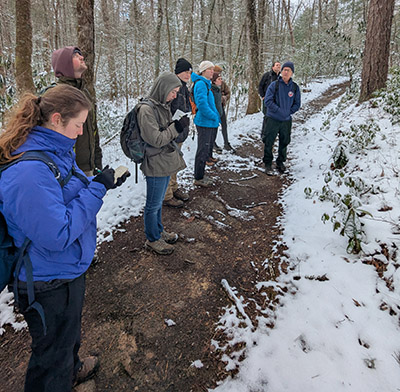 gained in the classroom.
“I learned that there is a huge difference between reading about disturbance ecology in the Smokies and actually standing in those ecosystems,” Willsey said. “Studying papers provides a decent picture of the region's diversity and history of human intervention but seeing it in person made that picture come alive. Experiencing critically endangered canebrakes, declining beech groves, heath balds and spruce-fir forests first-hand turned abstract lessons about human- and natural-caused disturbances, both intentional and unintentional, into something tangible and unforgettable. It's the kind of understanding I can carry with me throughout my time as a PhD student and into my career beyond Purdue.”
The trip also allowed Willsey to experience one of the ecosystems she had studied for many years.
“My favorite experience was visiting Albright Grove,” she shared. “In seven years of studying forestry, I have read and talked a lot about old-growth forests, what they mean to different people, their ecological value and the urgency of protecting them as they disappear, but I had never actually seen one in person. Walking through a stand dominated by old-growth hemlock and other species and finally seeing what an old-growth black cherry looks like was unforgettable. At the same time, signs of human-caused disturbance brought me 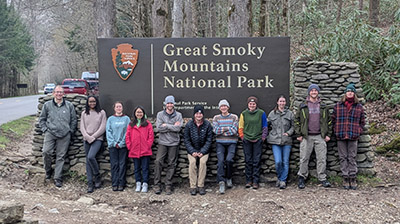 back to reality: the visible damage from hemlock woolly adelgid and the ongoing efforts by NPS staff to protect these trees made the vulnerability of these systems very real.”
FNR 53600 is an advanced lecture and discussion-based class that examines how disturbance shapes the composition and structure of communities and landscapes across major terrestrial biomes. Students examine and discuss the relationships between disturbance intensity, frequency and spatial extent and how these characteristics affect ecological processes and ecologically-based management of forest and grassland ecosystems. The class also looks at the synergistic effects of multiple disturbances and the restoration of endemic disturbance regimes in contemporary ecosystems.The course is co-taught by Dr. Mike Saunders and Dr. Mike Jenkins.
Featured Stories
Senior Isaac Johnson, a forestry major with a concentration in forest management, worked as an...
Carolyn Foley, a long-time member of the Purdue Forestry and Natural Resources (FNR) and...
Keep your eyes peeled across Indiana for the newly minted Purdue Forestry and Natural Resources...
Senior wildlife major Madison Medley spent her summer as a natural resource intern with Hamilton...
Addy Ellis, a sophomore aquatic sciences and political science double major, spent the summer as...
Zachary Feiner, who earned his PhD from FNR in 2015 and spent two additional years in West...