

Novel method produces sustainable soybean-based biokerosene for cold-weather use
Purdue University researchers have developed a novel, patent-pending process to synthesize soybean-based biokerosene that can be blended for use in cold-weather biodiesel and sustainable aviation fuel. Biokerosene fuel blends also emit lower levels of greenhouse gases and expand the market for locally grown soybeans.
The biokerosene was developed and tested by Nathan Mosier, Indiana Soybean Alliance Soybean Utilization Endowed Chair and head of the Department of Agricultural and Biological Engineering, Junli Liu, senior bioprocess engineering research scientist, and graduate student Elena Robles Molina, all working in Purdue’s Laboratory of Renewable Resources Engineering. The Indiana Soybean Alliance funded the research, which was published in Biofuel Research Journal.
To generate this form of biokerosene, ozone is injected into soybean oil to crack its carbon-carbon double bonds, producing nonanoic acid, a major component of biokerosene. Producing ozone via electricity is energy efficient and a large-scale process already used to purify municipal water supplies.
Compared to other methods of producing biokerosene, “It’s a little simpler process. It’s faster, doesn’t require a catalyst, and can be done at room temperature,” Mosier said.
Mosier and Liu disclosed their innovation to the Purdue Innovates Office of Technology Commercialization, which applied for a patent to protect the intellectual property.
 Nathan Mosier
  Junli Liu
 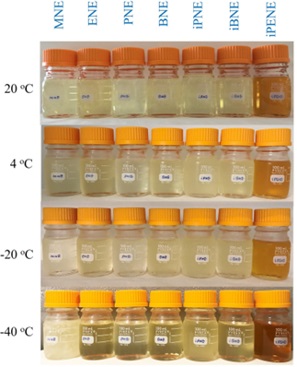 Blending biokerosene with biodiesel and sustainable jet fuel has several advantages.
“One of the challenges for biodiesel is that it can’t be used in winter, when temperatures are below 30 degrees Fahrenheit,” Liu said.
At low temperatures, biodiesel starts to gel and can cause engine damage. Biokerosene, however, performs well at temperatures as low as minus 40 degrees Fahrenheit. Blending biokerosene with biodiesel expands both the time of year and parts of the country where it can be used.
Biodiesel is also susceptible to oxidation, where exposure to oxygen causes it to break down into byproducts that decrease engine performance and cause engine damage. Since biokerosene has a higher level of oxidation stability, it can be stored for a longer period, reducing the cost of adding antioxidants.Engine tests for biokerosene showed that combustion was cleaner and more complete than traditional biodiesel and jet fuel, with reduced unburned hydrocarbon and carbon monoxide emissions.
In addition, nitrogen oxide (NOX) emissions, which are associated with a global warming potential 300 times greater than carbon dioxide, were significantly lower. Blending biokerosene with biodiesel and sustainable jet fuel brings their emission levels closer to those of petroleum fuels, an incentive making it easier to switch to biofuels.
“Sustainability is a big issue for everyone. Using biokerosene fuel blends can help reduce greenhouse gas emissions and contribute to the mitigation of climate change,” Liu said.
Biokerosene production also “expands domestic markets for higher value products from domestically grown soybeans,” Mosier said. “This benefits U.S. consumers and farmers because it’s made here and processed here without changing the production technology.”Featured Stories

For Brody Cox, preparing for the Indiana State Fair began long before he entered the show...

Carolyn Foley, a long-time member of the Purdue Forestry and Natural Resources (FNR) and...

In the September Purdue University/CME Group Ag Economy Barometer survey, 52% of respondents...

Purdue University’s College of Agriculture recognized nine alumni at the Distinguished...
Keep your eyes peeled across Indiana for the newly minted Purdue Forestry and Natural Resources...

“Being at Purdue has changed my thinking entirely,” says Mingyu Zhao, a third-year...