

Brewing up safety: Purdue Food Science and the Heartland Food Products Group team up to revolutionize coffee cleanliness
Coffee makers are everywhere — from kitchens to office break rooms — brewing up countless cups each day. But what’s really inside your morning brew?
Most of us assume hot water keeps our coffee safe, but research shows there’s more to the story. That’s why Heartland Food Products Group set out to launch a groundbreaking new coffee product and turned to  the Purdue Food Entrepreneurship and Manufacturing Institute (FEMI) to investigate the food safety risks hiding in everyday coffee makers.
Hansel Mina, the managing director of FEMI, explained that partnerships with groups such as the Heartland Food Products Group are core to the FEMI mission.
“The goal of this project was to assess the food safety of coffee makers and coffee brewers to compare them with their Java House Peel & Pour Pods that don’t need to go through the process of a brewer,” said Mina. “These pods are designed to be poured into hot or iced water with no machine required.”
Ami Krishan, head of Commercialization Management for Heartland Food Products Group, says their company's objective was to obtain quality and trusted research.
“In developing this project, we knew that reputation and attention to detail would make a huge difference in how this important information is received by the public, and there aren’t many institutions that represent both of those qualities like Purdue University,” said Krishan. “It’s one thing to conduct a study. It's another to do it in such a way that it can be trusted by the public-and we feel we did that here.”
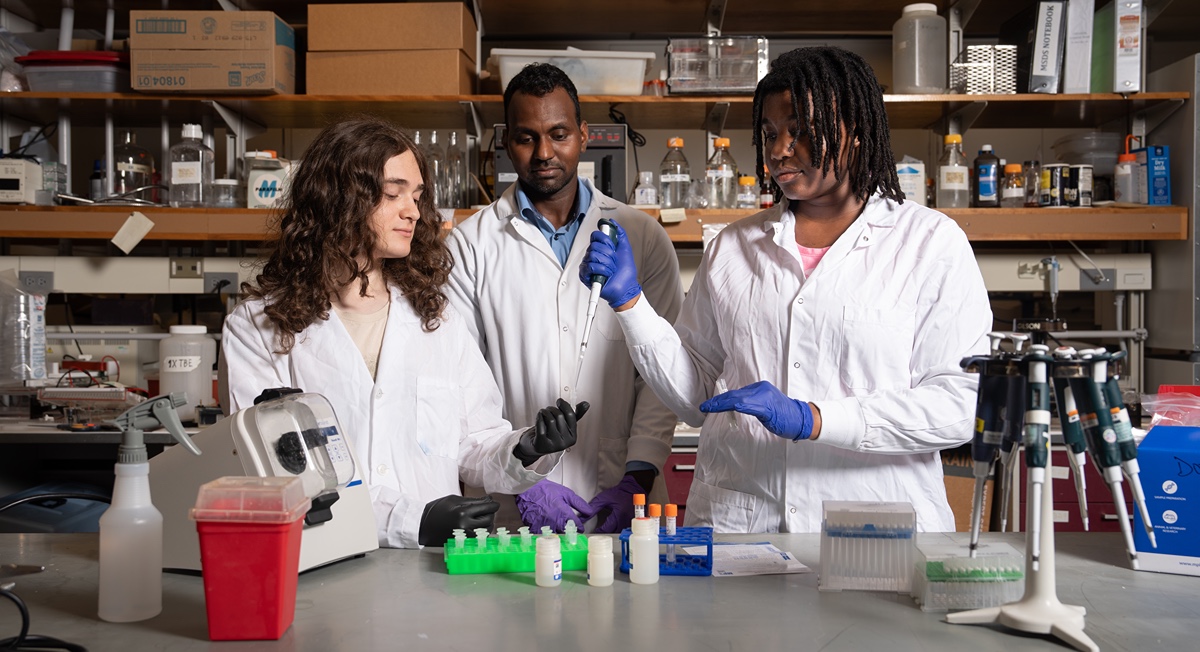
Over a four-month period, the FEMI team tested 21 coffee maker models typically found in home kitchens, office settings or other shared spaces to obtain a comprehensive dataset for their research.
Here were their key takeaways
- Shared coffee makers can harbor elevated levels of bacteria and mold
- Most users don’t regularly clean all machine components or follow manufacturer’s instructions
- Hot water alone does not sanitize a brewer
“FEMI has a team comprised of affiliated faculty from the College of Agriculture, staff scientists and undergrad students,” Mina said. “A project like this takes everyone in the department to accomplish the goal.”
Given that microorganisms are everywhere, most of what the FEMI team found concerned environmental microorganisms, Mina explained.
“Generally, the things we discovered were related to sanitary conditions and not properly cleaned coffee makers,” he said. “For these reasons, a product like the Java House Peel & Pour Pods, that carries little to no risk for contamination, offers a very safe cup of coffee in comparison to brewing in a traditional coffee maker, especially one in a shared space where you may be unsure of the cleaning practices.”
FEMI’s research revealed that shared brewers carry elevated levels of bacteria and mold across multiple components.
“From the start, we felt our Java House Cold Brew Peel & Pour Pods were solving an issue affecting the public — bacteria and mold buildup in shared frequently used coffee makers and brewers. Thanks to the  great work of the Purdue Food Science team, we now know that shared brewers can carry elevated levels of bacteria and mold across multiple components,” said Matt Thompson, director of content & communications at Heartland Food Products Group.
“We want to be known as an organization that can help and a place that can be trusted for these kinds of projects. We value solid science, research and transparency,” Said Mina.
Thompson believes the FEMI team kept to their promise of providing solid science and more.
“From the first call, where they walked us through the study's methodology, to the final meeting, where they shared their insights and results, we felt like we had a true partner in the process. They made every aspect of the project feel intentional, important and easy to understand,” Thompson said.
Mina said the hope for work like this is that the research will benefit all consumers by raising awareness of what is happening in their kitchens and the options they have in the marketplace that may provide safer products.
“Working with FEMI gives this study and the findings instant credibility with consumers. It’s one thing for a brand or a company to make claims. It’s another when you can back those claims with a scientific study conducted by a premier university like Purdue,” Krishan said.
Featured Stories

AI chatbots can provide useful food safety analysis. However, according to an analysis conducted...
Han Chen, a postdoctoral scholar in Feng’s lab, has worked with the California Almond Board...

Drying apples at home can be an easy, economic way to make your fall harvest last all winter....

Picnics bring friends and family together for a day filled with good food and laughter. However,...
As food recalls become more prevalent, more families toss more lettuce and deli meat into the...

Many changes occur for women during pregnancy, including new dietary considerations and intense...