

A food safety success story: California almonds
You know not to eat raw eggs. And you’ve probably heard of the E. coli outbreaks linked to lettuce and Listeria in deli meats. But did you know that low-moisture foods like dried fruits and flour can also house pathogenic bacteria? In the early 2000s, there were two major outbreaks of Salmonella in raw almonds — an issue that the California Almond Board took so seriously that in 2026 food borne illness in almonds is ancient history.
Almonds have been grown commercially in California since the mid-19th century. The state is now the biggest producer of almonds in the world, accounting for 99% of almonds in the U.S. and over 70% in the world. The California Almond Board, originally formed in 1950 to comply with federal standards and regulations, has grown to an international commodity group to represent over 7,600 California almond growers and 99 almond processors. With an elected board of directors, the Board now engages in advertising, quality control and research on production, nutrition, food safety and markets.
“The Almond Board of California supports the industry from pre-harvest production through post-harvest handling and processing. Because growers, processors, and industry partners are all connected through this commodity-wide system, it provides a valuable opportunity to study how food safety culture is developed, shared and sustained across an entire industry,” said Betty Feng, associate professor of food science.
Han Chen, a postdoctoral scholar in Feng’s lab, has worked with the California Almond Board to determine how it successfully formed an alliance among growers and processors for food quality and safety. With funding from the United States Department of Agriculture National Institute of Food and Agriculture, Chen and her co-authors wrote a comprehensive review published in the high-impact journal of Comprehensive Reviews in Food Science and Food Safety about how the California almond industry effected change after the Salmonella outbreaks in the early 2000s.
“The California Almond Board’s current approach to food safety management is viewed as the gold standard,” Chen said. “We were very fortunate to be able to interview some of the key individuals who were involved with almonds during the outbreaks, including those who worked at the Almond Board at the time, as well as individuals from the industry, food safety consultants and a regulatory agency. The Almond Board did also share their meeting minutes with us, so we could see where their food safety conversations were going at the time. We also reviewed newspapers from that period to understand the public discussion surrounding the outbreaks and the Almond Board’s actions.”
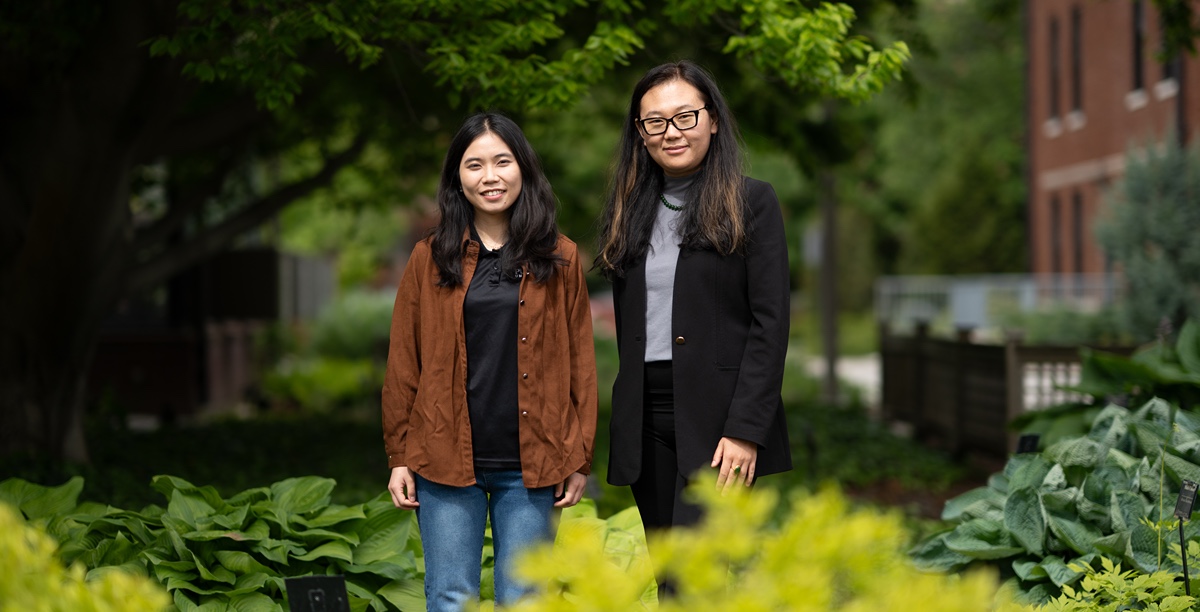 , opens larger image Han Chen, a postdoctoral scholar in Feng’s lab and Betty Feng, associate professor of food science.
 Chen found some members of the almond industry dismissed the first outbreak as an isolated event. They blamed the outbreak on issues at other affected facilities. Still, the Almond Board took the initiative to begin investing in research to learn why the outbreak happened and how they could reduce risk.
Then, just three years after the first outbreak, a second one happened. That led to a consensus across the industry that these outbreaks weren’t coincidental and that the risks needed to be controlled. After the second outbreak, the California Almond Board unanimously approved a voluntary action plan to treat all raw almonds to reduce the risk of Salmonella contamination. They broadened the research efforts to investigate more risk-reduction interventions and their impact on almond quality. They also communicated with government agencies and industry members about their plans to address the food safety issues, technological innovations and adoption, and rule-making for a mandatory Salmonella control program.
In 2007 a mandatory Salmonella-control program went into effect: all raw almonds were to be treated to achieve a minimum 4-log reduction, or about 99.99%, of Salmonella bacteria before they were sold to consumers in North America. Receiving industry-wide support was not easy. There was resistance during the rule-making process, but the Board adapted by refining the rules to include various industry segments, consistently communicating the need for the program, and collaborating with researchers, regulators, industry members and equipment manufacturers to ensure industry readiness for the mandatory program.
Chen said, “It takes a lot of effort to get industry-wide commitment for change. The Almond Board led the collaborative efforts from multiple groups. They partnered with the industry and equipment companies to ensure sufficient treatment capacity, worked with researchers to provide scientific evidence, and coordinated with regulators on rule-making. At the same time, they made extensive efforts to communicate with their growers and processors to bring them on board and prepare for the program. This ultimately drove a transformation in its food safety management, as well as a cultural change towards food safety.”
Eventually, almond growers and processors had multiple intervention options, ranging from roasting, blanching, to propylene oxide treatments for Salmonella control, and they could choose whichever fit their facility best. By the time the U.S. government passed the Food Safety Modernized Act (FSMA) in 2011, the almond industry’s mandatory Salmonella-control program was already in-place. Almond growers and processors were later granted enforcement discretion under the FSMA Produce Safety Rule due to their effective risk controls.
Chen was invited to present her research at the Annual Almond Conference, organized by the Almond Board, in December 2025, and to develop a workshop on food safety culture for dried fruits and tree nuts processors at the Safe Food California Conference in April 2026. “This work put our foot in the door for the almond and other tree nut industries,” said Feng. “For the next few years, I would like to see how we can apply what we learned from the almond industry to other low-moisture food industries and beyond.”
Featured Stories

Maksym Chepeliev, a leading international scholar recognized prominently for his work in...

In recent years attendees at Purdue Agriculture alumni, donor, and faculty and staff events have...
People think grass is simple. Lawns, right? Mow regularly and add some water and fertilizer. What...
The Office of Indiana State Chemist (OISC) is warning Indiana residents about an illegal...

A prominent protein on most human cells may be key to unlocking the code that makes humans...

Ava Hoskins, a double major in aquatic sciences (fisheries concentration) and natural resources...