Entomology
Wheat crops receive reinforcements in battle against Hessian fly
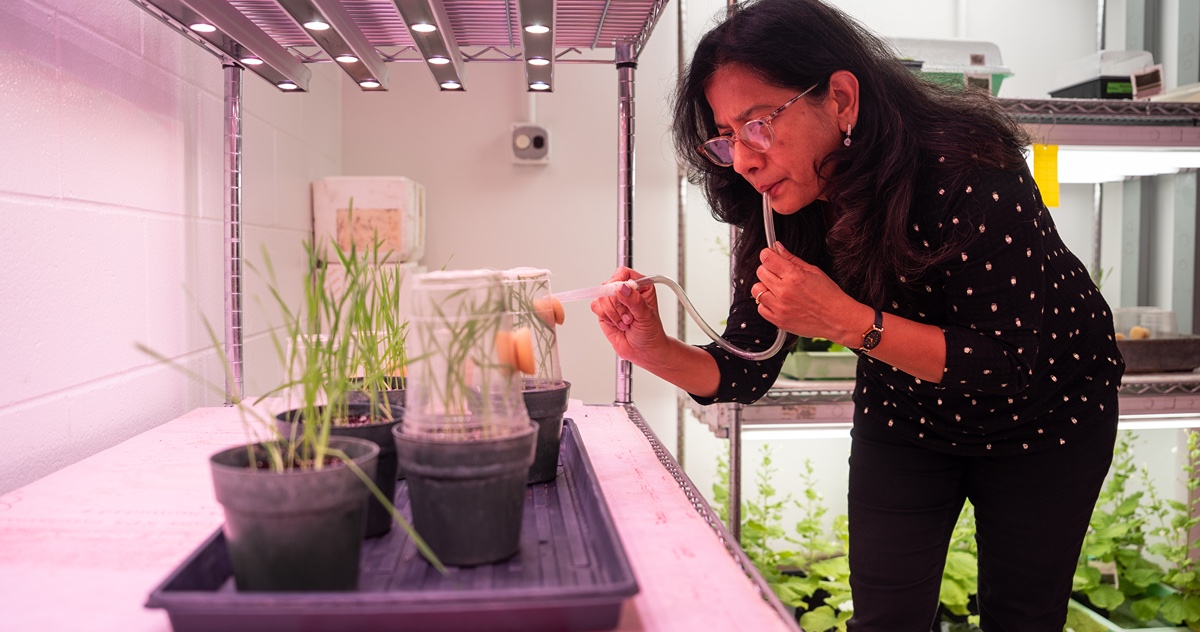 , opens larger image Subhashree Subramanyam of the U.S. Department of Agriculture and Purdue University infests wheat plants with Hessian flies using an aspirator. Purdue Agricultural Communications photo/Joshua Clark
WEST LAFAYETTE, Ind. — A tiny insect called the Hessian fly began plaguing U.S. wheat fields during the American Revolutionary War. Until recently, the molecular basis of the crop’s defense against Hessian fly has remained mostly unknown.
But now, researchers at the U.S. Department of Agriculture, Purdue University, Kansas State University and their collaborators have sequenced and cloned the first Hessian fly resistance gene in wheat.
“This breakthrough reveals critical molecular components of the wheat-Hessian fly relationship and offers new insights into how plants perceive and respond to insect attack,” said Subhashree Subramanyam, research molecular biologist at the USDA Agricultural Research Service and adjunct associate professor of entomology at Purdue University.
Global wheat production reached nearly 800 million metric tons in 2024-25, according to the USDA. “Wheat is the world’s second most produced cereal grain, and it plays a very critical role in U.S. agriculture and global food security,” Subramanyam said. “Insect pests continue to threaten this crop’s productivity. They cause significant yield losses and economic hardship for wheat growers.”
The gene produces a resistance protein that recognizes a protein secreted by the Hessian fly, which initiates a cascade of defense responses that kills the insect. A study co-led by Subramanyam and Kansas State University’s Bikram Gill appears in the Aug. 14, 2026, issue of Science Advances.
The wheat-Hessian fly gene-for-gene interaction operates as a lock-and-key mechanism. The gene-for-gene hypothesis was proposed in 1970 by USDA researchers based at Purdue and K-State. “Our discovery provides the first definitive molecular validation of the gene-for-gene in wheat-Hessian fly system — a mystery that has challenged scientists for more than half a century,” Subramanyam said of the new work.
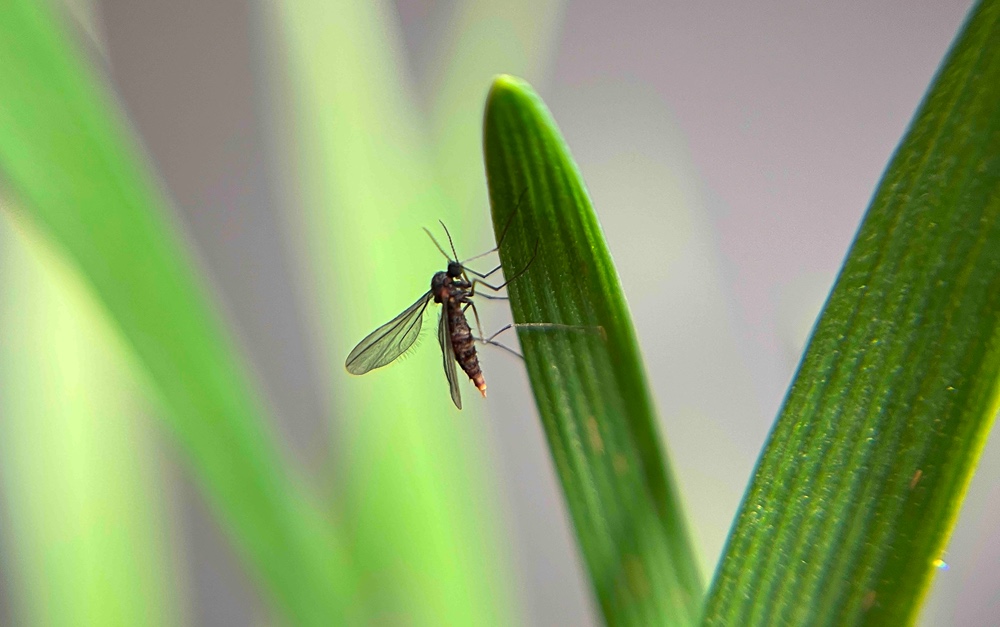 , opens larger image A female Hessian fly lays eggs on a wheat leaf. USDA/Purdue University photo/Subhashree Subramanyam
“The knowledge generated by this study opens promising avenues for engineering durable insect resistance in crops that will protect farmers’ yields, supporting long-term sustainable agriculture and global food security.”
Hessian fly causes hundreds of millions of dollars in losses annually for wheat production, said Steve Scofield, a supervisory research geneticist at the USDA Agricultural Research Service (ARS) and adjunct associate professor of agronomy at Purdue. “Genetic resistance is the most promising way to combat this pest, and this study reports the cloning of the first Hessian fly resistance gene from wheat. The work is elegant.”
This effort includes contributions from scientists and materials from multiple countries over almost 90 years. “Legendary scientists Hitoshi Kihara from Japan and Ernie Sears from the U.S. discovered during the 1940s that Iranian goatgrass sired emmer white to produce bread wheat,” said Gill, University Distinguished Professor Emeritus at Kansas State. “Kihara made extensive collections of Iranian goatgrass during the 1950s and resynthesized wheat. This is a satisfying close to a long quest and a start of a new chapter in this research endeavor.”
Working in parallel, Purdue’s Jeff Stuart, professor of entomology, Subramanyam and other collaborators in 2014 cloned the first insect avirulence gene, which interacts with a plant host resistance gene, from Hessian fly. Next, they sequenced the insect’s genome, providing insight into how Hessian fly stunted growth in wheat plants.
More than two centuries since its introduction into the United States, the Hessian fly stands as a national priority under the Wheat Resiliency Initiative (WRI), said Oswald Crasta, the USDA Agricultural Research Service national program leader in small grains. Supporting the initiative are stakeholders such as the National Wheat Improvement Committee and the National Association of Wheat Growers.
“WRI aims to improve wheat resilience against biotic and environmental stressors. The WRI is currently appropriated at $1.5 million with a priority of mitigating the devastating effects of Hessian fly and wheat stem sawfly through targeted genetic improvement,” Crasta said.
The collaborators’ varied expertise provided a holistic view of the molecular interactions between plants and insects that is crucial to understanding the system, Subramanyam noted. The newly cloned H13 wheat resistance gene recognizes vH13, its Hessian fly counterpart, rendering it unable to infect the plant. “They have to come together before anything is triggered,” Subramanyam explained.
Subramanyam likened the process to molecular-scale warfare. One side loses a battle, develops a new strategy, then counterattacks. Increasing temperatures, an ally of the Hessian fly, contribute to yield losses resulting from a decline in wheat’s native resistance to the pest. The insect populations can also develop resistance over time, making them more virulent. “There is a need to keep identifying novel sources of resistance,” she said.
Scientists now have a clearer picture of the process, “but some factors are still missing,” she said. Further research that leads to a better understanding of the resistance and susceptibility mechanisms in wheat and Hessian flies could also apply to other cereal crops.
“This is a learning process. Understanding the molecular components that are in play means you can change some of those factors,” Subramanyam said.
This project was funded by the USDA Current Research Information System, the USDA Agriculture and Food Research Initiative, and the USDA National Institute of Food and Agriculture.
About Purdue Agriculture
Purdue University’s College of Agriculture is one of the world’s leading colleges of agricultural, food, life and natural resource sciences. The college is committed to preparing students to make a difference in whatever careers they pursue; stretching the frontiers of science to discover solutions to some of our most pressing global, regional and local challenges; and, through Purdue Extension and other engagement programs, educating the people of Indiana, the nation and the world to improve their lives and livelihoods. To learn more about Purdue Agriculture, visit this site.
About Purdue University
Purdue University is a research institution ranked among the top 10 public universities in the United States. More than 111,000 students study at Purdue across multiple campuses, including more than 57,000 at our main campus locations in West Lafayette and Indianapolis. As a land-grant university committed to affordability and accessibility, Purdue’s main campus has frozen tuition 14 years in a row, enabling more students than ever to graduate debt-free.
Writer: Steve Koppes
Media contact: Trevor Peters, peter237@purdue.edu
Sources: Subhashree Subramanyam, ssubram@purdue.edu
Agricultural Communications: Maureen Manier, mmanier@purdue.edu, 765-494-8415
Journalist Assets: Publication quality images can be obtained at this link