Biochemistry
Fly’s eye opens window into important biological processes
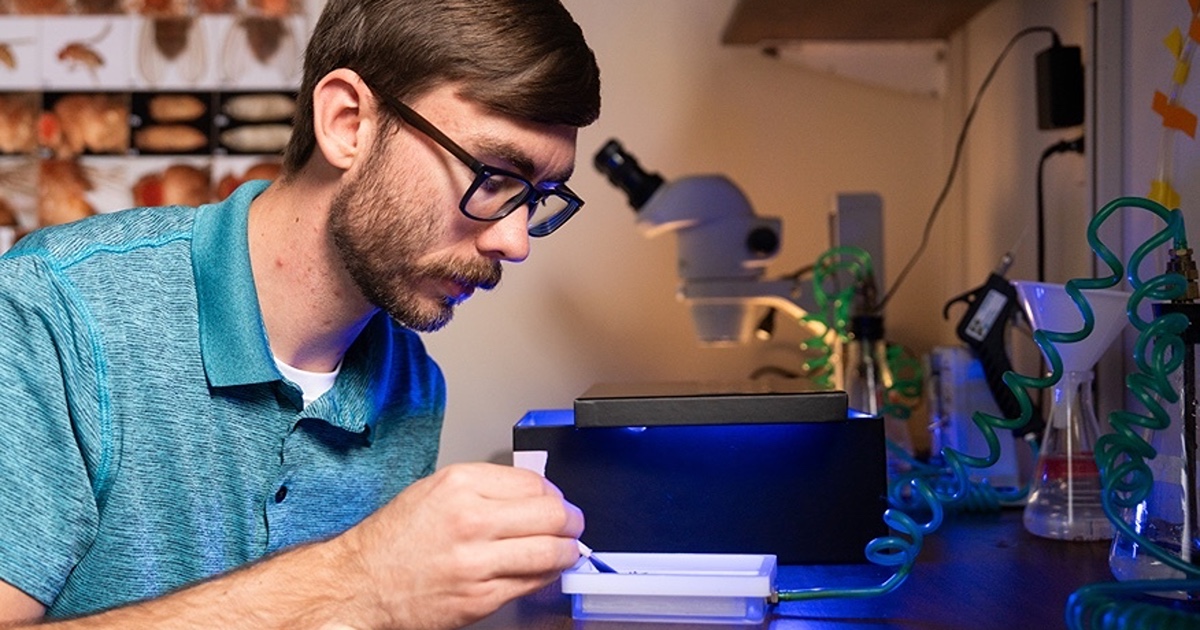 , opens larger image Lucas Kramer, a PhD candidate in biochemistry at Purdue University, sorts anesthetized fruit flies with a feather for light-regulation experiments. (Purdue University photo/Joshua Clark)
WEST LAFAYETTE, Ind. — The eyes are the window to the soul, according to an old saying. But Purdue University’s Vikki Weake sees them as a window into genetic and biological discoveries consequential to human health.
Her latest work details how the eyes of the fruit fly respond to light. The biochemical process that fly eyes follow to convert light into electrical signals can quickly adapt to huge changes in light intensity. Flies can also detect high-frequency oscillations in light.
The fly’s visual response serves as a scientifically important example of signal transduction cascades — streams of molecular events that translate signals into specific actions within a cell. “The signaling pathway used to sense light for fly vision works incredibly quickly,” said Weake, a professor of biochemistry and member of the Purdue Institute for Cancer Research. “Understanding how this pathway is regulated by light itself helps us to learn how these types of pathways work in other contexts such as cancer, or in our immune system.”
Despite their anatomical differences, fly eyes process light much like a subset of mammalian retinal neurons that help respond to the daily rhythms of light and darkness.
“Light is a really important environmental signal for the eye and for our bodies — not just for seeing objects, but also for synchronizing our bodies with the daily light cycle,” Weake said.
In Science Signaling, Weake and her associates recently showed how light remodels a specific protein that regulates how fruit flies respond to rapidly oscillating light. They found that phosphorylation, a key biological process that alters protein function, plays a major role in fruit fly light response.
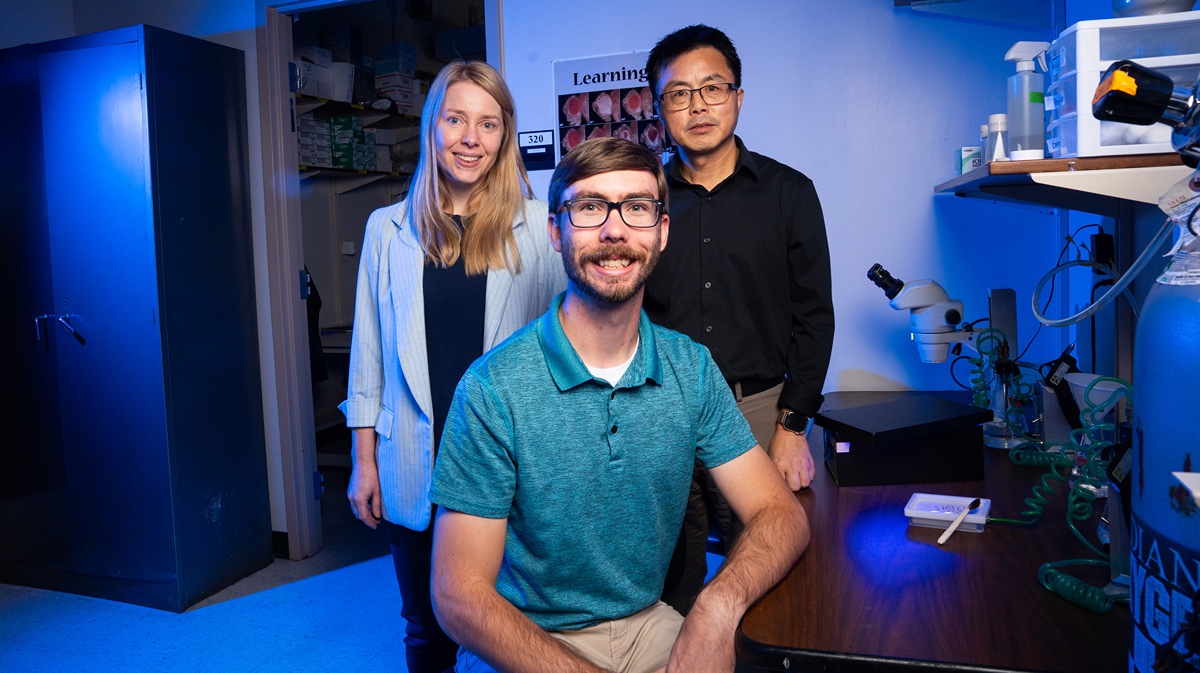 , opens larger image PhD candidate Lucas Kramer (center), and professors Vikki Weake and W. Andy Tao, all of the Purdue Department of Biochemistry, have published new findings about fruit fly vision in Science Signaling.
Lucas Kramer, a biochemistry graduate student, showed that many proteins undergo sweeping phosphorylation changes in response to light. “The most important part of this work is to better understand the biochemical mechanisms underlying light response. We do this by investigating proteins modified by phosphorylation in response to prolonged light exposure,” Kramer said.
Kramer’s work on protein phosphorylation produced striking results, Weake said.
“What you notice is that light increases nearly all of the phosphorylation site events that we see. Only a few happen in the opposite direction in the dark. Nearly everything else is on in the light,” Weake said. “The quality or intensity of the light matters as well. More intense light leads to more phosphorylation. And many of those proteins that become phosphorylated in the light are important for phototransduction, for the light response itself.”
The team found that phosphorylation of an important protein channel, which is related to channels for pain reception in humans, influences the fly eye’s response to increasing light frequencies. “At least some of these phosphorylation events directly influence light response,” Kramer said.
The team identified many other light-regulated proteins that do more than respond to light. “They are also involved in processes that occur further in the brain, such as synapse formation and neuronal remodeling,” Weake explained.
Other light-regulated proteins help maintain the daily biological cycles that occur in response to light and dark. “It helps to emphasize just how important an environmental signal light is for the eye and the brain. We see it in flies, but we would anticipate that many things we see in flies are going to be true in other systems,” Weake said.
The co-authors for this article included Baruch Minke and Tal Brandwine-Shemmer of the Hebrew University in Israel and Purdue’s W. Andy Tao and Lucas Kramer. This research was funded by the National Science Foundation, National Institutes of Health and the U.S.-Israel Binational Science Foundation.
About Purdue Agriculture
Purdue University’s College of Agriculture is one of the world’s leading colleges of agricultural, food, life and natural resource sciences. The college is committed to preparing students to make a difference in whatever careers they pursue; stretching the frontiers of science to discover solutions to some of our most pressing global, regional and local challenges; and, through Purdue Extension and other engagement programs, educating the people of Indiana, the nation and the world to improve their lives and livelihoods. To learn more about Purdue Agriculture, visit this site.
About Purdue University
Purdue University is a research institution ranked among the top 10 public universities in the United States. More than 111,000 students study at Purdue across multiple campuses, including more than 57,000 at our main campus locations in West Lafayette and Indianapolis. As a land-grant university committed to affordability and accessibility, Purdue’s main campus has frozen tuition 14 years in a row, enabling more students than ever to graduate debt-free.
Writer: Steve Koppes
Media contact: Devyn Ashlea Raver, draver@purdue.edu
Sources: Vikki Weake, vweake@purdue.edu; Lucas Kramer, krame155@purdue.edu
Agricultural Communications: Maureen Manier, mmanier@purdue.edu, 765-494-8415
Journalist Assets: Publication-quality images can be obtained at this link