

Behind the Research: Kelsey Budreau
Kelsey Budreau, Pilot Plant Manager
- Overseeing the creation of a food-grade lab space that adheres to FDA regulations
- Managing millions of dollars of industrial food processing equipment
- Helping companies create food products that wind up on shelves all over the world
The Department of Food Science’s Pilot Plant is a 9,500-square-foot facility with millions of dollars of food processing equipment. Some is brand-new, programmable, automated, with microprocessors and shiny screens. Other machines are so old their manuals have long since been lost to time. One homogenizer dates to the Great Depression.
The entire place is staffed by undergraduates, so the workforce turns over every year. Except for one person, the Pilot Plant manager, who holds all the institutional knowledge, who oversees everything from student experiments to major industrial partnerships.
That’s Kelsey Budreau.
“There are so many different things we can do here,” Budreau says. “The different products we’re capable of handling and working on, that really shocked me when I first came here.”
Budreau, who grew up in Vincennes, came to Purdue as an undergraduate to study biochemistry but switched midway to food science. It was a great fit, she says.
“I’m analytically minded and tactile, and food science has a lot of hands-on components, but also a little bit of biology, a little bit of chemistry, a little bit of engineering,” she says.
After graduating in 2015, Budreau worked at several food technology positions in Indiana. A few years later, her husband decided he wanted to work at his family’s farm in Fowler, about half an hour northwest of West Lafayette. The couple moved back to the area and Budreau began looking for jobs. When she saw the open position in the Pilot Plant in 2021, she knew it was for her.
“I didn’t have a lot of hands-on equipment experience, but I thought ‘why not me?’” she says. “And here we are, five years later!”
Budreau had been in the Pilot Plant for classes, but she hadn’t remembered its size or breadth. Seeing it again was a bit of a shock.
“It really opened my eyes — the capability of what we can do in one academic building,” she says.
The Pilot Plant has equipment for food processing techniques such as extrusion, fermentation, and aseptic packaging. The space is used for several purposes. It’s a classroom for food science students. It’s a research facility for faculty. And it’s where food industry partners can work on processing technologies they can later expand to full-scale manufacturing.
Learning how to use the 200-plus pieces of equipment in the plant’s inventory was the hardest part of Budreau’s new job. Help came from academic IT specialist Ben Paxson and graduate students who had become familiar with one piece of equipment or another during the course of their research.
“It was a huge learning curve,” she says.
Now, on any given day, Budreau might be training undergraduates how to operate and clean equipment, coordinating research trials (more than 50 a year), assisting faculty with live demonstrations, or — in the summer, especially — supporting Extension projects. But the bulk of her work is industry trials.
Some of that work comes through Purdue’s Food Entrepreneurship and Manufacturing Institute (FEMI), which offers support to agricultural entrepreneurs with innovative, value-added food ideas. If a pepper farmer, say, wants to create a new salsa, FEMI can help with everything from processing techniques to business and marketing plans.
“It’s a one-stop shop,” Budreau says.
Other work comes from much bigger companies looking to test small batches of new or changed products.
“Imagine you’re a large, established multinational company and you want to look at a new product, but you don’t want to shut your whole facility down to run 100,000 gallons of something that might not work,” Budreau says. “We can do 100 gallons. Testing to fail or succeed small really helps the food industry.”
One of Budreau’s proudest achievements is creating an FDA-inspectable food grade lab space. This means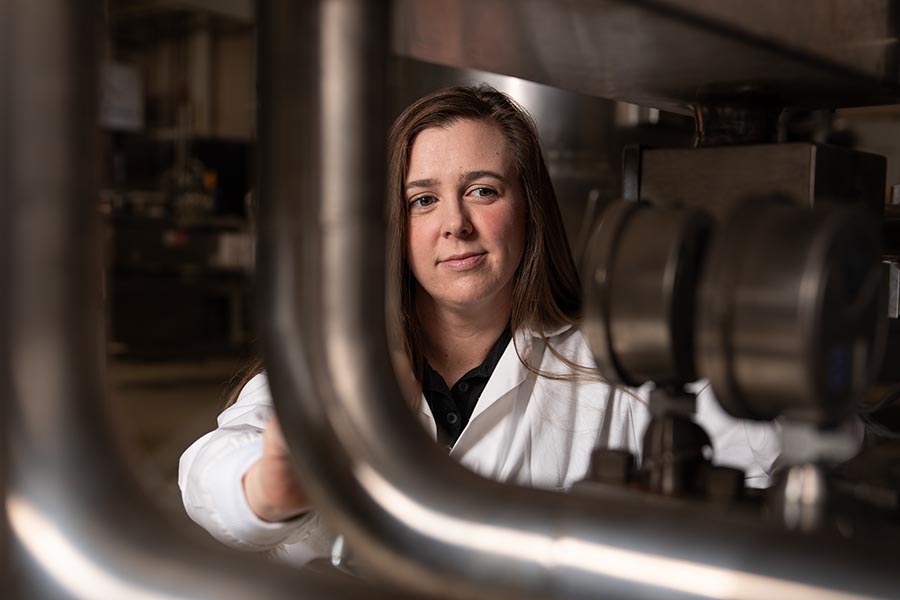 the plant can be used for legally consumable products, like creating foods for clinical trials or trade shows. The process involved developing a layout that made sense, going through sanitation and microbiological validation procedures, and overseeing the remodeling.
“It was a multiyear effort by a lot of people, and I’m really proud we got there,” Budreau says.
When she’s not working, Budreau spends time with her children, ages 6 and 3, and helps her husband around the farm. She recently took up weight training, with the Pilot Plant in mind. “It’s a physically demanding job.”
She’s thrilled she was able to find a home in food science after her time as an undergrad.
“I always thought it would be a place I’d like to come back to.”
About the Feature
Many people are involved in the remarkable range of programs, services and facilities that undergird research in the College of Agriculture. Collectively they’re integral to the college fulfilling its research mission. “Behind the Research” explores their individual roles. Each academic year, we profile six people whose work supports the College of Agriculture’s global reputation for developing innovative, multidisciplinary solutions to challenges and then putting those solutions into action.
More Behind the Research
Weed scientist Julie Young’s workweeks are sometimes chaotic — but never dull. On any...
Jackie Getson, project manager for Purdue’s Institute for Digital Forestry, has built a...
It’s winter, so right now the Southwest Purdue Agricultural Center (SWPAC) office is quiet....
It all started with 9th grade biology class. Growing up in Michigan, Laura Esman was lucky enough...
In 2015, Emily DeaKyne was a recent college graduate with a degree in applied ecology,...
Hemp makes comfortable clothing and excellent chicken feed. Its seeds can be crushed into oils...