

Behind the Research: Barbara Joyner
Barbara Joyner, senior administrative assistant, Southwest Purdue Agricultural Center
- Provides administrative support for the superintendents of Purdue Agricultural Centers (PACs) and the PAC director
- Supports two full-time Extension researchers at the Southwest Purdue Agricultural Program (SWPAP)
- Administers websites for PACs
It’s winter, so right now the Southwest Purdue Agricultural Center (SWPAC) office is quiet. But that will change as soon as the weather warms up.
“In a few months, that’s when growers start coming in the door with their plants, bringing them in to see what’s wrong with them,” Barbara Joyner says, laughing.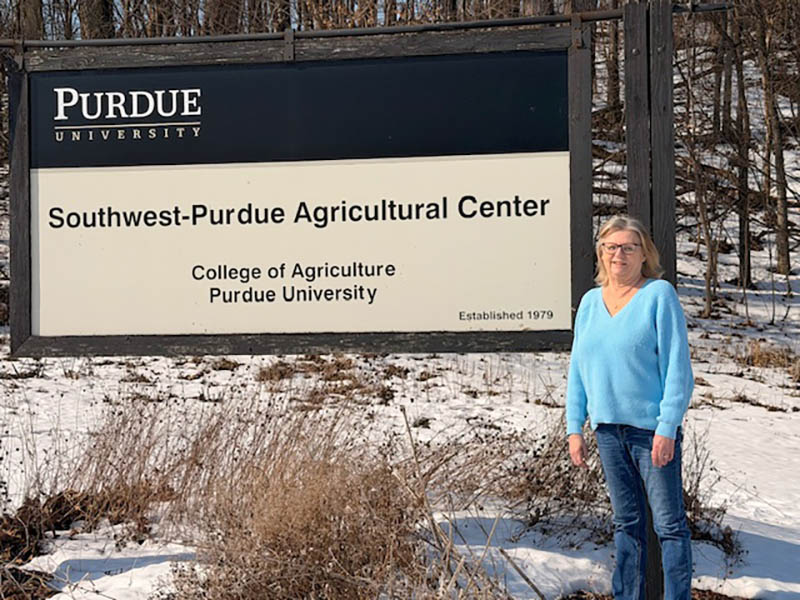
Joyner is a senior administrative assistant at SWPAC. She provides administrative support for the superintendents of the eight Purdue Agricultural Centers (PACs) across Indiana, the director of the PAC program, and the employees of the Southwest Purdue Agricultural Program (SWPAP), based at the SWPAC in Knox County.
“It’s a good place to work,” Joyner says. “Good people, and you never know what you’re going to be doing from day to day. You never know what grower’s going to walk in the door with what kind of problem.”
SWPAC is the smallest PAC in Purdue's regional farm system, with 220 acres north of Vincennes. Located in the SWPAC, SWPAP was founded in 1990 to support growers in the southern region of Indiana, where warmer weather and sandier soil are ideal for melons and other specialty crops. SWPAP has two full-time scientists, vegetable pathologist César Escalante and vegetable specialist Wenjing Guan.
“I help them with whatever they need help with throughout the season,” Joyner says. “Right now we’re going into growing season, so we’re doing a lot of ordering seeds and plastic and whatever they’re going to need for their research.”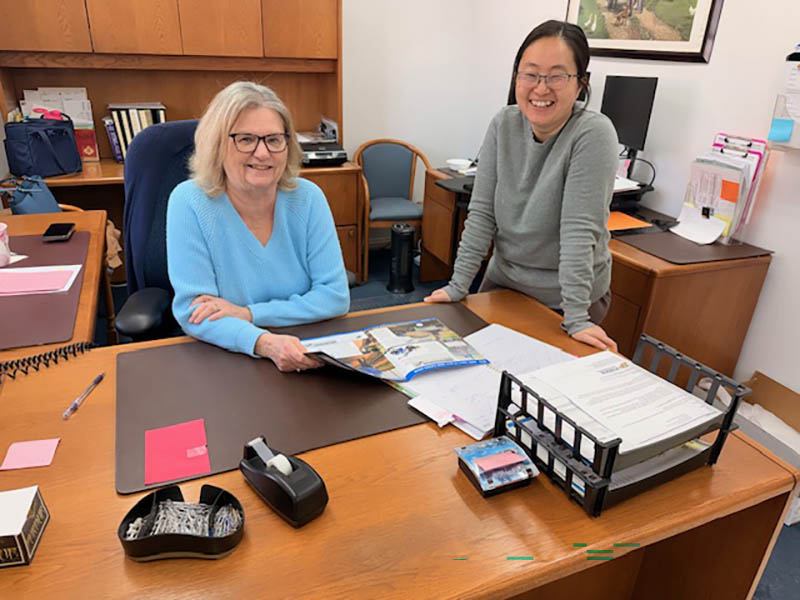
She also schedules research meetings, coordinates schedules across the various centers, and administers the websites for the PACs and SWPAP. “Anything technical, with the computers, I’m the one that takes care of it,” she says. She’s largely self-taught, learning skills from video tutorials and online instructions. “I figure out the new technology as it comes along. Not being on campus, there’s nobody else to ask.”
SWPAP connects growers with research-based Extension information specific to their region. Research at SWPAP includes vegetable variety evaluations, fungicide trials, rootstock evaluation for vegetable grafting and variety disease resistance evaluation. There’s a heavy focus on melons; Indiana’s annual watermelon and cantaloupe crop is worth more than $80 million.
When a grower walks in with a problem, it’s usually related to watermelons, cantaloupes or tomatoes, Joyner says. Though she doesn’t have an agricultural or scientific background, she’s happy to provide a friendly ear.
“I know the growers by name. They’ll come in and chat about their plants and tell me all about their problems,” she says. “They know I can’t help them, but I listen.”
Joyner’s position at Purdue came about by fortunate chance. She grew up in Jasonville, a former coal mining town of fewer than 2,000 people 45 minutes southeast of Terre Haute. She was working as an administrator for the March of Dimes in Terre Haute when an opening came up in the Purdue Extension office next door. She’s been working for Purdue since 1998.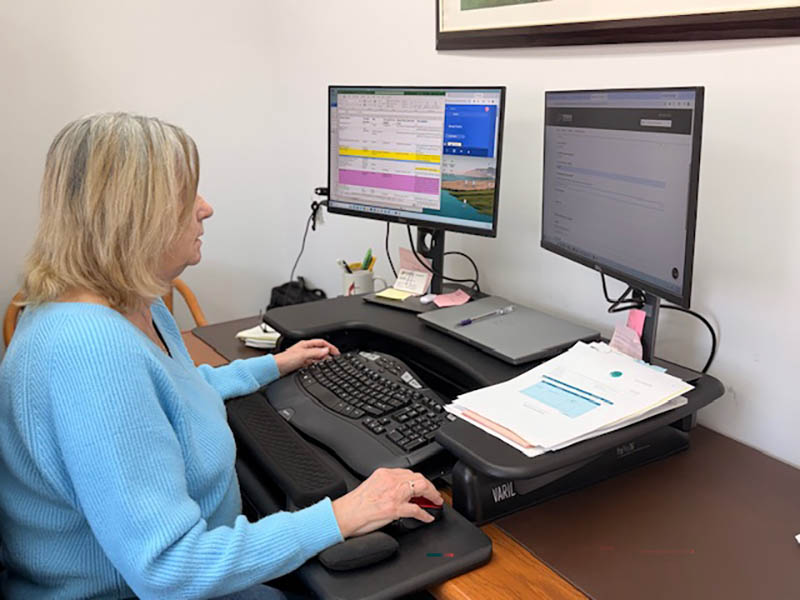
Joyner is looking forward to the birth of her fourth grandchild, due in late February.
“I hope she comes on time!” she says.
Joyner and her husband have two daughters — one in Seattle, one in Portland, Oregon — and a son in Evanston, Illinois. They spend much of their free time on the road visiting them and the grandchildren.
“That’s kind of what we do — we visit kids,” Joyner says.
Joyner especially enjoys the unpredictability of the job. But one thing stays the same, she says: “Whatever needs done is what I do.”
About the Feature
Many people are involved in the remarkable range of programs, services and facilities that undergird research in the College of Agriculture. Collectively they’re integral to the college fulfilling its research mission. “Behind the Research” explores their individual roles. Each academic year, we profile six people whose work supports the College of Agriculture’s global reputation for developing innovative, multidisciplinary solutions to challenges and then putting those solutions into action.
More Behind the Research
People think grass is simple. Lawns, right? Mow regularly and add some water and fertilizer. What...
Weed scientist Julie Young’s workweeks are sometimes chaotic — but never dull. On any...
Jackie Getson, project manager for Purdue’s Institute for Digital Forestry, has built a...

The Department of Food Science’s Pilot Plant is a 9,500-square-foot facility with millions...
It all started with 9th grade biology class. Growing up in Michigan, Laura Esman was lucky enough...
In 2015, Emily DeaKyne was a recent college graduate with a degree in applied ecology,...