Values for Indiana Pasture Land; Irrigated Farmland; Hay Ground; and On-Farm Grain Storage Rent

August 24, 2013

PAER-2013-05

Craig L. Dobbins, Professor; Kim Cook, Research Assistant 

Estimates for the rental value of irrigated farmland, pasture land, hay ground, and on-farm grain storage in Indiana are often difficult to locate. For the past several years, questions about these items have been contained in the Purdue Farmland Value Survey. The values from the June 2013 survey are reported here. Because the number of responses for some items may be small, the number of responses is also provided. 

Averages for pasture rent, the market value of and cash rent for irrigated farmland, and the rental of on-farm grain storage are presented in Tables 1, 2, and 3, respectively. The rental rate for grain bins includes the situation where the “bin only” is rented and the situation where the “bin and utilities” are provided. Table 4 provides information about the rental rate for established alfalfa-grass and grass hay ground. 
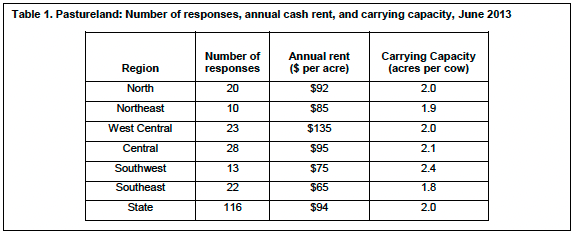
 

Table 1. Pastureland: Number of responses, annual cash rent, and carrying capacity, June 2013
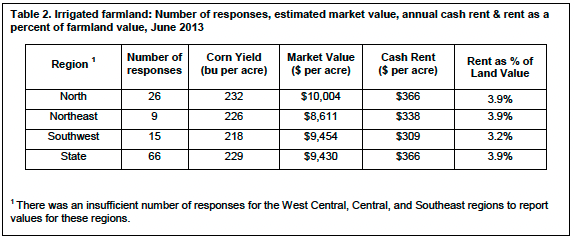
Table 1. Pastureland: Number of responses, annual cash rent, and carrying capacity, June 2013


Table 2. Irrigated farmland: Number of responses, estimated market value, annual cash rent & rent as a percent of farmland value, June 2013
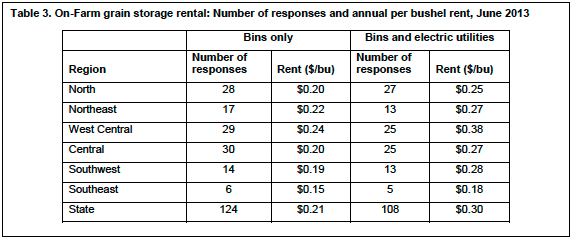
Table 2. Irrigated farmland: Number of responses, estimated market value, annual cash rent & rent as a percent of farmland value, June 2013


Table 3. On-Farm grain storage rental: Number of responses and annual per bushel rent, June 2013

Table 3. On-Farm grain storage rental: Number of responses and annual per bushel rent, June 2013
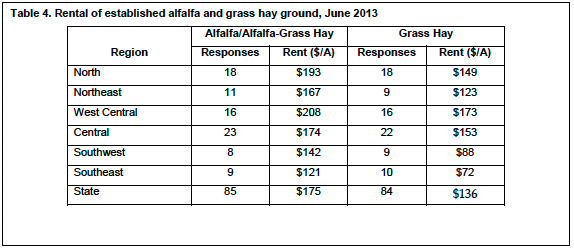


Table 4. Rental of established alfalfa and grass hay ground, June 2013

Table 4. Rental of established alfalfa and grass hay ground, June 2013

Publication Appeared Within:

Latest Articles:

The August 2026 Beef Import Waiver: A Narrow Tool Aimed at a Narrow Problem

August 25, 2026

This is a targeted policy aimed at a narrow slice of the beef market — imported product for ground beef, much of which is lean processing beef — rather than a broad intervention in the fed-cattle market. It was announced in response to historically tight cattle supplies and unusually high beef prices. Within that narrow lane, the most plausible effect is some additional availability of lower-cost processing beef and some downward pressure on ground-beef prices.

READ MORE

The July 2026 CPI and PPI Reports: The Energy Shock Bypasses the Food Pipeline

August 20, 2026

Energy prices are 14.7 percent above year-ago levels, and yet the raw agricultural commodities that sit at the head of the food pipeline are cheaper than they were last July. That combination is the whole story of this month’s release — but it is not evidence that the energy shock missed agriculture.

READ MORE

Indiana’s Farmland Market Holds Steady as Regions Swap Places

August 17, 2026

In sum, state-level aggregate farmland prices exhibited relatively modest changes from 2025 to 2026. Respondents suggest that the majority of market forces are placing downward pressure on farmland prices, so it is not surprising that they expect modest declines through the remainder of 2026.

READ MORE