The August 2026 Beef Import Waiver: A Narrow Tool Aimed at a Narrow Problem
August 25, 2026
PAERPB-2026-14
Ken Foster, Professor of Agricultural Economics and Director, Purdue Farm Policy Study Group; Bernhard Dalheimer, Assistant Professor of Macroeconomics and Trade;


On August 21, the administration announced a temporary waiver of the higher tariff normally charged on certain beef imports once applicable tariff-rate quotas are filled. The announcement would allow up to 300,000 metric tons of product for ground beef to enter over the next 90 days without the out-of-quota tariff. Importantly, 300,000 metric tons is a ceiling on eligible imports, not necessarily 300,000 metric tons of additional beef supply: some of that volume could consist of imports that would have entered the United States anyway. The stated goal is to bring down the price of ground beef while the domestic cattle herd rebuilds. This brief walks through what the policy actually covers, who in the beef supply chain stands to gain or lose, and how much of any cost saving is realistically likely to reach a shopping cart — and by when.
What Has Been Announced
The United States allows a set volume of beef into the country each year from various trading partners at a very low tariff. Once applicable quotas are filled, additional imports generally face a 26.4 percent ad valorem out-of-quota tariff. The announced policy would temporarily waive that out-of-quota tariff for up to 300,000 metric tons of product for ground beef over 90 days.
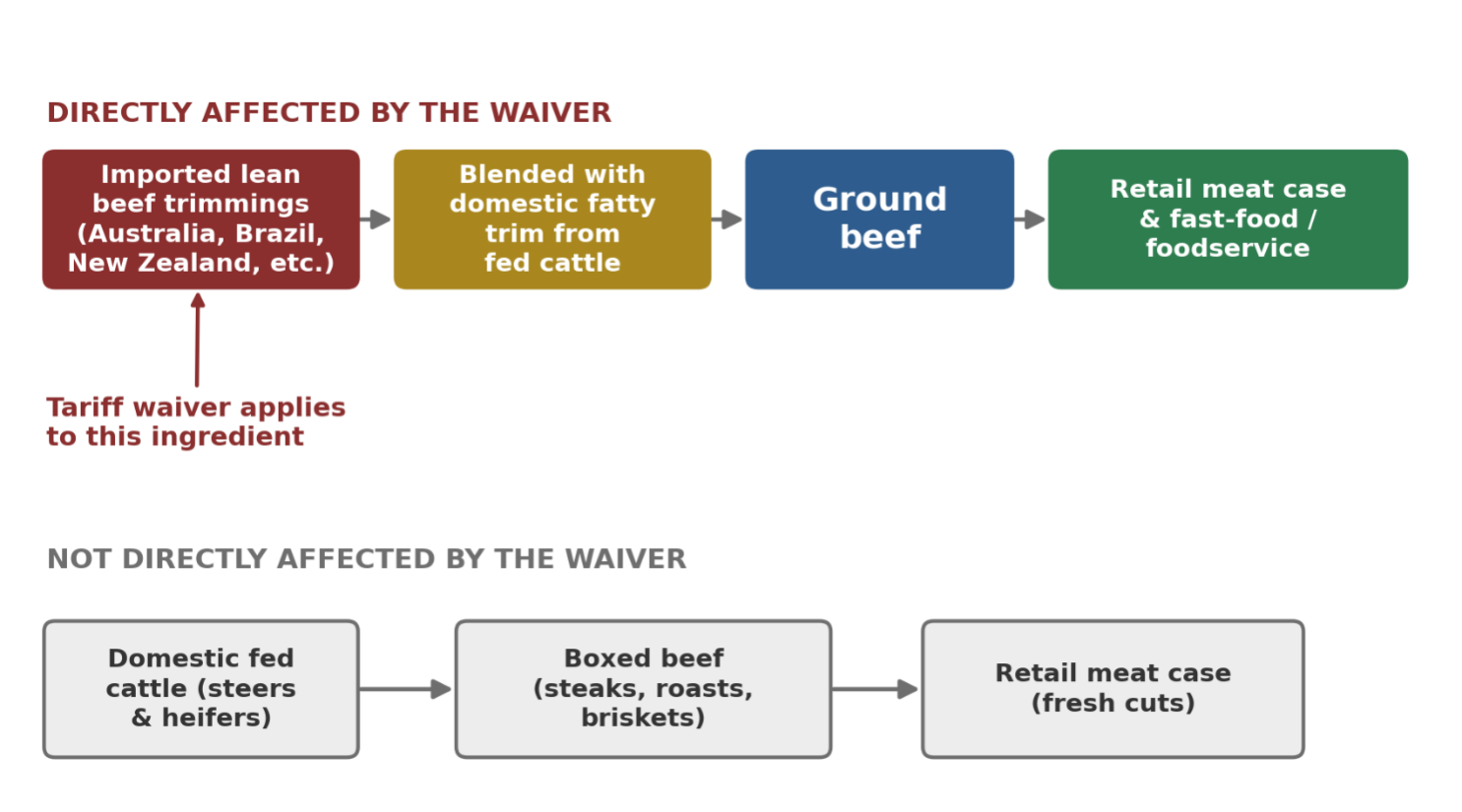
What matters most for understanding the likely effect of this waiver is what kind of beef this covers. The announcement is specifically aimed at products of ground beef. Much of the beef imported into the United States for this purpose consists of lean processing beef and lean trimmings — low-fat beef that can be blended with higher-fat domestic beef to produce ground beef. This is an important distinction because imported lean processing beef complements, rather than simply substitutes for, the fed-cattle beef used in steaks and roasts. A typical ground beef mix uses far more lean trim than fatty trim, and in the United States, lean trim comes mainly from older cows culled from the breeding herd (including the dairy herd), not from the steers and heifers raised specifically for steaks and roasts. As ranchers have delayed culling some cows to rebuild the beef herd rather than sending them to slaughter, the supply of that specific lean trim has tightened even more than the supply of higher-end cuts — which is exactly why ground beef prices have been under some of the most acute pressure. Imported lean trim from Australia, Brazil, New Zealand, and a handful of other countries fills that specific gap. But these imports are not a substitute for the corn-fed cattle that produce steaks and roasts, which most consumers think of first when they hear “beef prices.”
That distinction is the reason we titled this brief a “narrow” policy. Figure 1 lays out the two separate beef supply chains this implies: one for ground beef, where the waiver applies, and one for fed cattle and boxed beef — steaks, roasts, briskets — that this policy does not appear to directly target.
Figure 1
The two beef supply chains and where the tariff waiver applies
How large is 300,000 metric tons?
The announced ceiling equals about 661 million pounds. For perspective, Oklahoma State University Extension estimates 2025 U.S. ground-beef supplies at 28.6 pounds per person. Applied to the current U.S. population, that is roughly 9.8 billion pounds of annual ground-beef supply. The full 300,000-metric-ton ceiling therefore represents about 6.8 percent of one year’s ground-beef supply — and only if every pound represents direct additional supply.
What’s important to keep in mind, also, is that the United States was already importing large volumes of beef for processing this year while paying the out-of-quota tariff. The fact that importers were willing to pay the 26.4 percent tariff indicates that the tariff was not restrictive for many importers. It does not, however, mean that the tariff had no effect on import volumes. Removing the tariff could make some additional imports profitable, but some of the tariff-free volume may simply be imports that would have entered anyway, now entering at a lower cost. The key question is therefore not how much beef is eligible for tariff-free entry, but how much additional supply the waiver actually creates. A meaningful share of the tariff-free tonnage may simply be volume that would have entered anyway, now entering at a lower cost to whoever was already importing (or going to import) it. There is likely new supply in terms of beef that would not have been profitable to import before, but it is smaller than the 300,000-metric-ton headline figure implies.
Who’s Affected, and How
Four groups sit along this supply chain, and the effects on each are different in both direction and size.
- – Beef producers and ranchers face a narrow cost increase, plus a harder-to-measure confidence effect. This policy specifically softens the market for cull cows — older breeding females sold for slaughter — because that is the domestic product competing with the imported lean trim. It does not touch the calf and feeder-cattle sales that make up most of a typical cow-calf operation’s income. For that reason, the direct dollar impact on the average ranching operation is probably modest. The larger concern raised by ranchers is less about this month’s paycheck than about the multi-year bet herd rebuilding requires. A producer who holds back a young female for breeding today is trading current income for a payoff that only arrives once that decision starts adding cattle to the market, two to three years later. That decision only makes sense if elevated prices are expected to last. A policy tool that could be used to respond to sharp beef-price increases could also affect producer expectations. If producers believe future import waivers are likely when prices rise, they may place less value on the future prices they expect to receive from rebuilding the herd. That could make the multi-year investment required for herd rebuilding appear somewhat riskier—working against herd rebuilding and extending high beef prices further into the future than otherwise would have happened.
- – Beef processors and importers face a reduction in cost that they are unlikely to pass along. Removing the out-of-quota tariff reduces the landed cost of eligible imported product. How much of that reduction is captured by importers and processors, passed through to wholesale buyers, or ultimately reflected in consumer prices depends on competition and contracting throughout the supply chain. Whether that saving shows up as a lower wholesale price for ground beef, or is simply retained as wider processor margin, is a genuinely open question. Basic pricing theory and a long record of similar cases (discussed below) both suggest at least part of a cost saving like this tends to be kept rather than passed on, especially over a program as short as 90 days.
- – Retailers and restaurants face different exposure depending on the channel. Imported frozen trim more often ends up in large-volume foodservice and fast-food supply chains than in a supermarket’s fresh meat case, because many grocers use fresh, domestically sourced ground beef specifically. Foodservice is an important channel for imported processing beef, although the extent to which lower import costs reach restaurant operators will depend on procurement arrangements and competition. Restaurant menu prices also adjust slowly because chains often make pricing changes across many locations at once and infrequently, while grocery retailers have more flexibility to use temporary promotions. Whether grocery chains use these mechanisms, however, will depend on whether a lower wholesale cost actually reaches them in the first place.
- – Consumers face modest, gradually lower price pressure specific to ground beef. Putting the pieces together, any price relief consumers actually see should be concentrated in ground beef specifically, arrive gradually as shipments clear customs and existing inventory and contracts roll over, and fall well short of the full tariff amount. Steak, roast, and other fresh-cut beef prices should be much less directly affected because those products are not the target of the waiver. Some indirect effects through overall beef product demand substitution and cattle markets are possible, however.
Why Cost Savings Rarely Reach the Shelf Dollar-for-Dollar
It’s tempting to assume that if a cost falls by a given amount, the price a shopper pays should fall by roughly the same amount. Two well-established economic patterns explain why that usually isn’t what happens.
First, any business with some ability to set its own price — which describes most grocery chains and restaurant brands, because customers choose them partly on brand, location, and convenience rather than price alone — has an incentive to keep at least part of a cost saving rather than pass along all of it. This is a standard, well-documented feature of how businesses with any pricing power behave and consumers are willing to pay that price. A cost decrease therefore need not be passed through dollar for dollar. The actual share depends on the relative responsiveness of supply and demand, competition at each stage of the supply chain, and the terms of contracts between buyers and sellers. Especially when it comes to food, which is a necessity good, consumers keep buying even if prices rise. For beef specifically, USDA Economic Research Service research finds that wholesale-to-retail pass-through varies substantially with market conditions and timing. In its historical analysis, direct retail responses to wholesale beef price changes occurred within one to two months in some market regimes, while cumulative six-month pass-through was considerably larger. The evidence therefore supports partial and delayed pass-through, but not a single universal percentage.
Second, temporary cost reductions do not necessarily reach retail prices immediately. Inventory, existing contracts, uncertainty about how long a cost reduction will last, and the costs of changing prices can all slow the adjustment. USDA research on beef prices finds that retail responses to wholesale price changes can occur within one or two months but vary substantially with market conditions, with some adjustment taking considerably longer. There are ordinary business reasons for this, not bad faith. A company isn’t sure a cost decline will last and doesn’t want to cut a price it may have to raise again soon. Changing prices has real costs associated with labeling and transactions, especially across many locations at once, and companies are often still selling through inventory or working under supply contracts priced at the old, higher cost. This pattern shows up again and again in food and agricultural markets.
While it has been difficult to quantify, the meat processing industry has historically been a lightning rod for accusations of market power due to its high level of concentration. If significant market power does exist, it would impede pass-through and represent a third mechanism.
The beef supply chain has several links between the ranch and the shelf—packer, importer or blender, distributor, retailer or restaurant—and each is a place where part of a cost saving can be absorbed rather than passed on. A simple scenario calculation suggests that the effect on the average retail price of ground beef is likely to be much smaller than the 25-percent figure being discussed. The announced 300,000-metric-ton ceiling equals about 661 million pounds, or roughly 6.8 percent of annual ground-beef supply using 2025 per-capita ground-beef supply as a benchmark. If 25, 50, 75, or 100 percent of the announced ceiling represents genuinely additional imports, and if the tariff reduction lowers the relevant import cost by 20.9 percent, the resulting mechanical reduction in the average ground-beef cost is about 0.35, 0.70, 1.06, or 1.41 percent, respectively, before accounting for retail pass-through. Applying historical USDA estimates of wholesale-to-retail beef price pass-through produces an illustrative retail-price effect of roughly 0.07 to 0.54 percent over the relevant short-run period. If the administration’s separate 25-percent discount commitment for imported product is fully realized, the corresponding range is roughly 0.08 to 0.64 percent.[1] These are scenario estimates, not forecasts: they do not capture equilibrium responses elsewhere in the beef market, and the actual effect could differ. The adjustment will also not necessarily be complete within 90 days. USDA research on beef price transmission finds that some retail response to wholesale price changes occurs within one to two months, while additional adjustment can continue for several months. The temporary nature of this policy therefore matters: firms may be reluctant to make permanent retail-price changes in response to a cost reduction they expect to disappear after 90 days. Because the beef industry is biologically dynamic, the long-run impact could potentially change direction and result in beef prices that are higher than they would have been in the absence of this policy move if farmers appreciably alter their herd expansion targets.
The 300,000-metric-ton figure is thus a ceiling and not a supply forecast. Supplying the full amount within 90 days would require roughly 661 million pounds of eligible product to reach the United States during the window. Whether that happens depends on the availability of suitable beef in exporting countries, slaughter and processing capacity, U.S. import eligibility, contracting, transportation, and the final implementation rules. The administration has not yet demonstrated that the full ceiling will be supplied. The most useful measure of the policy’s effect will therefore be actual additional import volume, not the announced maximum.
The Bottom Line
This is a targeted policy aimed at a narrow slice of the beef market — imported product for ground beef, much of which is lean processing beef — rather than a broad intervention in the fed-cattle market. It was announced in response to historically tight cattle supplies and unusually high beef prices. Within that narrow lane, the most plausible effect is some additional availability of lower-cost processing beef and some downward pressure on ground-beef prices. But the 300,000-metric-ton ceiling should not be confused with 300,000 metric tons of additional supply. The simple scenario analysis above suggests that even a very favorable realization of the announced volume would translate into a relatively small effect on average retail prices. If the full 300,000-metric-ton ceiling were supplied and all of it represented genuinely additional product, the analysis indicates the effect on average retail ground-beef prices would likely be well below 1 percent under historically observed beef price-transmission rates. If only part of the announced volume is genuinely additional, the effect would be smaller.
Outside that lane, the policy’s effects are more indirect. It may reduce demand for competing domestic sources of lean beef, particularly slaughter cows, while potentially affecting producer expectations about the returns to rebuilding the herd. Whether that trade-off is worth making is a question of policy priorities. Economics can, however, clarify the scale of the intervention: its likely consumer benefit is considerably smaller than the headline 300,000-metric-ton figure or a 25-percent discount on imported product might suggest.
Data Sources
Roeger, E. and E. Leibtag, “How Retail Beef and Bread Prices Respond to Changes in Ingredient and Input Costs,” U.S. Department of Agriculture, Economic Research Service, ERR-112, 2011.
Peel, Derrell S., Oklahoma State University Extension, “The Hamburger Story,” 2026.
U.S. Department of Agriculture, Foreign Agricultural Service, “Reviewing the Tariff-Rate Quotas for U.S. Beef Imports, 2022.
U.S. Customs and Border Protection, Beef Tariff-Rate Quota schedule and quota bulletins, 2026.
U.S. Department of Agriculture, Economic Research Service and World Agricultural Outlook Board, Livestock, Dairy, and Poultry Outlook and Cattle Inventory reports, 2026.
U.S. Department of Agriculture, Economic Research Service, Cattle & Beef: Market Outlook, 2026.
U.S. Census Bureau, Population Clock, August 2026.
White House and administration public statements, August 21–22, 2026.
Earlier briefs in this series: Foster & Dalheimer (2026), available at ag.purdue.edu/commercialag.
[1] The calculation is deliberately simple. It treats the 300,000-metric-ton ceiling as an upper bound, varies the share that is genuinely additional from 25 to 100 percent, compares that volume with an estimated annual U.S. ground-beef supply benchmark, calculates the reduction in tariff-inclusive import cost from eliminating the 26.4-percent tariff, and then applies historical USDA estimates of wholesale-to-retail beef price pass-through. The calculation is intended to show the scale of the policy, not to forecast the market price. It does not assume that all eligible imports are additional, nor does it attempt to estimate changes in cattle prices, processor margins, consumer demand, or substitution among beef products.