Digital Agriculture and Rural Broadband
April 26, 2022
PAER-2022-19
Douglas Abney, M.S. Student; Brady Brewer, assistant professor of agricultural economics; and Nathan DeLay assistant professor of agricultural economics


The goal of this analysis is to quantify the size and growth of digital agriculture employment opportunities and reflect on whether the lack of rural high-speed internet is a limiting factor on digital agriculture jobs. There is an increasing use of digital technologies to collect data and integrate findings into actionable solutions within the agricultural sector. Within the last decade, precision agriculture and big data have gained the attention of many agribusinesses. This growing trend is called “digital agriculture.” Digital agriculture jobs are characterized by careers focused on technology and data usage for innovation and discovery within agriculture production, processing and marketing. These jobs require skills from drone piloting and software development to data-driven farm management and sales of digital tools.
Purdue University’s Department of Agricultural Economics started collecting monthly data on the agricultural job market during the summer of 2021. This data is used to report an overview of the agricultural job market over time. Data and monthly reports on the status of the agricultural job market are available for readers to explore at the Purdue ag-jobs-dashboard. The data extends from June 2021 to March 2022 and the Agricultural Job Market Report creates a measurement for the current state of agricultural job openings. Data was collected through Google’s job search engine using an Application Programming Interface (API) provided by SerpAPI. Data collected for this research include job title, company name, description, salary, posting date, and original job board site name.
Data
Data was collected using the search term “agriculture.” Digital agriculture jobs were extracted from this dataset by programmatically searching through the job titles and job descriptions with mentions of specific terms. Terms like “digital agriculture,” “analytics,” and “geospatial” were used to characterize a job posting as digital agriculture.
Findings
From June 2021 to March 2022 the agricultural jobs dataset consisted of 16,192 individual job postings. Figure 1 illustrates the steady rate of new jobs that mention digital agriculture, averaging around 14% of all jobs each month. A total of 2,298 digital agriculture jobs were identified within the dataset. Digital agriculture jobs are most common in the Midwest (696) followed by the South (577). Digital agriculture is typically focused on large-scale commercial operations like those located within the Midwest and South.
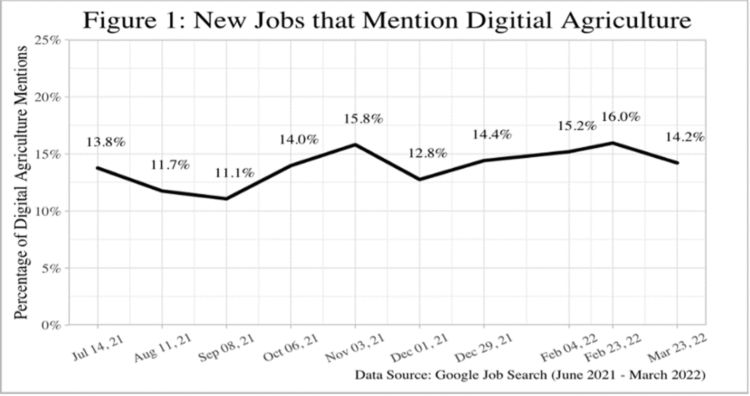
Figure 1: New jobs that mention digital agriculture
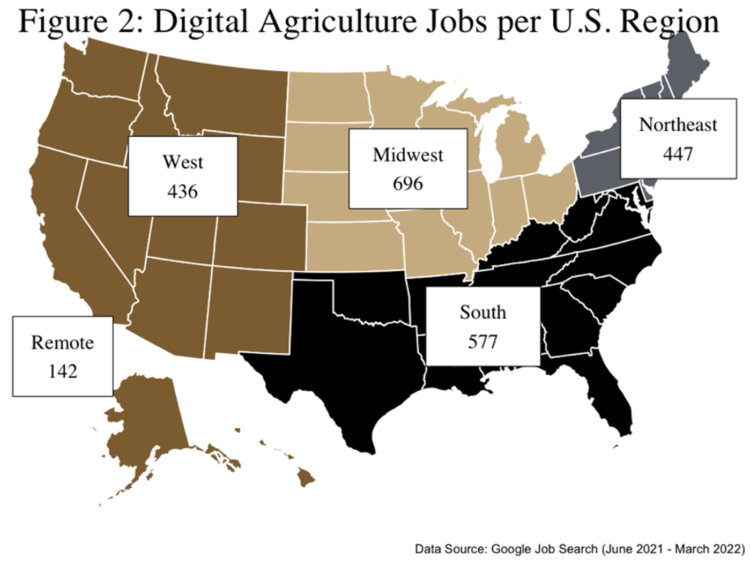
Figure 2: Digital agriculture jobs per U.S. region
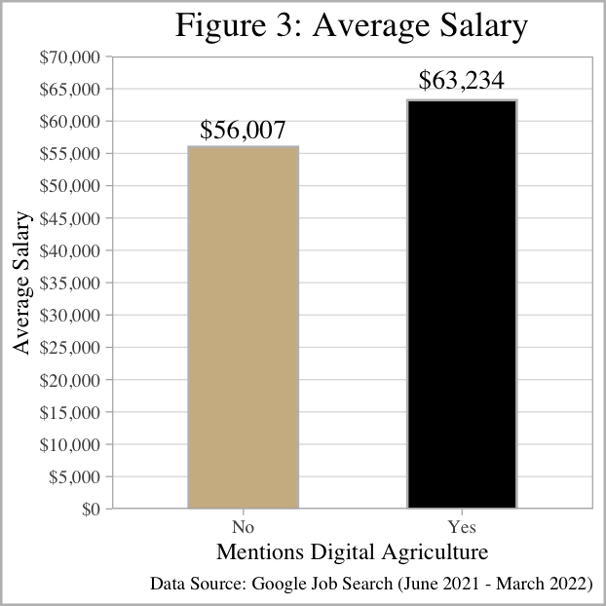
Figure 3: Average Salary
We found that digital agriculture jobs on average pay $63,234/year compared to non-digital agriculture jobs at $56,007/year. Constantly emerging technologies and new access to data means jobs in digital agriculture require innovation and the need for updating practitioner skills.
We were interested in how digital agriculture fits into job categories. Table 1 shows that the 5 highest concentrations of digital agriculture jobs by categories are engineering (31%), academics (24%), research (23%), economics (22%), and agronomy (18%). The highest percentage of the total digital agriculture jobs are in business administration (24%). Business administration jobs are the most popular within all the Google Job’s data and many of the jobs that mention digital agriculture are managerial jobs.
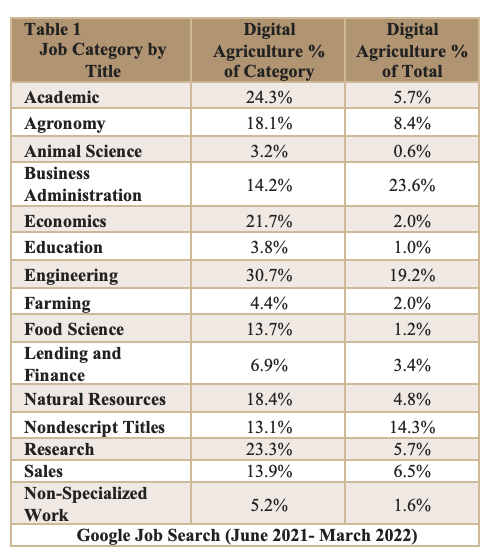
Table 1: Concentrations of digital agriculture jobs by category
Digital Ag and Internet Access
Digital agriculture requires the use of high-speed internet access within rural locations to transport, analyze, and create solutions from data. However, many U.S. rural household do not have access to high-speed internet. The increased use of high bandwidth tools combined with limited connectivity in rural America begs the question: Is rural broadband affecting the growth of digital agriculture? More specifically, is the growth of data-intensive jobs within agriculture limited by the connectivity rates within rural America? Douglas Abney, an Agricultural Economics Master’s Student at Purdue University, intends to identify a relationship between rural broadband connectivity rates and the presence of digital agriculture jobs across the United States for his thesis.
The Federal Communications Commission’s minimum goal for rural home internet speeds is equivalent to 2 devices simultaneously video conferencing at 25/3 Mbps (FCC). An internet speed of 25/3 Mbps signifies 25 megabits per second download and 3 megabits per second upload. According to the Federal Communications Commission, at the end of 2019, 11.2 million Americans in rural areas still did not have access to this minimum goal (FCC). In 2020, USDA-ERS estimated that 46 million Americans resided in rural areas (USDA-ERS). Therefore, a quarter of the U.S. rural population did not have access to broadband with speeds greater than 25/3 Mbps.
Prior research on rural broadband discusses the importance of productivity. Nationwide broadband adoption increases the productivity of national economies. Broadband infrastructure facilitates the increased sharing of ideas and knowledge. Studies have shown that broadband adoption impacts the growth of GDP per capita and internet use increases national output (Czernich et al, 2020). Past research also identified a relationship between connectivity and productivity. Results suggest that rural counties with limited broadband access experience less productivity growth (Gallardo et al, 2020). Unlike previous studies, our study will address the interaction between rural broadband and specific job types that rely on broadband connectivity. Prior research has not addressed how limited broadband could potentially discriminate against particular job types. It is hypothesized that increased levels of broadband connectivity are related to increased levels of digital agriculture jobs.
Based On
Abney, Douglas, et al. March 2022 ed., 2022, pp. 1–24, Agricultural Job Market Report.
Abney, Douglas, et al. Purdue Agricultural Economics Department’s Ag Jobs Dashboard, https://ag.purdue.edu/agecon/Pages/agjobs_dashboard.aspx.
References
Czernich, Nina, et al. “Broadband Infrastructure and Economic Growth.” The Economic Journal, vol. 121, no. 552, 2011, pp. 505–532., https://doi.org/10.1111/j.1468-0297.2011.02420.x.
“Fourteenth Broadband Deployment Report.” Federal Communications Commission (FCC), 1 Feb. 2021, https://www.fcc.gov/reports-research/reports/broadband-progress-reports/fourteenth-broadband-deployment-report.
Gallardo, Roberto, et al. “Broadband Metrics and Job Productivity: A Look at County-Level Data.” The Annals of Regional Science, vol. 66, no. 1, 2020, pp. 161–184., https://doi.org/10.1007/s00168-020-01015-0.
“Google Search API.” SerpAPI, 2022, https://serpapi.com/google-jobs-api.
“Household Broadband Guide.” Federal Communications Commission (FCC), 11 Mar. 2020, https://www.fcc.gov/consumers/guides/household-broadband-guide.
U.S. Department of Agriculture – Economic Research Service (USDA-ERS), 4 Feb. 2022, https://data.ers.usda.gov/reports.aspx?ID=17854. Accessed 11 Apr. 2022.