January 6, 2026

Labor Standards

by Michael Langemeier

A previous article discussed labor efficiency and productivity benchmarks (Langemeier, 2025a). Labor efficiency is computed by dividing total labor cost (hired labor plus family and operator labor) by gross farm income. Family and operator labor can be represented by owner withdrawals. Labor productivity is computed by dividing gross farm income by the number of farm workers. This article examines labor hours per acre and labor efficiency for crop farms using FINBIN data from 2007 to 2024. Crop farms are broken down into four farm size categories: less than 500 crop acres, 500 to 1000 crop acres, 1000 to 2000 crops acres, and greater than 2000 crop acres.

Labor Hour per Acre

Table 1 reports labor hours per acre for crop farms using FINBIN data from 2007 to 2024. Labor hours per acre dropped substantially for the first two farm categories, from 6.0 hours per acre for crop farms with less than 500 acres to 3.3 hours per acre for farms with 500 to 1000 crop acres. Labor hours continued to drop as farm size increased from 1000 to 2000 crop acres to over 2000 crop acres. Farms with more than 2000 acres averaged 1.7 hours per acre.

The average difference in labor hours per acre between the smallest and largest farm size category in table 1 was 4.3 hours per acre, which using annual data from 2007 to 2024 was significantly different from zero. Annual differences between these two farm size categories ranged from 2.9 to 7.2 hours per acre.
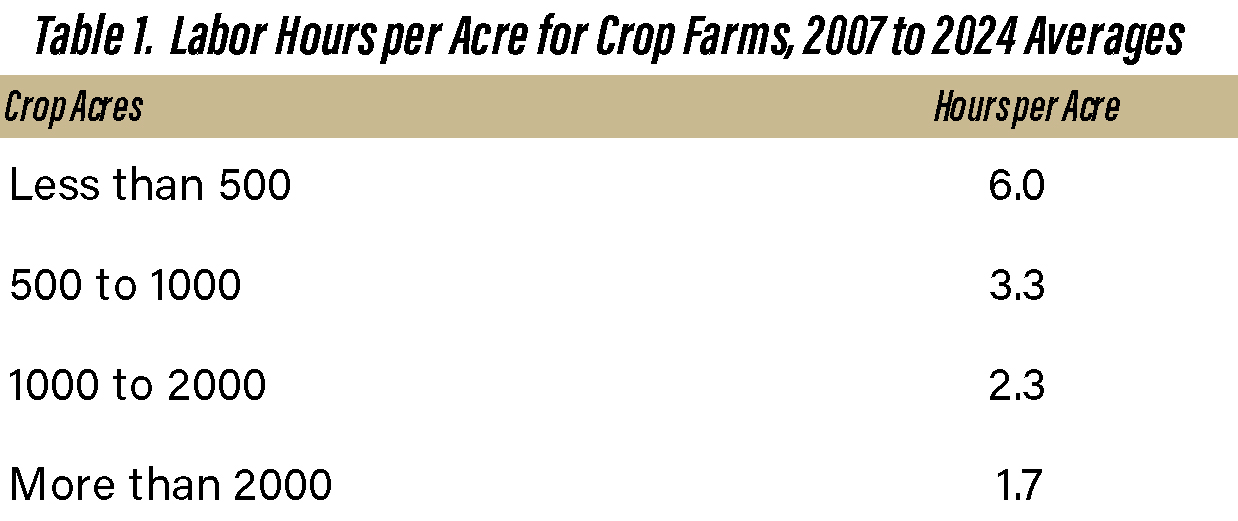
Table 1. Labor Hours per Acre for Crop Farms, 2007 to 2024 Averages

Table 1. Labor Hours per Acre for Crop Farms, 2007 to 2024 Averages

Labor Efficiency

As noted above, labor efficiency is computed by dividing total labor cost by gross farm income. The results in table 1 imply that labor efficiency improves with farm size. The results in table 2 confirm this hypothesis. The difference in labor efficiency between the smallest and largest farm size category was 0.128 or 12.8%, which using annual data from 2007 to 2024 was significantly different from zero. Annual differences in labor efficiency between the two farm size groups ranged from 0.085 to 0.190 over the study period. The average labor efficiency for the farms with more than 2000 acres was 0.089 or 8.9%.
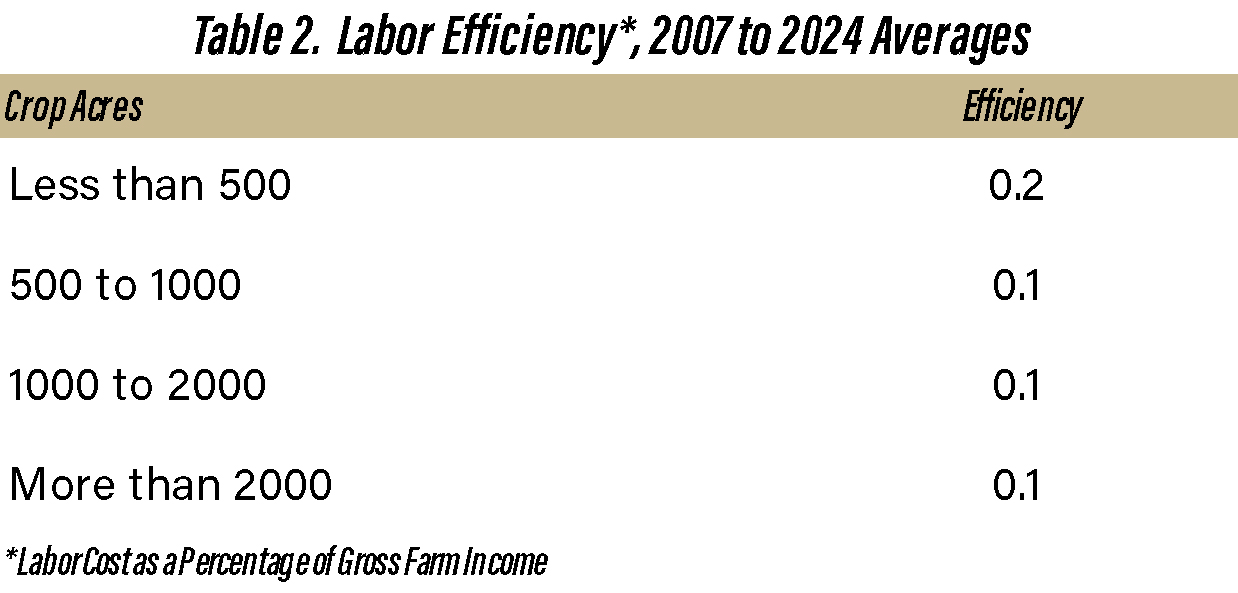
Table 2. Labor Efficiency (Labor Cost as a Percentage of Gross Farm Income), 2007 to 2024 Averages

Table 2. Labor Efficiency (Labor Cost as a Percentage of Gross Farm Income), 2007 to 2024 Averages

Summary

This article examined labor hours per acre and labor efficiency for crop farms using FINBIN data from 2007 to 2024. Comparing the smallest and largest farm categories, labor hours were significantly lower, and labor efficiency was significantly higher for the large farms. Labor hours per crop acre for the large farms averaged 1.7 hours per acre, while labor cost in proportion of gross farm income was 8.9 percent for the large farms.

The labor hours per acre and labor efficiency results in this article suggest that there are economies of scale with the use of labor on crop farms. To find out how important these economies are, we also need to examine machinery cost and investment per acre for various farm size categories. High labor costs are not as problematic if they result in lower machinery costs. Recent articles (Langemeier, 2025b; Langemeier, 2025c), indicate that machinery cost and investment are also lower for larger farms. Thus, there are economies of scale associated with both labor and capital.


References

Center for Farm Financial Management, University of Minnesota, FINBIN web site, accessed August 4, 2025.

Langemeier, M. “Benchmarking Labor Efficiency and Productivity.” Center for Commercial Agriculture, Purdue University, February 6, 2025a.

Langemeier, M. “Machinery Cost Benchmarks for Corn & Soybeans.” Center for Commercial Agriculture, Purdue University, December 3, 2025b.

Langemeier, M. “Crop Machinery Investment.” Center for Commercial Agriculture, Purdue University, December 12, 2025c.

TAGS:

TEAM LINKS:

RELATED RESOURCES

Benchmarking Labor Efficiency and Productivity

February 6, 2025

Labor costs are one of the most prevalent costs on a farm. As such, farm managers need to evaluate whether they are utilizing labor efficiently and productively. One way to evaluate this issue is to use benchmarks created using data from similar farms. Labor benchmarks should include family and operator labor as well as hired labor.

READ MORE

Crop Budget Spreadsheet

November 12, 2024

This spreadsheet can be used along with the Purdue Crop Cost & Return Guide to examine gross revenue, costs, and earnings for crop enterprises.  The user can evaluate up to three full-season crops, and the wheat double-crop soybean system. Updated March 2025.

READ MORE

Agricultural Jobs & Labor Update

August 2, 2024

Labor availability and labor retention are big issues in the U.S. economy and that’s especially true for agribusiness firms and for commercial scale farm operations. According to the latest Purdue Agricultural Job Market Report, job postings are up by 50%. More employers are seeking entry-level candidates with higher levels of education. Additionally, it has become more common for employers to include salary information in their job postings as a way to encourage applications. In this episode of the Purdue Commercial AgCast, host Brady Brewer joins Josh Strine, a Ph.D. student in Purdue’s Department of Agricultural Economics, to discuss the Purdue Ag Jobs Dashboard.

READ MORE

UPCOMING EVENTS

Cultivating Clarity: Understanding Farm Taxes Workshop, Purdue Extension

December 1 & 8, 2025

Join Purdue Extension for a two-part workshop designed to help you gain a clearer understanding of tax planning essentials. The first session on December 1 will focus on the fundamentals of farm taxes, with particular emphasis on strategies that can be used in a low net income year. The second session on December 8 will focus on key tax strategies and will allow plenty of time for questions. Registration cost is only $20.

Read More

Farm & Ranch Tax Issues Webinar, Purdue Income Tax School

December 15, 2025

This program provides in-depth coverage of agricultural and farm tax issues. In addition to covering timely tax issues, we will cover disaster tax issues, depreciation and expensing farm assets, retirement planning for farms, and tax planning in low-income years. This year’s webinar will be co-taught by a team from Ohio State and Purdue Universities.

Read More

Farm Shield: Protecting Your Legacy from Life’s Uncertainties Conference, Purdue Extension

January 27 or 28, 2026

Farm Shield is more than a conference, it’s a commitment to helping agricultural families build resilience and plan for a secure future. Don’t miss this opportunity to protect your legacy!

Read More

2026 Crop Cost and Return Guide

September 16, 2025

The 2026 Purdue Crop Cost and Return Guide provides estimated costs and net returns for planting, growing, and harvesting corn, soybeans, and wheat in the upcoming year. Cost and return information presents information for low, average, and high productivity soils. Early projections point to slightly higher breakeven prices.

READ MORE

2025 Farmland Values & Market Trends

September 9, 2025

Purdue ag economists Todd Kuethe and Michael Langemeier as they discuss Indiana farmland values on this, the first of two episodes reviewing the 2025 Purdue Farmland Values and Cash Rental Rates survey results. The survey shows Indiana land prices continue to rise and are anticipated to continue a modest increase for the rest of 2025 for most of the state.

READ MORE

Farmland Prices Increase Despite Downward Pressure, Purdue Ag Econ Report August 2025

August 19, 2025

Indiana farmland prices have continued the trend of record highs in 2025, according to the latest Purdue Farmland Value and Cash Rents Survey results. The average price of top-quality farmland reached $14,826 per acre, a 3.0% increase from June 2024. Statewide, cash rents increased from 1.5 to 1.7% for poor-, average-, and top-quality land.

READ MORE