The Impact of COVID-19 on Households: Lessons for 2022?
January 13, 2022
PAER-2022-2
Author: Maria I. Marshall, Professor, Jim and Lois Ackerman Endowed Chair in Agricultural Economics


Disasters, both natural and economic, tend to unearth cracks in our foundation. Weak links and inequities are not only revealed, but in many cases worsened. The COVID-19 pandemic has exposed the fissures in the labor market and the realities of employment with low pay, few benefits, and lack of childcare. Small businesses also bore the brunt of continued health risks and changes in consumer behavior.
The unprecedented amount of funds provided to both households and small businesses temporarily softened the economic shock caused by the pandemic. The CARES act in 2020 provided funds for households and forgivable loans for small businesses. The Coronavirus Response and Relief Supplemental Appropriations Act 2021 (signed in December 2020) provided additional stimulus payments from December 2020 through January 2021. The American Rescue Plan signed in March 2021 provided among other benefits expansion of the child tax credit for households and continued worker retention credits for small businesses.
The availability of COVID-19 vaccines in the spring led to an increase in the number of workers returning to work and the start of schools returning to in-person instruction. However, the damage of business and childcare closures (daycares and schools) to low-wage and low-skilled workers and to women will continue to be felt into 2022.
Employment
Federal unemployment benefits ended on September 6, 2021; although 25 states ended unemployment benefits as early as June 2021 citing lack of available workers and blaming the extended benefits. Figure 1 demonstrate that the unemployed had a variety of reasons for not being employed. In February 2021, layoffs and closures due to COVID-19 along with caring for children were among the highest-ranking reasons for not working. This changed substantially by October when layoffs and closes decreased. However, caring for children remained one of the most significant reasons for not working.
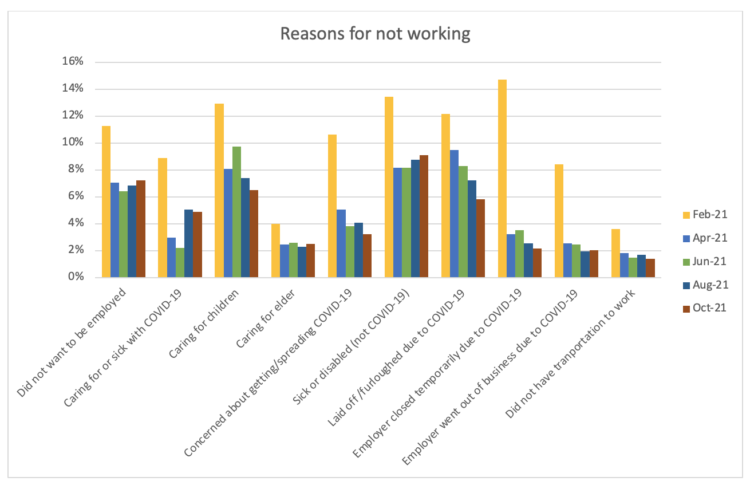
Figure 1. Stated reasons for not working from February 2021-October 2021. Data: U.S. Census Bureau, Household Pulse Survey (author calculations)
Not included in the figure below is the number of individuals who were retired which increased by 11 percentage points from the beginning of the pandemic to the last Household Pulse Survey in October 2021. According to Pew Research Center (Fry, 2021), the number of retirees increased by 29% since the pandemic. This increase in retirement not only affects the number of individuals available for wage employment, but the number of small businesses that have closed as Baby Boomers that own small businesses retire in record numbers.
Childcare
The last two years have demonstrated the uneven impact of COVID-19 on households with children and particularly women in the workforce. School and daycare closures exacerbated a problem already felt by many parents and especially those in rural communities (USDA, 2021). Figure 2 shows the disproportionate impact of these closures on women. In October, the majority of those that did not look for a job, lost a job, and left a job due to lack of childcare were women. For example, 69% of the adults that did not look for a job because of lack of childcare were women, compared to 41% that were men. Of the total adults that lost their job because of time away to take care of children, 66% were women and 44% were men. These are issues still pervasive well into the second year of the pandemic that will linger well into 2022.
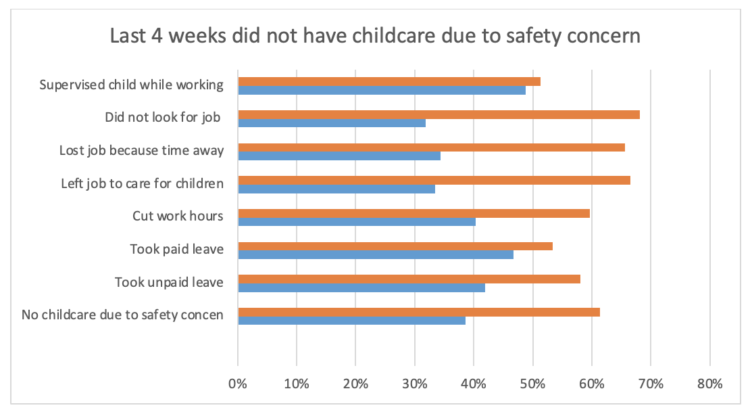
Figure 2. Impact of COVID-19 on Childcare, October 2021. Data: U.S. Census Bureau, Household Pulse Survey (author calculations)
Lessons for 2022?
Rural communities which lagged urban communities in recovering from the Great Recession may continue to fall behind not only in employment but also job growth. According to McKinsey and Company, post-pandemic job growth is set to occur in high-wage jobs and most low-wage workers that lost their jobs during the pandemic may have to retool and shift occupations. We may continue to see an increase in the number of workers that shift to not only higher paying job, but also to jobs with guaranteed benefits. So, we may not have seen the end of the Great Resignation and we may continue to see a great retirement as well. If we see the end to the pandemic in 2022 (or at least manage it enough to decrease health-based closures to schools and daycares) we may see the increased return of women with children to the workforce. Looking ahead, access to workforce development and quality childcare may be the most important policy issues to ensure the equitable recovery of low and medium-income households in both urban and rural communities to the pandemic.
References:
Fry, R. (2021). Amid the pandemic, a rising share of older U.S. adults are now retired. Pew Research Center. Available at https://www.pewresearch.org/fact-tank/2021/11/04/amid-the-pandemic-a-rising-share-of-older-u-s-adults-are-now-retired/
McKinsey & Company. 2021. The future of work after COVID-19 found at https://www.mckinsey.com/featured-insights/future-of-work/the-future-of-work-after-covid-19?hdpid=eb423ead-8d12-4ab1-860a-8a90ed92673c&hctky=9965120&hlkid=e118a00324a64012be47bd2715f1182d
U.S. Census Bureau, Household Pulse Survey found at https://www.census.gov/data/experimental-data-products/household-pulse-survey.html
USDA, Rural Development found at https://www.rd.usda.gov/sites/default/files/rd_hhs-acf_jointchildcareresourceguide.pdf