

Muscle Reserves Before Calving Influence Milk Production and Muscle Metabolism Differently in First Lactation Dairy Cows
Why this research is being done
Associate Professor Jackie Boerman's lab has previously looked at the role of muscle on the performance of older cows (multiparous) with more muscle before calving resulting in greater calf birth weight and higher milk yield. The purpose of this research was to determine how differences in skeletal muscle reserves before calving in animals entering their first lactation would influence tissue mobilization, muscle characteristics and early-lactation milk production.
Results
Both high and low muscle cows lose muscle in the week before calving to 3 to 4 weeks of lactation, losing 1 to 1.2 cm of muscle depth (Figure 1). First-lactation cows with less muscle before calving produced more milk in early lactation but lost more body weight, while cows with greater muscle reserves lost less body weight, had different muscle fiber types, and produced milk with higher components, resulting in similar energy-corrected milk. Different from multiparous cows, animals with greater muscle did not mobilize muscle weeks before calving and did not give birth to larger calves than cows with less muscle reserves.
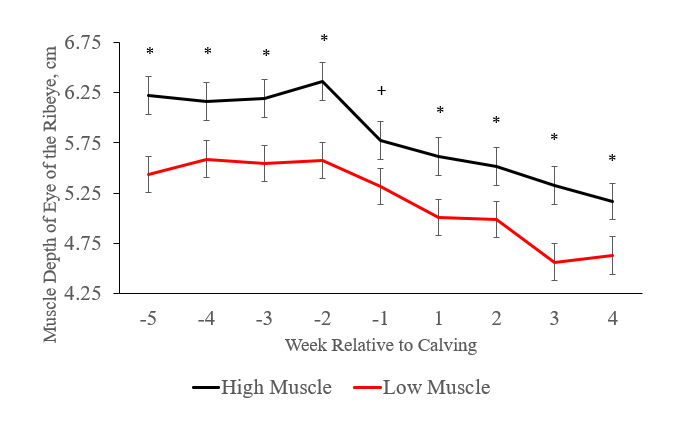 Figure 1. Muscle depth of the Longissimus dorsi (eye of the ribeye) of high muscle and low muscle animals measured from -5 to 4 weeks in first-lactation cows. * Represents significantly different (P<0.05) and + represents a tendency for significantly different (P<0.10).
 Conclusions
These findings suggest that cows entering their first lactation and multiparous cows likely have different mechanisms for regulating the mobilization of muscle around calving. This has implications on the amino acids that are available to the fetus and available for the mammary gland for development prior to lactation. Future research may focus on how nutrition and management can optimize muscle metabolism to improve milk production and long-term performance while recognizing that these populations of animals may have different mechanisms that regulate muscle utilization around calving.
Contact/Additional Information
Jackie Boerman, Ph.D. | jboerma@purdue.edu | 765-494-6290
DOI: 10.3168/jds.2024-25197