

Student’s research makes healthy indoor plants more attainable
"P
lant nitrogen is important in determining the growth and quality of ornamental plants,” explained Ranjeeta Adhikari, a Ph.D. student in horticulture and landscape architecture. “But indoor growers have limited options for simple, reliable and affordable technology to measure it.” Through her research at Purdue University, Adhikari has taken steps toward removing the limitations.
Adhikari’s fascination with indoor plants stems from her childhood in Nepal. There, she helped her mother care for the family’s extensive kitchen garden. “Tending the plants built up an interest and passion for agriculture.”
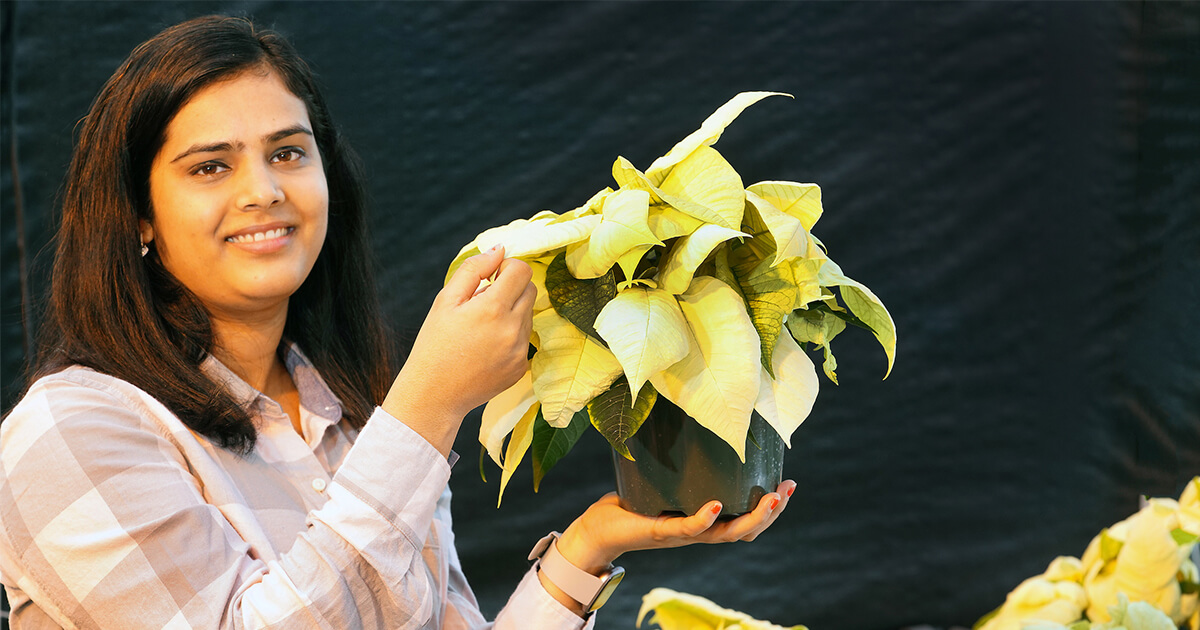
Adhikari studied as an undergraduate at Nepal’s Tribhuvan University. There, she earned a scholarship to complete a master’s degree in horticulture at an agricultural university in the Indian state of Maharashtra. In 2016, Adhikari traveled to the United States with her husband, who enrolled in a doctoral program at Purdue.
As she explored doctoral programs for herself, the work of Purdue researcher Krishna Nemali, assistant professor of controlled environment agriculture, grabbed her attention. Nemali focused on vegetables and ornamentals grown in greenhouses and vertical farms using hydroponic production systems. “I applied and was offered a research assistantship for a Ph.D.,” Adhikari recalled.
Adhikari’s research focuses on developing and improving smart sensors to measure nitrogen in plants. She also aims to understand plant responses to nitrogen supply and optimization.
Using data that Adhikari generated, the Nemali Lab has developed affordable smart sensors that use smartphone images to analyze plant traits, including nitrogen status.
“I’m thrilled to be able to give growers in the greenhouse industry a new technology to help in sustainable production,” said Adhikari.
In addition to being a “great mentor,” Adhikari credits Nemali’s involvement in Extension with giving her opportunities to speak at seminars and interact with growers to improve her communication and leadership. Adhikari earned an award recognizing her outstanding research and Extension work in the floriculture sector from the American Floral Endowment in 2020.
After graduating this spring, Adhikari plans to stay in the United States to continue her Extension activities and work in controlled environment agriculture and crop physiology.
Featured Stories

The Office of Indiana State Chemist (OISC) is warning Indiana residents about an illegal...
A prominent protein on most human cells may be key to unlocking the code that makes humans...
Ava Hoskins, a double major in aquatic sciences (fisheries concentration) and natural resources...
Ashlynn McLaughlin, a senior aquatic sciences major with a concentration in marine and freshwater...

For Brody Cox, preparing for the Indiana State Fair began long before he entered the show...
Carolyn Foley, a long-time member of the Purdue Forestry and Natural Resources (FNR) and...