

From curiosity to care
A
s a first-generation college student, Christopher Uribe was looking for an environment that would challenge him academically while also offering a supportive community. For the Lafayette, Indiana native, who will graduate in Spring 2026 with a degree in biochemistry, Purdue has been a place where his interests in science, service and helping others have come together in meaningful ways.
“I wanted to be somewhere I could grow, not just as a student but as a person,” he said. “From the beginning, Purdue felt like a place where I belonged.”
His interest in science started early in life, gardening with his mother, where his curiosity about how plants grow and how food fuels the body sparked a lasting interest. His curiosity was nurtured in high school, where he participated in biochemistry research at Purdue, an experience that gave him confidence in the lab and helped him imagine what was possible.
During Purdue’s Molecular Agriculture Summer Institute, he worked on a research project focused on Juglone, a natural herbicide found in black walnut trees. The experience confirmed for him that studying biochemistry was the right path.
At Purdue, in the Gowher Lab, he studies DNA methylation during early embryonic development. Over time, he has evolved from learning alongside graduate students to running and analyzing his own experiments.
Support Makes the Difference
“Research can be challenging,” he said. “But it teaches you how to be patient, how to troubleshoot and how to think through problems. Being in a supportive lab makes all the difference.”
While research shaped Uribe academically, impactful learning also happened outside the lab.
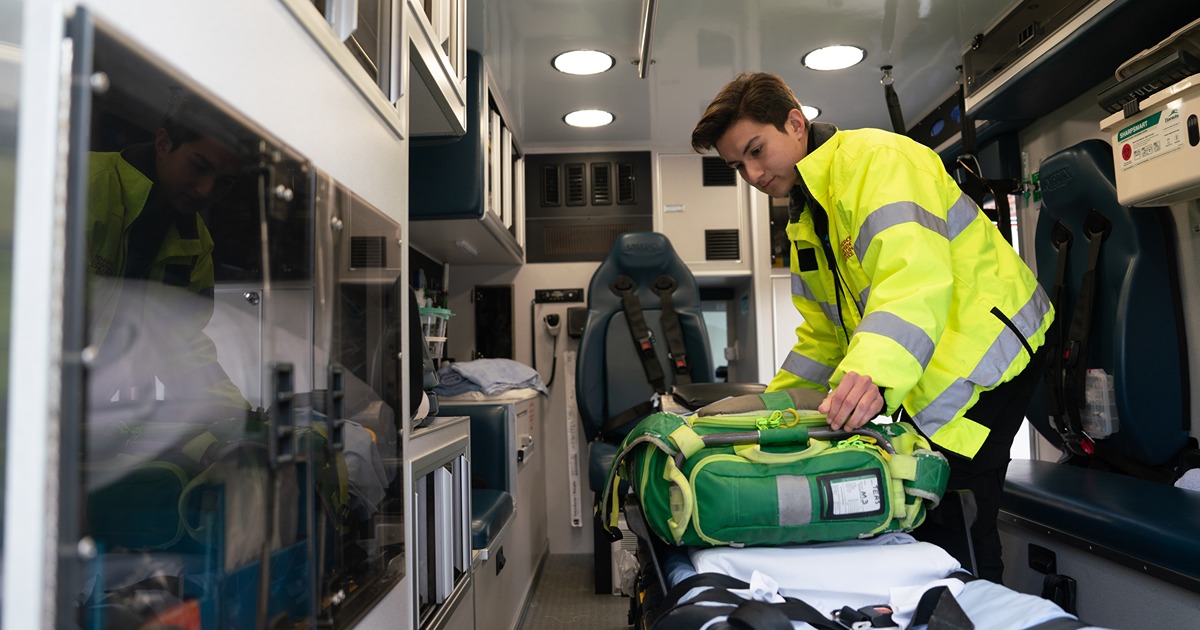
As a student on the pre-physician assistant track, Uribe knew he needed hands-on clinical experience. After earning his Emergency Medical Training (EMT) certification, he began working in emergency medical services (EMS) and now serves with Tippecanoe Emergency Ambulance Services.
“Every shift is different,” he said. “You never know what you’re walking into, and you have to learn how to stay calm and think clearly in stressful situations.”
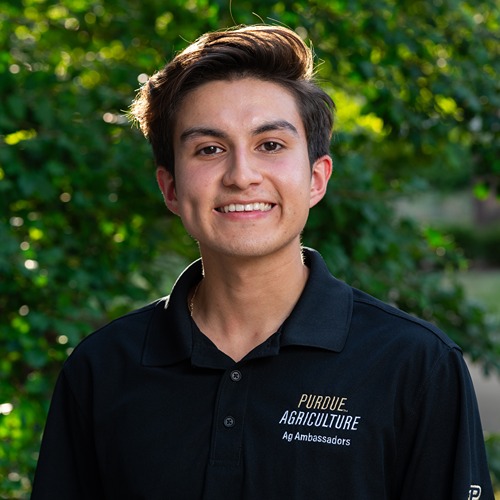 Purdue Ag Ambassadors are student volunteers who represent the College of Agriculture in a variety of ways.
 Christopher Uribe sits in the driver’s seat of an ambulance while working as an EMT.
 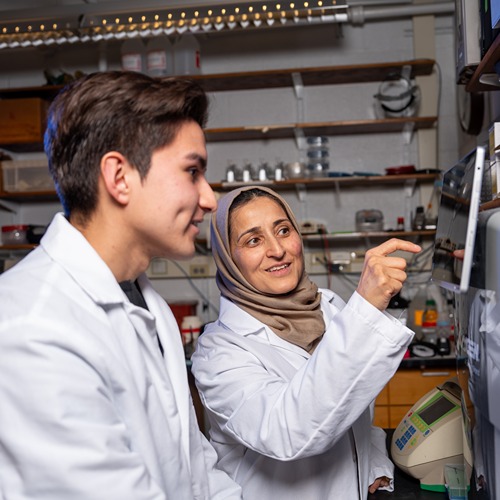 Christopher Uribe works alongside Professor Gowher in a biochemistry research lab, gaining hands-on experience through faculty-mentored research at Purdue.
 Working in EMS has allowed Uribe to apply what he learns in the classroom to real-life situations, from assessing patients to understanding how underlying conditions affect treatment decisions. He credits his Purdue coursework with helping him think critically and confidently in the field.
Uribe has also found community and leadership opportunities across campus. As an Ag Ambassador, he gives tours to prospective students and families. He is also involved with the Purdue Foundation Student Board, Mortar Board, the Biochemistry Club and College Mentors for Kids, the program that first brought him to Purdue as a fifth grader.
Looking ahead, Uribe plans to earn his paramedic license before applying to physician assistant programs.
Purdue Agriculture gave me the space to explore, grow and figure out what kind of impact I want to make in the world,” he said. “It helped me turn my interests into something real.”
Featured Stories
For Brody Cox, preparing for the Indiana State Fair began long before he entered the show...
Carolyn Foley, a long-time member of the Purdue Forestry and Natural Resources (FNR) and...

In the September Purdue University/CME Group Ag Economy Barometer survey, 52% of respondents...
Purdue University’s College of Agriculture recognized nine alumni at the Distinguished...
Keep your eyes peeled across Indiana for the newly minted Purdue Forestry and Natural Resources...
“Being at Purdue has changed my thinking entirely,” says Mingyu Zhao, a third-year...