Agricultural Economics
Consumers choose differently when grocery shopping online
WEST LAFAYETTE, Ind. — Only 37% of surveyed individuals selected taste preferences as the most important factor they consider when shopping for groceries online. This sharply contrasts with long-reported food purchasing values, where taste typically ranks first when shopping in person, according to the February Consumer Food Insights Report (CFI).
The survey-based report from Purdue University’s Center for Food Demand Analysis and Sustainability (CFDAS) assesses food spending, consumer satisfaction and values, support of agricultural and food policies, and trust in information sources. Purdue experts conducted and evaluated the survey, which included 1,200 consumers across the U.S.
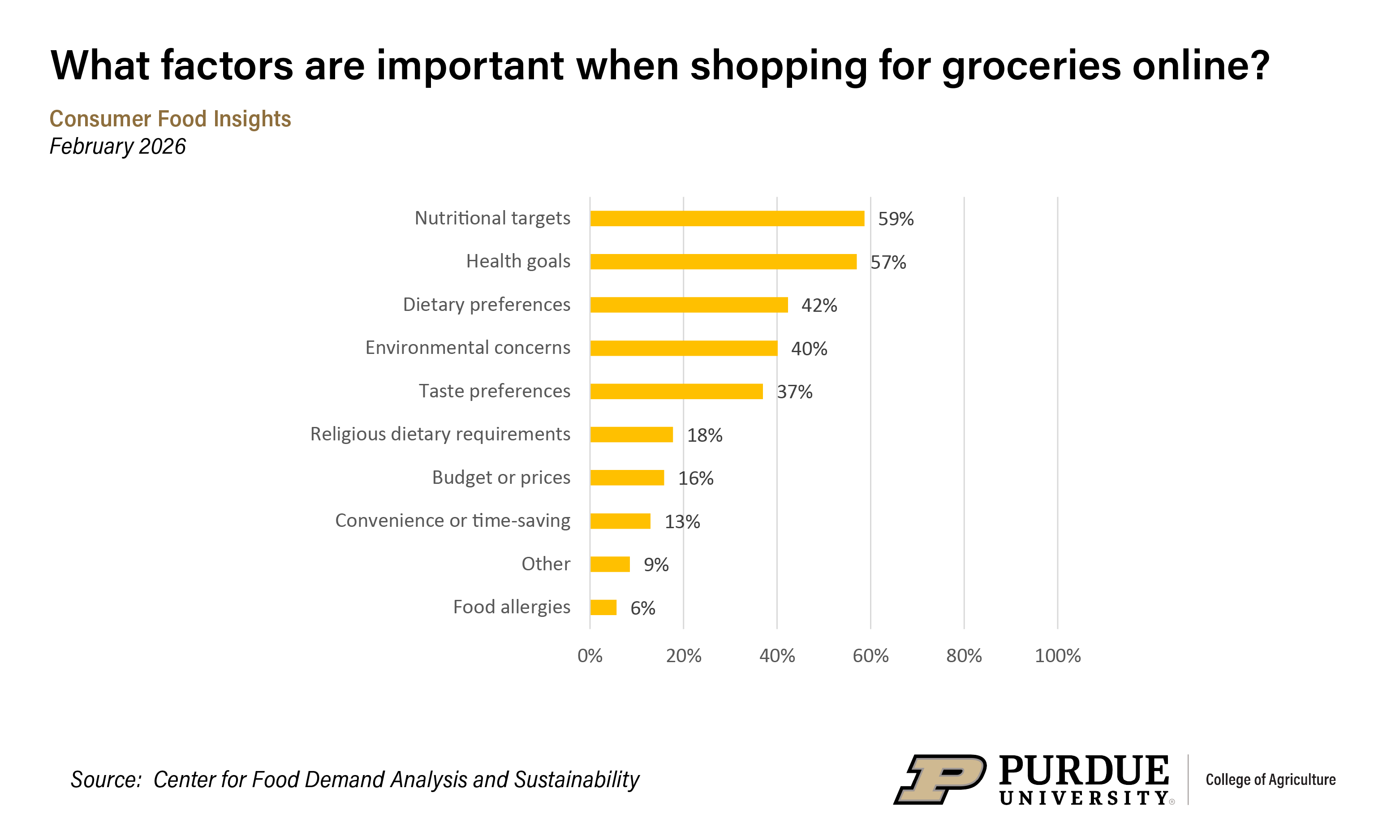 , opens larger image Figure 1. "Which of the following factors do you consider important when shopping for groceries? Select all that apply." Feb. 2026
 The February report breaks down long-running CFI data by retirees and nonretirees. In addition, new questions describe consumers’ preferences for online grocery shopping.
“Asked which factors consumers consider important when shopping for groceries, nutritional targets and health goals were selected by 59% and 57%, respectively,” said the report’s lead author, Joseph Balagtas, professor of agricultural economics at Purdue and director of CFDAS.
When asked about their priorities for personalized online shopping, 26% indicated that they most valued personalization related to budgets and prices. And when it comes to retailers’ use of consumer data to customize the online shopping experience, 51% were willing to share existing personal data such as past purchases and browsing history, compared to 28% who were unwilling to share that data.
“The attributes that consumers value most when shopping remain one of the most stable measures we track in the CFI,” Balagtas said. “Taste, affordability and nutrition — in that order — are the most important to American consumers. Social responsibility and the environmental impact of our food system are less important to consumers.”
Last month’s survey revealed distinct patterns in consumer trust across food-related information sources according to retirement status, noted Caitlinn Hubbell, a market research analyst at CFDAS and a report co-author. Retirees (31.5%) place more trust in the U.S. Department of Agriculture than nonretirees (18.2%). Similarly, more retirees trust the American Medical Association (49.5%) than the nonretired (29%).
Smaller differences emerged between retirees and nonretirees in the consumer behaviors category. Nonretirees were slightly more likely to buy local over nonlocal foods. Further, nonretirees reported that they sometimes choose organic over nonorganic foods, while retirees indicated that they rarely do.
As for consumer beliefs, more than two-thirds of both groups (66%) agree that local food is better for the environment than nonlocal food.
“National food insecurity stood at 13% in February, representing a 2% decline from January,” Hubbell said. More retirees were food insecure (14%) than nonretirees (10%), but the self-assessed diet quality for both groups was about the same. “Retired and nonretired individuals fall well below the healthy diet threshold,” she said.
 , opens larger image Figure 7. Rate of household food insecurity in the last 30 days among households receiving retiree benefits, Feb. 2026
 Consumer food spending remained stable from January, with households reporting an average of $128 weekly on groceries and $73 weekly on dining out in February. “Consumer estimates of food inflation remain higher than official consumer price index figures, suggesting a persistent perception gap,” Hubbell noted. “The Consumer Price Index for food inflation was down 0.2% from the previous month.”
The Center for Food Demand Analysis and Sustainability is part of Purdue’s Next Moves in Plant Sciences 2.0 and uses innovative data analysis shared through user-friendly platforms to improve the food system. In addition to the Consumer Food Insights Report, the center offers a portfolio of online dashboards.
About Purdue Agriculture
Purdue University’s College of Agriculture is one of the world’s leading colleges of agricultural, food, life and natural resource sciences. The college is committed to preparing students to make a difference in whatever careers they pursue; stretching the frontiers of science to discover solutions to some of our most pressing global, regional and local challenges; and, through Purdue Extension and other engagement programs, educating the people of Indiana, the nation and the world to improve their lives and livelihoods. To learn more about Purdue Agriculture, visit this site.
About Purdue University
Purdue University is a research institution ranked among the top 10 public universities in the United States. More than 111,000 students study at Purdue across multiple campuses, including more than 57,000 at our main campus locations in West Lafayette and Indianapolis. As a land-grant university committed to affordability and accessibility, Purdue’s main campus has frozen tuition 14 years in a row, enabling more students than ever to graduate debt-free.
Writer: Steve Koppes
Media contact: Devyn Ashlea Raver, draver@purdue.edu
Sources: Joseph Balagtas, balagtas@purdue.edu
Agricultural Communications: Maureen Manier, mmanier@purdue.edu, 765-494-8415
Journalist Assets: Publication quality charts and images can be obtained at this link.