

Forest ecologist earns new support for global collaborations
Jingjing Liang, a University Faculty Scholar and associate professor of forestry and natural resources, has been appointed a Global Forest Informatics fellow. This appointment recognizes his leadership at the intersection of global forestry, environmental data science and AI, said Tomas Höök, professor and head of the Department of Forestry and Natural Resources in the College of Agriculture.
“As the Global Forest Informatics fellow, Professor Liang will lead efforts to develop and elevate scholarship in global forestry and broader environmental data science, emphasizing large-scale datasets, advanced analytics and AI-driven approaches,” Höök said.
Liang has attracted competitive external research support and growing collaboration interest from multinational companies and international organizations focused on climate, sustainability and environmental analytics. He will use this fellowship to continue advancing large-scale forest carbon and ecosystem modeling through his wide network of collaborators.
“We are using our data resources, artificial intelligence and high-performance computing capacity to help the countries turn their forest monitoring capacity and forest inventory data into perceivable outcomes,” Liang said.
Liang is the founder and chief science officer of Science-i, an open-science platform that fosters collaborations among hundreds of scientists worldwide. He also coordinates the Global Forest Biodiversity Initiative (GFBI), a network spanning 50 researchers across 55 nations.
He will also be spearheading new research initiatives, building interdisciplinary collaborations and leading training programs that prepare students and researchers to address pressing global environmental challenges. His plan includes establishing a nonprofit organization to consolidate the gains that Science-i and the GFBI have already realized.
Through his worldwide connections, he will continue to foster collaborations between academia and the governments of various nations in Central and South America, Africa, and Asia. “The research award is going to strengthen multilateral collaboration and help countries like Peru and Honduras,” he said.
Liang began collaborating with Javier Gamarra of the Food and Agriculture Organization of the United Nations (FAO) in 2017. During Liang’s 2024-25 sabbatical, he served as an international consultant to the FAO. The collaboration combined Liang’s expertise in modeling and forest growth dynamics with FAO’s global forest monitoring data and familiarity with the operational context that countries need for their international reporting.
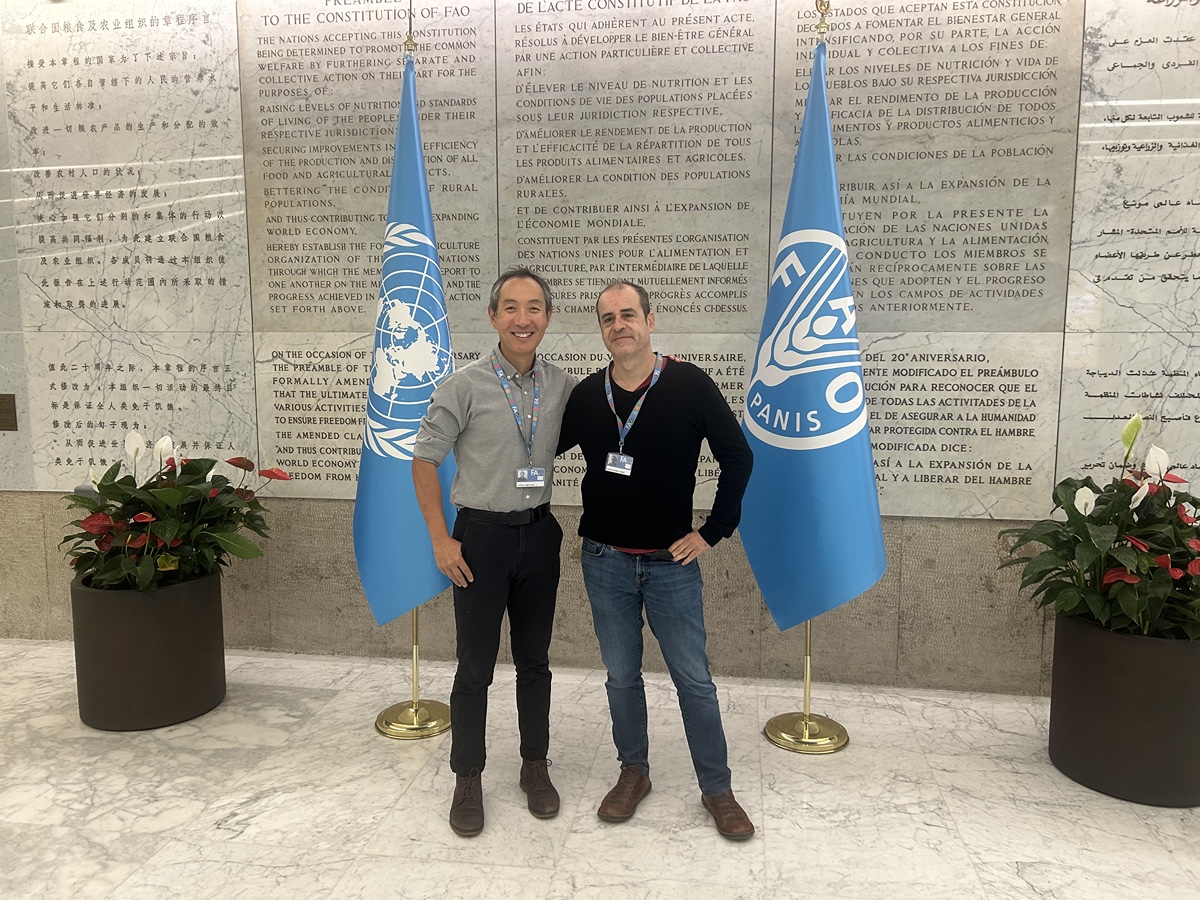 Purdue University’s Jingjing Liang (left) and Javier Gamarra of the U.N. Food and Agriculture Organization have collaborated on global forestry issues since 2017. (Photo provided by Jingjing Liang)
 “What I appreciated most was how he approached the science,” said Gamarra, a member of FAO’s Forest monitoring and data platforms team. “His model fills a gap we’ve had for years: credible forest growth estimates at a global scale.
“For FAO,” Gamarra continued, “having a partner like Purdue means access to cutting-edge research that we can translate into tools countries could actually use. We’re also exploring how AI can help us scale up this kind of work: making complex models more accessible and actionable for national forest monitoring teams.”
Liang also leads the Forest Advanced Computing and Artificial Intelligence Laboratory, which consistently supports postdoctoral, graduate and undergraduate student research. He plans to continue that support while also developing training opportunities so that professionals in the global south can learn how to build and interpret models to generate insights into forest dynamics at a variety of scales.
“My long-term goal is to integrate current infrastructures of GFBI and Science-i into a global hub of all information regarding the biosphere,” he said. “I plan to leverage our AI data capacity and high-performance computing infrastructure here at Purdue, as well as our connection with industry, country governments and local communities to make giant leaps in forest science.”
Featured Stories
In recent years attendees at Purdue Agriculture alumni, donor, and faculty and staff events have...
People think grass is simple. Lawns, right? Mow regularly and add some water and fertilizer. What...

The Office of Indiana State Chemist (OISC) is warning Indiana residents about an illegal...

A prominent protein on most human cells may be key to unlocking the code that makes humans...
Ava Hoskins, a double major in aquatic sciences (fisheries concentration) and natural resources...
Ashlynn McLaughlin, a senior aquatic sciences major with a concentration in marine and freshwater...