Agricultural Economics
U.S. consumers report diet satisfaction patterns in latest Consumer Food Insights survey

WEST LAFAYETTE, Ind. — The January Consumer Food Insights Report (CFI) sought to determine whether those classified as overweight — using the Center for Disease Control and Prevention (CDC)’s measurement of a body mass index of 25 or above — are more or less satisfied with their diets than those who are not classified as overweight.
The survey-based report from Purdue University’s Center for Food Demand Analysis and Sustainability (CFDAS) assesses food spending, consumer satisfaction and values, support of agricultural and food policies, and trust in information sources. Purdue experts conducted and evaluated the survey, which included 1,200 consumers across the U.S.
The January report breaks down long-running CFI data. New questions in this edition addressed consumers’ diet-related plans and changes in food consumption for 2026.
Using the Cantril Scale of well-being, the CFI survey asked consumers to score their diets on a scale from 0 to 10, with 10 representing the respondents’ ideal diets.
“A majority of Americans — 68% — give themselves a score of 7 to 10, which corresponds to the label of ‘thriving’ on the well-being index,” said the report’s lead author, Joseph Balagtas, professor of agricultural economics at Purdue and director of CFDAS.
Of the consumers who self-classified as not overweight, 9% said they are thriving in their ideal diet, compared to 15% of respondents who self-classify as overweight.
As for 2026 New Year’s resolutions, 29% of those surveyed reported food- or nutrition-related goals. Respondents indicated a focus on eating healthier, either by limiting the intake of foods such as sugar or by increasing the intake of foods like vegetables. A slightly larger proportion of survey respondents who self-classified as overweight said they had made food-related resolutions compared to those who self-classified as not overweight.
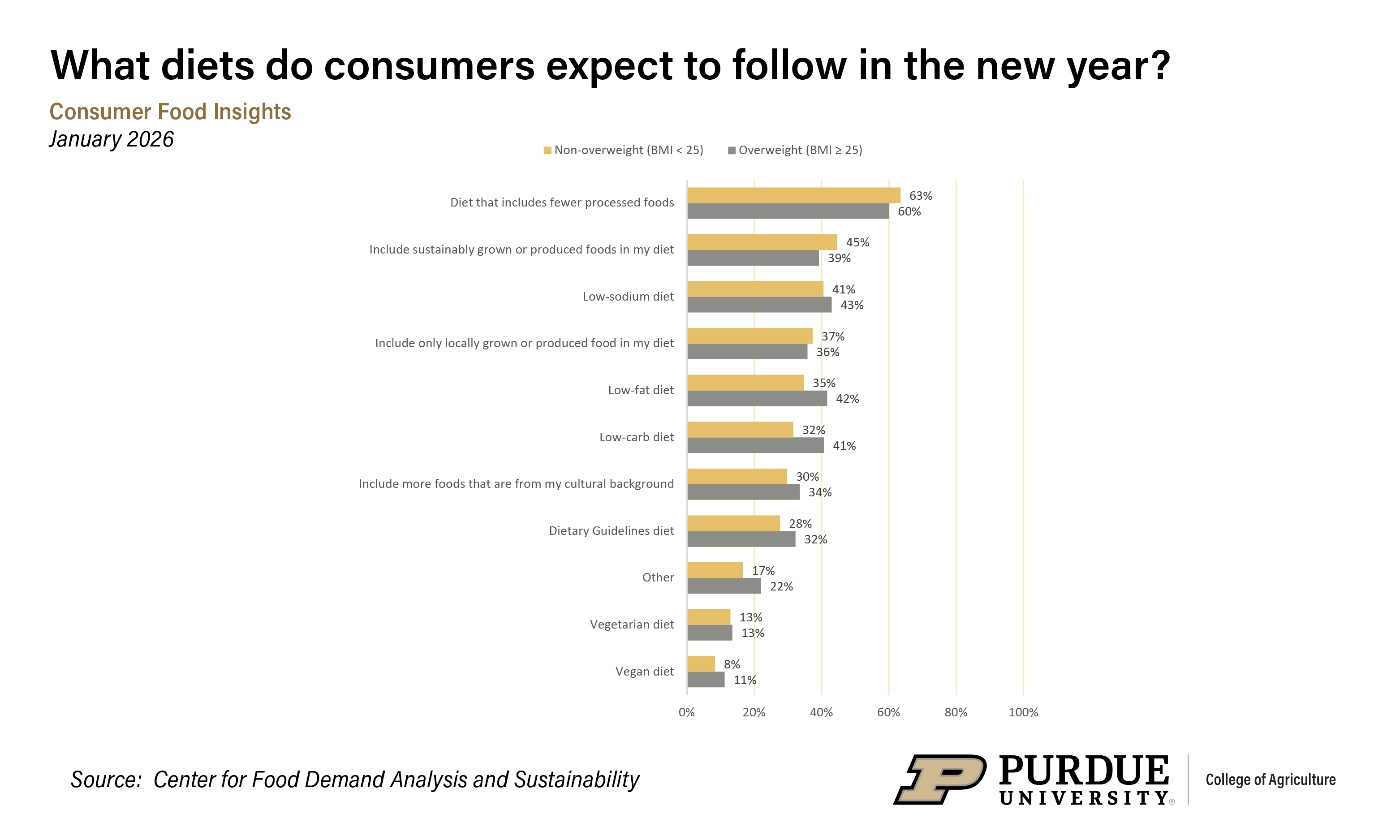 , opens larger image Figure 6. Share of Consumers Who Plan to Follow a Specific Diet in 2026 by BMI Group, Jan. 2026
 “Consumers cite improving current and long-term health and weight loss as the top motivations behind their resolutions,” Balagtas said. However, “weight loss is a primary motivator for 49% of consumers self-classified as overweight compared to 29% of non-overweight consumers.”
Using the U.S. Department of Agriculture’s 5-point Likert Scale question to measure self-assessed diet quality, 75% of consumers rated their diet as “good” or “very good.” Consumers who have “excellent” (45%) or “poor” (35%) diets are more likely to have set a resolution for 2026.
“Notably, there is a positive correlation between awareness of the Dietary Guidelines for Americans, which provides advice on what to drink and eat to ensure nutrient needs are met, and the perceived health of one’s diet,” Balagtas said. “This might indicate the importance of having programs aimed at informing consumers about healthy eating behaviors.”
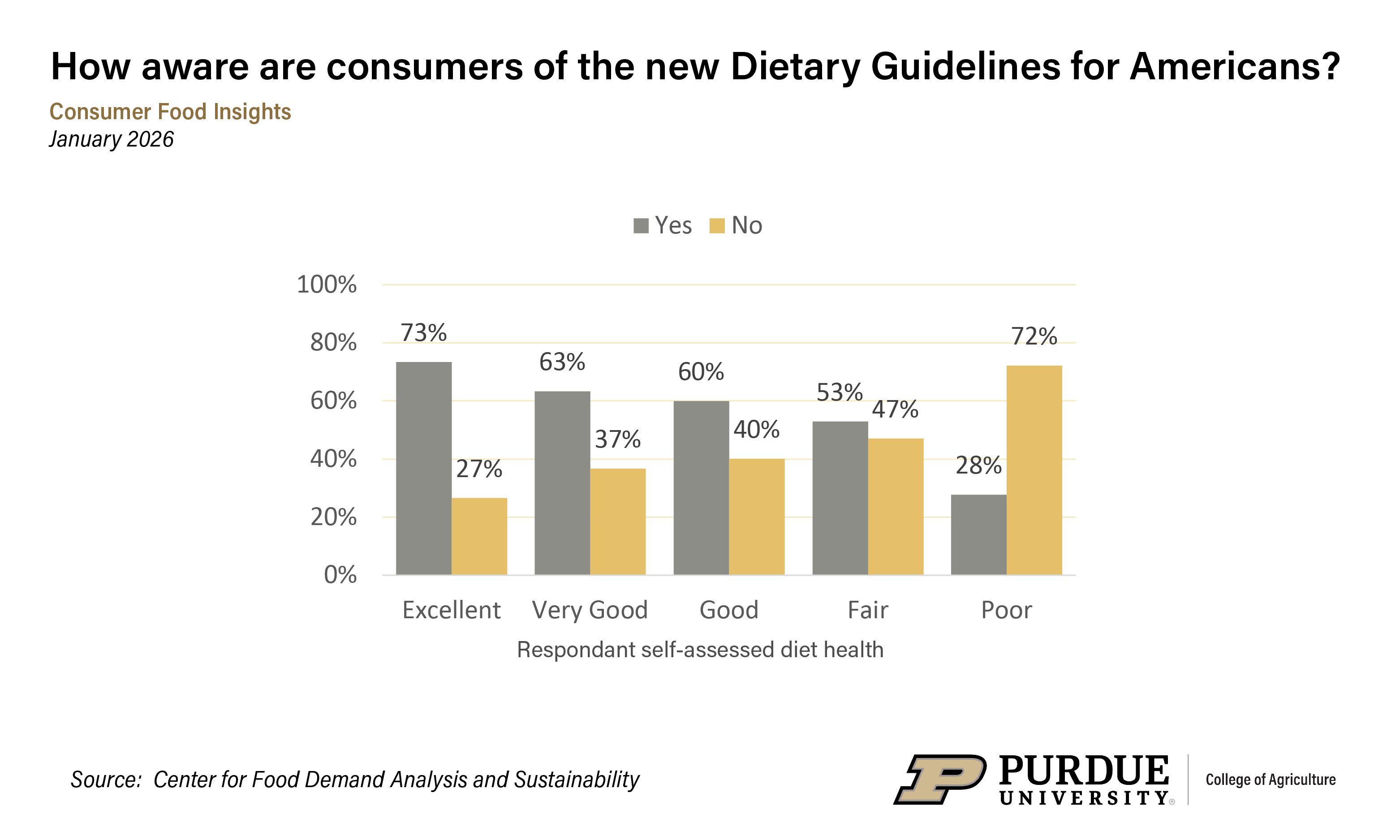 , opens larger image Figure 9. Dietary Guidelines for Americans (DGA) Awareness by Self-assessed Diet Health, Jan. 2026
 National food insecurity stood at 15% in January, a 1% increase from December. Those who self-classified under the CDC’s definition of overweight are slightly more food insecure (16%) than those who are not (13%).
This relationship between food insecurity and obesity has been demonstrated in past CFI surveys, including January 2024, and research by others. “This represents a complex situation that is not fully understood,” said Caitlinn Hubbell, a market research analyst at CFDAS and a report co-author.
“Overweight and non-overweight individuals still fall well below the healthy diet threshold, suggesting other factors are at play when it comes to the relationship between diet and weight,” Hubbell said.
Consumer spending fell from December, with households reporting a weekly average of $131 on groceries and $70 on dining out in January. “While consumer estimates of food inflation have slightly declined, they remain higher than official consumer price index figures, suggesting a persistent perception gap,” she said. The index indicated food inflation was up 0.5% from the previous month.
In the consumer trust category, CFDAS researchers observed distinct patterns according to self-classified BMI. More consumers who self-classified as not overweight said they trust the Food and Drug Administration (32%) than those who self-classify as overweight (16.9%). Similarly, consumers self-classified as not overweight have more trust in the American Medical Association — 41% — than those who self-classify as overweight — 32.6%.
The Center for Food Demand Analysis and Sustainability is part of Purdue’s Next Moves in Plant Sciences 2.0 and uses innovative data analysis shared through user-friendly platforms to improve the food system. In addition to the Consumer Food Insights Report, the center offers a portfolio of online dashboards.
About Purdue Agriculture
Purdue University’s College of Agriculture is one of the world’s leading colleges of agricultural, food, life and natural resource sciences. The college is committed to preparing students to make a difference in whatever careers they pursue; stretching the frontiers of science to discover solutions to some of our most pressing global, regional and local challenges; and, through Purdue Extension and other engagement programs, educating the people of Indiana, the nation and the world to improve their lives and livelihoods. To learn more about Purdue Agriculture, visit this site.
About Purdue University
Purdue University is a research institution ranked among the top 10 public universities in the United States. More than 111,000 students study at Purdue across multiple campuses, including more than 57,000 at our main campus locations in West Lafayette and Indianapolis. As a land-grant university committed to affordability and accessibility, Purdue’s main campus has frozen tuition 14 years in a row, enabling more students than ever to graduate debt-free.
Writer: Steve Koppes
Media contact: Devyn Ashlea Raver, draver@purdue.edu
Sources: Joseph Balagtas , balagtas@purdue.edu
Agricultural Communications: Maureen Manier, mmanier@purdue.edu, 765-494-8415
Journalist Assets: Publication quality charts and images can be obtained at this link.