Agronomy
Purdue acquires soybean germplasm with unique yield traits
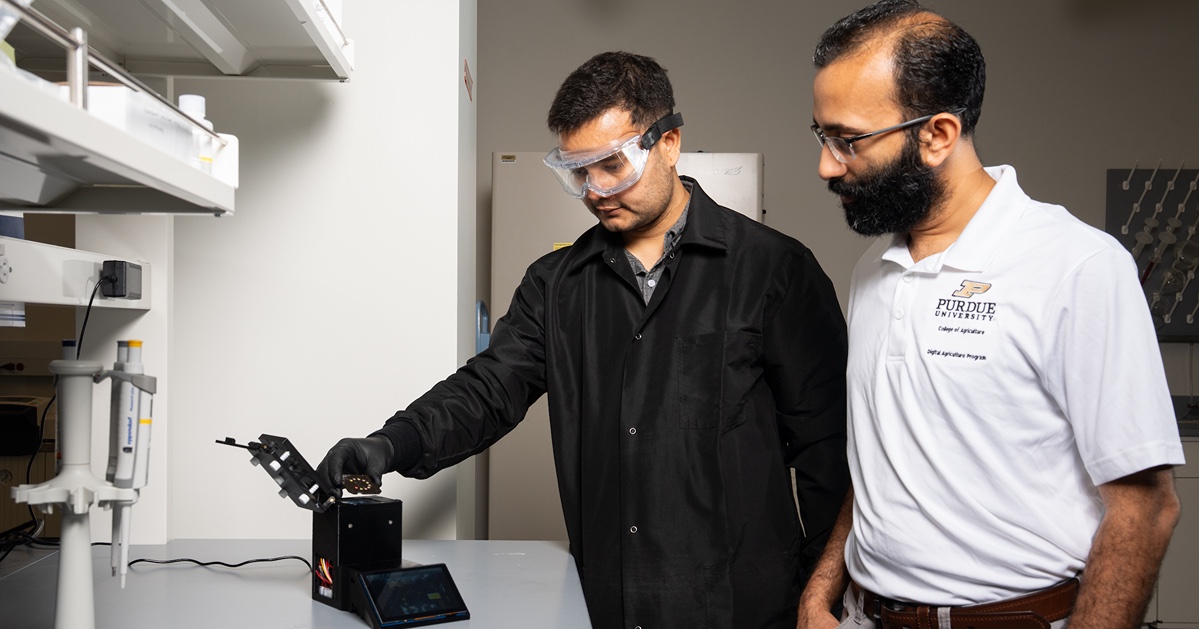
 Katy Rainey, professor of agronomy and director of the Purdue Soybean Center, examines soybeans grown from the KenAvis soybean germplasm collection, with Bob Taylor, the soybean breeder who developed them. (Purdue University photo/Charles Jischke)
 WEST LAFAYETTE, Ind. — Purdue’s Department of Agronomy has acquired the KenAvis soybean germplasm collection, a rare reservoir of underexploited genetic diversity, from Purdue alumnus Bob Taylor. The collection includes soybean lines with at least 20 distinct traits that Purdue will use and license for research, breeding and new varieties.
Current soybean breeding programs can be traced to a small number of breeding lines and lack the genetic diversity of the KenAvis collection. The collection’s unique traits, including four- and five-seeded pods, ultrashort internodes and terminal racemes with more than 20 pods, have the potential to transform soybean breeding.
“Purdue has the distinct expertise to maximize the return on this valuable collection for all sectors: independent farmers, food-grade growers and the seed industry,” said Katy Rainey, professor of agronomy and director of the Purdue Soybean Center.
The KenAvis collection will be managed by the center, with research potential for:
- New food-grade specialty soybean varieties, including increased yield and protein content and the seed coloring required for foods like tofu.
- Novel genes for genetic mapping of the unique traits of the collection, including multiple mechanisms for atypical seed formation, such as five-seeded pods.
- A soybean breeding pool distinct from commercial germplasm, which could serve as a new source for other desirable traits.
- Boosts in yield potential with the introduction of novel germplasm to current elite breeding lines.
“This collection really gives Purdue’s soybean program the opportunity to create a germplasm pool that is different from most of what’s available right now in the U.S.,” said Craig Anderson, CEO of Ag Alumni Seed. “Researchers can take the work that Bob did and enhance it with modern breeding technologies, genomics and some of the other germplasm tools that exist today.”
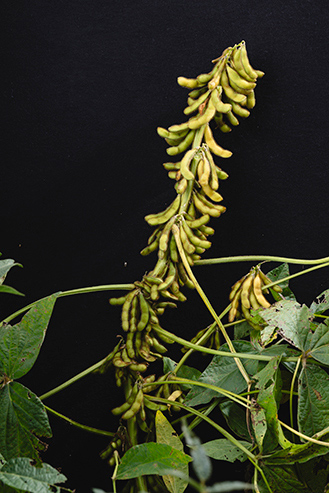 A terminal raceme with more than 20 pods
  Five-seeded soybean pod
 Taylor, who graduated with a bachelor’s degree in agronomy in 1960, began his soybean breeding career in 1968, first with FFR Cooperative and later at Stewart Seeds, prior to its acquisition by Monsanto. Following his tenure at Stewart Seeds, Taylor retained 150 elite soybean lines, which he systematically crossed with 40 diverse accessions from the U.S. Department of Agriculture’s National Plant Germplasm System.
For over 38 years, he performed hundreds of cross-pollinations each field season, selecting for at least 20 distinct yield traits in the KenAvis collection, named after his parents.
“You must have diversity,” Taylor said. “And one of the biggest factors in the use of the diversity is getting a breeder to look at all of the traits we examined, rather than just yield testing whatever they get.”
Looking for assistance with planting and a possible home for his germplasm, Taylor connected with Rainey and Laura Bowling, professor and head of the Department of Agronomy. In June 2025, Rainey planted some of his soybean seed at Purdue’s Agronomy Center for Research and Education. The collection’s unique traits were immediately obvious in the field.
“I’ve had farmers and seed industry people visit, and everyone who encounters it is excited about it,” Rainey said.
Ag Alumni Seed has long served as Purdue Agriculture’s primary partner for advancing, scaling and delivering improved germplasm to farmers, so Rainey invited Anderson to view the planting. Bowling then worked with Rainey and Anderson to acquire the collection for research and licensing.
“I am honored that Bob Taylor has trusted Purdue Agronomy with the management of his legacy. The incredible diversity in this germplasm collection represents decades of effort and has the potential to transform currently available soybean varieties,” Bowling said.
The Purdue Innovates Office of Technology Commercialization assisted with the intellectual property assignment so Purdue could take possession of the germplasm.
Abhijit Karve, director of business development and licensing, said, “OTC is excited about the potential for new inventions and traits emerging from this research. We look forward to supporting commercial opportunities as Rainey develops new and elite soybean varieties and lines.”
Purdue’s collaboration with Taylor provides opportunities to increase the understanding of soybean genetics and make the collection’s distinct traits available to soybean farmers.
“The KenAvis soybean germplasm is an outstanding genetic resource that offers a variety of traits to support the development of new lines with improved agronomic performance, stress response and growth characteristics,” said Ron Turco, associate dean for Agricultural Research and Graduate Education in the College of Agriculture and professor of agronomy. “The KenAvis lines were developed under Midwestern growing conditions and should ultimately lead to enhanced yields for the Indiana farm community.”
About Purdue Agriculture
Purdue University’s College of Agriculture is one of the world’s leading colleges of agricultural, food, life and natural resource sciences. The college is committed to preparing students to make a difference in whatever careers they pursue; stretching the frontiers of science to discover solutions to some of our most pressing global, regional and local challenges; and, through Purdue Extension and other engagement programs, educating the people of Indiana, the nation and the world to improve their lives and livelihoods. To learn more about Purdue Agriculture, visit this site.
About Purdue University
Purdue University is a research institution ranked among the top 10 public universities in the United States. More than 111,000 students study at Purdue across multiple campuses, including more than 57,000 at our main campus locations in West Lafayette and Indianapolis. As a land-grant university committed to affordability and accessibility, Purdue’s main campus has frozen tuition 14 years in a row, enabling more students than ever to graduate debt-free.
Writer: Stacey Mickelbart
Media contact: Devyn Ashlea Raver, draver@purdue.edu
Agricultural Communications: Maureen Manier, mmanier@purdue.edu, 765-494-8415
Journalist Assets: Publication quality images can be obtained at this link