

Global collaboration on provitamin A reaps reward
When Torbert Rocheford, the Dr. Fred L. Patterson Endowed Chair in Translational Genomics for Crop Improvement at Purdue University, and Abebe Menkir, maize breeder and geneticist, walked dusty rows of maize trials together in 2003, it would have been hard for them to imagine the impact that meeting would have across continents. Their collaboration over 22 years has produced major advances in biofortified corn in sub-Saharan Africa, improving nutrition there, where corn is a staple crop.
As Menkir reviewed these results at a recent seminar at Purdue’s Department of Agronomy, it was clear the work continues to provide not only research inspiration for Rocheford, but also insight and motivation for Purdue students exploring their own paths.
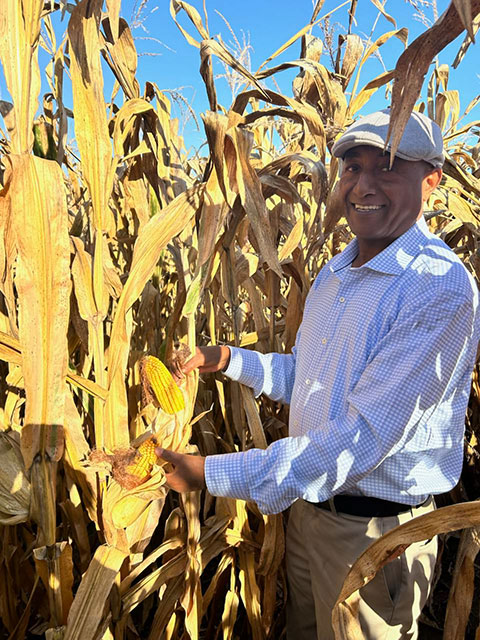
Menkir, who grew up in Ethiopia, recently retired after 29 years at the International Institute for Tropical Agriculture in Nigeria. He and Rocheford met through HarvestPlus, a program with the goal of eliminating or reducing global micronutrient deficiencies by delivering an increase in vitamin A, iron and zinc through regularly consumed staple crops. Vitamin A deficiency can lead to delayed growth, a weak immune system and vision loss. It’s also a significant cause of death for young
children and pregnant and nursing mothers.
Rocheford, then at the University of Illinois, was working on maize varieties with increased levels of beta-carotene, one of a group of carotenoids that are a precursor the body can convert to vitamin A; this group of precursors is often called provitamin A. Menkir visited him to tour the nursery of maize diversity lines and selected those genetically favorable for beta-carotene and other desirable traits.
Rocheford arrived at Purdue in 2009 and continued to work with Menkir and other international collaborators to develop lines rich in beta-carotene. Over their 22-year collaboration, they completed phases of the project: first, breeding to find lines that reached the target of providing 50% of daily recommended vitamin A intake; then developing and testing lines in different agroecological zones and priority countries; and finally, releasing the seed for nutrient-enriched corn varieties for wide dissemination.
The results changed lives. In his seminar, Menkir shared that a 2021 national food consumption and nutrition survey in Nigeria found that 13.4% of the population — more than 28 million people — consumed the new maize varieties biofortified with provitamin A.
The collaboration I was blessed to have with Torbert — that was really the defining moment of our biofortification. The value of the power of science in transforming lives comes through collaboration."
- Abebe Menkir, maize breeder and geneticist
Both scientists worked on other traits as well, since desirable traits need to work in combination, not isolation. Menkir was able to breed nutrient-rich corn with no compromise to grain yield and also worked on maize lines that were drought tolerant and resistant to the parasitic weed striga.
Since most Americans aren’t vitamin A deficient, Rocheford began working on breeding for macular carotenoids that benefit eye health, like lutein and zeaxanthin. He founded NutraMaize with his son Evan Rocheford to share more nutritious products like Professor Torbert’s Orange Corn with American consumers. NutraMaize licenses its orange corn through the Purdue Innovates Office of Technology Commercialization.
Menkir’s research helped develop maize lines Rocheford would now like to work with, including a line that’s high in both provitamin A beta-carotene and the macular carotenoids lutein and zeaxanthin. He also learned during Menkir’s seminar that grain harvested from maize lines high in beta-carotene also appeared more resistant to aflatoxins, poisonous carcinogens produced by certain molds that develop in maturing corn. Aflatoxins are a threat to U.S. corn production, so Rocheford would also like to explore those lines — not for their nutritive value, but to reduce the onset of aflatoxins.
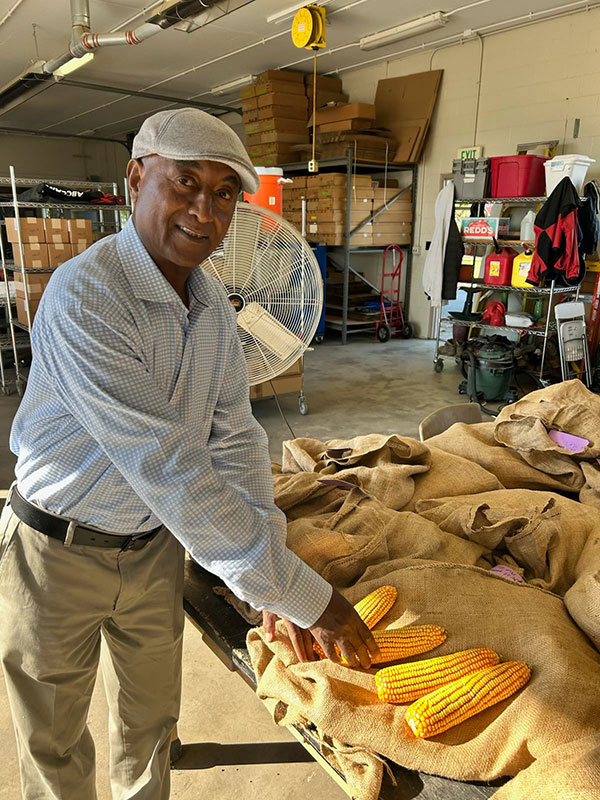
“That’s a case where you share material and knowledge, people work on it for a good while, and then you can get something back that you don't expect,” Rocheford said.
Purdue students also benefit by learning from international researchers. Arianna McCrory, a sophomore in plant genetics, breeding and biotechnology, attended Menkir’s seminar.
McCrory, who is interested in both plants and equity, completed an honors project on the benefits of orange corn in sub-Saharan Africa for the class World Crop Adaptation and Distribution. “It’s something that I became really passionate about,” she said.
After attending Menkir’s seminar, she met with him to learn more about his career. “We just talked for an hour about his research and his life story,” McCrory said. “He was very insightful, and he’s definitely broadened my horizons.”
One of her main takeaways is that “it’s so important to talk to the communities that you’re trying to help and get their perspective on what is going on. They live there, and they know so much.”
Menkir has collaborated with many Purdue faculty, including Gebisa Ejeta, a Presidential Fellow, Distinguished Professor Emeritus of Agronomy and World Food Prize winner; Mitch Tuinstra, the Wickersham Chair of Excellence in Agricultural Research; Peter Goldsbrough, professor emeritus and former department head of the Department of Botany and Plant Pathology; and Wyman Nyquist, professor emeritus, who served as statistician for the Purdue Agricultural Experiment Station.
“It is indeed an honor and a pleasure for me to come back to the Department of Agronomy,” Menkir said. “I would like to express my profound gratitude to the department for foundational support that really prepared me for my career.”
Featured Stories

For Brody Cox, preparing for the Indiana State Fair began long before he entered the show...
Carolyn Foley, a long-time member of the Purdue Forestry and Natural Resources (FNR) and...

In the September Purdue University/CME Group Ag Economy Barometer survey, 52% of respondents...
Purdue University’s College of Agriculture recognized nine alumni at the Distinguished...
Keep your eyes peeled across Indiana for the newly minted Purdue Forestry and Natural Resources...
“Being at Purdue has changed my thinking entirely,” says Mingyu Zhao, a third-year...