

Biochemistry
Protein modification discovery opens cancer therapy possibilities
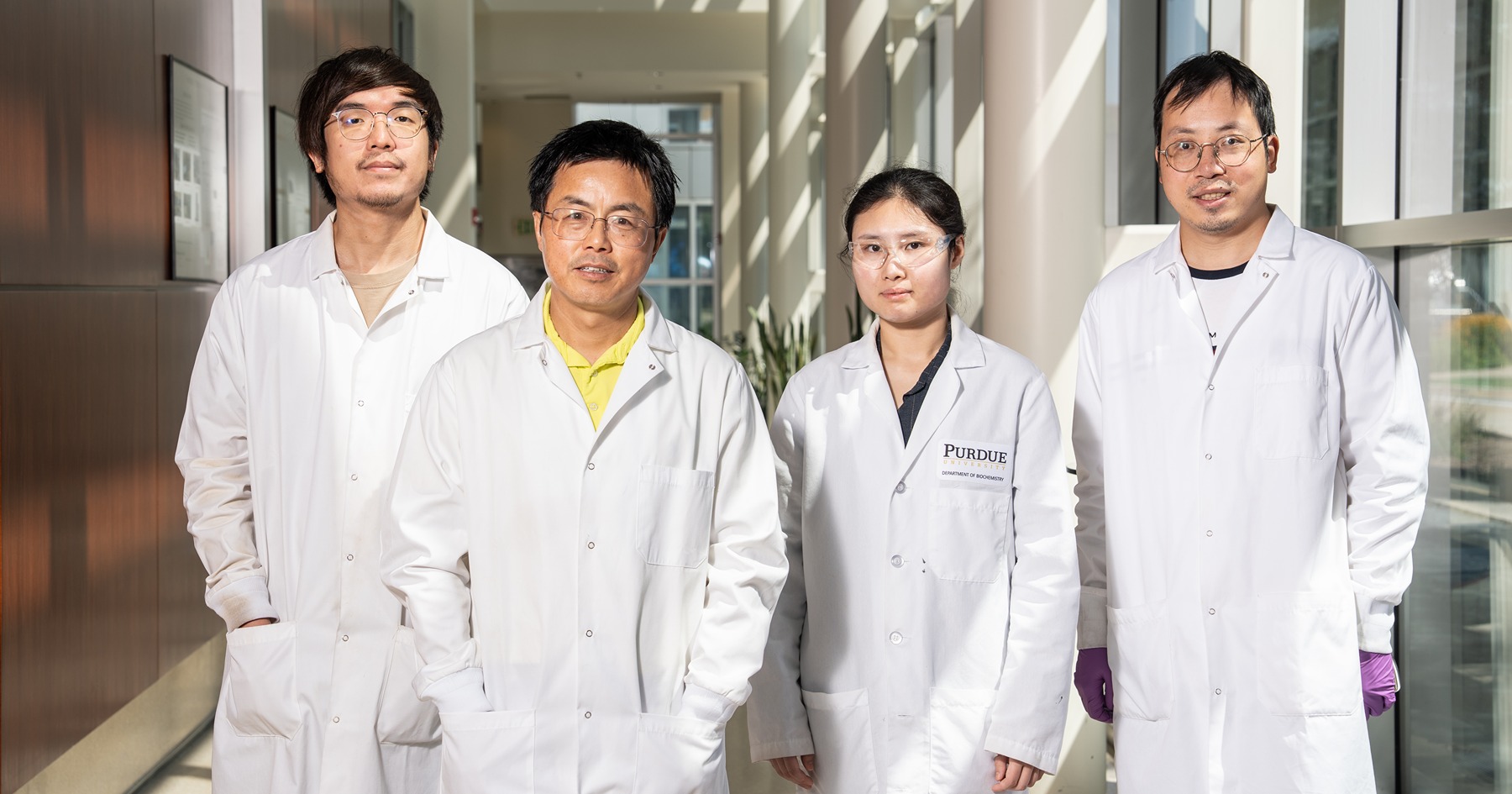 Purdue’s W. Andy Tao (front) and his associates have discovered a new type of modification on proteins from cancer-related mutation that holds potential as a therapeutic target. Three members of his group are co- authors of the study published in Nature Chemistry. From left are graduate students Yi-Kai Liu, Zhoujun Luo, and postdoctoral scientist Zheng Zhang. (Purdue Agricultural Communications photo/Joshua Clark)
 WEST LAFAYETTE, Ind. — A research team led by Purdue University’s W. Andy Tao has discovered of a new type of protein modification related to cellular mutation that impairs a crucial enzyme’s ability to help drive energy processes. Their discovery, reported in Nature Chemistry, opens a new route to therapeutic cancer intervention.
“Mutation is considered the driving mechanism leading to cancer. Many mutations are hidden and harmless, but the mutation of enzymes like kinases can lead to the uncontrolled growth of cancer cells,” said Tao, a professor of biochemistry in Purdue’s College of Agriculture.
The Nature Chemistry study wades into the interactive dynamic complexity of the human genome (containing 20,000 to 25,000 genes) and the human proteome (containing more than 1 million proteins). The study identified a new modification on proteins because of the mutation in the isocitrate dehydrogenase (IDH) enzyme, which affects how kinase enzymes control protein function.
“IDH mutation is quite common in multiple cancer cells, especially for glioma, acute myeloid leukemia and rare liver cancer,” Tao said. The mutation is found in some of these cancers more than 70% of the time. Various drugs are available to treat this type of mutation, but their effectiveness varies depending on the cancer type. “By identifying this new modification, there’s potential to open a new path for therapeutics,” Tao said.
Fast-growing cancers consume a lot of energy. To feed that energy appetite, cancer cells reprogram their metabolism.
IDH mutation causes cells to accumulate D-2-hydroxyglutarate (D2HG), a metabolite. Under normal conditions, the IDH enzyme helps provide the energy that fuels cellular processes. Usually, the IDH enzyme converts isocitrate into alpha-ketoglutarate. But the mutation snags the enzyme, resulting in the D2HG accumulation excessively.
During its laboratory analysis, Tao’s team examined normal cells, IDH1 mutant cells and IDH1 mutant cells treated with an anti-cancer drug. Through this analysis, researchers identified dozens of D2HG-modified proteins. “Many of these proteins are involved in tumor progression, suggesting that D2HG modification may play a regulatory role in cancer development,” Tao and his co-authors wrote in Nature Chemistry.
The modification by D2HG stems from its chirality. A hallmark of all life processes, chirality refers to the mirror-image forms displayed by many biological molecules. Cancer also affects D-L-2-hydroxyglutarate (L2HG) molecules, which are mirror images of D2HG molecules. The lack of oxygen (hypoxia) is a major trait of fast-growing tumors. L2HG accumulates under hypoxic conditions to help cells cope with low oxygen.
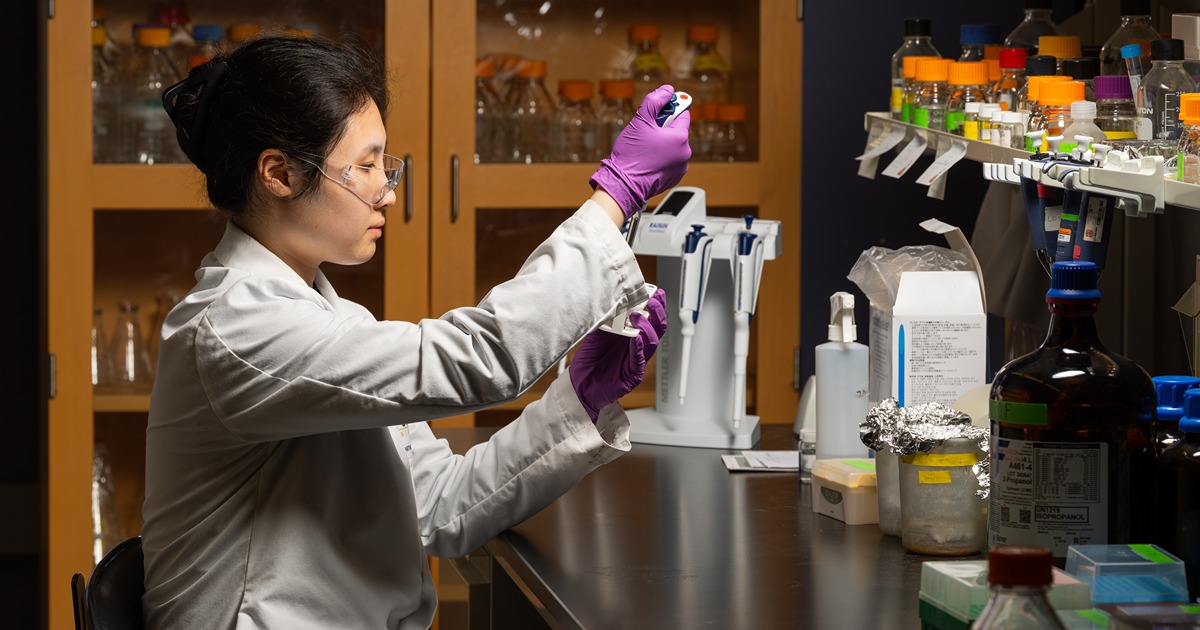 Purdue’s Zhoujun-Luo, graduate student in biochemistry, is a co-author on a study published in Nature Chemistry that identifies a potentially new cancer therapy. (Purdue Agricultural Communications photo/Joshua Clark)
 “People haven’t thought about it. And, certainly, few have reported chiral-dependent modification of metabolites,” Tao said. Metabolic reprogramming has become a popular research field, he noted, because IDH mutations occur in multiple cancer types. Biomedical researchers may need to address metabolite modification by focusing their attention on this type of protein mutation, a new research direction, he noted.
The team analyzed and identified a wide array of proteins in completing the Nature Chemistry study. The tools they used included PolyMAC (polymer-based metal ion affinity capture), which Tao and his associates introduced in 2010. Tao is a co-founder of Tymora Analytical Operations, which commercialized the PolyMAC enrichment kit.
Many of the examined proteins had been phosphorylated, a biochemical process in which phosphate groups are added onto proteins, which Tao’s lab studies intensively. “Phosphorylation is important because many phosphorylated proteins are messenger molecules related to cancer,” he said. “People usually do not consider this IDH mutation related to phosphorylation, but by identifying this modification, we see crosstalk with phosphorylation.”
D2HG and L2HG exchange chemical messages via crosstalk, which can affect protein function and cellular processes that lead to cancer. This finding brings post-translational modifications into play as potential therapeutic targets.
These modifications, such as phosphorylation, are chemical edits made to proteins after their production. Tao’s group focuses much of its work on developing new techniques for detecting post-translational modifications, given their importance in many disease-related signaling pathways.
Tao and Nature Chemistry study co-authors Elizabeth Parkinson, primarily appointed in the James Tarpo Jr. and Margaret Tarpo Department of Chemistry, and Zhong-Yin Zhang, both of the Borch Department of Medicinal Chemistry and Molecular Pharmacology, are members of the Purdue Institute for Cancer Research. The institute has the specialized tools to make both diagnostic and therapeutic contributions to precision medicine, Tao said.
On the diagnostic side, R. Graham Cooks, the Henry Bohn Hass Distinguished Professor of Chemistry, specializes in imaging cancer-related metabolic products. Tao was trained in Cooks’ lab as a PhD student. Cooks’ recent work includes a method for imaging hydroxyglutarates as specific biomarkers only present in IDH-mutant glioma, a type of brain cancer.
The new study provides a framework for probing chirality-dependent protein modifications such as L2HG in cancer biology. “Purdue has a good, concentrated effort in this direction,” Tao said.
This work is part of Purdue’s One Health initiative, which brings together research on human, animal and plant health. The study was funded by grants from the National Institutes of Health and the National Science Foundation. Study co-authors included Lia Stanciu, professor of materials engineering at Purdue, and researchers at the Massachusetts General Hospital Cancer Center, the Broad Institute of Harvard University and Massachusetts Institute of Technology, and the University of Technology in Australia.
About Purdue Agriculture
Purdue University’s College of Agriculture is one of the world’s leading colleges of agricultural, food, life and natural resource sciences. The college is committed to preparing students to make a difference in whatever careers they pursue; stretching the frontiers of science to discover solutions to some of our most pressing global, regional and local challenges; and, through Purdue Extension and other engagement programs, educating the people of Indiana, the nation and the world to improve their lives and livelihoods. To learn more about Purdue Agriculture, visit this site.
About Purdue University
Purdue University is a research institution ranked among the top 10 public universities in the United States. More than 111,000 students study at Purdue across multiple campuses, including more than 57,000 at our main campus locations in West Lafayette and Indianapolis. As a land-grant university committed to affordability and accessibility, Purdue’s main campus has frozen tuition 14 years in a row, enabling more students than ever to graduate debt-free.
Writer: Steve Koppes
Media contact: Devyn Ashlea Raver, draver@purdue.edu
Sources: W. Andy Tao, watao@purdue.edu
Agricultural Communications: Maureen Manier, mmanier@purdue.edu, 765-494-8415
Journalist Assets: Publication quality images can be obtained at this link


This research is a part of Purdue’s presidential One Health initiative, which involves research at the intersection of human, animal and plant health and well-being.